
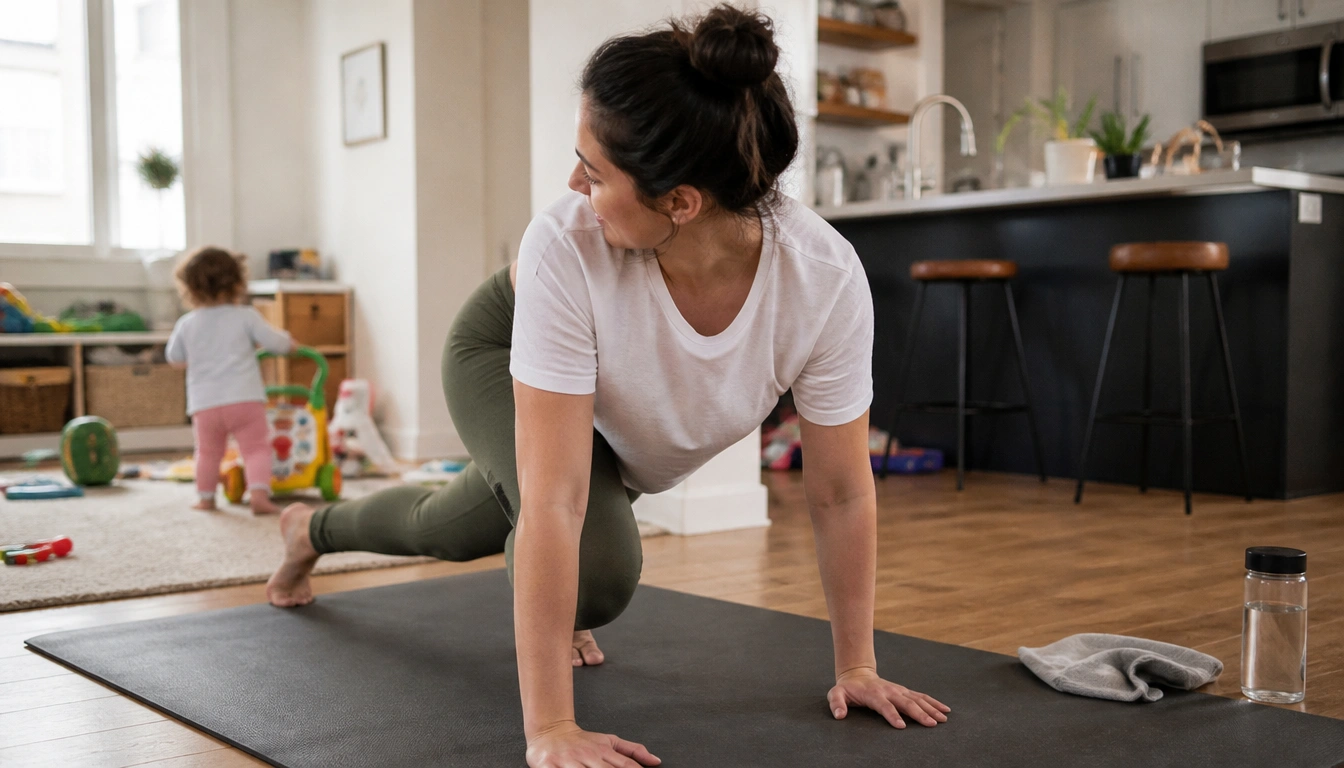
The simplest effective movement goal for busy parents is to build your week from short, repeatable bouts of movement rather than waiting for one perfect workout. Aim for a mix of brisk walking, active play, and basic strength work in 10-minute blocks when needed. For most adults, that means working toward 150 minutes of moderate activity a week and strength work on at least two days, with flexibility for real family life.
Key Takeaways
- Short sessions can count. You do not need one long workout for movement to matter; several 10-minute bouts can add up across the week.
- A practical baseline is brisk walking, active play, and two days of muscle-strengthening work spread through the week.
- Parenting itself is physical, so squatting, carrying, pushing, and core stability are useful movement targets, not just gym exercises.
- The easiest plan is the one tied to existing routines such as school runs, naptime, laundry, cooking, or sports practice.
- Postpartum parents should return gradually and watch for pelvic floor or core symptoms before pushing intensity.
- Missed days are not failure. The goal is to restart quickly and keep the habit small enough to survive busy weeks.
Why an all-or-nothing exercise mindset breaks down for parents
Busy parents often think exercise only “counts” if it happens as a full session, in a specific place, and for a long uninterrupted stretch. That mindset makes movement feel harder than parenting itself. The result is predictable: once a day gets derailed by a sick child, a late pickup, or a work call, the whole plan disappears.
A more workable approach is a movement-first mindset. Public-health guidance from the CDC and the NHS supports the idea that activity can be accumulated across the week, not limited to one long workout. That matters for caregivers because family life is already fragmented. The goal is not to make exercise another source of pressure. It is to make it fit the way your day already works.
For many parents, consistency comes from lowering the activation energy. A shorter plan is easier to repeat, easier to restart after interruptions, and easier to keep during exhausting seasons. If the routine survives real life, it is more effective than a perfect plan that never gets done.
The simplest movement goal for busy parents
The most realistic movement goal for busy parents is to work toward the standard weekly target in pieces: 150 minutes of moderate activity a week, plus muscle-strengthening work on at least 2 days a week. Moderate activity includes things like brisk walking, energetic cleaning, active play, or cycling at a pace that raises your breathing but still lets you talk.
If a full workout is not possible, use 10-minute blocks. Three 10-minute sessions in a day can be more achievable than one 30-minute session, and the body still benefits from accumulated movement. This is the practical version of the “minimum effective dose” idea: a little, repeated often, is better than waiting for the ideal hour that never comes.
Think of the weekly target as a baseline, not a test. Some weeks you may do more, and some weeks less. The win is keeping movement present enough that your body does not have to start over every Monday.
How normal parenting moments can become movement
Many parents already have small openings for movement; they just do not look like workouts. A school run can become a brisk walk. A toddler’s playtime can become squats, reaching, crawling, or chasing games. Sports practice can become a walking loop around the field. Cooking time can include calf raises, counter push-ups, or a few minutes of mobility work.
The point is not to turn every task into exercise. It is to notice the moments that already exist and use them instead of waiting for a separate fitness appointment.
A realistic mix of cardio, strength, and mobility
For most caregivers, the best plan is not complicated. It usually includes three parts: cardio for heart and stamina, strength for lifting and carrying, and mobility for comfort and recovery.
Cardio does not have to mean running. Brisk walking, dancing in the kitchen, pushing a stroller with purpose, or active playground time all count when they raise your breathing. Strength work can be simple bodyweight movement or resistance exercises that use major muscle groups. Mobility can be a short sequence of gentle stretches, breathing work, or controlled joint movement to keep you from feeling locked up after long hours of caregiving.
A useful rule for parents is to avoid overcomplicating the week. If you can repeatedly do a few walks, two strength sessions, and brief mobility on some days, that is a solid foundation. You do not need to build a perfect athlete’s program to get meaningful health benefits.
Why functional fitness matters for caregiving
Parenting is physical work. You lift toddlers, carry bags, push strollers, bend into cribs, chase children in the yard, and twist while holding a car seat or laundry basket. That means the most useful exercises often look like ordinary movement patterns: squatting, carrying, pushing, and core stabilization.
Squats help with getting down to toys, picking up children, and standing up from low seats. Carries build grip, back, and trunk strength for car seats, groceries, and sleeping children. Pushing strength supports strollers, doors, and household tasks. Core stability helps you transfer force safely when you are reaching, lifting, or turning while holding weight.
This is why “functional” matters. The goal is not appearance or athletic novelty. It is making the physical demands of parenthood feel less draining and less likely to cause strain.
Simple movements that match daily life
If you want a short list, start with sit-to-stand squats, wall or counter push-ups, split-stance carries with a child-free load, glute bridges, rows with a band, and brief core drills such as dead-bug variations or bird-dog holds. These movements cover the patterns parents use every day without requiring equipment or a gym.
Choose only a few. A small set done regularly is better than a long list done once.
How to build a no-gym weekly plan using 10-minute blocks
A no-gym week works best when it is attached to existing routines. Instead of asking, “When will I find time to exercise?” ask, “Which parts of my day already repeat?” The answer is usually naptime, school drop-off, lunch, sports practice, laundry, dinner prep, and the time after bedtime.
Here is a simple pattern many parents can adapt:
- Two or three brisk walks of 10 to 20 minutes, including school runs or stroller walks.
- Two strength blocks of about 10 minutes each, done during naptime, after bedtime, or while food cooks.
- One or two mobility breaks for stretching, breathing, or gentle floor work.
- Active play with children when possible, especially on days when structured exercise is unrealistic.
You can stack these in different ways. One day might include a brisk morning walk, a short strength circuit while dinner cooks, and a family walk after supper. Another day might only allow one 10-minute session. That still counts. The week matters more than any single day.
If you like structure, choose a repeating cue: after the school run, before the shower, during naptime, or while waiting for pasta water to boil. The cue does the work of motivation. You do not need to feel inspired every time.
Postpartum and return-to-exercise considerations for new mothers
For postpartum parents, the simplest movement goal still applies, but the pace matters more. The body has gone through pregnancy, birth, recovery, sleep disruption, and often feeding demands. That is not the time to force intensity or chase pre-baby fitness standards.
General guidance from the NHS and CDC supports a gradual return, with higher-intensity exercise usually best delayed until after the usual postnatal medical check, often around 6 to 8 weeks postpartum, or until a clinician says it is appropriate. Gentle walking, breathing work, and light mobility often make the best starting point. Then activity can progress based on symptoms, energy, and recovery.
Pay attention to pelvic floor and core signals. Urinary leakage, pelvic heaviness, pain, bulging along the midline of the abdomen, or a feeling that something is “not right” are reasons to slow down and seek support. A pelvic floor physical therapist can be especially helpful when symptoms linger.
Postpartum exercise should feel gradual, not proving ground. You are rebuilding capacity, not racing back to a former routine.
Safety checks: when to slow down or ask for help
Some tiredness is normal. Sharp pain is not. If a movement causes joint pain, tendon pain, dizziness, chest pain, unusual shortness of breath, or symptoms that get worse instead of settling, stop and get medical advice. The same is true if you are returning after a long break and have a chronic condition such as heart disease, high blood pressure, diabetes, or another condition that affects exercise safety.
Watch for the difference between effort and warning signs. Muscles may feel worked after activity, but your body should not feel unstable, sharp, or increasingly painful. For postpartum parents, leaking urine, pelvic pressure, or doming at the abdomen during exertion are important signals to modify the plan and get assessed.
If you are unsure, a clinician can help you adjust the type, intensity, or timing of activity. That support is not a setback. It is part of making movement sustainable.
How to keep going when fatigue, guilt, and chaos get in the way
Most parents do not need a better exercise plan. They need a plan that survives fatigue, guilt, and interruptions. The answer is usually to shrink the goal, not raise the pressure. On hard weeks, your job is to keep the habit visible, even if the dose is small.
Helpful troubleshooting strategies include the following:
- Use a floor, not a perfect target. Even a 10-minute walk is a win if the week is otherwise hectic.
- Drop the guilt. Movement is not selfish; it supports the energy and patience parenting requires.
- Keep a backup option. If the planned workout fails, do a short bodyweight circuit at home.
- Link movement to routines. Use naptime, school pick-up, laundry folding, or dinner prep as cues.
- Restart quickly after missed days. Missing a session is normal. The next small action is what keeps the habit alive.
If you want progress, focus on repeatability. The best plan is the one you can do on ordinary weeks, not only on ideal ones. For busy parents, a sustainable movement habit is often built from ordinary moments that happen again and again.
Frequently Asked Questions
How much exercise do busy parents really need each week?
A practical baseline is the adult public-health target: about 150 minutes of moderate activity each week, plus muscle-strengthening work on at least 2 days. You do not have to do it in one workout. For busy parents, short sessions spread through the week are usually more realistic and easier to sustain.
Can short bouts of movement count if I can’t do a full workout?
Yes. Short bouts can count toward your weekly total, especially when they are moderate intensity and repeated regularly. A 10-minute brisk walk, a brief strength circuit, or active play with children all contribute. The goal is accumulation, not perfection.
What are the best quick exercises for parents with very little time?
The most useful quick moves usually match parenting demands: squats, push-ups against a wall or counter, carries, rows with a band, glute bridges, and core stability drills. These build the strength and endurance used in lifting, carrying, pushing, and bending throughout the day.
How can I fit movement into childcare, errands, and household routines?
Attach movement to things you already do. Walk during school drop-off, do a short circuit during naptime, stretch while food cooks, or use sports practice as a chance to walk the perimeter of the field. Repeating cues is more effective than waiting for a separate free hour.
What should postpartum parents know before restarting exercise?
Return gradually and avoid high-intensity exercise until after the usual postnatal medical check, unless your clinician advises otherwise. Start with walking, gentle mobility, and light strength work. If you notice leakage, pelvic heaviness, pain, or abdominal doming, slow down and seek professional guidance.
The Bottom Line
The simplest effective movement goal for busy parents is not a perfect workout schedule. It is a repeatable pattern of short movement bouts that add up across the week, supported by a little strength work and a lot of flexibility.
If you build movement into school runs, naptime, errands, cooking, and play, you are more likely to keep going during real family life. That is especially true after childbirth, when gradual progress and symptom awareness matter most.
Start small, keep it practical, and let the week do the work. A plan that survives chaos is usually the plan that helps the most.
Medical disclaimer
Medical disclaimer: This content is for educational and informational purposes only and is not a substitute for professional medical advice, diagnosis, or treatment. Dietary needs and supplement suitability vary by individual.
Sources
- National Health Service (NHS) — www.nhs.uk. Accessed October 2026.
- Centers for Disease Control and Prevention (CDC) — cdc.gov. Accessed October 2026.
