
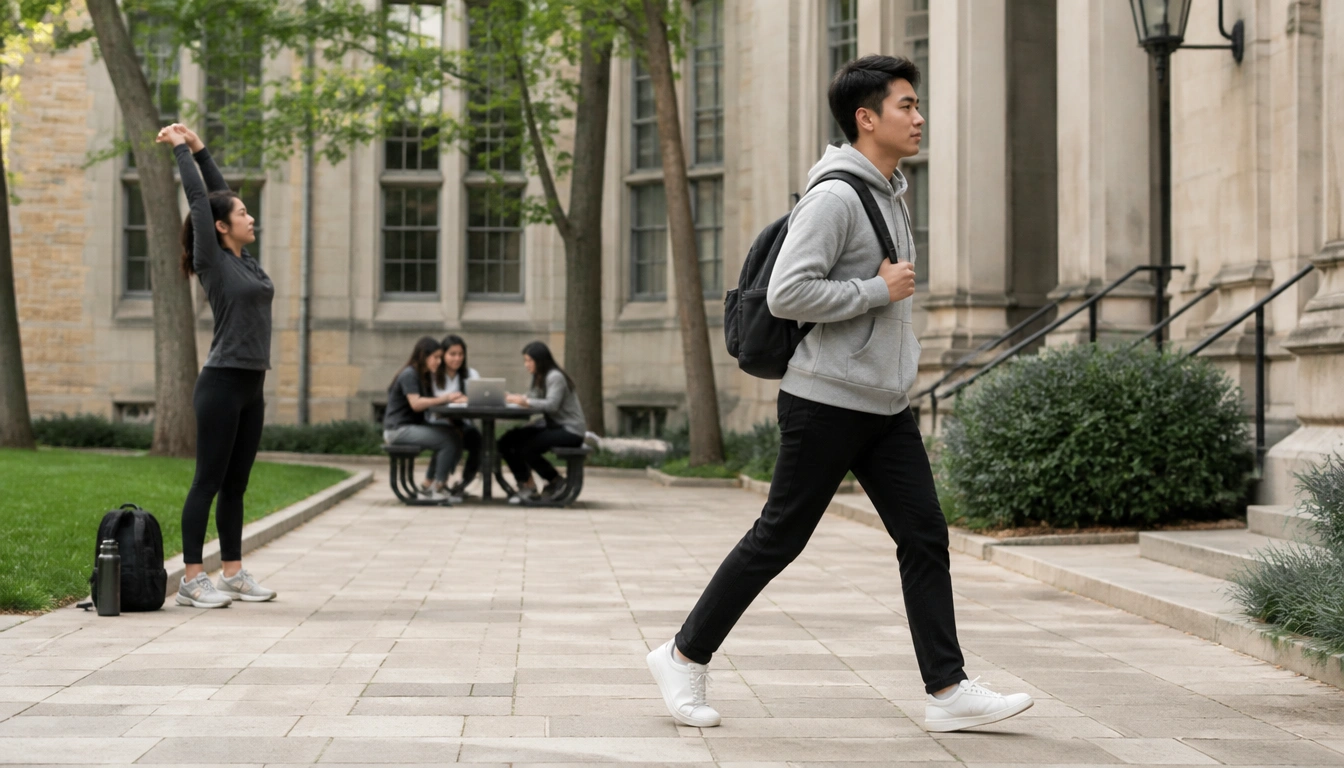
A simple movement goal for a college student is to aim for regular movement across the week instead of chasing a perfect workout plan. A practical baseline is to build toward the public health target for adults: 150 to 300 minutes of moderate activity each week, plus muscle-strengthening activity on 2 or more days. Short walks, active study breaks, stairs, and campus movement all count.
Key Takeaways
- Short bouts of movement count, so you do not need one long workout to make progress.
- A good student goal is flexible: walk more, sit less, and add a few strength sessions when you can.
- During midterms or finals, aim to keep some movement going instead of stopping completely.
- Campus life offers easy options such as walking to class, taking stairs, and using study breaks.
- If you are starting from zero, increase gradually and stop for red-flag symptoms like chest pain or fainting.
Why a simple movement goal works better than an all-or-nothing workout plan for college students
College schedules change fast. Classes move around, assignments stack up, sleep gets squeezed, and stress can make exercise feel like one more thing to fail at. A simple movement goal works better than a rigid plan because it lowers the chance of giving up after one missed workout. It also fits the way student days actually look: walking across campus, sitting through lectures, studying for hours, and squeezing in small windows of time.
Public health guidance supports that approach. The U.S. Department of Health and Human Services, the CDC, WHO, and ACSM all emphasize that some activity is better than none. That matters for students because a movement routine does not need to be perfect to help. Regular movement supports heart health, helps protect against the effects of long sitting, and is linked with better mood, focus, and stress management.
For many students, the best goal is not “work out every day.” It is “move in a way I can repeat during a normal school week, a busy week, and an exam week.” That mindset makes movement a stable part of college life instead of a short-lived burst of motivation.
The smallest effective weekly target: turning public health guidelines into a student-friendly baseline
The standard adult guideline is 150 to 300 minutes of moderate-intensity aerobic activity each week, or 75 to 150 minutes of vigorous activity, or a mix of both. Adults should also do muscle-strengthening activity on 2 or more days each week. For a student, that can sound large, so it helps to translate it into a simpler baseline: keep moving most days, and let the minutes accumulate.
Moderate activity does not have to mean a formal workout. Brisk walking, steady cycling, dancing, or an active campus walk can fit the category if it raises your heart rate and breathing a bit while still allowing conversation. Strength work can also be brief. Bodyweight squats, wall push-ups, resistance-band rows, or a short campus gym session can all help if they are done consistently.
A student-friendly target might be: move most days of the week, include a few longer walks, and add two short strength sessions when possible. That is not a replacement for the guideline, but it is a practical bridge toward it. If you can only do a portion of the weekly total right now, that still counts as progress.
How to count movement when your day is packed: walking, stairs, active commuting, and short study breaks
One of the easiest ways to build movement into college life is to count the movement you are already doing. Walking to class, climbing stairs, carrying books, and moving between buildings all add up. If your campus is walkable, this may be the simplest way to raise activity without scheduling a separate workout.
Short movement breaks are especially useful for students who study for long stretches. Standing up every 45 to 60 minutes to walk the hallway, do a few bodyweight squats, stretch your hips, or take a quick lap around the building can interrupt long sitting time. These breaks are not a substitute for all exercise, but they can reduce the “I have no time” problem and make your day feel less sedentary.
Ten-minute chunks are worth taking seriously. A brisk 10-minute walk after breakfast, between classes, or after dinner can be a real part of your weekly total. If three 10-minute walks are more realistic than one 30-minute workout, use the three walks. This is where students often benefit most from dropping the all-or-nothing idea.
If you use active commuting, aim to make one part of your trip more active when possible. That might mean walking from the far end of the parking lot, getting off a shuttle early, biking part of the way, or choosing stairs when they are reasonable. The goal is not to maximize effort every time; it is to create repeatable movement opportunities.
A realistic movement plan for busy weeks: normal class weeks, midterms, and finals
During a normal week, your plan can be simple: add movement to the routine you already have. Walk to class, take short study breaks, and use one or two sessions for strength or a longer cardio block. If you like structure, choose a minimum goal for the week and a backup goal for stressful days. For example, a full week might include several walks and two short strength sessions, while the backup plan is a single 10- to 15-minute session on a hard day.
Midterms and finals call for a different strategy. Instead of asking whether you can maintain your ideal routine, ask what is the smallest amount of movement that keeps the habit alive. A 15-minute walk, a few sets of squats and push-ups, or a short dance break can be enough to keep you from fully stopping. This helps prevent the common pattern of doing nothing for two weeks and then needing to restart from zero.
Stress weeks are not the time to punish yourself for doing less. They are the time to protect consistency in a smaller form. If your study schedule is packed, move the goal from performance to maintenance. That shift often makes it easier to resume normal activity once the exam period ends.
How to build consistency without relying on motivation: habit stacking, social accountability, and campus resources
Motivation is unreliable during college. Habits work better. One useful method is habit stacking, which means attaching movement to something you already do. Walk for 10 minutes after breakfast. Do a short mobility routine after brushing your teeth. Take the stairs after lunch. These anchors make movement feel less dependent on willpower.
Social accountability also helps. A friend, roommate, classmate, or club member can make movement more likely simply by expecting it. That might look like a study-and-walk meetup, a shared campus loop, or a recreation class you attend together. Even low-pressure plans work when they are easy to repeat.
Campus resources can lower the barrier further. Many schools offer recreation center classes, intramural sports, walking routes, open gyms, or beginner-friendly spaces that do not require advanced fitness. If the gym feels intimidating, start with the most accessible option available: a walking path, a beginner class, or a simple bodyweight routine in your room. Convenience often matters more than intensity when the goal is consistency.
How to progress safely if you are starting from zero or returning after a sedentary stretch
If you have been mostly sedentary, start below the level you think you “should” do and build up gradually. A sudden jump into hard workouts can lead to soreness, shin splints, or other overuse problems. A safer approach is to begin with short, manageable sessions and increase time or intensity little by little as your body adapts.
Progress can be very plain. Add one extra walk each week. Make one walk slightly longer. Use stairs for one trip a day. Add a second strength day after the first one feels manageable. These small steps matter because they reduce injury risk and make the plan easier to keep.
If you have not exercised in a while, the first goal is often to rebuild comfort, not fitness. Mild muscle fatigue or temporary soreness can be normal, but sharp pain, worsening joint pain, or feeling unwell is different. If a session feels too hard, scale back. You do not need to prove anything by pushing through every discomfort.
When a simple goal should be modified for injury, chronic illness, disability, or recovery
Not every student should follow the same movement target in the same way. If you are recovering from an injury, living with a chronic condition, managing a disability, or healing after surgery, the best goal is one that fits your current capacity. That may mean shorter bouts, different exercises, more rest, or a slower progression.
In these situations, movement can still be valuable, but the plan should be individualized. A student health clinician, physical therapist, or other healthcare professional can help you adjust the type, amount, and pace of activity. For some students, that means focusing on walking or gentle mobility work first. For others, it means carefully returning to strength training or sport.
Stop exercising and seek medical help if you have chest pain, severe shortness of breath, dizziness, fainting, or sudden joint or bone pain. Students with known heart or metabolic conditions, or those returning after a major orthopedic problem, should get medical guidance before starting a vigorous new routine. A simple movement goal should support your health, not ignore warning signs.
Optional comparison of movement options by effort level and convenience
| Option | Effort | Convenience | Best use |
|---|---|---|---|
| Walk | Low to moderate | Very high | Between classes, after meals, or as a reset during study sessions |
| Bike | Moderate | High if campus is bike-friendly | Active commuting and longer trips across campus |
| Campus rec class | Low to vigorous | Moderate | Structured movement when you want guidance or social accountability |
| Bodyweight break | Low to moderate | Very high | Short sessions in a dorm, apartment, or library hallway |
The best option is usually the one you can repeat. A walk may not feel as “serious” as a workout class, but it is often easier to fit into a crowded week. A short bodyweight break may be enough on an exam day. A campus class may help when you need structure. You do not need one perfect method; you need a few reliable ones you can rotate based on energy, schedule, and access.
Frequently Asked Questions
How much movement should a college student aim for each week?
The standard adult guideline is 150 to 300 minutes of moderate-intensity activity each week, or 75 to 150 minutes of vigorous activity, plus muscle-strengthening activity on 2 or more days. If that sounds like a lot, start with a smaller, repeatable goal and build up gradually.
Can short movement breaks count if I do not have time for a full workout?
Yes. Short bouts of movement can count toward your weekly total, especially when they add up across the day. A 10-minute walk, a stair climb, or a brief bodyweight circuit is more useful than doing nothing because it keeps the habit alive.
What are easy ways to add movement between classes and study sessions?
Walk to class, take stairs when it makes sense, park farther away, get off a shuttle early, or set a timer for short study-break walks. Even standing up and moving every 45 to 60 minutes can help break up long sitting periods.
How should I adjust my movement goal during midterms or finals?
Switch from a performance goal to a maintenance goal. Aim for the smallest amount of movement that keeps you from stopping completely, such as a 10- to 15-minute walk or a short bodyweight session. That approach makes it easier to restart after exams.
When should a student stop exercising and get medical help?
Stop exercising and seek medical care if you have chest pain, severe shortness of breath, dizziness, fainting, or sudden joint or bone pain. If you have a known medical condition or are returning after a major injury or surgery, get guidance before starting vigorous exercise.
The Bottom Line
A simple movement goal for college students should be flexible enough to survive real campus life. The goal is not perfection; it is to keep some movement in the week through walking, short breaks, stairs, and a few stronger sessions when possible.
If you are starting from zero, begin with what you can repeat and build slowly. If a stressful week hits, reduce the target rather than abandoning it. That approach protects the habit and makes it easier to return to a fuller routine later.
Pay attention to red flags and modify the plan if you have an injury, chronic condition, disability, or recovery needs. A sustainable movement goal should fit your body, your schedule, and your semester—not the other way around.
Medical disclaimer
Medical disclaimer: This content is for educational and informational purposes only and is not a substitute for professional medical advice, diagnosis, or treatment. Dietary needs and supplement suitability vary by individual.
Sources
- Centers for Disease Control and Prevention (CDC) — cdc.gov. Accessed October 2026.
- World Health Organization (WHO) — who.int. Accessed October 2026.
- National Institutes of Health (NIH) — nih.gov. Accessed October 2026.
- U.S. Government / Health Authority — health.gov. Accessed October 2026.
- American College of Sports Medicine (ACSM) — acsm.org. Accessed October 2026.
