
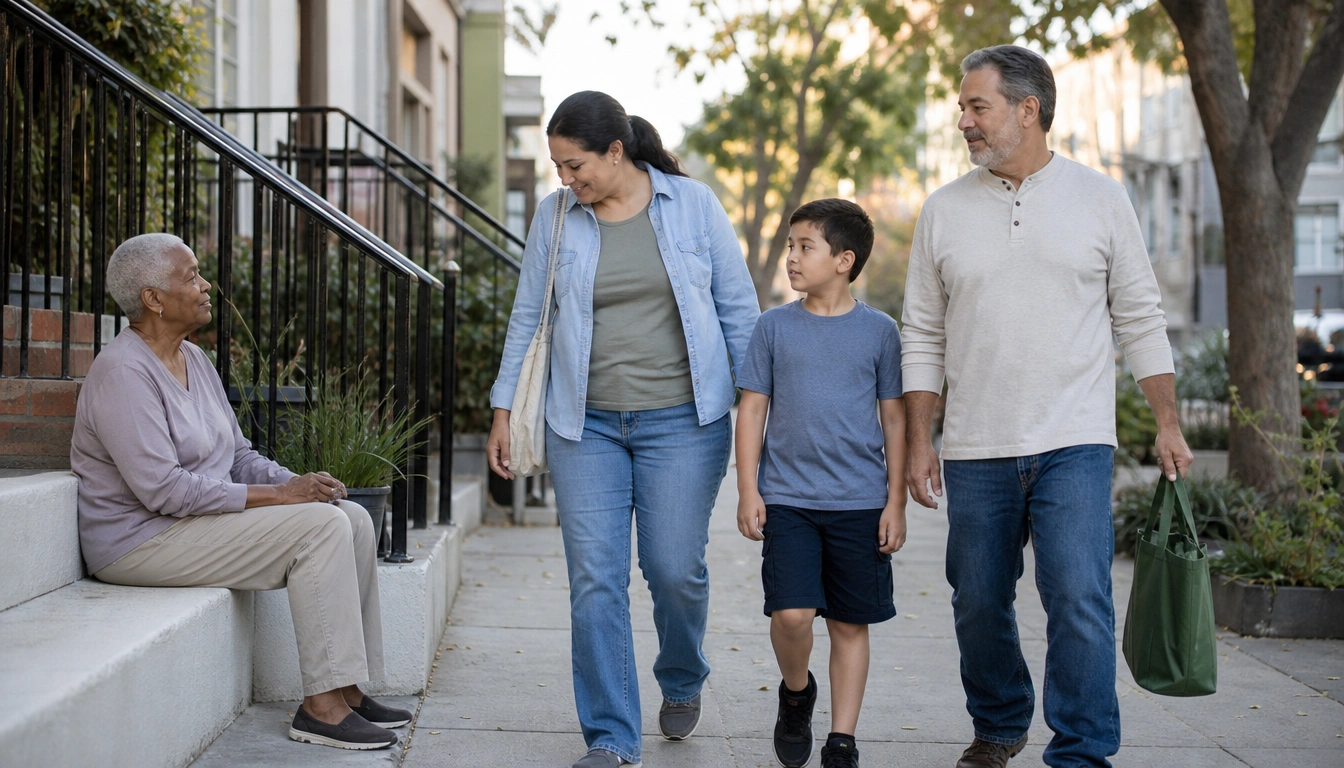
Yes—your household can build a simple outdoor time routine without spending much by using free spaces, short daily micro-bouts, and existing errands or transitions. Aiming for about 2 hours a week of outdoor exposure, split into 10- to 20-minute pieces, is a practical way to support mood, attention, movement, and family connection. The best routine is the one you can repeat most days, even in a city or on a tight schedule.
Key Takeaways
- You do not need a park membership or special equipment; sidewalks, courtyards, street trees, community gardens, and small green patches can all count.
- Breaking outdoor time into short daily bouts is often easier than planning one long outing and still supports a weekly habit.
- Children, teens, adults, and older adults can all benefit, but the routine should match age, mobility, and energy level.
- Weather, air quality, hydration, sun protection, footwear, and insects matter, especially when the goal is to keep the habit low-cost and low-stress.
- Outdoor time helps general wellbeing, but it does not replace medical care for depression, anxiety, persistent pain, sleep problems, or other health concerns.
Why outdoor time is a smart budget habit
A simple outdoor time routine for budget-conscious households works because it gives a lot back for very little cost. Public health and research groups consistently point to outdoor time as a low-barrier way to support stress relief, movement, and emotional recovery. Natural settings can help the body settle after a busy day, and even small amounts of exposure to trees, light, and open air may feel restorative compared with staying indoors all day.
The other advantage is practical: outdoor time can be built into everyday life instead of added as a separate “project.” A walk to the corner store, a few minutes in a courtyard, or sitting outside while a child plays can all count. For households with limited money or limited time, that flexibility matters more than perfect scenery. According to the CDC and Harvard-affiliated research summaries, regular exposure to green space is linked with better overall wellbeing and more physical activity, especially when people make it part of normal routines.
What counts as outdoor time? More than many people expect. Sidewalks, front steps, building courtyards, community gardens, school drop-off areas, local trails, pocket parks, and tree-lined blocks can all provide meaningful exposure. If a household has only a tiny yard or a few street trees nearby, that still counts. The goal is not to find the “best” nature setting; it is to create repeatable contact with outdoor spaces that are easy to reach and free to use.
A simple weekly pattern that actually fits real life
The easiest way to make outdoor time sustainable is to think in micro-bouts rather than long sessions. A weekly goal of about 2 hours can be divided into short pieces spread across the week. That might look like 15 minutes after breakfast, 10 minutes after work, 20 minutes after school pickup, and a longer walk on one weekend day. The exact pattern matters less than repeating it often enough to become normal.
Short bouts are especially useful for busy households because they reduce the chance that weather, fatigue, childcare, or work demands will wipe out the whole plan. A 15-minute walk still counts. A 10-minute sit outside while waiting for laundry, dinner, or a ride can also count. If the household is starting from zero, it can help to begin with the smallest version that feels almost too easy and then build from there.
A useful progression is to keep the same time slots most days and only adjust the activity. For example, one week might include walking on Monday, Wednesday, and Friday, and sitting or playing outside on the other days. The next week might add a few extra minutes or a longer weekend outing. The routine becomes easier when the schedule is predictable, not when it is intense.
How households can build the habit around daily routines
For many families, the real challenge is not motivation; it is timing. Outdoor time works best when it is tied to something that already happens. Before work, a household might step outside with coffee or tea and walk one block. After school, children can spend a short burst outside before homework or dinner. During lunch breaks, an adult can take a lap around the block instead of scrolling indoors. In the evening, a brief post-dinner walk can help close the day.
These routines do not need to be identical every day. The point is to create a default option that is easier than deciding from scratch each time. If mornings are chaotic, use afternoon or evening. If the weather is better at lunch, choose that. If a caregiver has limited time, even standing outside for a few minutes while a child rides a scooter or tosses a ball can be enough to keep the habit alive.
Households with shared responsibilities can also divide the routine. One adult may walk with one child while another prepares food; another day, the roles can switch. If older relatives live with the family, a slower walk or a seated outdoor visit can make the habit feel shared rather than separate. The best routine is the one that fits the household’s existing flow instead of fighting it.
Free ways to get nature exposure without special gear
Outdoor time does not have to mean hiking, sports, or equipment. Low-cost options are often the easiest to repeat. Walking is the simplest: around the block, to transit, to school, to a store, or through a nearby green patch. Sitting outside is another option, especially for people who need a lower-effort routine. Reading, talking, listening to birds, or watching clouds all provide outdoor exposure without buying anything.
Sensory grounding can make the time feel more meaningful without turning it into a “wellness task.” A person can notice the temperature, the sound of traffic fading in the distance, the feel of shade, the smell after rain, or the changes in leaves across the seasons. Children often do well with simple prompts like “find three colors,” “listen for one bird,” or “spot one tree you have not noticed before.”
Commuting on foot is another free strategy. If a trip already has to happen, see whether part of it can be walked, even if not the entire route. A walk to a bus stop, school gate, or nearby errand can add up fast. The goal is not athletic intensity; it is repeated, realistic contact with the outdoors.
How outdoor time can look different by age
Children often benefit from outdoor time through play, movement, and attention support. Outdoor play can help them use energy, practice coordination, and shift out of screen-heavy routines. Keep it simple: chalk on pavement, chasing bubbles, collecting leaves, walking while talking, or just moving around a safe open space. They do not need expensive toys for the time to be useful.
Teens may prefer more independence. A short solo walk, a walk with a sibling, or time outside while listening to music can feel more realistic than family play. For some teens, outdoor time works best when it is linked to social connection, like walking with a friend or taking a family pet out. The routine should feel respectful, not forced.
Adults often benefit most when outdoor time is attached to stress relief and movement. A brisk walk, a quiet sit after work, or a walk during a break can help reset attention and separate work from home life. Older adults may need a slower pace, nearby seating, flat ground, and a predictable route. For them, the goal is often safe movement, balance, routine, and social contact rather than distance or speed.
For all ages, the safest routine is the one that matches the person’s energy, mobility, and supervision needs. A child’s version may be active and supervised; an older adult’s version may be short, steady, and close to home. Both can be valuable.
What to do when green space is limited
Many households do not live near a large park, and that should not end the plan. Small green places still count: a courtyard with a tree, a median with landscaping, a school field after hours, a community garden, a street with mature trees, or a sidewalk route with more shade. Even a few minutes in a greener micro-space can be a better option than waiting for a perfect location that never happens.
If the neighborhood feels noisy, crowded, or not ideal, focus on what is available and manageable. Some people use an early-morning walk before traffic builds up. Others choose a quieter side street, a building entrance area, or a nearby church, library, or community center exterior if sitting there is allowed. The point is to look for the nearest workable space, not the most scenic one.
When access is very limited, indoor-outdoor hybrids can help. A few minutes outside on a stoop, balcony, or open doorway with fresh air and daylight may be better than skipping the habit entirely. For families, rotating between walking, sitting, and brief active play can keep the routine flexible when the neighborhood environment is imperfect.
Safety basics that keep the routine low-cost and sustainable
Weather and air quality should guide the day’s plan. On very hot, cold, smoky, or stormy days, shorten the outing, shift the time, or move the routine to a safer part of the day. The CDC recommends paying attention to local air quality conditions, especially for children, older adults, and people with asthma or heart and lung conditions. If outdoor air is poor, a shorter outing or a different location may be smarter than pushing through.
Hydration does not need to be expensive. Tap water from home is enough for most routine outings. Sun protection can also be simple: use shade when possible, wear a hat if you already own one, and choose lightweight long sleeves or pants if that is what you have. Footwear matters too; stable shoes reduce the chance of slips, blisters, or sore feet. Insects can be a problem in some seasons, so long clothing, avoiding standing water, and checking skin after being outside can help. If a family uses repellent, follow the label directions.
Keep the routine practical rather than perfect. If the weather changes, shorten the outing. If someone feels dizzy, overheated, short of breath, or unwell, head indoors. A safe habit is one people can repeat tomorrow.
How to keep it free over the long term
Budget-friendly routines last longer when they are built around what the household already has. Bring water from home. Eat a snack before or after the outing if that helps prevent extra spending. Use the same shoes and clothing you already own instead of buying special gear for every season. Keep expectations modest so the habit does not turn into a burden.
Routine stacking is one of the cheapest ways to make outdoor time stick. Pair it with things that already happen: morning coffee, school drop-off, a work break, laundry, dinner cleanup, or bedtime wind-down. If a family keeps a calendar or phone reminder, use it to protect the time slot. If the schedule is unpredictable, use a “backup version” such as five minutes outside plus a short walk around the building.
As the habit settles in, increase it only if it feels easy. More time is not always better than more consistency. A household that gets outside most days, in small doses, is usually doing more for its health than a household that plans a perfect outing once in a while and then stops.
Frequently Asked Questions
How much outdoor time do people need each week to see benefits?
A practical target is about 2 hours per week, and it can be split into short bouts. You do not need to do it all at once. For many households, 10- to 20-minute pieces across the week are easier to sustain and still add up to meaningful exposure.
What are the cheapest ways to get nature exposure if you do not live near a big park?
Use what is nearby: sidewalks with trees, courtyards, community gardens, school edges, small green patches, or even a quiet block for walking. Sitting outside, watching clouds, or taking a short daily loop around the neighborhood can also count.
What should families do outdoors when they have no special gear or equipment?
Keep it simple. Walk, play tag, chalk on pavement, look for birds, collect leaves, or sit and talk outside. Basic clothes, stable shoes, and water from home are usually enough for a routine that is meant to be free and repeatable.
How can children and older adults safely fit outdoor time into a routine?
Children usually do best with short, playful, supervised time outside. Older adults often do better with flat routes, slower walking, nearby seating, and predictable schedules. In both cases, start with a manageable amount and choose times of day that match energy and safety needs.
What safety steps matter most for weather, air quality, sun, and insects?
Check the weather and local air quality before longer outings, shorten the time in heat or smoke, drink water, use shade when possible, wear stable shoes, and reduce insect exposure with clothing and common-sense route choices. If someone feels unwell, head inside.
The Bottom Line
A free outdoor routine does not need to be elaborate to be useful. For many households, the most realistic plan is a series of short, repeatable micro-bouts that add up across the week.
The strongest version of the habit is the one that fits your real schedule, nearby space, weather, and mobility needs. Small, steady exposure is usually more sustainable than waiting for the perfect outing.
Outdoor time can support general wellbeing, but it is not a substitute for medical care when symptoms are persistent or severe. If mood, sleep, pain, breathing, or functioning are becoming a problem, professional help is still important.
Medical disclaimer
Medical disclaimer: This content is for educational and informational purposes only and is not a substitute for professional medical advice, diagnosis, or treatment. Dietary needs and supplement suitability vary by individual.
Sources
- Centers for Disease Control and Prevention (CDC) — cdc.gov. Accessed October 2026.
- National Health Service (NHS) — humber.nhs.uk. Accessed October 2026.
- Centers for Disease Control and Prevention (CDC) — cdc.gov. Accessed October 2026.
- Academic Research Institution — harvard.edu. Accessed October 2026.
