
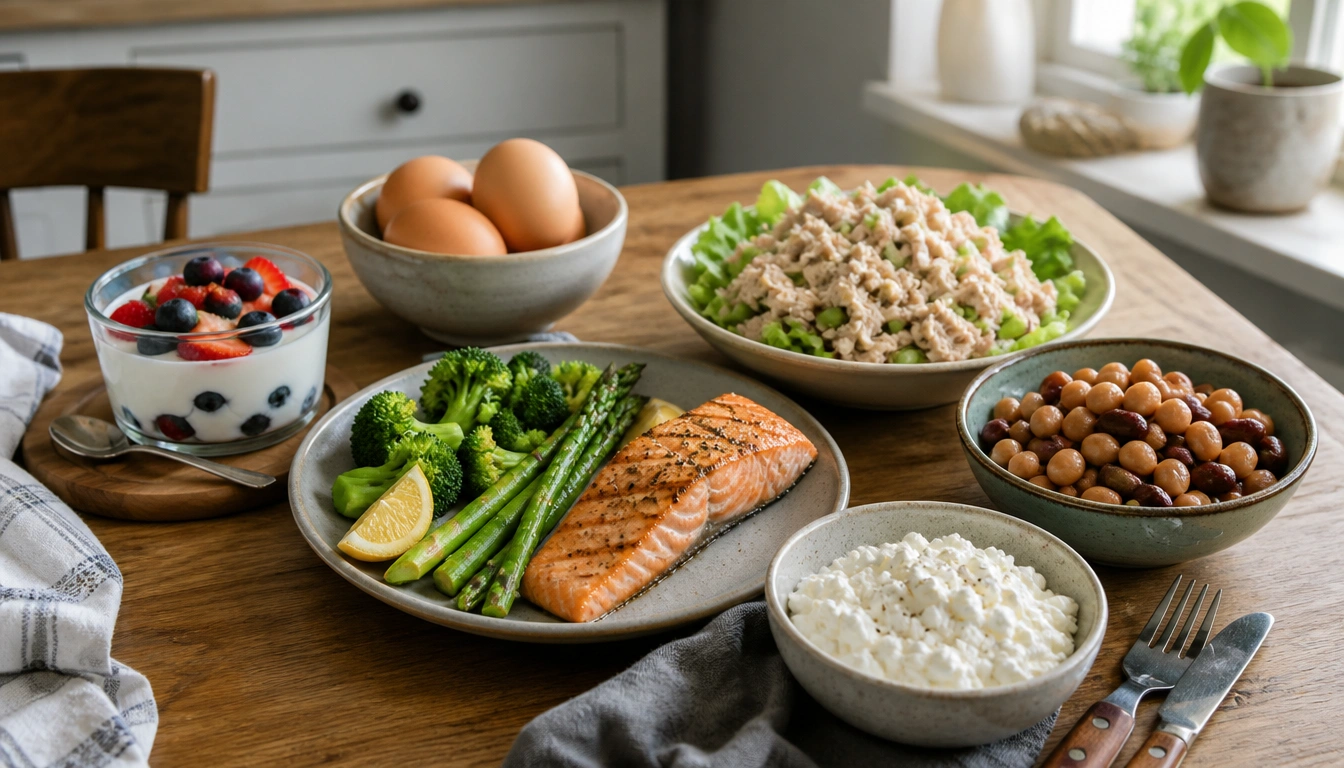
For many healthy adults over 50, a simple day-to-day protein meal plan aims for about 1.0 to 1.2 grams of protein per kilogram of body weight per day, with protein spread across meals instead of loaded at dinner. In real life, that often means roughly 25 to 30 grams at breakfast, lunch, and dinner, plus a snack if needed to meet the day’s total.
Key Takeaways
- Older muscles often need a stronger protein signal, so evenly spacing protein across the day usually works better than one large serving at night.
- A small protein snack can help, but older adults may need a meaningful meal-sized amount to support muscle maintenance.
- Soft, convenient foods such as Greek yogurt, eggs, cottage cheese, tofu, canned fish, lentils, and powdered milk can make protein easier to eat.
- Protein works best alongside resistance training or regular physical activity; food alone is only part of the plan.
- A higher-protein approach is not right for everyone over 50, especially if kidney disease, liver disease, gout, or unexplained weight loss is present.
Why protein needs change after 50
After age 50, the body often becomes less responsive to the usual protein dose. Researchers call this anabolic resistance: muscle does not respond as strongly to the amino acids in a meal as it did earlier in life. That matters because protein helps maintain muscle tissue, strength, mobility, and day-to-day function.
This does not mean every adult over 50 needs a high-protein diet by default. It does mean the standard adult RDA of 0.8 grams per kilogram per day is often a floor, not a practical target, for many older adults who want to preserve muscle. The National Institute on Aging and other expert groups emphasize eating enough protein while staying physically active, especially if appetite is smaller or activity is dropping.
The other reason timing matters is that muscle protein synthesis responds to a meal. If most protein is saved for dinner, breakfast and lunch may not provide enough building material for the rest of the day. A steadier intake pattern is usually easier to use in a simple meal plan.
How much protein adults over 50 generally need per day
For many healthy older adults, a practical daily target is about 1.0 to 1.2 grams of protein per kilogram of body weight. More active adults, or those recovering from illness or unintentional weight loss, may need more individualized guidance and sometimes a higher range under professional supervision.
That range is not a prescription for everyone. It is a useful planning target when the goal is muscle maintenance, steady energy, and easier meal construction. Someone who weighs less and eats three smaller meals may reach the target with modest portions; someone larger or more active may need more.
Instead of counting every gram perfectly, many people do better by thinking in meals. A common practical pattern is to aim for roughly 25 to 30 grams of protein per meal, with an optional snack if the total for the day is still short. That approach fits the way older adults actually eat and makes breakfast and lunch count.
People with chronic kidney disease, liver disease, gout, or unexplained weight loss should not use a one-size-fits-all target. Their protein plan may need medical adjustment.
How to spread protein across the day
The simplest pattern is to build each main meal around a protein anchor rather than treating protein as an afterthought. Breakfast, lunch, and dinner all matter. If appetite is low, a snack can help, but a small snack alone usually will not provide the same muscle-supporting effect as a full meal.
A practical distribution looks like this:
- Breakfast: about 20 to 30 grams if possible
- Lunch: about 25 to 30 grams
- Dinner: about 25 to 30 grams
- Snack: 5 to 15 grams as needed to close the gap
This pattern is especially helpful for adults who tend to skip breakfast or nibble lightly at lunch. If the first meal of the day is too small, the rest of the day has to work harder, which is often harder for people with early satiety. Spreading protein out also makes it easier to use softer foods and smaller portions without missing the mark.
A simple protein meal plan for adults over 50
A good plan does not need complicated prep. Think in three parts: one protein anchor, one supporting side, and one easy produce or fiber addition. That structure keeps meals simple while still building enough protein, color, and satiety.
Example 1-day plan:
| Meal | Simple example | Approximate protein |
|---|---|---|
| Breakfast | Plain Greek yogurt with berries and a small handful of nuts | About 25 to 30 grams |
| Lunch | Tuna or chicken salad on greens with beans or chickpeas | About 25 to 30 grams |
| Dinner | Salmon, quinoa, and a cooked vegetable | About 25 to 30 grams |
| Snack if needed | Hard-boiled egg, cottage cheese, or milk-based smoothie | About 5 to 15 grams |
This kind of plan is realistic because it uses ordinary food, not a separate cooking project. The same formula works for bowls, plates, and leftovers. If you like oatmeal, soup, or smoothies, those can also carry protein when fortified with milk, yogurt, tofu, beans, or powdered milk.
Easy high-protein foods for adults over 50
The most practical foods are usually the ones that are already in the fridge, pantry, or freezer. Budget-friendly protein staples include eggs, milk, yogurt, cottage cheese, canned tuna or salmon, rotisserie chicken, tofu, lentils, beans, and peanut butter. Frozen edamame and pre-cooked lentils can also save time.
For people with low appetite, taste changes, or chewing difficulty, texture matters as much as protein content. Soft or easy-to-chew choices include scrambled eggs, Greek yogurt, cottage cheese, tofu, flaky fish, lentil soup, hummus, and tender shredded chicken. Blended additions such as powdered milk stirred into oatmeal, soups, or mashed potatoes can raise protein without adding much volume.
If swallowing is difficult, texture should be discussed with a clinician or speech-language pathologist. The goal is to make meals safer and easier to finish, not just higher in protein.
Convenience foods can be part of a good plan. A protein-rich meal does not have to be homemade from scratch to be useful.
How to adapt the plan for active adults, weight loss goals, or sarcopenic obesity
Adults over 50 who walk regularly, lift weights, garden intensely, or train for sports often need the higher end of protein planning. Physical activity increases the need to support repair and recovery, and it improves the usefulness of protein at the muscle level.
For people trying to lose weight, protein helps preserve lean tissue while calories come down. That is especially important in sarcopenic obesity, where body fat is higher but muscle is not where it should be. In that situation, a higher-protein plan can help protect muscle during weight loss, but food quality and total energy still matter.
Even with weight-loss goals, the plan should not become so restrictive that meals are too small. If protein is the only thing being counted, energy intake may drop too low and appetite may fall further. A better approach is protein first, then add vegetables, fruit, whole grains, or other fiber-rich sides as tolerated.
When a higher-protein plan needs medical guidance
Some adults over 50 should check with a clinician before making a major protein change. This is especially important with kidney disease, liver disease, or gout, because the right protein target may differ from general advice. Medical history, lab values, medications, and hydration status all matter.
Unexplained weight loss also deserves attention. If a person is losing weight without trying, the first step should be medical evaluation rather than simply increasing protein. The cause could be reduced intake, swallowing trouble, medication effects, depression, digestive disease, or another condition that needs treatment.
People with reduced kidney function should not assume that more protein is always better. Individualized guidance is the safest way to balance muscle support with organ health.
Simple implementation tips
One of the easiest habits is to make the protein portion the first food you notice on the plate. That does not mean eating in a rigid order every time; it means making sure the meal contains enough protein before the plate fills up with bread, chips, rice, or other low-protein foods.
Meal prep can stay very simple. Keep a few low-effort staples on hand: yogurt cups, boiled eggs, canned fish, cottage cheese, tofu, frozen vegetables, and ready-to-eat beans or lentils. A store-bought rotisserie chicken, microwave rice, and bagged salad can make a solid dinner with almost no cooking.
Supplements are best treated as backup tools, not the main strategy. Protein powder can help when appetite is low or chewing is difficult, and powdered milk can be an easy add-in. Still, food should come first whenever possible because it brings protein along with vitamins, minerals, and satisfaction.
If breakfast is usually light, start there. If lunch is the weak spot, fix lunch first. The most workable protein plan is the one a person can repeat most days, not the one that looks perfect on paper.
Frequently Asked Questions
How much protein per day do adults over 50 need?
A common planning target for healthy older adults is about 1.0 to 1.2 grams of protein per kilogram of body weight per day. Active adults or people recovering from illness may need individualized advice. The standard adult RDA of 0.8 grams per kilogram is often a minimum, not an ideal target, for many people over 50.
How much protein should be eaten at each meal to support muscle maintenance after 50?
A practical goal is often about 25 to 30 grams per meal, spread across breakfast, lunch, and dinner. Older muscles may need a stronger protein dose than younger muscles because of anabolic resistance. A small snack can help, but it usually should not replace a real meal when the goal is muscle support.
What are easy high-protein breakfast, lunch, dinner, and snack ideas for older adults?
Good low-prep options include Greek yogurt, eggs, cottage cheese, oatmeal made with milk, tuna salad, chicken salad, tofu bowls, lentil soup, salmon, and beans. For snacks, try a hard-boiled egg, yogurt, cottage cheese, milk, or a small smoothie. Convenience foods can still be nutritious if they are protein-focused.
Which protein foods are easiest to digest or chew for adults over 50?
Soft foods are often easiest, including Greek yogurt, scrambled eggs, cottage cheese, tofu, canned fish, hummus, lentil soup, and tender shredded chicken. Smoothies and blended foods can also help when appetite is low or chewing is tiring. If swallowing is difficult, it is important to get professional guidance on food texture and safety.
Can adults over 50 use protein powder or other supplements instead of food?
Protein powder can be useful when food intake is low or meals are hard to finish, but it is usually a backup rather than the main plan. Food gives protein plus other nutrients and is often easier to keep satisfying. If you have kidney disease, liver disease, gout, or unexplained weight loss, ask a clinician before adding supplements.
The Bottom Line
A simple protein meal plan for adults over 50 does not need to be complicated. For many healthy people, the practical target is about 1.0 to 1.2 grams of protein per kilogram of body weight per day, divided across breakfast, lunch, and dinner.
The most useful meals are the ones that fit real life: yogurt and eggs at breakfast, tuna or chicken at lunch, fish, tofu, beans, or lean meat at dinner, with soft options when appetite or chewing is a problem. Food first is the best starting point, with supplements only when needed.
If kidney disease, liver disease, gout, or unexplained weight loss is in the picture, the plan should be individualized before making it higher in protein.
Medical disclaimer
Medical disclaimer: This content is for educational and informational purposes only and is not a substitute for professional medical advice, diagnosis, or treatment. Dietary needs and supplement suitability vary by individual.
Sources
- National Institutes of Health (NIH) — nih.gov. Accessed October 2026.
- U.S. Government / Health Authority — acl.gov. Accessed October 2026.
- National Institutes of Health (NIH) — nih.gov. Accessed October 2026.
- National Institutes of Health (NIH) — nih.gov. Accessed October 2026.
- Academic Research Institution — harvard.edu. Accessed October 2026.
- Academic Research Institution — harvard.edu. Accessed October 2026.
- espen.org — espen.org. Accessed October 2026.
