
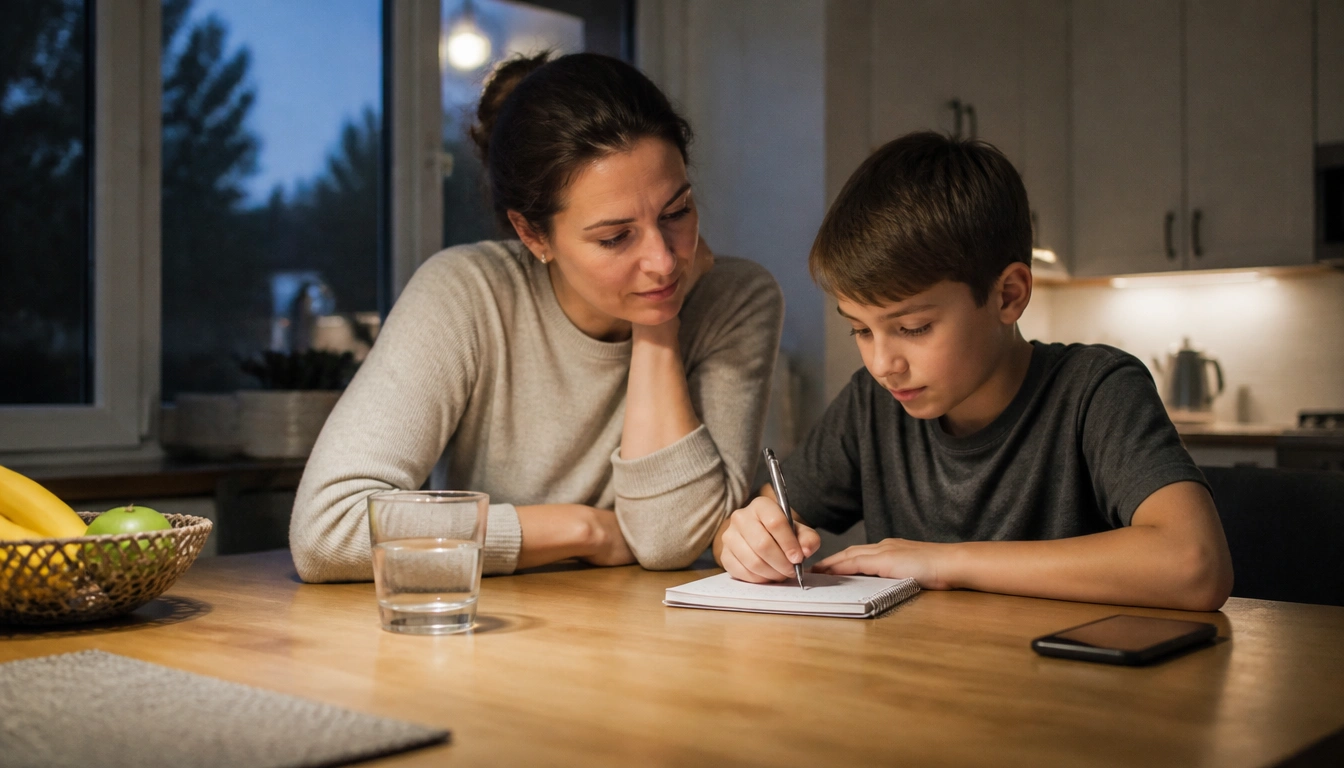
A simple routine for exam stress at home is a short, repeatable pattern built around three transition points: a calm morning check-in, a brief after-school reset, and an evening screen-and-study cut-off. For busy parents, the goal is not to eliminate pressure, but to lower household tension enough that everyone can think, talk, and sleep more easily.
Key Takeaways
- Use existing daily transitions instead of inventing a new schedule; that makes the routine more realistic and easier to keep.
- A 2- to 5-minute micro-reset can be enough to interrupt rising stress and help parent and child settle before tension escalates.
- Your own regulation matters first: children often pick up on a parent’s anxiety, tone, and frustration before they hear the words.
- Younger children usually need more reassurance and physical co-regulation, while teenagers tend to respond better to calm autonomy and a non-judgmental check-in.
- If a child has ADHD, autism, or another learning difference, break the routine into smaller steps and build in more movement breaks.
- Missing a step is not a failure. For single parents and overloaded households, a partial routine is still useful if it reduces stress rather than adding guilt.
Why exam season stresses the whole household
Exam season rarely stays neatly inside one student’s timetable. It changes the mood of the whole home: parents feel pressure to monitor revision, remember deadlines, manage meals and sleep, and keep everything else running. That extra load can create secondary stress, especially when work, childcare, and household tasks are already full.
Children usually do not experience pressure in isolation. They absorb tone, pace, and tension from the adults around them. A parent who is rushed, worried, or irritated may unintentionally turn a difficult day into a louder one. That is one reason a simple routine for exam stress can help the household, not just the student.
The aim is not a perfect calm home. It is a home where the stress level does not keep climbing all day.
How stress spreads between parents and children
Stress is contagious in both behavior and biology. When adults sound tense, move quickly, or respond with frustration, children often mirror that state. The body can also react as if there is a threat: breathing gets shallow, muscles tighten, thoughts speed up, and patience drops. The CDC and NHS both describe stress management as a practical response to restoring control, predictability, and brief recovery time.
That is why parent regulation comes first. If you try to calm a child while you are still activated, your words may be sensible but your nervous system may say something else. A short pause, a slower voice, or a few steady breaths can shift the tone before the conversation starts.
This is not about suppressing your own feelings. It is about reducing the chance that your stress becomes the loudest thing in the room.
The simplest parent-friendly routine
The most workable routine is one you can repeat without much thinking. Instead of creating new tasks, use three natural transition points that already happen in many families: morning, after school or after work, and bedtime. Each one can hold a small reset that takes only a few minutes.
Morning: set the emotional tone. After-school or after-work: create a buffer before anyone starts discussing exams. Evening: draw a clear boundary around study and screens so the home can start winding down.
This structure works because it is predictable. Predictability lowers friction, especially when the rest of the day feels crowded or uncertain. It also gives children a signal that the family has a plan, even if the plan is simple.
If you can only manage one part on a given day, start with the afternoon reset. That is often the point where tension spikes fastest.
A morning anchor and an afternoon reset
In the morning, keep the check-in short. Two minutes is enough. You might take one slow breath together before school, the commute, or the first cup of coffee. Try a calm phrase such as, “We will take today one step at a time.” The point is not motivation or pep talks; it is to start the day without a burst of exam talk.
The after-school reset matters even more. Many parents want updates immediately: How was the test? Did you revise enough? What is next? Those questions are understandable, but they often land when the child is depleted and the parent is also tired. A 15-minute no-exams buffer gives both people time to downshift.
During that buffer, keep interaction low-pressure. Drink water, change clothes, listen to music, sit quietly, or take a short walk. The CDC notes that brief pauses and movement can help interrupt stress before it snowballs. You are not avoiding the issue; you are giving the conversation a better chance of going well.
If your child wants to talk sooner, let them lead. If they do not, do not force a debrief the second they walk in the door.
An evening boundary that protects sleep
Evening is where many families lose momentum. The child wants to keep revising, check messages, or scroll to recover from the day. The parent may want one more conversation about homework, and the result is more tension at the exact time everyone needs to soften.
A useful boundary is a screen-and-study cut-off about 45 to 60 minutes before bed. That does not need to be rigidly perfect every night. It is simply a signal that the academic part of the day is closing. Dim the lights, put study materials away, and switch to something low-stimulation: a shower, stretching, a quiet chat, or a book that is not exam-related.
Sleep matters because stress and sleep loss reinforce each other. When sleep is short or restless, the next day’s emotions are harder to regulate and concentration is harder to sustain. For students, that can make revision less effective; for parents, it can make ordinary requests feel heavier than they are.
Try not to let bedtime become the last place where exam pressure gets discussed in detail.
How to adapt the routine by age and learning style
Younger children usually need more co-regulation. That can mean sitting nearby, using a gentle voice, giving a hug if they want one, or helping them name what they feel. They may not have the language to say “I am overwhelmed,” so behavior often tells the story first. Physical reassurance and simple choices help more than long explanations.
Teenagers usually do better with respect for autonomy. They may resist being monitored, but still need a calm, non-judgmental check-in. A brief “How are you holding up?” is often more useful than a long lecture about effort. Let them choose whether they want advice, quiet company, or practical help.
For ADHD, autism, or other learning differences, the routine may need to be smaller and more explicit. Break tasks into short steps, use visual reminders if helpful, and build in frequent movement breaks. Some children need more time to switch gears, and some are more sensitive to noise, sudden questions, or crowded spaces. That does not mean the routine is failing; it means the routine should fit the child.
According to the NHS, predictable routines and reduced overload can support emotional regulation. The same principle applies here: less friction, more clarity.
How to make it realistic in a packed household
Single parents, shift workers, and overloaded households often hear advice that assumes extra time, extra energy, and extra hands. That is not the reality for many families. This routine is designed to survive imperfect days.
If you miss the morning check-in, do the afternoon one. If the afternoon falls apart, keep only the evening boundary. If even that is too much, use one micro-reset for yourself before you answer your child. A few slow breaths in the car, at the sink, or in the bathroom can lower the emotional temperature enough to change how the next ten minutes go.
Self-compassion is part of the plan, not a bonus. Missing a step should not become another source of guilt. The goal is to reduce pressure, not add a performance standard to an already full day.
If family life is especially noisy, post reminders where they are easy to see: a note on the fridge, a phone alarm for the evening cut-off, or a shared phrase such as “buffer first, exam talk later.” Simple cues reduce the need for repeated reminders.
What not to do when exam stress is rising
Some well-meant habits make exam stress worse. One common mistake is leading with questions the moment your child arrives home. Another is using fear, comparisons, or constant correction to push them into studying. These approaches can increase defensiveness and make it harder for a tired student to re-engage.
Try not to use the child as a place to release your own stress. If you need to vent, do it away from them or after you have calmed yourself first. Also avoid turning every interaction into a progress report. A home can support academic effort without becoming an exam checkpoint.
Watch for signs that stress is moving beyond ordinary pressure. These can include ongoing sleep problems, frequent stomachaches or headaches, panic-like symptoms, persistent avoidance, major changes in appetite, or expressions of hopelessness. If those signs show up, extra support is appropriate. The NHS recommends seeking professional help when stress starts interfering with daily functioning, and the CDC similarly advises getting support when symptoms are persistent or severe.
That applies to parents too. If your own stress is leading to insomnia, burnout, or a sense that you cannot cope, it is reasonable to ask for help.
Frequently Asked Questions
How can I help my child decompress after school without starting an argument about exams?
Use a 15-minute buffer with no exam questions. Offer water, a snack, quiet time, a walk, music, or a shower. Keep your voice calm and let your child decide whether they want to talk. The goal is to lower tension before you bring up anything academic.
What are the best short stress-reset techniques for parents with no spare time?
The most useful resets are brief: a few slow breaths, a short walk, stretching your shoulders, stepping outside for fresh air, or pausing before you answer. Even 2 to 5 minutes can help interrupt rising stress and make the next conversation less reactive.
How do I keep my own stress from rubbing off on my child during exam season?
Start with your own regulation before you try to fix theirs. Lower your voice, slow your pace, and take a short pause if you feel yourself getting sharp or rushed. Children often notice tone and body language first, so even a small reset can change the atmosphere at home.
What should an evening routine look like before bed when exams are causing tension?
A good evening routine is simple and predictable: stop study and screens before bed, dim the lights, and switch to quiet, low-stimulation activities. Avoid last-minute exam talks if possible. Protecting sleep helps both mood and concentration the next day.
When does normal exam stress become a sign that my child needs extra support?
Seek extra support if stress is persistent, intense, or starts interfering with daily life. Red flags include panic symptoms, major sleep or appetite changes, frequent physical complaints, strong avoidance, or hopeless talk. A school counselor, GP, or mental health professional can help assess what is going on.
The Bottom Line
A simple routine for exam stress does not need to be elaborate. The most effective version is often a morning check-in, a protected after-school buffer, and a clear evening boundary that helps the whole house come down from the day.
The more stressed the household feels, the more important it is to keep the routine small and repeatable. If you are exhausted, choose one step and keep it going rather than trying to do everything perfectly.
If stress is becoming persistent, severe, or disruptive, bring in outside support. Busy parents do not have to carry exam season alone, and children do not benefit from pressure that keeps escalating at home.
Medical disclaimer
Medical disclaimer: This content is for educational and informational purposes only and is not a substitute for professional medical advice, diagnosis, or treatment. Dietary needs and supplement suitability vary by individual.
Sources
- Centers for Disease Control and Prevention (CDC) — cdc.gov. Accessed November 2026.
- National Health Service (NHS) — www.nhs.uk. Accessed November 2026.
- National Health Service (NHS) — bsmhft.nhs.uk. Accessed November 2026.
