
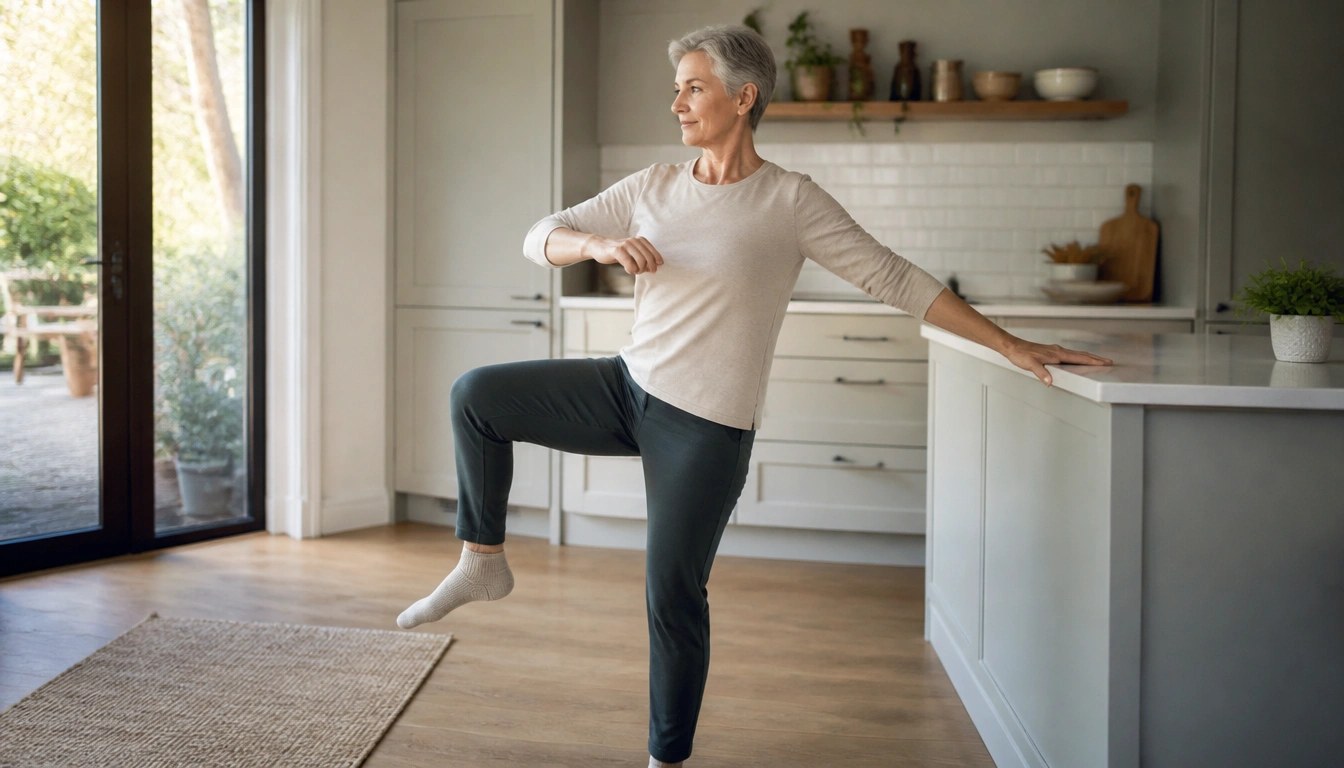
Yes—absolute beginners can safely start with standing core exercises such as marching with an opposite arm reach, side bends, modified woodchops, and tandem heel-to-toe holds. These moves train trunk stability, balance, and posture without requiring floor work. Begin near a wall or counter, use slow controlled motion, and start with a small number of reps or short holds.
Key Takeaways
- Standing core work is not just about the “six-pack”; it trains deep trunk muscles, breathing control, and the ability to resist unwanted movement.
- A standing routine can be easier to start than floor exercises if you have wrist, knee, or low-back discomfort, because it avoids getting down and back up.
- For beginners, start with 5–10 repetitions or 10–15 second holds and use a wall, counter, or sturdy chair for support.
- Standing drills also challenge balance systems in the hips, ankles, and deep spine, so you get core and stability practice at the same time.
- Stop right away for sharp pain, chest discomfort, dizziness, shortness of breath, or sudden instability; get medical clearance first if you have major balance problems or an active injury.
Why a standing core routine works for absolute beginners
A standing core routine is often the easiest way to begin because it asks less of your joints and setup than floor exercise. If getting down to a mat feels awkward, painful, or tiring, standing work can remove that barrier and make it more likely that you actually stick with the habit. That matters, because the best routine is the one you can repeat consistently.
The “core” is more than the visible abdominal muscles. It includes deep trunk muscles such as the transversus abdominis, obliques, spinal stabilizers, pelvic floor, and diaphragm. In standing drills, these muscles help you resist unwanted movement while you move your arms or legs. Instead of doing repeated crunch-style flexion, you are training posture, control, and the ability to stay steady against gravity.
This style of work is especially useful for beginners, older adults, and people who want a lower-barrier option while recovering from stiffness. According to the CDC and NHS guidance, adults should include muscle-strengthening activity for major muscle groups at least two days a week, and balance practice is valuable too. Standing core exercise lets you work on both at once.
Before you start: setup, support, breathing, and effort
Choose a stable place to stand, such as next to a wall, kitchen counter, or sturdy chair. Keep the floor clear, wear supportive shoes if barefoot standing feels uncertain, and leave enough space to move your arms without bumping into furniture. If balance is a concern, place one or two fingertips on the support surface before you start.
Use a light to moderate effort. You should feel your muscles working, but you should still be able to breathe smoothly and maintain good form. If you are holding your breath, bracing too hard, or rushing through the motion, the exercise is probably too intense for this stage. Gentle breathing helps the trunk muscles do their job without creating unnecessary strain.
A useful mindset is “steady and controlled,” not “hard and fast.” For most beginners, one slow round is enough to practice the pattern. You can build from there over time as your confidence and control improve.
Standing core exercises for beginners
Below is a simple standing core routine you can do at home without equipment. Move slowly, keep your chest tall, and use support as needed.
March with opposite arm reach
Stand tall with feet hip-width apart. Lift one knee a few inches, then swing the opposite arm forward in a comfortable reach. Lower with control and switch sides. Keep your torso upright rather than leaning back or hunching. This drill asks your trunk to stay steady while your limbs move, which is a core skill, not just a leg exercise.
Easier: Lift the knee only slightly and keep one hand lightly on a counter.
Harder: Reduce hand support and slow the tempo.
Standing side crunch
Stand tall and let one hand rest lightly on a support surface. Slide the other hand down the outside of your thigh as you bend a little to the side, then draw yourself back to center using your side waist muscles. Keep the movement in the side plane; do not twist forward or collapse through the chest. This targets the obliques while keeping the spine in a controlled position.
Easier: Make the side bend very small.
Harder: Pause briefly at the bottom before returning upright.
Modified standing woodchopper
Stand with feet slightly wider than hip-width and knees soft. Clasp your hands together in front of you, then sweep them diagonally upward to one side and down toward the opposite hip. Move as if you are guiding the motion with your trunk rather than throwing your arms around. The goal is controlled rotation and coordination, not momentum.
Easier: Keep the range of motion small and the pace slow.
Harder: Stand farther from the wall or support and maintain a smoother trunk position.
Tandem heel-to-toe hold
Place one heel directly in front of the other foot’s toes, like a narrow line. Keep one or both fingertips near a wall or counter, then stand tall and breathe normally. This is not a “core crunch” move, but it challenges the balance system that helps your deep spine and hips stabilize. Switch which foot is in front after the hold.
Easier: Widen the stance slightly or keep more hand contact.
Harder: Reduce support until you are only hovering near the surface.
How often to do the routine and how much to do
For a beginner, one short session can be enough to start. Aim for at least two days per week so the routine lines up with public health guidance for muscle-strengthening activity. If you enjoy it, you can add a third light day, but consistency matters more than doing a long workout once in a while.
Start with 5 to 10 repetitions for each moving exercise, or 10 to 15 second holds for the balance drill. Rest as needed between moves so your form stays steady. If a movement feels shaky, shorten the range, slow it down, or reduce the number of repetitions before you add more.
One simple beginner format is to do each move once on each side, then repeat the circuit one more time if you still feel fresh. That gives you practice without turning the session into a test of endurance. Over time, you can add a few reps, hold a balance position a little longer, or perform an extra round.
How to progress over several weeks
Progress is mostly about reducing support and improving control. Start with a full hand on a wall or counter if that feels safest. As the movements become familiar, move to light fingertip contact, then to hovering the hand just above the support. That small change often makes a big difference in confidence and balance challenge.
You can also progress by making the motion smoother, not just bigger. For example, lift the knee a little higher with the marching move, keep the side bend cleaner and more upright, or hold the tandem stance for a few extra seconds. If your trunk twists, your shoulders hike up, or your breath gets choppy, the step up was probably too large.
Think in weeks, not days. A standing core routine is meant to build a base of control, especially if you have not exercised in a while. Gradual progression helps you adapt without flaring joint discomfort or making balance feel intimidating.
Form mistakes and easy fixes
One common mistake is rushing. Fast repetitions often turn a control exercise into a momentum exercise, which reduces the core challenge. Slow the movement down and pause briefly at the hardest point if you need more feedback from your muscles.
Another mistake is holding the breath. A steady exhale during the effort phase can help your trunk stay organized without excess tension. If you catch yourself gripping your abdomen so tightly that you cannot breathe comfortably, back off the effort.
People also tend to lean backward, shrug the shoulders, or twist through the low back instead of moving from the trunk. A quick fix is to imagine the ribcage stacked over the pelvis and the head balanced over the shoulders. If balance is the problem, keep more support under the hand and make the stance a little wider until the movement feels under control.
Safety rules and stop signs
Stop exercising immediately if you feel sharp pain, chest discomfort, dizziness, shortness of breath that seems unusual for the effort, faintness, or sudden joint instability. Those are not “push through it” signals. They are cues to pause and assess what is happening.
Seek medical or physical therapy advice before starting if you have an active musculoskeletal injury, severe osteoporosis, a known cardiovascular condition that is not well managed, or notable unsteadiness that makes standing exercise feel unsafe. If you are unsure whether a symptom is normal muscle effort or something more concerning, it is safer to get individualized guidance.
If a movement causes pain in the knees, low back, or wrists even though you are using support and moving gently, modify the exercise or choose a different one. The aim is to create a routine you can tolerate and repeat, not to force a position that your body is resisting.
Special considerations for pregnancy, postpartum, and mobility limits
Standing core exercise can be a good option during pregnancy or postpartum because it avoids lying flat if that feels uncomfortable. Upright drills may also feel more manageable if you are dealing with pelvic girdle discomfort, abdominal wall sensitivity, or difficulty getting on and off the floor. Keep the effort moderate and choose movements that feel stable, not strained.
If you are pregnant or recently postpartum, avoid aggressive twisting, over-stretching the abdomen, or any position that worsens pelvic pain or pressure. If something feels unstable, shorten the range of motion and use more support. If you have ongoing pelvic floor symptoms, abdominal separation concerns, or pain that changes with movement, a clinician or pelvic health physical therapist can help you tailor the routine.
For people with poor balance or joint stiffness, the safest version is usually the one done closest to a wall or counter, with the hand support used as a tool rather than a crutch. That support can make the routine feel possible, which is often the first step toward better strength and confidence.
Frequently Asked Questions
How often should a beginner do standing core exercises each week?
A good starting point is two days per week, matching general muscle-strengthening guidance for adults. You can do a short circuit on those days and build gradually as the movements feel more natural. Consistency matters more than long sessions.
Which standing core moves are best for people with poor balance or joint stiffness?
The safest starting moves are marching with support, small side bends, and a tandem heel-to-toe hold near a wall or counter. These let you practice trunk control while keeping the balance challenge manageable.
Can standing core exercises help if I can’t comfortably get down on the floor?
Yes. Standing routines are often a better entry point for people with wrist, knee, hip, or back discomfort because they avoid floor transfers. They still train posture, balance, and trunk control, which are important parts of core fitness.
How can I make a standing core routine easier or harder as a beginner?
Make it easier by using more hand support, shortening the movement, and slowing down. Make it harder by reducing support from a full hand to fingertips to hovering, or by adding a little more range while keeping control.
Is standing core work appropriate during pregnancy or postpartum?
Often yes, but the routine should stay gentle and comfortable. Standing work can be easier than floor exercise for some people, yet you should avoid anything that worsens pain, pressure, or instability. If you have pelvic pain or abdominal wall concerns, check with a clinician or pelvic health physical therapist.
The Bottom Line
A standing core routine gives absolute beginners a practical way to train trunk strength, balance, and posture without getting on the floor. The best starter moves are simple, controlled, and supported by a wall or counter if needed.
Begin with a few slow repetitions or short holds, then progress by reducing support and improving control rather than chasing speed or fatigue. If you have sharp pain, dizziness, chest symptoms, or major medical concerns, stop and get professional guidance before continuing.
Medical disclaimer
Medical disclaimer: This content is for educational and informational purposes only and is not a substitute for professional medical advice, diagnosis, or treatment. Dietary needs and supplement suitability vary by individual.
Sources
- Centers for Disease Control and Prevention (CDC) — cdc.gov. Accessed October 2026.
- National Health Service (NHS) — www.nhs.uk. Accessed October 2026.
- National Health Service (NHS) — scot.nhs.uk. Accessed October 2026.
- National Health Service (NHS) — royaldevon.nhs.uk. Accessed October 2026.
- National Health Service (NHS) — jpaget.nhs.uk. Accessed October 2026.
