
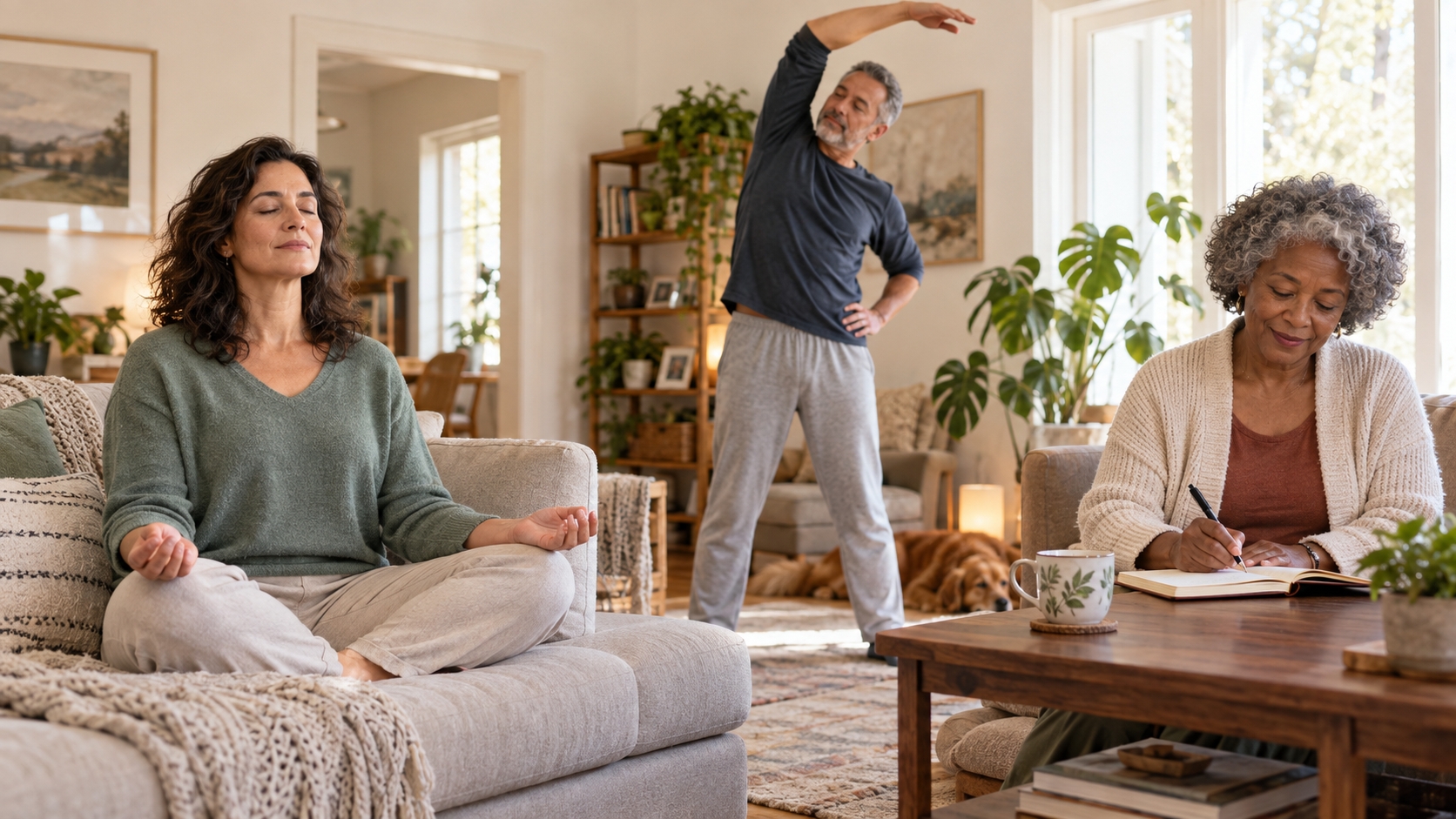
A stress relief routine at home can be simple: slow your breathing, move your body, reduce unnecessary demands, protect sleep, and stay connected with supportive people. You do not need special equipment or a long meditation session. Instead, choose a few calming habits that fit your day and repeat them regularly. If stress becomes severe, lasts for weeks, or starts interfering with sleep, appetite, work, or daily tasks, professional support may be appropriate.
Key Takeaways
- Slow breathing, relaxation, movement, and healthy routines can all play a role in stress management.
- Regular physical activity can reduce short-term feelings of anxiety and support sleep.
- Relaxation techniques can usually be practiced at home with little or no equipment.
- Good sleep, regular meals, hydration, realistic priorities, and social connection also support mental well-being.
- Breathing exercises may help with stress and anxiety, although research methods and results vary.
- Severe or persistent symptoms deserve professional attention rather than self-care alone.
Why a Home Stress Routine Can Help
Stress is a normal response to demands, uncertainty, conflict, and change. However, when stress stays high for long periods, it can affect sleep, mood, concentration, digestion, and other parts of daily life.
NIMH recommends several basic self-care habits for mental health, including regular exercise, healthy meals, hydration, sleep, relaxing activities, realistic priorities, gratitude, and social connection. These habits do not have to be complicated to be useful.
Therefore, a home routine can work best when it combines several small habits rather than relying on one technique alone.
Simple principle: the goal is not to remove every source of stress. Instead, build habits that help you respond more calmly and recover more effectively.
Step 1: Slow Your Breathing
Breathing exercises are among the simplest relaxation tools to practice at home. NCCIH describes slow, deep breathing as one technique used to help produce the body’s relaxation response.
A 2025 systematic review of 19 studies found that many breathing interventions were associated with improvements in anxiety or stress. Still, the authors noted that larger randomized trials are needed.
For a simple home practice, sit comfortably and breathe more slowly than usual. Let your abdomen expand gently as you inhale, then exhale without forcing the breath. If you become dizzy or uncomfortable, return to normal breathing.
Keep it comfortable: stress-relief breathing should feel gentle. There is no need to hold your breath for long periods or force unusually deep breaths.
Step 2: Add a Few Minutes of Movement
Movement can support stress management as well as physical health. CDC reports that a single session of moderate-to-vigorous physical activity can reduce short-term feelings of anxiety in adults.
You do not need a full workout. For example, walk around your home, walk outside, march in place, climb stairs when appropriate, or use simple body-weight movements.
In addition, regular activity can support sleep and long-term mental health. Therefore, movement can serve both as an immediate break and as part of a broader healthy routine.
- Walk indoors or outside for a few minutes.
- March in place while listening to music.
- Do gentle mobility movements for your shoulders, hips, or ankles.
- Use light strength movements when they are appropriate for you.
Step 3: Relax Your Muscles
Progressive muscle relaxation is another home-based technique described by NCCIH. It involves tightening and then releasing different muscle groups to help you notice the contrast between tension and relaxation.
For instance, you might gently tense your hands for a few seconds and then let them relax. Next, move to your shoulders, face, legs, or other areas.
However, avoid strongly tightening painful or injured areas. The exercise should feel calming rather than strenuous.
Step 4: Reduce Mental Clutter
Stress often feels worse when every task seems urgent. NIMH recommends setting goals and priorities, deciding what must be done now, and recognizing what can wait.
Instead of writing a long list, choose one or two priorities for the next part of the day. This can make a busy schedule feel more manageable.
- What needs attention today?
- What can wait?
- What can I simplify?
- Do I need help from someone else?
Helpful shift: stress relief sometimes comes from reducing demands, not adding another self-care task.
Step 5: Create a Calmer Environment
Your surroundings can influence how easy it feels to relax. A calmer space does not have to look perfect or expensive.
For example, lower unnecessary noise, put your phone away for a few minutes, sit near a window, or choose one uncluttered area for relaxation. Music, reading, time in nature, and low-stress hobbies are also among the activities NIMH suggests exploring.
At the same time, do not turn cleaning or organizing into another requirement. The aim is simply to reduce distractions enough to give your mind a short break.
Step 6: Stay Connected
Stress can become harder to manage when you feel isolated. NIMH recommends staying connected with friends or family members who can provide emotional support or practical help.
A short phone call, message, shared meal, or conversation can be enough. You do not have to wait until stress becomes overwhelming before reaching out.
Likewise, asking for practical help can reduce pressure when your workload becomes too heavy.
Step 7: Protect Sleep
Stress and sleep can affect each other. A stressful day may make sleep harder, while poor sleep can make the next day feel more difficult.
NIMH recommends making sleep a priority and keeping a schedule when possible. It also notes that reducing blue-light exposure from phones or computers before bedtime may help with falling asleep.
Therefore, an evening stress routine can be useful too. Dim the environment, reduce work-related tasks, and choose a calming activity before bed.
A Simple 10-Minute Stress Relief Routine at Home
| Time | Activity |
|---|---|
| Minutes 0–2 | Sit comfortably and slow your breathing |
| Minutes 2–5 | Walk, march in place, or use gentle movement |
| Minutes 5–8 | Use progressive relaxation or sit quietly |
| Minutes 8–10 | Choose one priority and one thing that can wait |
You can use this routine once or repeat parts of it later in the day. However, it does not need to follow an exact clock to be useful.
A Two-Minute Reset for Busy Days
- First 30 seconds: put down your phone and relax your shoulders.
- Next 60 seconds: breathe slowly and comfortably.
- Final 30 seconds: choose the next useful action rather than thinking about the entire day at once.
A short reset will not solve every source of stress. Still, it can create a useful pause before you return to work, caregiving, or other responsibilities.
Stress Relief Without Special Equipment
Many relaxation practices can be done without buying anything. NCCIH notes that most relaxation techniques can be self-taught and practiced independently after basic instruction.
- Slow breathing
- Progressive muscle relaxation
- Guided imagery from memory or written instructions
- Walking
- Stretching or gentle mobility
- Music
- Reading
- Talking with someone supportive
Paid apps, massage devices, wearables, and classes may be useful for some people. However, they are optional rather than essential parts of a stress routine.
Common Stress Relief Mistakes
Trying to Eliminate All Stress
Some stress is part of normal life. Therefore, a more realistic goal is to improve coping and recovery rather than expecting to feel calm all the time.
Making Relaxation Another Obligation
A complicated routine can create more pressure. Instead, use one or two techniques you actually like.
Ignoring Sleep
Breathing exercises cannot fully compensate for an ongoing lack of sleep. Protecting sleep should remain part of the broader plan.
Using Alcohol as the Main Coping Tool
NIMH recommends noticing how alcohol and caffeine affect mood and well-being. If either seems to worsen anxiety, sleep, or stress, reducing intake may help.
Delaying Professional Help
Relaxation techniques should not replace appropriate care. NCCIH specifically advises against using them to postpone seeing a healthcare professional about a medical problem.
When to Get Professional Help
NIMH advises seeking professional help when severe or distressing symptoms last for two weeks or more. These symptoms can include trouble sleeping, changes in appetite or weight, difficulty concentrating, loss of interest, trouble completing usual tasks, or persistent irritability and restlessness.
A primary care clinician or mental health professional can help evaluate what is happening and discuss treatment options. Self-care can support treatment, but it does not have to replace it.
Frequently Asked Questions
The Bottom Line
A stress relief routine at home can combine slow breathing, movement, relaxation, realistic priorities, supportive connection, and healthy sleep habits. You do not need to practice every technique at once. Instead, choose a few methods that feel manageable and repeat them consistently.
Self-care can help with everyday stress, but persistent or severe symptoms deserve more attention. If stress is affecting your ability to sleep, eat, concentrate, work, or manage ordinary tasks, consider speaking with a healthcare or mental health professional.
Medical disclaimer
Medical disclaimer: This content is for educational and informational purposes only and is not a substitute for professional medical advice, diagnosis, or treatment. Dietary needs and supplement suitability vary by individual.
Sources
- National Institute of Mental Health — Caring for Your Mental Health. Last reviewed April 2026.
- National Center for Complementary and Integrative Health — Stress. Accessed September 2026.
- National Center for Complementary and Integrative Health — Relaxation Techniques: What You Need To Know. Accessed September 2026.
- Centers for Disease Control and Prevention — Health Benefits of Physical Activity for Adults. March 10, 2026.
- Morgan SP, Lengacher CA, Seo Y. A Systematic Review of Breathing Exercise Interventions: An Integrative Complementary Approach for Anxiety and Stress in Adult Populations. Journal of Holistic Nursing. 2025;43(4):354–376.
