
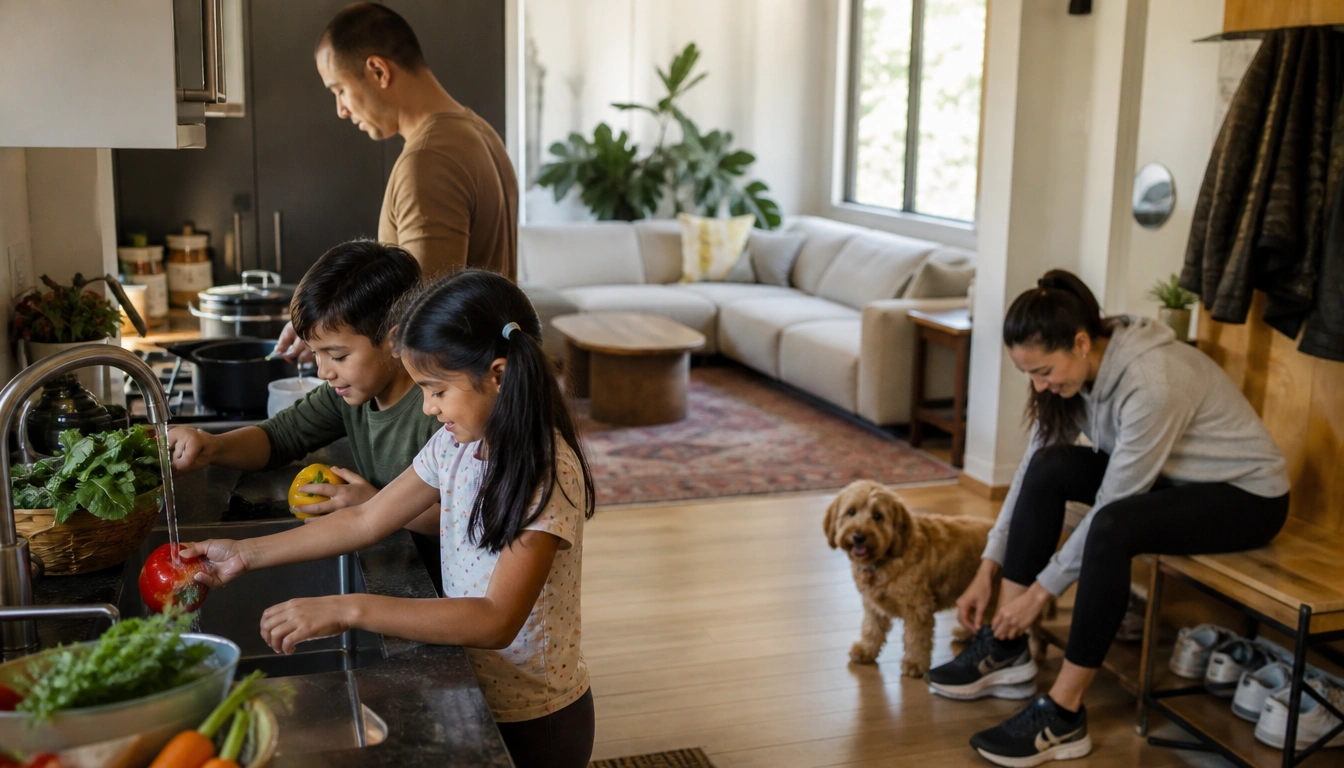
You can build healthier routines for your family by starting small, attaching new habits to things you already do, and focusing on consistency over perfection. For busy parents, the most sustainable changes usually involve easier meals, more everyday movement, better sleep routines, and realistic screen boundaries. The goal is not a rigid household makeover; it is a few repeatable habits that fit your family’s real life.
Key Takeaways
- Start with one or two repeatable habits, such as a walk after dinner or a screen-free bedtime routine, instead of overhauling everything at once.
- Habit stacking works because it ties a new action to an existing routine, which lowers stress and makes follow-through easier.
- Make the healthy choice easier by changing the home environment: keep simple foods visible, place water within reach, and reduce friction around movement.
- Focus on energy, mood, sleep, and strength rather than weight or dieting language to reduce food guilt and body pressure.
- Toddlers, school-age kids, and teens need different kinds of support, so family habits should flex with age and independence.
- If sleep, eating, mood, growth, or burnout are causing concern, get help early from a pediatrician or other qualified professional.
Family reality check: why sustainable health habits beat all-or-nothing overhauls
For busy parents, the best version of sustainable healthy habits for busy parents is usually the one you can repeat on an average Tuesday. Public health guidance from the CDC and pediatric experts consistently supports a simple idea: health improves through small patterns, not heroic one-time resets. That matters because family schedules change, children resist routines, and adults get tired.
All-or-nothing plans tend to fail for ordinary reasons. They require too much time, too much decision-making, and too much emotional energy. A more realistic approach is to choose a few habits that affect the whole household: one food shift, one movement habit, one sleep boundary, and one screen rule. Those changes are easier to keep going when work gets busy, a child is sick, or dinner happens later than planned.
It also helps to think in terms of household systems rather than individual willpower. If healthy food is hard to find, if everyone is overtired, or if screens are the easiest way to decompress, the problem is usually the routine—not the family’s motivation.
Public health models such as 5-2-1-0 are useful because they keep the focus on a few core behaviors: fruits and vegetables, screen boundaries, physical activity, and sugary drinks. Families do not need to hit every target perfectly for the framework to be helpful. It works best as a guide for what to nudge, not a scorecard.
The habit stack that matters most for busy families
A habit stack means linking a new action to something that already happens every day. That lowers the mental effort needed to remember it. For example, after you start the coffee maker, fill water bottles. After dinner, take a short walk. After brushing teeth, begin the bedtime screen wind-down. Small links like that are often more successful than vague promises to “do better.”
For family health, the most useful habit pillars are food, movement, sleep, and screen boundaries. Those areas overlap. Better sleep can improve appetite regulation and mood. Less evening screen time can make bedtime easier. More movement can help children settle and can reduce stress for adults. Even one stack can create momentum.
Try to keep the stack tiny at first. A five- to ten-minute version is enough to build the pattern. If it becomes automatic, you can expand it later. If it is too ambitious, the family will usually stop doing it after the first hard week.
Examples:
- After loading the dishwasher, place tomorrow’s breakfast items on the counter.
- After arriving home, everyone changes clothes and does a short movement break before screens.
- After dinner, one parent clears the table while the other walks with the kids for ten minutes.
- After tooth brushing, devices go to a charging spot outside bedrooms.
These are not grand health interventions. They are practical connectors that make healthy routines feel like part of normal family life.
Make the healthy choice the easy choice
Environment matters because busy people follow the path of least resistance. If the easiest snack is a processed food near the front of the pantry and the easiest drink is soda in the fridge, that is what will get used most often. The same is true for movement: if shoes are hard to find, no one goes out for a walk. Healthier routines become more realistic when the home setup does some of the work.
Start by changing what is visible and convenient. Put fruit where kids can see it. Keep water bottles filled. Put a bowl of washed vegetables near the front of the fridge if your family actually eats them raw. Set out walking shoes by the door. Charge devices in a shared area rather than in bedrooms. Small environmental changes can reduce arguments because the preferred choice requires less effort.
Think in terms of friction, not discipline. If a habit feels hard every single day, the setup may need adjustment. That could mean pre-cutting produce, using frozen vegetables, keeping simple breakfast foods on hand, or creating a “grab and go” basket for outdoor play. Families do not need a perfect kitchen to make progress.
Home rules should also be clear but not punitive. A family media plan works better when it is predictable: where devices can be used, when screens turn off, and what happens before bedtime. Consistency lowers conflict because the rule is about the household routine, not a punishment for individual behavior.
Family movement that does not require a gym
The CDC recommends regular physical activity for children and teens, but families do not need special equipment or a gym membership to move more. Everyday movement is often the most sustainable option. The goal is to make activity normal enough that it fits between school, work, errands, and meals.
Short bursts count. A walk after dinner, a dance break in the kitchen, a game of tag in the yard, stair climbing, active chores, and weekend bike rides all add up. For parents, movement can also be practical stress relief. The routine only needs to be realistic enough to repeat.
If safe outdoor space is limited, move indoors. Use living-room stretching, kid-friendly workout videos, hallway races, or games that involve balancing, marching, and jumping. For families with tight schedules, linking movement to another routine helps: move right after school pickup, after homework, or before the evening bath.
Children also learn that movement is a normal part of life when parents treat it that way. Saying “let’s go walk the dog” or “let’s carry groceries together” sends a stronger message than making exercise sound like a punishment or a weight-control chore.
Food strategies that work when time is tight
Busy families usually do better with repeatable meals than with complicated meal plans. The most sustainable food strategy is often to make familiar meals a little more nutrient-dense, not to redesign the menu completely. For example, you can add beans to soup, serve fruit with breakfast, or offer a vegetable side with a favorite dinner.
Kitchen involvement helps too. Children are often more willing to try foods they helped wash, stir, sort, or plate. Younger children can rinse produce, tear lettuce, or place toppings on a tray. Older kids can help with measuring, chopping with supervision, and assembling simple meals. The point is not gourmet cooking; it is familiarity and ownership.
Picky eating is common, especially in younger children. Repeated exposure can help because many children need to see a food many times before they accept it. That means small, pressure-free exposures matter more than insisting on a bite at every meal. Put the food on the plate, keep portions small, and let the child decide whether to explore it.
It also helps to avoid turning eating into a battle about “good” and “bad” foods. A calmer approach is usually more effective: offer a range of foods, include one familiar option, and keep the family tone neutral. That reduces food stress and supports a healthier relationship with eating.
Sleep protection for the whole family
Sleep is one of the most underused health habits because it is easy to sacrifice and hard to catch up on. Yet sleep affects mood, attention, hunger cues, and stress tolerance. The National Institutes of Health and pediatric guidance both point to sleep as a foundational behavior, not a luxury.
For busy households, a simple evening wind-down can protect sleep without creating a perfect bedtime. Start by choosing one consistent cue that says the day is shifting: dim lights, put devices on charge, lower the volume of activity, or switch to quieter routines. When this same pattern happens most nights, the body begins to recognize it.
Screen boundaries matter here. A family media plan that includes a screen curfew can reduce the “just one more video” spiral that pushes bedtime later. Many families do best when screens are out of bedrooms overnight and the last screen session ends well before lights-out. The goal is not to police every minute; it is to make the evening easier to settle.
Age matters. Younger children often need more structure and earlier wind-down cues, while teens may need support because homework, social life, and natural sleep timing make it harder to disconnect. The plan should fit the child’s development and the household’s actual schedule, not an ideal bedtime that no one can keep.
How to adjust for toddlers, school-age kids, and teens
One-size-fits-all rules rarely work because children have different needs at different ages. Toddlers often need repetition, structure, and many exposures to new foods. School-age children benefit from routines they can understand and help with. Teens need more autonomy, but they still benefit from family expectations around meals, movement, and sleep.
For toddlers, keep the routine simple and predictable. Offer new foods alongside familiar ones. Let them copy you. Keep activity playful. For school-age children, involve them in choosing between two healthy options, packing part of a meal, or helping plan a movement break. For teens, the better strategy is collaboration: discuss bedtime targets, device rules, and food options in a way that respects their growing independence.
Teens also face school stress, late homework, social pressure, and more control over what they eat outside the home. Rather than micromanaging, focus on household anchors: regular meals, sleep support, and open conversation about energy and mood. That supports autonomy without abandoning structure.
In mixed-age households, build one routine that can flex. A family walk may look different for a toddler, a grader, and a teen, but they can still participate together. The same is true for dinner: everyone can share the meal even if portions, textures, and side choices differ.
How to stay flexible with neurodivergent children and high-stress seasons
Children with sensory needs, ADHD, autism, anxiety, or other neurodevelopmental differences may react strongly to texture changes, noise, transitions, or rigid expectations. In those cases, pressure can backfire. A flexible approach is usually more successful than forcing a standard routine.
That might mean keeping preferred foods available while adding a tiny “learning food” beside them, using visual schedules, warning before transitions, or choosing quieter movement options. Some children do better with parallel routines instead of whole-family changes all at once. For example, one child may need headphones and a calm corner while the rest of the family does an active game.
High-stress seasons matter too. During illness, travel, caregiving strain, new jobs, or school transitions, the routine may need to shrink. That is not failure. In stressful periods, aim for maintenance, not expansion. Protect one or two anchors, such as breakfast, a short walk, or a bedtime wind-down, and let the rest be flexible.
If a child’s eating, sleep, or behavior pattern seems tightly linked to anxiety, sensory distress, or a sudden routine change, it is reasonable to ask a pediatrician for guidance. Individualized support can make habit changes safer and easier.
What to do when resources are limited
Healthy routines do not require a perfect budget, a large home, or access to a safe park. Families facing time, money, or space limits can still make meaningful changes by focusing on the smallest useful step. That may be more realistic than trying to match advice designed for ideal conditions.
Low-cost food ideas include frozen vegetables, beans, eggs, oats, peanut butter, brown rice, plain yogurt, canned fruit in juice, and store-brand staples. Simple meals can still be nutritious. If you have limited time, use convenience foods strategically: prewashed greens, rotisserie chicken, microwaveable grains, and frozen produce can help you avoid last-minute fast-food dependence.
For movement, use what you already have. Hallways, staircases, driveways, parking lots, living rooms, and school pick-up waits can all become opportunities to move. For screen boundaries, the best plan is the one you can actually enforce consistently. A charge station, a shared reminder, or a fixed off-time can work even in a busy household.
Equity-aware habits are not about doing less for the sake of it. They are about making practical changes that fit the family’s reality. That is often the difference between advice that sounds good and advice that lasts.
How parents can model habits without food guilt or burnout
Children learn from what parents do more than from what parents say. That includes how adults talk about food, movement, sleep, and their own bodies. Parents are powerful health models, but they do not need to be perfect. They need to be visible and believable.
Modeling works best when adults frame habits around energy, strength, mood, and rest instead of body size or dieting. Avoid comments that make foods “bad” or that treat exercise as punishment. Children can absorb those messages quickly, and weight-stigma-focused language may increase stress around eating. A steadier message is that food helps us learn, play, grow, and recover.
Parents should also model self-compassion. If a routine falls apart, restart it without apology or drama. That teaches children that healthy habits are recoverable. It also protects parents from burnout, which is often what makes family routines collapse in the first place.
Modeling can be simple: drink water, sit down for meals when possible, take a walk, close devices at night, and speak respectfully about your own body. Those small visible actions often matter more than lectures.
When sustainable habits need medical or professional support
Most family routines can be adjusted at home, but some situations call for professional input. Talk with a pediatrician, doctor, or another qualified health professional if you notice persistent sleep problems, major appetite changes, frequent fatigue, sudden shifts in growth or weight, repeated stomach issues, or signs of disordered eating. The same is true if anxiety, behavior changes, or school problems seem connected to food, sleep, or stress.
Get help sooner if you are considering a major diet change, a restrictive eating plan, or a more intense exercise routine for a child or for yourself and there is a medical condition involved. Some changes should be individualized. That is especially important when a child has sensory challenges, chronic illness, developmental differences, or a history of food-related stress.
Parental burnout also deserves attention. If daily life feels unmanageable, you are constantly irritable or overwhelmed, or you cannot maintain basic routines, support is appropriate. A family cannot build sustainable habits while running on empty forever.
The point of healthy routines is to make life steadier, not more punishing. When a habit plan starts to increase conflict, fear, or exhaustion, it is time to simplify and ask for help.
Frequently Asked Questions
What are the easiest healthy habits a busy parent can start with today?
Start with one small change that fits an existing routine: a short family walk after dinner, water at meals, a screen-free 20 to 30 minutes before bed, or a simple breakfast reset. The easiest habit is usually the one that needs the least planning and can be repeated most days.
How can parents use habit stacking to improve family nutrition, movement, and sleep?
Attach a new habit to something that already happens. After brushing teeth, start bedtime wind-down. After dinner, take a short walk. After unloading groceries, wash fruit. Habit stacking works because it reduces decision-making and makes the new behavior feel connected to daily life.
How do I encourage healthy habits in kids without creating food stress or weight stigma?
Keep the language neutral and focus on energy, strength, mood, and sleep rather than body size. Offer a variety of foods without pressure, avoid calling foods “good” or “bad,” and let children decide how much to eat from the healthy options you provide. That supports healthier habits without turning meals into a battle.
What if my child is picky, neurodivergent, or resistant to routine changes?
Use smaller steps and more flexibility. For picky eaters, keep offering new foods alongside familiar foods without pressure. For neurodivergent children, reduce sensory overload, use visual cues, and respect preferred textures or routines when possible. Resistance often means the change is too big or too fast, not that habit-building is impossible.
How can families with limited time, money, or safe outdoor space still build healthier routines?
Use low-cost foods like beans, oats, eggs, frozen vegetables, and store-brand staples, and choose indoor or neighborhood-friendly movement like dancing, stretching, or stair walks. For screen and sleep routines, focus on predictable rules and a shared charging spot. Small, consistent changes still count.
The Bottom Line
Busy parents do not need a perfect wellness plan. The most sustainable approach is to pick a few repeatable habits that fit real family life: one easier food pattern, one movement routine, one sleep boundary, and one screen rule.
If you want progress without extra stress, make the home setup do more of the work. Use habit stacking, keep healthy choices visible, and adjust for age, neurodiversity, budget, and busy seasons. Progress is more likely to last when it feels practical, not punishing.
If sleep, eating, mood, or burnout start to feel bigger than routine adjustments can handle, bring in a pediatrician or other qualified professional. Sustainable habits should support the family, not overwhelm it.
Medical disclaimer
Medical disclaimer: This content is for educational and informational purposes only and is not a substitute for professional medical advice, diagnosis, or treatment. Dietary needs and supplement suitability vary by individual.
Sources
- Centers for Disease Control and Prevention (CDC) — cdc.gov. Accessed November 2026.
- National Institutes of Health (NIH) — nih.gov. Accessed November 2026.
- National Institutes of Health (NIH) — nih.gov. Accessed November 2026.
- Centers for Disease Control and Prevention (CDC) — cdc.gov. Accessed November 2026.
- healthychildren.org — healthychildren.org. Accessed November 2026.
