
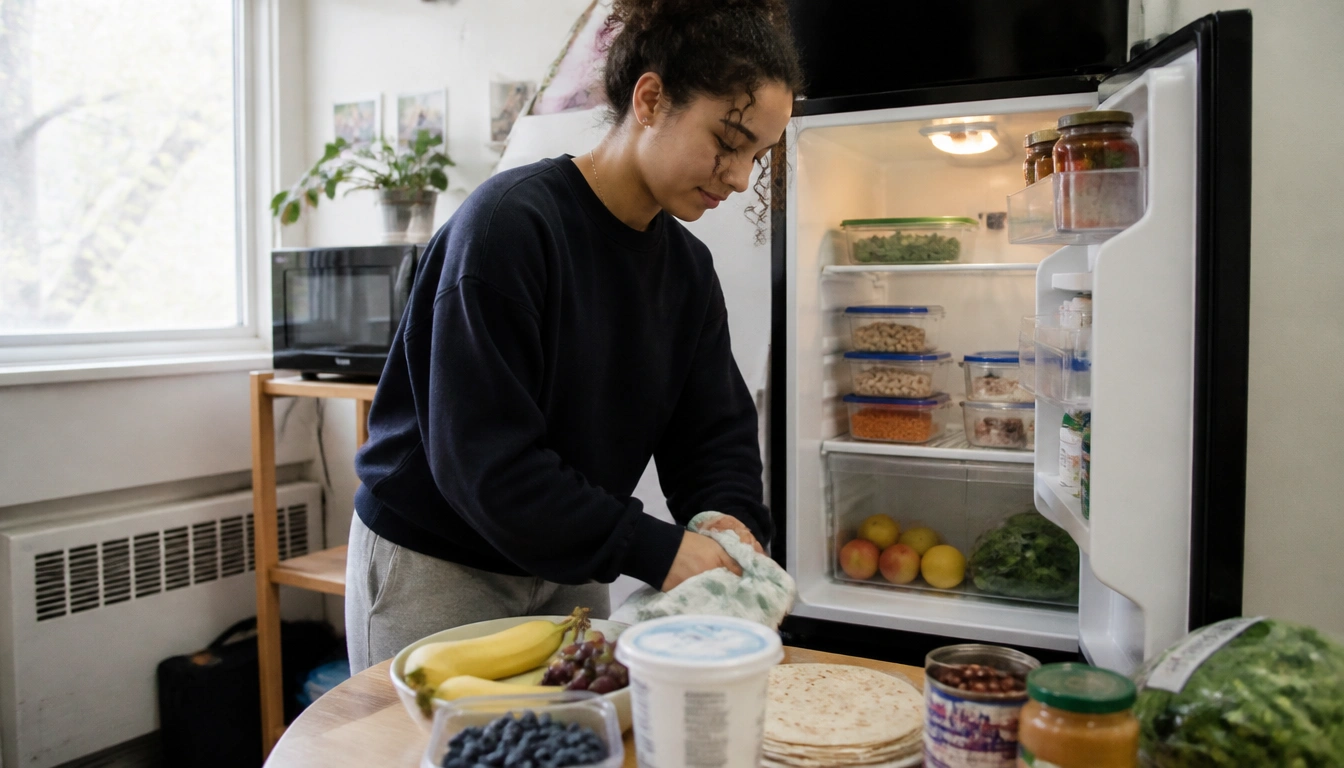
A weekly kitchen reset works best when it is short, repeatable, and realistic: clear out spoiled food, clean the main surfaces, check what you already have, and restock a few budget-friendly staples that can become fast meals. For most students, 20 minutes once a week is enough to make the kitchen easier to use, reduce impulsive takeout, and lower the risk of eating unsafe leftovers.
Key Takeaways
- A clean, visible kitchen makes healthier choices easier because you spend less energy deciding what to eat.
- Start with food safety: toss questionable leftovers, keep your fridge at or below 40°F, and follow the 2-hour rule.
- Dorm kitchens need a simpler reset than off-campus kitchens, especially if you only have a mini-fridge and microwave.
- Use modular staples instead of complicated recipes so you can build meals from a small, affordable grocery list.
- During exam weeks, an assembly-only backup plan is better than skipping the reset completely.
- If you are unsure whether food is safe, do not taste it to test it—throw it out.
Why a weekly kitchen reset helps college students
A weekly kitchen reset helps because your environment shapes your choices. If the fridge is crowded, the counters are sticky, and you cannot see what food you already own, cooking starts to feel harder than ordering takeout. A clear kitchen lowers friction. You are more likely to reach for the food that is easy to see, easy to grab, and already safe to eat.
That matters during college, when decision fatigue is real. After classes, work shifts, studying, and commuting, students often do not have the energy to plan a full meal from scratch. A reset reduces the number of decisions you have to make later in the week. Instead of asking, “What can I cook?” you can ask, “What can I assemble from the food I already stocked?”
It also helps with food waste. Many students buy groceries with good intentions, then forget them behind takeout containers or random snack items. A weekly check-in keeps those ingredients visible before they spoil. Over time, that can save money and make your meals more consistent without requiring a strict meal-prep routine.
There is another benefit too: a cleaner food environment makes it easier to shift away from a week of mostly ultra-processed convenience foods. When you can see fruit, yogurt, eggs, beans, or leftovers clearly, healthier choices become the easier default instead of the exception.
The 20-minute reset framework at a glance
The simplest version of a weekly kitchen reset is four steps: purge, clean, audit, and restock. You do not need a full deep clean. You need a repeatable routine that keeps your kitchen usable.
Purge: Remove spoiled food, mystery containers, and anything that is past the point of safety or clearly past its prime. Clean: Wipe shelves, counters, handles, and microwave surfaces. Audit: Look at what is left so you do not buy duplicates. Restock: Replace the basics that let you make quick meals during the week.
A good reset is not about making your kitchen look perfect. It is about making sure the next meal is easier than the last one. If you only have 20 minutes, spend the first half on safety and cleanup, then use the rest to set up the week ahead. The best routine is the one you can repeat even when you are tired.
For most students, the order matters. Start by removing old food before you clean, because it is easier to wipe surfaces once the clutter is gone. Then take a fast inventory. A reset works best when you know what is already usable, what needs to be used soon, and what should never make it into next week.
What to toss first
The fastest way to reset your kitchen is to clear the obvious problem items first. Throw out leftovers that are past the safe storage window, food with visible mold, and anything that smells off, looks separated in an unusual way, or has been sitting open for too long. If you cannot remember when you made it, that is usually a sign it should go.
Focus on these categories first:
- Leftovers that are older than the safe fridge window.
- Wilted produce that is slimy, moldy, or dried out beyond use.
- Open containers with unknown contents.
- Forgotten drinks, sauces, and dairy products that are well past their prime.
- Takeout containers that have become clutter instead of food.
Do not taste food to check whether it is safe. Foodborne illness can happen even when food does not smell unusual. If an item seems questionable and you cannot verify how long it has been there, it is safer to discard it.
After the obvious toss-out items are gone, deal with any containers that can be saved for later. If you have cooked rice, pasta, or roasted vegetables that are still within the safe window, move them to a visible shelf so they are used first. The goal is not just less clutter. The goal is to make the best remaining food easy to notice and easy to eat.
Food safety rules students actually need
Food safety is the non-negotiable part of a weekly reset. The Centers for Disease Control and Prevention and the U.S. Department of Agriculture emphasize a few basic rules that matter in student kitchens.
First, keep your refrigerator at or below 40°F. If your mini-fridge is packed tightly or not cooling well, food can spoil faster than you expect. A refrigerator thermometer is a useful low-cost tool if you are not sure your fridge is cold enough.
Second, use the 2-hour rule. Perishable food should not sit at room temperature for more than 2 hours. If the room is hotter than 90°F, the time drops to 1 hour. That matters for delivery food, leftovers left out while studying, and shared meals that sit on the counter during a long hangout.
Third, most refrigerated leftovers should be eaten within 3 to 4 days. If you know you will not finish them, freeze them sooner rather than hoping they will last. This is one of the easiest ways to reduce waste without guessing.
During the reset, keep raw foods separate from ready-to-eat foods, and clean surfaces that touched spills or unpacked groceries. If you are living with roommates, label leftovers with the date so no one has to guess. These habits are simple, but they prevent the most common student-kitchen mistakes.
Dorm vs. off-campus setup
Your reset should match the space you actually have. A dorm mini-fridge and microwave require a very different strategy from a shared apartment kitchen with a full refrigerator, stove, and freezer.
For a dorm setup: Focus on visibility, small portions, and foods that can be eaten with minimal equipment. Keep the fridge organized so the most perishable items are at eye level. Use stackable containers, small bins, or one shelf for “use this first” items. Your restock list should lean on foods that work cold or with just a microwave, such as yogurt, fruit, hummus, microwaveable grains, canned beans, tortillas, eggs if allowed, and single-serve proteins.
For an off-campus kitchen: You can add batch cooking and freezer support. Make a little extra rice, pasta, or protein when you cook, then freeze portions you will not use in the next few days. You can also keep more produce on hand because you have more storage room and more ways to use it.
In both setups, the same principle applies: make the healthiest option the easiest option. A dorm student may need a ready-to-eat snack box. An apartment student may need a clear shelf for leftovers and lunch ingredients. The reset is not one-size-fits-all; it is supposed to fit your actual living situation.
Budget-friendly restock list built around modular staples
Instead of shopping for complicated recipes, build your week around modular staples. That means buying ingredients that can combine in several ways with very little effort. A strong restock list usually includes five groups: proteins, carbs, produce, fats, and flavor.
Proteins: eggs, canned tuna or salmon, canned beans, lentils, tofu, Greek yogurt, or rotisserie chicken if your budget allows. Carbs: oats, microwaveable brown rice, whole-wheat tortillas, whole-grain bread, or pasta. Produce: apples, oranges, baby carrots, peppers, cucumbers, bananas, or bagged greens that can be eaten quickly. Fats: peanut butter, nuts, olive oil, or avocado when it is affordable. Flavor: salsa, soy sauce, mustard, hot sauce, garlic powder, black pepper, cumin, or simple seasoning blends.
These foods work because they are flexible. Beans plus rice plus salsa becomes a quick bowl. Tortillas plus eggs plus spinach become breakfast or dinner. Yogurt, fruit, and oats can become a no-cook breakfast. You do not need a long recipe list if you have a few ingredients that play multiple roles.
The easiest version of restocking is to buy one item from each group and repeat what worked last week. If you keep a running list on your phone, you can spot patterns quickly: maybe you always run out of fruit first, or maybe you keep buying spices but never enough protein. That awareness saves money and makes future resets faster.
Exam-week version of the reset
During exams, the goal changes. You are not trying to build a perfect meal plan. You are trying to stay fed with the least possible effort. A no-cook or assembly-only reset keeps the habit alive when energy is low.
For this version, keep the reset to the essentials: throw out anything unsafe, wipe the high-touch surfaces, and restock foods that can be eaten almost immediately. Think of combinations like canned beans with microwavable rice and salsa, yogurt with fruit, peanut butter on toast, hummus with carrots and tortillas, or a microwaveable grain bowl with bagged greens and a ready protein.
If you only have a microwave and mini-fridge, make your food choices even simpler. Buy fewer ingredients, but choose ones that do more than one job. Pre-washed greens, canned beans, microwavable grains, fruit, yogurt, nut butter, and tortillas can cover breakfast, lunch, dinner, and snacks without a lot of cleanup.
The exam-week version should protect your time, not add to your stress. If you can do one small thing that keeps you from relying entirely on takeout, that is enough. A reset does not have to be elaborate to be useful.
How to make the habit stick
The easiest way to keep a weekly kitchen reset going is to attach it to something you already do. Pick one day and make it routine, such as Sunday evening, after your grocery trip, or before your weekly class schedule gets busy. Pairing the reset with another habit makes it easier to remember.
Keep the tools you need visible and in one place. If cleaning supplies are buried under clutter, the reset becomes harder than it needs to be. Store wipes, sponges, trash bags, and reusable containers where you can reach them quickly. Visibility matters for food too. Put the items you need to use soon in front, not behind new groceries.
Students often make the same mistakes: buying too much, cleaning only when things look bad, ignoring leftovers until they are unsafe, or trying to meal prep like they have unlimited time. A better approach is smaller and steadier. Reset the kitchen, buy only what you can use, and keep the system simple enough to repeat next week.
If you live with roommates, agree on a shared expectation for labeling food and clearing old items. A reset works better when everyone understands the rules. You do not need a perfect shared system, but you do need enough structure to keep the fridge usable for everyone.
Frequently Asked Questions
What should I throw out during a weekly kitchen reset?
Start with leftovers older than 3 to 4 days, anything left out too long, spoiled produce, moldy food, and opened items you cannot confidently date. If food seems questionable and you cannot verify it is safe, discard it rather than testing it by smell or taste.
How do I clean a dorm mini-fridge safely?
Unplug it if you can, remove food, and wipe shelves and handles with warm soapy water or a food-safe cleaner. Dry the surfaces before plugging it back in. Clean up spills right away, because mini-fridges can get crowded and messy quickly.
What are the best cheap staples to restock for a college week?
Good low-cost staples include oats, rice, tortillas, beans, lentils, eggs, yogurt, frozen or bagged produce, peanut butter, and a few simple sauces or seasonings. The best staples are versatile enough to become several meals without much cooking.
How can I do this if I only have a microwave and mini-fridge?
Keep the reset simple: toss unsafe food, wipe the fridge and microwave, and restock foods that work cold or after short heating. Canned beans, microwavable grains, tortillas, yogurt, fruit, hummus, and pre-washed greens are especially useful.
How do I know leftovers are still safe to eat?
Use time and storage conditions first. Refrigerated leftovers are usually best within 3 to 4 days, and food should not sit out more than 2 hours, or 1 hour if it is very warm. If you are unsure, do not risk it.
The Bottom Line
A weekly kitchen reset gives college students a simple way to eat better without turning life into a full meal-prep project. Clear out unsafe food, clean the spaces you use most, and restock a few flexible staples that make quick meals easier than takeout.
The routine works best when it is small, repeatable, and matched to your living situation. A dorm setup needs different food choices than an off-campus kitchen, and exam weeks may call for assembly-only meals instead of cooking from scratch.
If you can keep your fridge cold, your leftovers dated, and your staples visible, you will waste less food and spend less time deciding what to eat next.
Medical disclaimer
Medical disclaimer: This content is for educational and informational purposes only and is not a substitute for professional medical advice, diagnosis, or treatment. Dietary needs and supplement suitability vary by individual.
Sources
- Centers for Disease Control and Prevention (CDC) — cdc.gov. Accessed October 2026.
- U.S. Government / Health Authority — usda.gov. Accessed October 2026.
- U.S. Government / Health Authority — ed.gov. Accessed October 2026.
- Academic Research Institution — harvard.edu. Accessed October 2026.
