
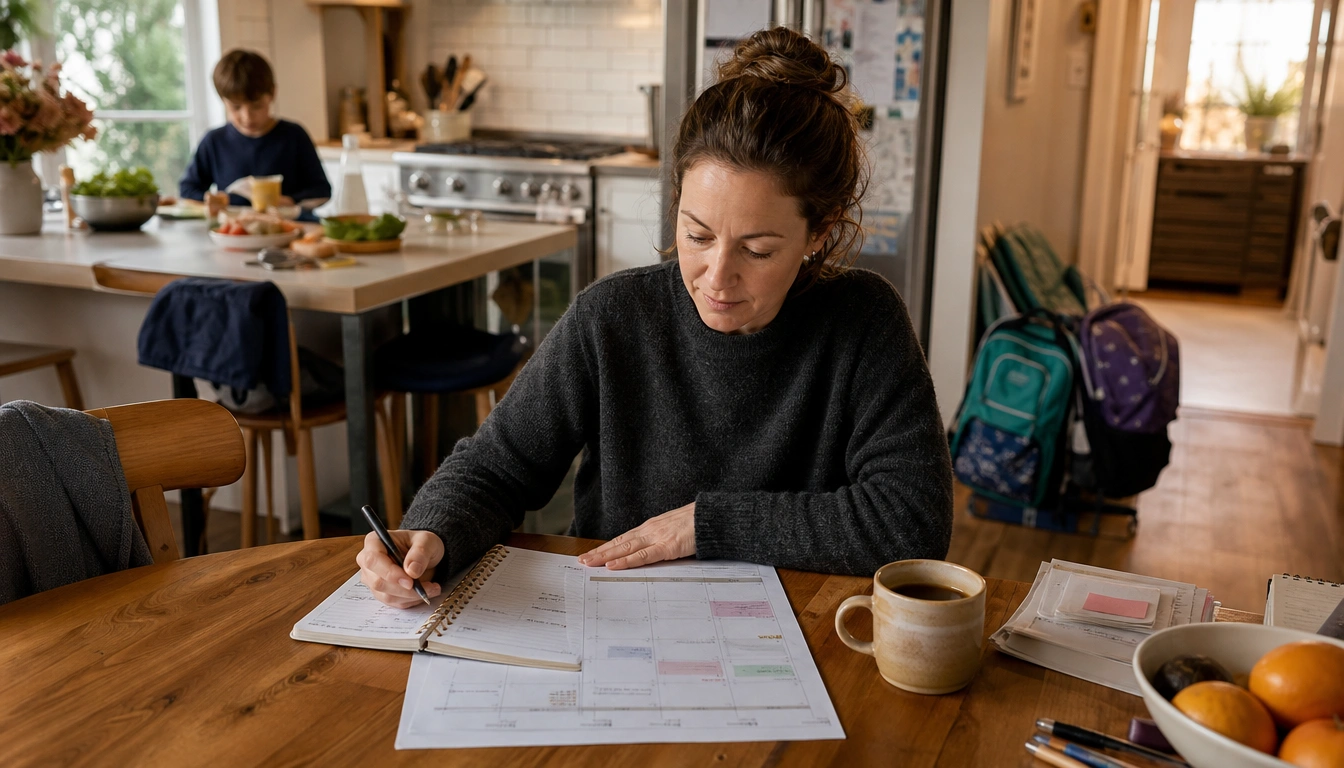
A realistic weekly wellness plan for busy parents is short, flexible, and built around your family’s real schedule. Start with a 15–20 minute weekly check-in, choose a few anchor habits for meals, movement, and sleep, and build in buffer space for sick days and schedule changes. The goal is not perfection; it is a plan that reduces decision fatigue and helps the whole household run more smoothly.
Key Takeaways
- Plan one brief weekly check-in, ideally on Sunday, to spot pressure points before the week starts.
- Choose a few anchor habits instead of trying to optimize everything at once: meals, sleep, movement, and one recovery habit.
- Use 5-minute self-care resets that calm your nervous system and fit between school drop-off, work, and bedtime.
- Build buffer time and flex-days so one sick child or late work meeting does not collapse the entire week.
- Adapt the plan to your parenting stage: toddler households need containment and micro-breaks, while teen households need coaching and logistics.
- Ask for specific help directly from partners, relatives, or friends instead of hoping your needs will be noticed.
Why weekly wellness planning matters for parents
Busy parents are often running a household on default mode, which means each day is shaped by whatever is most urgent. That usually leaves little room for sleep, movement, food planning, or quiet recovery. A weekly wellness plan helps interrupt that pattern by turning the most important decisions into a simple structure before the week gets crowded.
This matters because chronic stress does not stay private. Public health guidance from the CDC and other organizations recognizes that stress affects mood, sleep, energy, and daily functioning, and that family routines influence one another. When parents are constantly depleted, children often feel it through more screen time, less predictable meals, and a more reactive home environment.
Planning also reduces decision fatigue. Instead of asking yourself every evening what to cook, when to exercise, or how to squeeze in rest, you have already made a few decisions in advance. That preserves mental energy for the unexpected parts of parenting, which are unavoidable.
The core weekly wellness framework
A good weekly wellness plan usually comes down to three parts: one short planning session, a few anchor habits, and built-in buffer space. That is enough to make the week feel steadier without adding another complicated system to maintain.
The planning session can be brief. Fifteen to twenty minutes is enough to review school events, work deadlines, appointments, meals, and any high-friction windows. A high-friction window is simply a stretch of time that tends to unravel the day, such as a late sports practice overlapping with dinner or a morning when both parents need to leave early. Identifying those windows in advance gives you time to solve problems before they become emergencies.
Anchor habits are the small routines that keep the week from drifting. Examples include a planned breakfast, a consistent wind-down time, a short walk, or a repeatable bedtime routine. These should be basic enough that they can survive a busy week. Buffer space is equally important. A plan that fills every evening to the edge will collapse the first time a child gets sick, a meeting runs long, or traffic changes the schedule.
The most sustainable weekly plans leave room for flex-days. A flex-day is a day when the usual routine can be simplified without guilt. That may mean relying on leftovers, skipping a workout, or doing an earlier bedtime instead of trying to keep every habit intact. Flexibility is not failure; it is part of the design.
What to plan each week
Most parents do better when the plan covers a few practical categories instead of every possible wellness goal. Meals, movement, sleep, school or sports logistics, and recovery time are usually the most useful places to start.
Meals: Choose a structure that reduces last-minute scrambling. Batch cooking a few staples, planning theme-night dinners, or lining up easy backup meals can prevent the week from becoming a series of takeout decisions. Public health nutrition advice consistently emphasizes vegetables, whole grains, and lean proteins, but the real win for busy parents is repeatability.
Movement: Put movement on the calendar as if it matters, because it does. The CDC recommends regular physical activity for adults, and for parents that may mean a brisk walk, a short home workout, or active play with the kids. The form matters less than consistency and realism.
Sleep: Decide what the wind-down window will look like for adults and children. A predictable screen cutoff and a repeatable bedtime routine can support sleep quality. Sleep planning should also include the parts that protect bedtime, such as finishing laundry earlier, preparing school items the night before, or saying no to one extra evening commitment.
Logistics and recovery: Add school forms, sports rides, appointments, and one short recovery block for yourself if possible. Recovery time does not have to be long to be useful. A ten-minute pause between work and pickup, a quiet cup of tea, or a few minutes outside can make the rest of the evening feel more manageable.
How to make it realistic
The most useful wellness plans for parents are built around the minimum effective dose. That means choosing the smallest version of a habit that still helps. If you cannot manage a full workout, do a walk around the block. If cooking feels overwhelming, build dinner from a few prepped components. If meditation feels impossible, take five slow breaths in the car before walking into pickup.
This is where the idea of self-care as nervous-system regulation becomes practical. Many parents assume self-care requires a long break, but a five-minute reset can still matter if it lowers stress enough to help you respond with more patience. That can be as simple as drinking water, stepping outside, stretching, or sitting quietly before the next child task starts.
Habit stacking also helps. Attach a tiny wellness habit to something you already do. Stretch while the coffee brews. Check your calendar while lunch packs are being made. Take a brief breathing break while a child is getting dressed. These pairings reduce the need for extra motivation because the habit rides on an existing routine.
Theme-night dinners are another low-friction strategy. Repeating a familiar pattern for one or two nights each week reduces decision fatigue, shortens grocery lists, and makes it easier for older children to know what to expect. The goal is not culinary variety every night. The goal is to make dinner less mentally expensive.
How to adapt the plan by family season
Different parenting stages create different kinds of strain, so the same plan will not work equally well for every household. A toddler household needs containment, short transitions, and micro-breaks. That might mean keeping snacks, water, and simple meals within reach; protecting nap or quiet times; and using five-minute resets instead of expecting long uninterrupted self-care.
School-age households often need more coordination. Homework, practices, and social events can fragment the evening, so the plan may focus on after-school routines, a shared family calendar, and a clear bedtime sequence. The wellness win here is often fewer surprises, not more ambition.
Teen households tend to bring emotional coaching and transportation logistics into the center of the week. Teens may need later bedtimes, more discussion, and more driving, which can squeeze a parent’s time and energy. In this season, planning may mean protecting your own sleep window, setting ride boundaries, and reserving a few predictable times for conversation rather than trying to be available on demand.
Solo parents and single caregivers usually need the plan to be simpler, not more detailed. That often means leaning on community support, saying yes to specific offers of help, and reducing anything that is optional. A sustainable plan for a solo caregiver should assume interruptions and include backup meals, backup rides if possible, and at least one small recovery habit that does not depend on anyone else being available.
How to communicate the plan with a partner or support network
Plans work better when other people can see them. That means saying what you need clearly instead of assuming your partner, relatives, or friends will infer it. Busy parents often carry invisible labor, and unspoken expectations tend to become resentment.
Use specific requests. Instead of saying you are overwhelmed, say, “I need Tuesday evening free from bedtime so I can exercise,” or “Can you handle the school pickup on Thursday while I finish work?” Specific coverage is easier to agree to than vague support. The same approach works with grandparents, neighbors, and trusted friends.
It also helps to divide responsibilities by task, not by mood. If one person always ends up managing food, bedtime, or forms, the load becomes lopsided fast. A simple shared calendar or a quick Sunday meeting can clarify who is responsible for what. This is especially useful when work schedules change from week to week.
For families with changing childcare needs, explicit communication can prevent a lot of stress. If you know a hard day is coming, say so early. If you need a ride, ask in advance. If you have to protect one block of time for rest, name it. Clear requests are not burdensome; they make cooperation possible.
What to do when the week falls apart
Even the best weekly wellness plan will break sometimes. A child gets sick, a deadline moves, sleep is disrupted, or a routine disappears for a few days. The answer is not to rebuild the entire system mid-crisis. The answer is to reset to the smallest workable version.
A good reset rule is to protect the essentials first: food, sleep, medication or medical care if needed, school or work obligations that truly cannot move, and one moment of personal decompression. Everything else can be simplified. If the original plan had a workout, a full dinner, and a long evening routine, the reset version might be leftovers, a short walk, and an earlier bedtime.
Flex-days make this easier because they give you permission to adapt instead of start over. If one day goes sideways, you do not need to treat the whole week as a loss. You can still recover the next day with a smaller plan. That may mean postponing a chore, using a convenience meal, or cutting one nonessential commitment.
Guilt is often the thing that makes a rough week feel worse. A calmer response is to ask, “What is the smallest version of this plan that still supports our family today?” That question keeps you out of all-or-nothing thinking and helps the plan survive real life.
Signs the stress is beyond routine strain
Some stress is part of parenting, but persistent burnout deserves attention. Warning signs can include ongoing sleep problems, constant irritability, dread that does not lift, emotional numbness, frequent anxiety, or feeling unable to function in daily life. If stress is affecting your safety, your relationships, or your ability to care for yourself and your family, it is time to seek help.
The CDC and NIH both emphasize that mental and physical health affect each other. If you notice symptoms of depression, anxiety, or exhaustion that do not improve with rest and basic support, a licensed mental health professional or physician can help you sort out what is happening and what treatment or support may be needed. This is especially important if you are having panic symptoms, hopelessness, or thoughts of harming yourself.
Routine stress management is useful, but it is not a substitute for care when the problem is bigger than overload. Reaching out early can prevent a temporary strain from becoming a longer-term health issue.
Frequently Asked Questions
What should a busy parent include in a weekly wellness plan?
Keep it simple: meals, sleep, movement, recovery time, and logistics. A weekly wellness plan works best when it covers the pressure points that usually cause stress, such as rushed dinners, late nights, and schedule conflicts. You do not need every category to be perfect; you need a few reliable anchors.
How do I plan meals, movement, and sleep without adding more stress?
Use repeatable routines instead of elaborate goals. Pick a few theme-night meals, schedule movement in short blocks, and protect a realistic wind-down routine. If a habit creates more planning work than it saves, make it smaller or simpler.
What are the best quick self-care habits for parents with no free time?
Choose resets that take five minutes or less and calm your body: slow breathing, water, a short walk, stretching, fresh air, or sitting quietly before the next task. Short resets can still improve regulation when they are done consistently.
How do I make a wellness plan that still works when the week goes off track?
Build in flex-days and decide in advance what can be dropped first. When the week gets messy, keep the essentials and simplify everything else. A good plan survives interruptions because it assumes they will happen.
How should wellness planning differ for toddlers, teens, or single parents?
Toddlers usually call for containment, snacks, and micro-breaks. Teen households often need more emotional coaching and transportation planning. Single parents usually need an even simpler plan with backup meals, community help, and fewer optional commitments. The plan should fit the season you are in, not the ideal schedule you wish you had.
The Bottom Line
A weekly wellness plan for busy parents works best when it is short, practical, and forgiving. One weekly check-in, a few anchor habits, and built-in buffer space can reduce decision fatigue without turning family life into a performance.
The most sustainable plans focus on what helps the whole household function: predictable meals, realistic sleep routines, brief movement, and quick nervous-system resets. Clear communication with partners or support systems matters just as much as the plan itself.
If stress starts to look like burnout, persistent anxiety, depression, or trouble functioning day to day, treat that as a health issue, not a motivation issue. A simple routine can support you, but it should not replace professional care when you need it.
Medical disclaimer
Medical disclaimer: This content is for educational and informational purposes only and is not a substitute for professional medical advice, diagnosis, or treatment. Dietary needs and supplement suitability vary by individual.
