
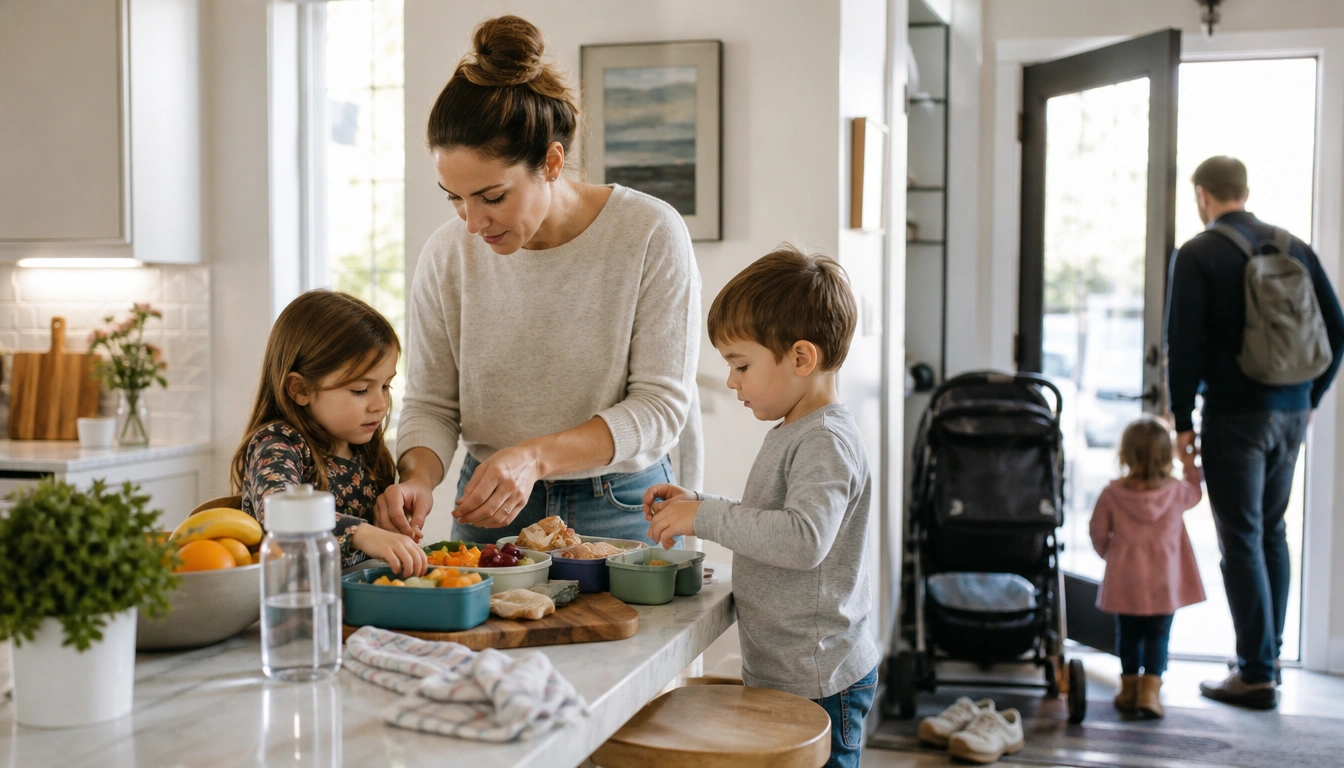
The easiest healthy habits for busy parents are the ones that fit into routines you already do: a short walk after drop-off, water within reach, a simple plate formula at meals, a brief wind-down before bed, and 2-minute reset breaks between tasks. You do not need a perfect plan to make progress. Small daily actions, repeated most days, are enough to support family health over time.
Key Takeaways
- Attach healthy actions to routines you already have, like school runs, meal prep, or bedtime, so they are easier to repeat.
- Aim for family-friendly movement in short chunks; adults can accumulate activity across the day, and children can build movement into play.
- Use simple meal formulas and low-prep foods such as frozen vegetables, pre-washed greens, beans, and quick grains to reduce weekday friction.
- Protect sleep with a consistent wind-down and screen cutoff, because poor sleep can raise cravings and drain energy.
- Missed workouts or convenience meals do not erase your progress; weekly consistency matters more than any single day.
- If you have postpartum needs, chronic conditions, persistent fatigue, pain, or mood symptoms, personalize the plan with a healthcare professional.
A family-first way to think about healthy habits
For busy parents, the most realistic approach to health is not “do more,” but “attach a little health to what already happens.” That is the idea behind habit stacking: pairing a small healthy action with a routine you already repeat, such as brushing teeth, waiting for the kettle to boil, packing lunches, or buckling a child into a car seat. This reduces decision fatigue because you are not trying to find a brand-new time slot every day.
The U.S. Centers for Disease Control and Prevention recommends adults get at least 150 minutes of moderate-intensity physical activity each week, plus muscle-strengthening activity on 2 days. Children and teens need more movement than adults, with daily activity built into play, sport, walking, and active transport. Those goals can sound large, but they become much more workable when you stop treating health as one extra task and start folding it into family life.
A whole-family approach also helps because children learn what they see. If movement, water, sleep boundaries, and simple meals are normal in the household, they are more likely to feel normal rather than like chores or punishments. That makes consistency easier for everyone.
Movement that fits real life
You do not need a gym session to count as active. School drop-off walks, parking farther away, taking stairs when possible, or pacing while on a phone call all add up. If your day is fragmented, think in blocks rather than all-or-nothing workouts. A 10-minute brisk walk before work, a 10-minute movement break after lunch, and a few minutes of stretching in the evening can be more realistic than waiting for one large window that never appears.
For families, “sneaked activity” works well because it does not compete with childcare. Younger children can join a living-room dance break, a hallway obstacle course, or a short walk around the block. Older children can bike beside an adult, help carry groceries, or do a quick backyard game. According to the CDC, children and adolescents should accumulate 60 minutes of moderate-to-vigorous movement daily, but that does not have to happen in one long session. Active play, chores that require effort, and family walks all contribute.
Adults can use the same idea. A brisk walk after dinner, a few sets of bodyweight squats while waiting for pasta to cook, or stretching during screen breaks may sound small, but the point is repetition. If you can do something most days, you are building a habit that survives busy weeks.
Make meals easier, not perfect
Meal stress is often less about nutrition knowledge and more about energy. The easiest weekday meals are usually built from repeatable parts: a protein, a plant food, and a filling carbohydrate. That might look like eggs and toast with fruit, beans with rice and frozen vegetables, yogurt with oats and berries, or chicken, whole-grain pasta, and a side salad. You are not trying to cook from scratch every night; you are trying to make the healthy choice the low-friction choice.
Frozen vegetables, pre-washed greens, canned beans, rotisserie chicken, microwavable grains, and bagged salad kits are practical tools, not shortcuts to feel guilty about. They can help you serve a balanced meal with less chopping and less cleanup. If evenings are chaotic, prep only one or two anchors ahead of time, such as washing fruit, cooking a batch of rice, or portioning snacks for the week.
Hydration can be simplified too. Making water the default household drink reduces the need to negotiate at every meal. Keeping refillable bottles visible and easy to reach is often more effective than trying to remember to “drink more” in a vague way. For many families, the healthiest plan is the one that lowers daily friction rather than raising expectations.
Use the kitchen as a teaching tool
Children often become more open to foods when they help prepare them. The task should match the child’s age and skill, and it should be about participation rather than performance. Younger children can rinse produce, tear lettuce, stir ingredients, or place items in a bowl. Preschoolers can help mash soft foods, set napkins on the table, or sort fruit. School-age children can measure ingredients, assemble wraps, or build simple snack plates. Older children can follow a short recipe with supervision and learn basic kitchen safety.
This does more than teach skills. It gives children ownership, which can reduce resistance at mealtimes. It also turns healthy eating into a normal family routine instead of a lecture. You do not need elaborate cooking projects for this to matter. Even a few minutes of helping with dinner can make a child more willing to taste what was prepared.
For busy parents, the practical aim is to let children contribute without creating more work for the adult. Choose low-mess jobs, use a stable stool or step, and keep expectations modest. If the kitchen activity slows dinner by a few minutes but reduces dinner-time battles, that is often a worthwhile trade.
Protect sleep and recovery
Sleep is one of the highest-yield habits for busy parents because it affects everything else. The sleep-activity loop runs both ways: when sleep is short or fragmented, energy drops, cravings often rise, and the motivation to move usually falls. That can make convenience foods more appealing and activity harder to start. Better sleep does not solve every problem, but it can make the rest of your plan easier to follow.
A simple family wind-down routine works better than a complicated one. Pick a consistent sequence that signals bedtime: dim lights, put devices away, wash up, choose clothes for the next day, and spend a few quiet minutes reading or talking. The NHS advises limiting screens before bed because late-night screen time can interfere with sleep quality. If a full screen cutoff feels unrealistic, start with a small boundary, such as keeping phones out of the bedroom or stopping screens during the last part of the evening routine.
For children, the same logic applies. A calmer evening often means fewer power struggles, and it may also make mornings easier. Protecting sleep is not indulgent; it is a basic recovery habit that supports mood, attention, and appetite regulation for the whole family.
Mental health micro-resets that fit between tasks
Busy parents often move straight from one demand to the next with no reset time. That constant switching can keep stress levels high even when nothing dramatic is happening. Short breathing breaks can interrupt that spiral. Two or three minutes of slow diaphragmatic breathing, a few shoulder rolls, or sitting quietly before starting the next task can lower the sense of being permanently on edge.
These resets work best when they are tied to transitions. Try them after school drop-off, before opening work email, after a difficult call, or while waiting for dinner to heat. The goal is not to achieve perfect calm. It is to give your body a small signal that the previous task is over and the next one can begin without carrying as much tension.
Parents sometimes skip self-care because it feels selfish or too small to matter. But a brief pause is often what keeps the rest of the day from spilling into one long stress response. Small recovery habits are easier to keep than big ones, and they are often the ones that last.
How to stay consistent without burnout
Consistency is easier when your weekly plan is flexible. Instead of trying to “win” every day, choose a minimum effective dose for the week. For example, you might aim for a few short walks, one or two strength sessions at home, vegetables at most meals, and a bedtime routine on most nights. If a day goes sideways, the plan should become smaller, not disappear.
That mindset matters because family life is unpredictable. Children get sick, work runs late, and some evenings are simply survival mode. On those days, it is enough to keep the basics going: eat something reasonably balanced, drink water, move a little if possible, and protect sleep where you can. A convenience meal or a missed workout does not cancel the value of everything you did earlier in the week.
One helpful strategy is to decide in advance what “good enough” looks like. That might mean a 10-minute walk instead of a full workout, a frozen vegetable side instead of fresh chopping, or an earlier bedtime after a rough day. The point is not lowering your standards. It is building a plan that survives real life.
When your situation needs a more personal plan
Some parents need extra caution before changing habits. If you are postpartum, breastfeeding, managing diabetes, high blood pressure, heart disease, joint pain, or another chronic condition, your nutrition and activity needs may be different from general advice. A new exercise plan, major diet change, or aggressive weight-loss approach may not be appropriate without individualized guidance.
It is also wise to ask for medical advice if fatigue does not improve with rest, pain keeps returning with movement, or mood symptoms start affecting daily functioning. The same is true if a child seems unusually tired, irritable, or unable to keep up with normal activity. In those cases, the goal is not to push harder. It is to make sure something medical, nutritional, or mental health-related is not being missed.
Healthy habits should support family life, not add pressure or create risk. If a change feels confusing, too restrictive, or hard to maintain, that is a sign to simplify and personalize rather than force it.
Frequently Asked Questions
How can busy parents stay healthy without long workouts or complicated meal prep?
Use short movement blocks, simple meal formulas, and habits tied to routines you already do. A walk after drop-off, a few minutes of bodyweight movement, frozen vegetables, canned beans, and repeatable dinners are often more sustainable than complex plans.
What are the best micro-habits for improving sleep, stress, and energy during a hectic week?
The most useful micro-habits are a consistent wind-down, a screen boundary before bed, water within reach, and 2- to 3-minute breathing pauses between tasks. These small routines help reduce stress buildup and make sleep and recovery more predictable.
How can parents model healthy behaviors for children in a way that fits normal family routines?
Children learn most from what they see every day. If they watch adults walk after dinner, drink water, prepare simple meals, and protect bedtime, those habits feel normal. You do not need special lessons for modeling to work.
What are simple family food and hydration habits that work on weekdays?
Keep meals flexible and repeatable: protein, plant food, and a filling carbohydrate. Use convenient foods like frozen vegetables, pre-washed greens, yogurt, beans, and microwavable grains. Make water the default drink and keep bottles visible and easy to refill.
What should parents do when they miss a workout or have an off day?
Treat it as a normal part of a busy week, not a failure. Do the next smallest helpful thing: take a short walk, eat a decent meal, drink water, or go to bed on time. Consistency over weeks matters more than one missed day.
The Bottom Line
Busy parents usually do best with small habits that fit into existing routines, not with plans that demand extra time and perfect follow-through. Habit stacking, simple meals, short movement breaks, and a consistent bedtime routine can make healthy behavior feel more manageable.
If you only change one thing, choose the habit that removes the most friction from your day. For many families, that is a walk built into an errand, a repeatable dinner formula, water on hand, or a screen cutoff before bed.
If you have postpartum needs, chronic conditions, persistent fatigue, pain, or mood symptoms, get individualized advice so the plan matches your situation. A good health routine should help your life run more smoothly, not make it harder.
Medical disclaimer
Medical disclaimer: This content is for educational and informational purposes only and is not a substitute for professional medical advice, diagnosis, or treatment. Dietary needs and supplement suitability vary by individual.
Sources
- Centers for Disease Control and Prevention (CDC) — cdc.gov. Accessed October 2026.
- National Health Service (NHS) — newcastle-hospitals.nhs.uk. Accessed October 2026.
