
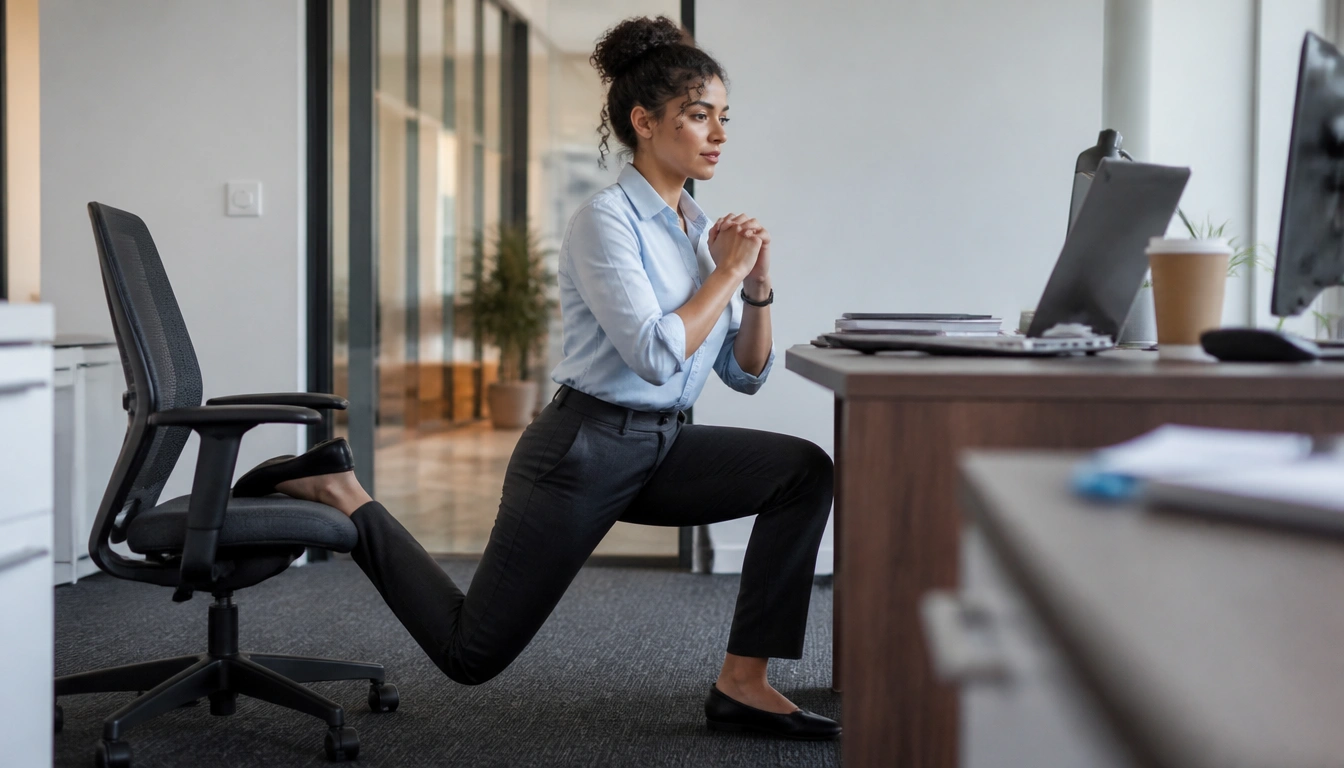
The best no-equipment leg workout for office workers is a short circuit built around sit-to-stands, reverse lunges, glute bridges, and calf raises. Those moves train the major leg muscles that tend to go quiet during long sitting. Do them near your desk in small sets, repeat them a few times per week, and scale the difficulty with tempo, range, balance, or single-leg versions instead of weights.
Key Takeaways
- Long sitting keeps the hip flexors shortened and the glutes, hamstrings, and calves underused, so a leg routine should target those areas on purpose.
- A practical office circuit uses sit-to-stands, reverse lunges, glute bridges, and calf raises because they are simple, quiet, and effective without equipment.
- You can make bodyweight leg work harder by slowing the lowering phase, deepening the range, pausing at the hard part, or switching to single-leg variations.
- Micro-breaks matter: a few reps tied to water breaks, calendar reminders, or Pomodoro-style timers can make the routine realistic during a workday.
- Normal effort feels like muscle fatigue or a burn; sharp pain, locking, swelling, or radiating pain are signs to stop and get checked.
Why office sitting makes your legs and hips feel stale
Long periods of sitting ask very little from the lower body. Over time, the hip flexors stay shortened, the glutes and hamstrings do less work, and the calves get fewer strong contractions than they would during walking, standing, or stair climbing. That is one reason office workers often feel stiff hips, sleepy glutes, or heavy legs by the end of the day.
The problem is not only strength. Prolonged sitting also reduces how often the large muscles of the legs squeeze and relax, which can slow local circulation. A short lower-body routine helps break up that pattern. It gives the glutes, quads, hamstrings, and calves a reason to contract again, which supports movement quality and makes standing up feel less sluggish.
For office workers, the goal is not a heroic workout. The goal is to interrupt sitting with purposeful movement that is easy to repeat. That is why a no-equipment routine works well: it is accessible, discreet, and simple enough to use consistently.
The best no-equipment leg exercises for office workers
The most useful desk-friendly leg exercises are the ones that train several major muscles at once and do not require much space. A strong starter set is sit-to-stands, reverse lunges, glute bridges, and calf raises. Together, they cover the quads, glutes, hamstrings, and lower legs.
Sit-to-stands are especially practical because they mimic a common daily task: standing up from a chair. They teach the legs to drive the body upward with control.
Reverse lunges add unilateral work, which means one leg does more of the job at a time. That can reveal side-to-side differences and build balance without needing equipment.
Glute bridges are a good counterbalance to sitting because they emphasize the glutes and hamstrings while unloading the knees and spine.
Calf raises look simple, but they are useful for lower-leg strength and repeated ankle motion, both of which matter when you spend hours at a desk.
If space is very limited, you can still do sit-to-stands and calf raises at your desk area, then save glute bridges for a private room, home, or floor space. The best routine is the one you can repeat without friction.
How to perform each move correctly: sit-to-stands, reverse lunges, glute bridges, and calf raises
Sit-to-stands: Stand in front of a stable chair with your feet about shoulder-width apart. Hinge slightly at the hips, bend your knees, and lower until you lightly touch the seat or stop just above it. Press through your heels and stand tall. Keep your chest open and avoid collapsing inward at the knees. If needed, rest a hand on the desk for light support.
Reverse lunges: Stand upright, then step one foot backward and lower your hips straight down. Aim for a comfortable depth rather than forcing a deep bend. Push through the front foot to return to standing, then switch sides. Reverse lunges are often easier on the knees than forward lunges because the backward step gives you more control. If balance is shaky, hold the desk lightly.
Glute bridges: Lie on your back with knees bent and feet flat. Brace lightly through the core, press through your heels, and lift the hips until your body forms a long line from shoulders to knees. Pause briefly at the top, then lower under control. Keep the movement smooth instead of arching the lower back to get higher.
Calf raises: Stand tall with feet hip-width apart. Rise onto the balls of your feet, pause at the top, then lower slowly until the heels settle back down. Use a wall or chair for balance if needed. For a more discreet version, do them slowly while you wait for a file to load or before a meeting starts.
A good form cue for all four moves is to move with control. If the body swings, bounces, or twists to create momentum, reduce the range and slow down.
A simple office-ready workout format: sets, reps, rest, and where to do it
A realistic routine for busy office workers is short enough to fit between tasks but long enough to challenge the muscles. One practical format is to choose three or four of the moves above and do one to three sets of each.
For beginners or deconditioned workers, start with a small dose: a few controlled reps per set, with enough rest to recover your breath and form. As the movement feels more natural, build toward more repetitions or another set. You do not need to finish sweaty to make the routine worthwhile.
Where to do it depends on privacy and space. Sit-to-stands and calf raises can be done beside your desk, near a break area, or in an empty conference room. Reverse lunges need a bit more clearance, so a hallway, open corner, or home setup may work better. Glute bridges usually require floor space, so they are a useful at-home or after-work option if the office setting is too public.
Many people do well with a short circuit two or more days per week, which aligns with public health guidance from the CDC and the NHS to include muscle-strengthening work for major muscle groups at least twice weekly. If you are using the routine as a movement break during the day, you can also split it into smaller bouts rather than doing everything at once.
How to progress the routine without equipment: tempo, range, balance, and unilateral variations
Once the routine feels easy, progress it without adding dumbbells. The first lever is tempo. Slowing the lowering phase of a sit-to-stand or lunge makes the muscles work longer and gives the exercise more challenge without changing the movement itself.
The second lever is range. You can lower a little deeper in a sit-to-stand, pause briefly near the bottom of a lunge, or rise higher at the top of a calf raise. Small changes in depth can make a familiar movement feel new again.
The third lever is stability. Try fewer hand supports, a narrower stance, or a longer pause when you are balancing on one leg. Less external help means the legs and hips have to do more control work.
The fourth lever is unilateral loading, even without weights. Single-leg sit-to-stands to a higher chair, split-stance squats, single-leg glute bridge holds, or one-leg calf raises increase demand on one side at a time. You do not need to jump straight to the hardest version. Move up gradually so your joints and tendons adapt.
A useful rule is to change just one variable at a time. If you make the tempo slower, keep the range and balance the same at first. That makes the progression easier to track and safer to repeat.
How to fit the routine into a busy workday: micro-breaks, reminders, and consistency tips
Most office workers do better when exercise is attached to an existing habit. Micro-break triggers are the easiest place to start. For example, do a few calf raises every time you wait for the kettle, or a short set of sit-to-stands when you return from the printer. The point is not perfection. The point is to make movement automatic.
Pomodoro-style reminders can also help. If you already use a timer for focused work blocks, add a standing or movement reminder when the timer ends. Even a brief reset can break up sitting time and make it easier to stay consistent across the day.
Consistency usually improves when the routine feels private, quick, and predictable. Keep one version for the office and a slightly fuller version for home, so you are not deciding from scratch every day. If a meeting runs long, do the next set later instead of skipping the whole day.
The best routine is the one that survives a busy calendar. Short movement breaks are more realistic than waiting for an ideal workout window that never appears.
Safety, pain signals, and when to modify or stop
Some muscle effort is normal. You may feel a burn in the thighs or glutes, or a sense that the muscles are working hard. That is different from stop-sign symptoms. Sharp pain, joint locking, swelling, a sudden twinge in the back, or pain that radiates down the leg should not be pushed through.
If squats or lunges bother your knees, shorten the range, use a chair for support, or switch to sit-to-stands and glute bridges for a while. A supported version is not a failure; it is a useful modification. People with poor balance can also keep one hand on the desk or wall during standing moves.
If you have a history of knee osteoarthritis, ongoing lower-back problems, pregnancy-related balance changes, or a medical condition that affects exercise tolerance, it is smart to check with a healthcare professional before starting or progressing a new routine. The same goes for persistent swelling, mechanical clicking or locking, or leg pain that feels more like nerve symptoms than muscle fatigue. Exercise should challenge the body, not create new symptoms.
Common mistakes that make bodyweight leg workouts less effective
One common mistake is moving too fast. Speed can make a bodyweight workout feel harder, but it often shifts the work away from the target muscles and into momentum. Slower, controlled reps usually do more for strength and control.
Another mistake is turning every exercise into a partial effort. Half-standing, shallow lunges with no control, or calf raises that barely leave the floor reduce the training effect. At the same time, there is no need to force a deep range that feels uncomfortable. Use a range you can control with good form.
A third mistake is ignoring the rest of the week. A single enthusiastic session does not offset long hours of sitting. Public health guidance from the CDC and NHS supports regular muscle-strengthening work, so the routine should repeat across the week rather than appear once in a while.
Finally, some people treat every sensation as a problem. Mild muscular challenge is expected; joint pain is not. Learn the difference, adjust early, and keep the routine simple enough that you will actually use it.
Frequently Asked Questions
How often should office workers do leg-strengthening exercises each week?
A good target is at least two days per week, in line with public health guidance from the CDC and the NHS for muscle-strengthening activity. Many office workers also benefit from brief movement breaks on more days, especially if they sit for long stretches.
Can I do a leg workout at my desk without equipment or a gym?
Yes. Sit-to-stands, calf raises, and some supported balance work can be done right beside a desk. Reverse lunges and glute bridges may need a little more space or privacy, but the routine can still be done without equipment.
What leg exercises are best for people who sit all day?
The most useful moves are sit-to-stands, reverse lunges, glute bridges, and calf raises. They target the glutes, quads, hamstrings, and calves, which are the main lower-body muscles that tend to get underused during long sitting.
How do I make bodyweight leg exercises harder without weights?
Use slower reps, longer pauses, deeper but controlled range of motion, less hand support, or single-leg versions. You can also make the exercise harder by changing stability, such as narrowing your stance or removing a chair assist.
What should I do if squats or lunges hurt my knees?
Do not push through knee pain. Shorten the range, slow the motion down, hold onto a desk or wall, or switch to supported sit-to-stands and glute bridges. If the pain is sharp, swollen, locking, or persistent, get medical advice.
The Bottom Line
A practical no-equipment leg workout for office workers does not need to be long or complicated. Sit-to-stands, reverse lunges, glute bridges, and calf raises cover the main muscles that sitting tends to leave underused, and they can be done in short sessions near a desk or at home.
Progress by changing the tempo, range, stability, or unilateral challenge instead of reaching for weights right away. Build the routine into the workday with reminders and micro-breaks, and keep an eye on pain signals so normal muscle effort does not turn into a joint problem.
Medical disclaimer
Medical disclaimer: This content is for educational and informational purposes only and is not a substitute for professional medical advice, diagnosis, or treatment. Dietary needs and supplement suitability vary by individual.
Sources
- Centers for Disease Control and Prevention (CDC) — cdc.gov. Accessed October 2026.
- National Health Service (NHS) — www.nhs.uk. Accessed October 2026.
- National Health Service (NHS) — www.nhs.uk. Accessed October 2026.
