
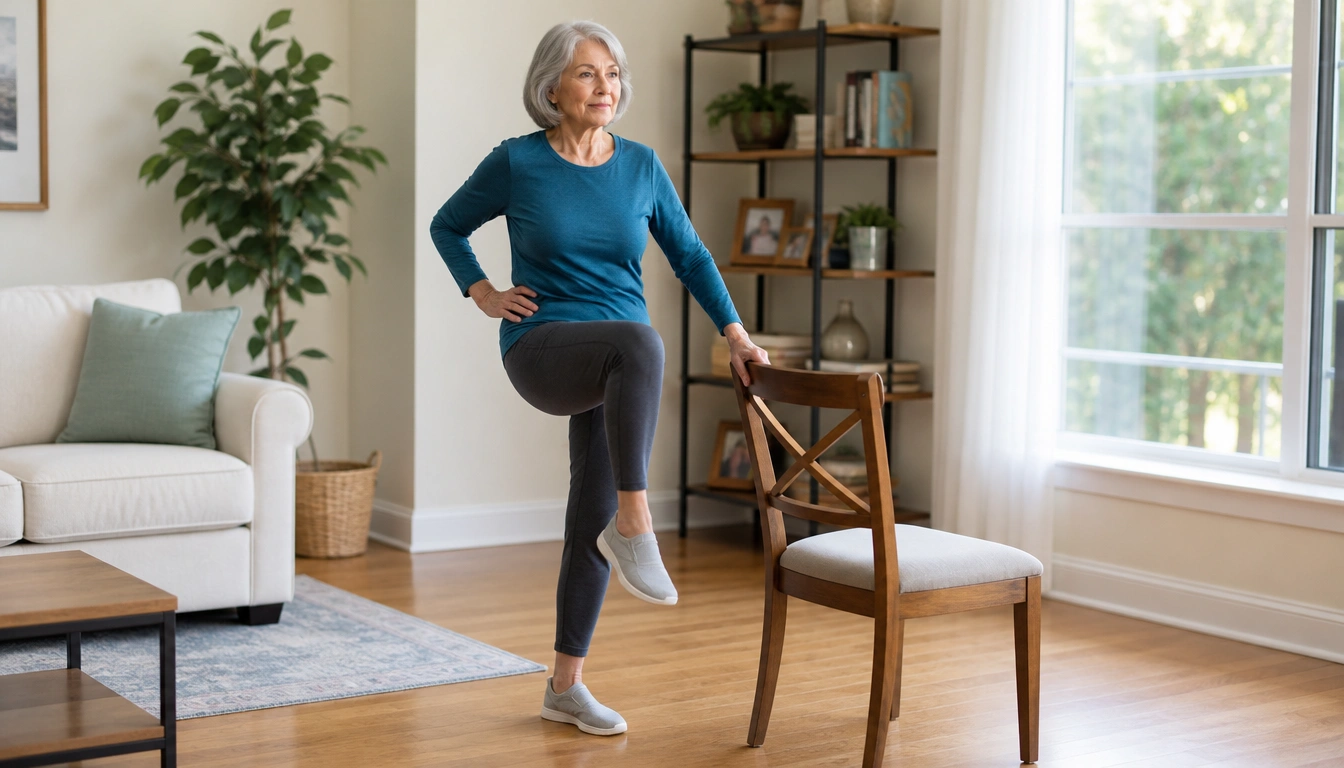
Yes—many adults over 50 can do safe, effective core exercises standing up at home. A standing core routine can strengthen the muscles that support posture and balance while reducing the need for floor work that may bother the knees, wrists, or lower back. Start with light support from a wall or sturdy chair, move slowly, and build gradually.
Key Takeaways
- Standing core exercises train the trunk in an upright position, which better matches daily tasks like walking, reaching, and carrying groceries.
- You do not need equipment for a useful routine; a wall, counter, or sturdy chair can provide the support many adults over 50 need.
- The core is not just your abs. It includes deep stabilizers, the obliques, back muscles, diaphragm, and pelvic floor working together.
- A good beginner routine should feel controlled, not rushed, and should leave room to progress over time rather than chase fatigue.
- If you have back pain, osteoporosis, balance problems, or high blood pressure, adjust the moves and avoid breath-holding or aggressive twisting.
Why standing core work fits better than floor exercises for some adults over 50
A standing core routine for adults over 50 can be easier to start than floor-based work when getting down to the ground feels awkward, painful, or simply less appealing. Many people prefer it because it avoids repeated kneeling, wrist loading, and getting up and down from the floor. That can make the routine more realistic, which matters because the best routine is the one you can do consistently.
Standing work also keeps the body in a weight-bearing position. That is useful for older adults because it asks the trunk to stabilize while you are upright, which is closer to how you move through the day. According to the Centers for Disease Control and Prevention and the American College of Sports Medicine, older adults benefit from muscle-strengthening work that includes the abdomen, back, hips, and legs, along with balance practice. Standing core drills naturally combine those goals.
There is another practical reason to choose standing work: it can reduce the mental barrier that sometimes comes with floor exercise. If you feel unsure about getting down, staying down, or getting back up, a standing routine can remove that hurdle and make regular exercise feel safer and more manageable.
What the core does in upright movement and balance
The core is more than the visible abdominal muscles. It works like an integrated support system around the trunk: deep abdominal muscles help brace the spine, the obliques help control rotation and side-bending, the back muscles help maintain posture, and the diaphragm and pelvic floor contribute to pressure control and trunk stability. In everyday movement, these parts work together instead of in isolation.
That matters because most real-life tasks are upright. You use core control when you stand up from a chair, walk across a room, reach overhead, turn to look behind you, carry groceries, or catch yourself after a small stumble. A standing routine trains the trunk to resist unwanted movement while the arms and legs are moving, which is a more functional way to build stability.
Standing core work may also support fall prevention indirectly by improving balance, proprioception, and coordination. Proprioception is your body’s sense of where it is in space. When you practice controlled weight shifts, single-leg support, and gentle trunk control while standing, you are asking your nervous system to coordinate posture and movement together. That combination is one reason standing core exercises can be a useful part of a broader balance-focused routine for older adults.
When to choose standing core exercises instead of crunches, planks, or floor work
Choose standing core exercises when floor work feels limited by joint discomfort, reduced mobility, fear of falling, or low confidence getting up and down. Standing moves are often a better first step if your wrists hurt during planks, your knees object to kneeling, or your back feels worse in repeated floor flexion. They can also be a good option on days when you want a shorter, simpler routine that still feels purposeful.
Standing work is not automatically easier; it is just different. Because you are upright, balance becomes part of the exercise. That can be helpful if your goal is not only stronger abs but also steadier movement in daily life. If your balance is very limited, start with support from a wall or heavy, stable chair so the standing position itself feels secure before you add challenge.
Floor exercises still have value for many people, but they are not required to train the core well. If you can hold your posture, brace gently, and move with control while standing, you are training useful skills in a joint-friendly way. For many adults over 50, that is the more practical option.
Warm-up and setup for a safe home routine
Set up in a clear space with no loose rugs, cords, clutter, or pets underfoot. Stand near a wall, counter, or sturdy chair so you can lightly hold on if needed. The support is there for safety and confidence, not because you are “doing it wrong.” If you feel unsteady, begin with one hand hovering near support, then progress to fingertips, then to no hand contact as confidence improves.
A simple warm-up should prepare the shoulders, spine, hips, and breathing. Try gentle shoulder rolls, easy side-to-side weight shifts, and a few comfortable torso turns. Keep the motions small and smooth. The goal is to wake up the body, not stretch aggressively or fatigue yourself before the main routine.
Breathing matters as much as the movement itself. Exhale during the effort phase of each exercise and avoid holding your breath. If you tend to brace hard or squeeze your stomach tightly, soften that effort. Think of gentle support, not maximum tension. For many older adults, that cue makes the routine more sustainable and more comfortable.
The standing core routine
Do the movements slowly and with control. If a move feels too easy, add a small pause, a little more range, or one extra set before you jump to a harder version. If your form starts to wobble, that is a signal to reduce the challenge.
Standing march with core brace
Stand tall with feet hip-width apart and one hand near a wall or sturdy chair if needed. Gently draw the lower abdomen inward without holding your breath. Lift one knee a few inches, pause, then lower it with control. Alternate sides. This move trains upright trunk stability and single-leg balance at the same time. Aim for 8 to 10 slow repetitions on each leg.
Diagonal reach or standing wood-chop
Stand with feet slightly wider than hip-width. Reach both hands up and slightly to one side, then bring them diagonally down across the body toward the opposite hip. Keep the motion smooth and avoid forcing a twist. This helps train the obliques and the ability to control rotation. Do 8 to 10 repetitions on one side, then switch.
Standing side crunch
Place one hand on your hip or behind your head for light support. Shift your weight onto one leg and bring the opposite knee and elbow gently toward each other from the side. The range can be small. You are looking for controlled side-bending and trunk engagement, not a big crunch. Perform 6 to 8 repetitions per side.
Wall push-away plank variation
Face a wall and place your hands at shoulder height. Step your feet back so your body leans forward at an angle, then keep a straight line from head to heels as you bend and straighten the elbows. This challenges the front of the trunk while staying upright and joint-friendly. Aim for 8 to 12 controlled repetitions.
Finish with a short cool-down: slow breathing, a gentle side stretch, and relaxed standing posture. If you feel dizzy, stop and sit down safely before continuing.
How to scale the routine up or down
To make the routine easier, use more support, shorten the range of motion, and slow the pace. You can keep both feet planted for the side crunch instead of lifting a knee, or do the standing march with toes staying close to the floor. For the wall push-away, stand closer to the wall to reduce load. These changes preserve the movement pattern while lowering balance demands.
To make it harder, reduce hand support, hold the top position for a second or two, add one extra set, or move a little farther from the wall. You can also increase the challenge by moving more slowly, because slower movement often requires better control. Another progression is to practice weight shifts without touching support, as long as your balance is steady.
Use your current fitness level, not your age alone, to judge where to start. Some adults over 50 have trained for years; others are just getting back into movement. Both groups can use standing core work, but the starting point should match the body you have today. The best progression is steady, not dramatic.
Safety notes for back pain, osteoporosis, balance concerns, and high blood pressure
If you have a sensitive back, keep the spine neutral and avoid big, fast twisting motions. Small, controlled movements are usually a better place to begin. If a move causes sharp pain, a catching sensation, or symptoms that spread down the leg, stop and get medical guidance. For some people, a physical therapist can help determine whether a particular standing drill is appropriate.
If you have osteoporosis or are concerned about spinal fragility, be cautious with loaded twisting or forceful bending. A conservative approach is often best: emphasize bracing, marching, and wall-based work before adding larger rotational movements. Ask a clinician if you are unsure which motions fit your bone health and medical history.
If your balance is limited, keep the support surface within easy reach and stand on a level, non-slippery floor. Do not practice near stairs or while distracted. If you have high blood pressure, avoid breath-holding and do not strain as if you are trying to “push through” the move. Exhale on effort and keep the intensity moderate.
Stop exercising and seek medical guidance if you develop chest pain, faintness, severe shortness of breath, sudden weakness, or a new major loss of balance. Those are not normal training sensations and should not be ignored.
How often to do the routine and how to progress over time
A good starting point is two to three sessions per week on non-consecutive days. That fits well with public health guidance for older adults who need muscle-strengthening work at least twice weekly. You do not need long sessions to make the routine worthwhile. Consistent, controlled practice matters more than duration.
Start with one set of each move and see how your body responds over the next day or two. If you feel fine, build to two sets before adding difficulty. Progress only one variable at a time: more repetitions, less support, a longer pause, or a slightly larger range. That approach helps you notice what your body tolerates and reduces the chance of overdoing it.
Look for practical signs of progress: better control during the standing march, less wobble during diagonal reaches, smoother breathing, or more confidence while standing on one leg near support. Those are meaningful gains because they reflect strength and coordination you can use in daily life. If a session leaves you unusually sore, unstable, or fatigued, scale back next time.
For many adults over 50, the best plan is not a hard workout once in a while. It is a repeatable standing routine that supports balance, posture, and everyday movement week after week.
Frequently Asked Questions
How often should adults over 50 do standing core exercises?
A practical starting point is two to three times per week on non-consecutive days. That gives your muscles time to recover and fits with guidance that older adults do muscle-strengthening work at least twice weekly. If you are new to exercise, start with one set and build gradually.
What muscles does a standing core routine work?
It works more than the “six-pack” muscles. Standing core exercise uses the deep abdominal muscles, obliques, back muscles, diaphragm, and pelvic floor together. Many moves also bring in the hips, shoulders, and legs because standing stability depends on the whole trunk-to-limb system.
How do I modify standing core moves if I have bad knees, a sensitive back, or balance concerns?
Use more support, shorten the range of motion, and slow the pace. Keep twisting small if your back is sensitive, avoid deep knee lifts if your knees complain, and stand near a wall or sturdy chair if balance is a concern. Comfort and control come before challenge.
Can standing core exercises help with balance and fall prevention?
They can help as part of a broader balance routine. Standing core work trains trunk control, weight shifting, and coordination in an upright position, which supports stability during daily activities. It is not a guarantee against falls, but it can strengthen important skills that help you stay steadier.
What safety signs mean I should stop exercising or get medical guidance?
Stop if you feel chest pain, dizziness, faintness, sharp pain, sudden weakness, unusual shortness of breath, or a major loss of balance. Get medical guidance if symptoms persist, if a movement repeatedly worsens back pain, or if you have a recent injury, surgery, or a condition that affects balance.
The Bottom Line
A standing core routine can be a smart option for adults over 50 who want a joint-friendly way to build trunk strength, posture control, and balance without going to the floor. The most useful moves are simple, slow, and easy to repeat consistently.
Start with support from a wall or sturdy chair, breathe steadily, and progress in small steps. If you have back pain, osteoporosis, balance issues, or high blood pressure, tailor the routine to your needs and ask a healthcare professional or physical therapist for individualized advice when needed.
Medical disclaimer
Medical disclaimer: This content is for educational and informational purposes only and is not a substitute for professional medical advice, diagnosis, or treatment. Dietary needs and supplement suitability vary by individual.
Sources
- Centers for Disease Control and Prevention (CDC) — cdc.gov. Accessed October 2026.
- American College of Sports Medicine (ACSM) — acsm.org. Accessed October 2026.
- Academic Research Institution — washington.edu. Accessed October 2026.
