
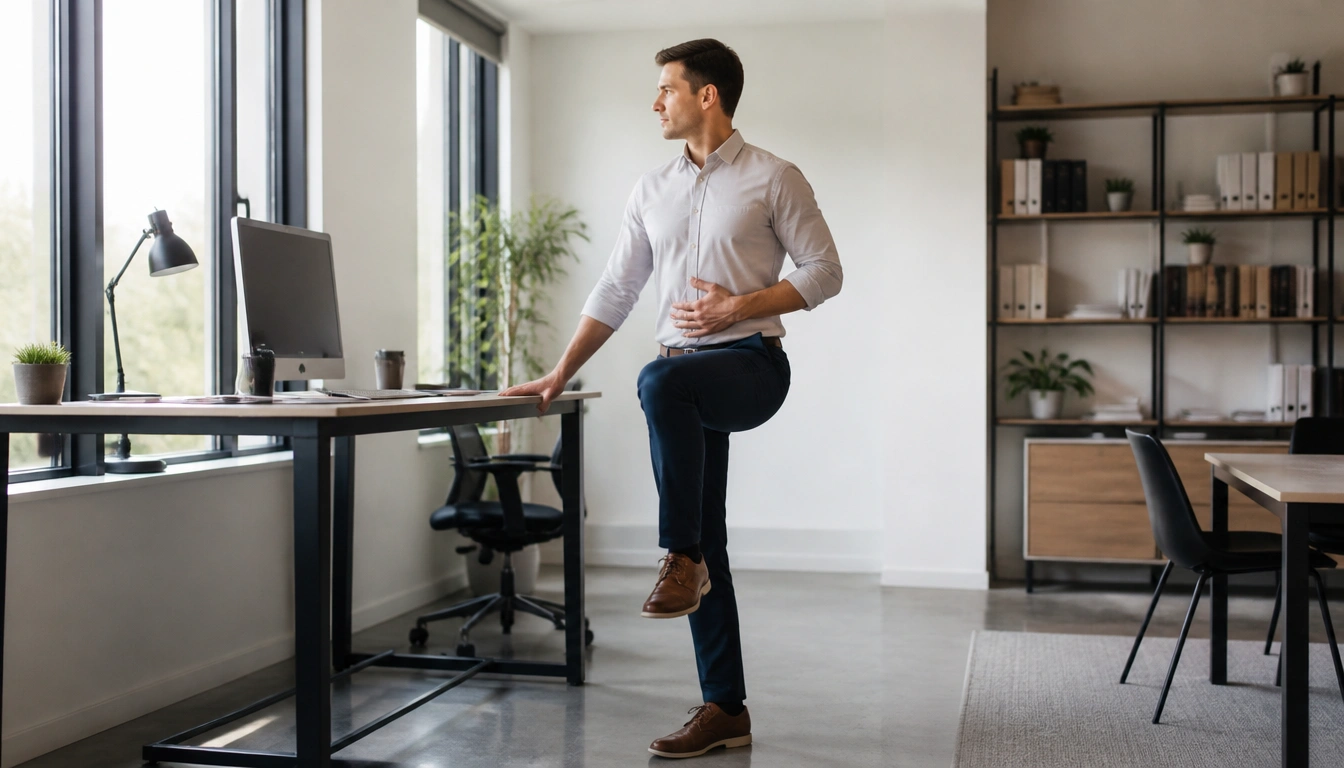
Yes—there are several safe standing core exercises you can do at your desk or during short work breaks, including abdominal drawing-in, slow marching, controlled woodchops, and gentle side-bends. The goal is not to “burn out” your abs; it is to train deep trunk support, balance, and spinal control. For most office workers, these moves work best as brief movement breaks that complement, not replace, regular aerobic and strength exercise.
Key Takeaways
- Long sitting can tighten hip flexors, reduce glute and upper-back activity, and increase stress on the lower back.
- A useful “core” routine trains deep stabilizers and control, not just the visible abdominal muscles.
- Begin with short, low-amplitude movements you can do near a desk, in a break room, or between meetings.
- Beginners, older adults, and anyone with balance concerns can keep one hand on the desk for support.
- Pregnancy, postpartum recovery, and chronic back pain may need tailored modifications or clinical guidance.
- Use the routine as a movement snack alongside weekly aerobic and strength goals, not as a full fitness plan.
Why sitting all day changes how your core and hips work
Prolonged sitting changes how your body holds itself, even if you do not notice it right away. The hip flexors stay shortened, the glutes and upper back do less work, and the pelvis can drift into a position that increases load on the lumbar spine. Over time, that can show up as stiffness, tired hips, a “creaky” low back, or a posture that feels harder to reset when you stand up.
That is one reason a standing core routine can be useful for desk workers: it gives the trunk and hips a chance to re-engage without needing a mat, machines, or a full workout block. The point is not to fight your posture with force. It is to restore control, pressure management, and small stabilizing actions that sitting tends to turn off.
In this context, “core stability” means more than visible abdominal effort. The core includes deep stabilizers such as the transversus abdominis, the obliques, the erector spinae, and the diaphragm working together to support the spine. A good standing routine trains those muscles to coordinate while you breathe normally and stay upright.
That is also why this routine avoids crunch-style effort. You are training support, not straining for a hard abdominal burn. For office work, the most useful version is usually the one that is quiet, controlled, and easy to repeat.
How to use this routine at a desk, in a break room, or between meetings
Think of this as a movement break, not a separate gym session. You can do one exercise while waiting for a meeting to start, run through the full sequence during a 2-minute pause, or pick one drill whenever you catch yourself sitting for a long stretch. The routine works especially well as a habit stacked onto something you already do, such as checking email, refilling water, or finishing a call.
In an open office, choose small movements with minimal arm swing and no jumping. In a private office or break room, you may have a little more room for torso rotation, but you still do not need large ranges. Standing core exercises for office workers should be subtle enough that you can do them in work clothes without drawing attention or breaking a sweat.
If you use a standing desk, make sure the desk height is set so your shoulders are relaxed and your wrists stay neutral. Good ergonomics matter because awkward desk height can make you shrug, lean, or arch your back while you exercise. If you are between desks or away from your workstation, stand tall with feet about hip-width apart and keep the effort slow.
A practical rule is to match the routine to the moment. If you have 30 seconds, do one exercise. If you have 2 to 3 minutes, do the full sequence. If you feel stiff after a long meeting, focus first on breathing and gentle control rather than trying to “make up” for lost movement.
Abdominal drawing-in for deep core activation
This is the foundation move. It teaches the deep abdominal muscles to engage without breath-holding or hard bracing. Stand tall, soften your knees, and let your rib cage rest over your pelvis. Inhale normally, then as you exhale gently draw your lower belly inward, as if zipping up a snug pair of pants. Keep the effort light enough that you can keep breathing.
You should not tuck your pelvis aggressively or clench your glutes hard. The movement is small and quiet. If you feel pressure pushing outward, back off. The purpose is to create a mild support signal through the trunk, not to brace as if you are lifting something heavy.
For a standing desk routine, this exercise is especially useful because it is discreet. You can do it while reading, listening in on a call, or waiting for a file to load. A few controlled repetitions are enough to remind your trunk how to stabilize without large motion.
Standing march, woodchopper, and side-bends for control and balance
The next three exercises add movement while still staying office-friendly. They build control in different directions: marching for balance, woodchoppers for rotation, and side-bends for lateral support. Together they train the trunk to resist unwanted motion and guide deliberate motion, which is more relevant to daily life than static abdominal tension alone.
Standing march: Lift one knee slowly, then lower it with control and switch sides. Keep your torso upright and avoid leaning back. This is a useful drill for coordination because one side of the trunk has to stabilize while the opposite leg moves. If balance is a concern, lightly touch the desk with one hand.
Standing woodchopper: With clasped hands or a very light object, move your arms diagonally across the body and back with a small rotation through the torso. Keep the motion smooth, and let the back foot pivot if needed so the knees and hips do not twist sharply. This helps train rotational stability without fast, forceful twisting.
Standing side-bends: Slide one hand down the outside of the thigh while keeping the shoulders level and the chest open. Return to center and switch sides. This targets lateral trunk control and can feel helpful if sitting makes your sides feel tight or one-sided. Keep the range small; a gentle bend is enough.
If you want a short sequence, pair the march with the woodchopper and side-bend in a quiet loop. If you only have time for one movement, choose the one that feels most awkward in a controlled way. That often gives the biggest “wake up” effect for underused stabilizers.
How to dose the routine without overdoing it
For most people, the best standing core routine is brief and repeatable. Rather than doing one long session, spread short bouts through the day. That approach fits office life better and reduces the chance of fatigue turning your form sloppy. Public health guidance also emphasizes breaking up sedentary time rather than trying to fix a full day of sitting with one burst of exercise.
A useful starting point is one short round at a time, then repeating it later in the day if it feels good. You do not need to chase exhaustion. If the muscles around your trunk feel gently active and your posture feels easier to hold afterward, that is usually enough for a desk break.
Beginners, older adults, and anyone who feels unsteady should simplify first. Keep one hand on the desk, shorten the range of motion, and slow the pace. The standing march can become a toe tap; the woodchopper can become a small diagonal reach; the side-bend can be reduced to a mild shift away from the working side. These changes make the routine safer while still training control.
If you have a standing desk, do not stand rigidly all day. Alternate sitting and standing, and use the routine as one tool within that larger rhythm. The goal is regular movement, not a forced posture that creates a new problem in the feet, calves, or low back.
When to avoid or stop the routine and what pain signals matter
Stop if you feel sharp pain, radiating pain, numbness, tingling, dizziness, or a sudden increase in back, hip, or leg symptoms. Mild muscle work is expected; joint pain, spinal pain, or symptoms that travel down the leg are not the same thing. If an exercise makes your back feel worse while you are doing it or afterward, do not push through and assume it will “loosen up.”
Some office workers should get clinical input before trying a new core routine. That includes people with chronic low back pain, a history of spine injury, a recent surgery, known disc problems, or pain that keeps recurring without clear improvement. A physical therapist or other qualified clinician can help sort out whether the issue is weakness, mobility, load tolerance, or something that needs a different approach.
Pregnancy and postpartum recovery deserve extra caution. People in these stages may need to avoid breath-holding, aggressive bracing, or any movement that causes abdominal doming, pelvic heaviness, leaking, or discomfort. A pelvic floor physical therapist is often the best starting point if symptoms are present or if the person is unsure how to modify safely. Self-directed exercise can still be useful, but it should be adapted to the individual situation.
If you are unsure whether a symptom is normal effort or a warning sign, err on the side of stopping and reassessing. A good office routine should make you feel more settled, not more guarded.
How this routine fits with broader weekly activity guidelines
A standing core routine is a helpful supplement, but it does not replace full physical activity. The U.S. Department of Health and Human Services and the CDC recommend regular aerobic activity, plus muscle-strengthening work for all major muscle groups on at least two days per week. That broader plan matters because posture drills alone do not build the full fitness base people need for heart health, leg strength, or overall capacity.
Use the office routine as a bridge between formal workouts. It can reduce long uninterrupted sitting, keep your trunk more active, and make it easier to stay comfortable until you can walk, lift, cycle, or do a planned strength session later. In other words, it supports your weekly movement plan; it does not replace it.
If you are building an exercise habit from scratch, do not wait for the perfect schedule. A few micro-breaks during the day can coexist with a walk at lunch, a strength session after work, or a weekend workout. The standing routine simply helps the workday become less sedentary.
Habit-stacking ideas for busy office workers and open-plan offices
The easiest routine is the one you actually remember. Habit stacking makes that more likely by linking movement to something that already happens automatically. For example, do the abdominal drawing-in maneuver every time you open your email inbox, then follow it with one round of marching after each major meeting. These anchors reduce decision fatigue.
If you forget often, set a quiet recurring reminder for every 45 to 60 minutes. The point is not perfect timing; it is interrupting long sitting stretches before stiffness builds up. Even a brief standing break can reset your focus and make the next work block feel less glued to the chair.
In a shared workspace, choose low-profile options. Keep the march small, use desk support if needed, and avoid big torso swings. If you feel self-conscious, remember that the best office movement is usually the movement no one has to notice. You are not trying to perform a workout; you are trying to interrupt sitting and give your trunk a little more useful work during the day.
Over time, the routine should become boring in a good way. If it feels easy to start, easy to repeat, and safe to modify, it is doing its job.
Frequently Asked Questions
How often should I do a standing core routine during the workday?
Short bouts work better than one long session. Many office workers do well with brief movement breaks every 45 to 60 minutes, or whenever they finish a task, meeting, or email block. The exact timing is less important than consistently breaking up long sitting stretches.
Is standing core work enough if I sit for most of the day?
No. It helps reduce sedentary time and can improve trunk control, but it should complement, not replace, regular aerobic exercise and full-body strength training. Think of it as a movement snack during the workday, not your whole fitness plan.
Which standing core exercises are safest for beginners or older adults?
The safest starting points are usually the abdominal drawing-in maneuver, small standing marches, and gentle side-bends with a hand on the desk for support. Keep the range small, move slowly, and stop if balance feels uncertain or symptoms increase.
What should pregnant or postpartum people modify or avoid in a standing core routine?
Avoid breath-holding, forceful bracing, and any movement that causes abdominal doming, pelvic heaviness, leaking, or pain. Postpartum recovery and pregnancy can change how the core and pelvic floor respond, so a pelvic floor physical therapist or clinician can help with safer, individualized modifications.
How do I know if an office core exercise is helping versus irritating my back?
Helpful exercise usually feels controlled and leaves you looser or more supported afterward. Stop if you get sharp pain, radiating pain, numbness, tingling, dizziness, or a clear worsening of back, hip, or leg symptoms. If symptoms keep recurring, get a clinical evaluation.
The Bottom Line
A standing core routine can be a practical way to interrupt long sitting, reawaken deep trunk muscles, and reduce the stiffness that desk work can create. The most useful moves are quiet, controlled, and easy to repeat in small doses.
Start with abdominal drawing-in, then add a slow march, a gentle woodchopper, and a small side-bend if they feel safe. Use desk support when needed, and keep the routine short enough that you can fit it into real workdays without hassle.
If you have chronic back pain, are pregnant or postpartum, or notice symptoms that go beyond normal muscle effort, a clinician or pelvic floor physical therapist can help you adapt the routine more safely. The goal is better movement, not pushing through pain.
Medical disclaimer
Medical disclaimer: This content is for educational and informational purposes only and is not a substitute for professional medical advice, diagnosis, or treatment. Dietary needs and supplement suitability vary by individual.
Sources
- National Institutes of Health (NIH) — nih.gov. Accessed October 2026.
- Centers for Disease Control and Prevention (CDC) — cdc.gov. Accessed October 2026.
- American College of Sports Medicine (ACSM) — acsm.org. Accessed October 2026.
- American College of Sports Medicine (ACSM) — acsm.org. Accessed October 2026.
- Academic Research Institution — etsu.edu. Accessed October 2026.
