
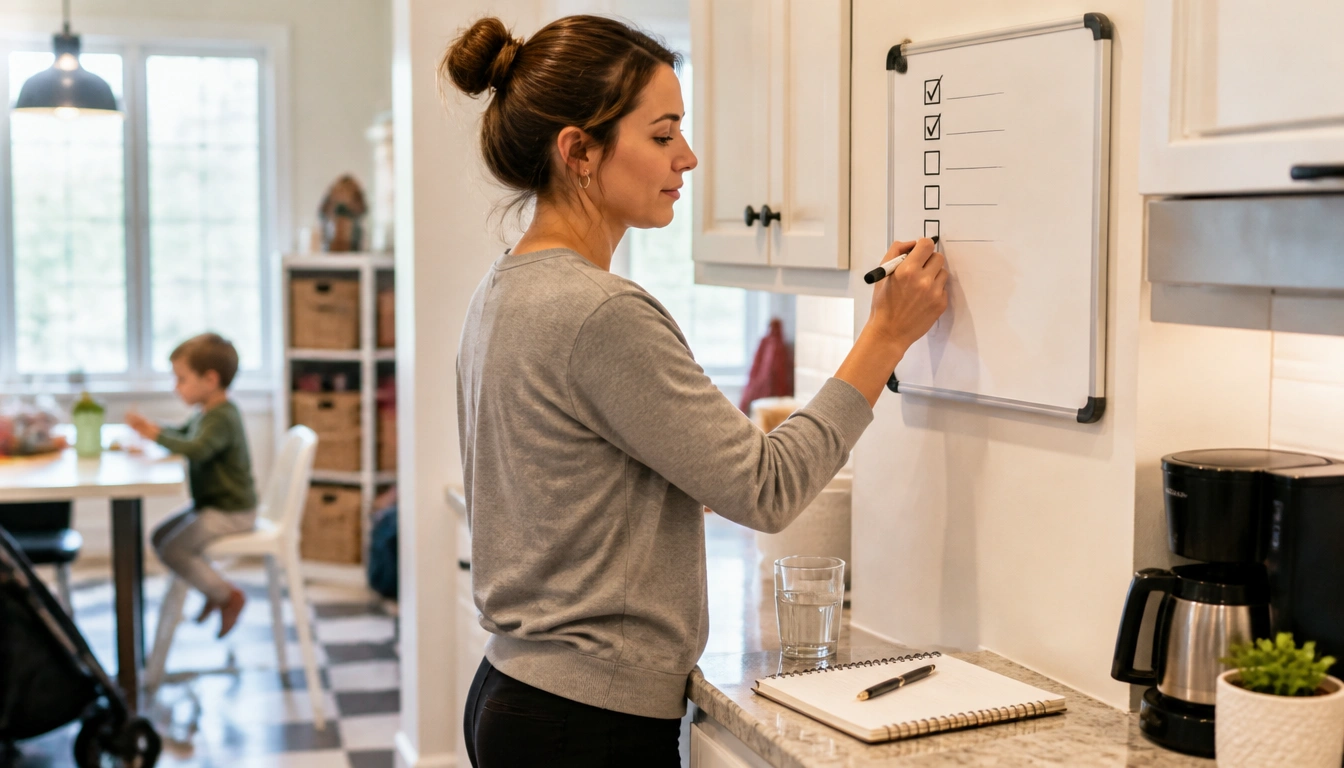
Set up a healthy habit tracker for busy parents by choosing one to three very small habits, linking them to existing routines, and using a format you can update in seconds. Make the tracker flexible enough to survive missed days, sleep disruption, and changing childcare demands. If tracking starts to feel guilt-heavy, obsessive, or restrictive, scale it back or stop.
Key Takeaways
- Start with micro-habits that fit a fragmented day, such as one glass of water, a 10-minute walk, or adding vegetables to one meal.
- Anchor each habit to an existing cue, like coffee, tooth brushing, or school drop-off, so you rely less on motivation.
- Keep the system low-friction: paper, whiteboard, or app all work if they are truly easy to use in under 10 seconds.
- Track only 2 to 3 habits at once and define exactly what success means so the plan stays realistic.
- Build in a reset rule for missed days; one lapse is normal, but the tracker should prevent a long quit cycle.
- Stop or simplify the tracker if it increases anxiety, obsessive checking, guilt, or disordered eating-type behavior.
Why busy parents need a different kind of habit tracker
Busy parents do not live inside a tidy wellness schedule. They live inside interruptions, sleep loss, shifting child needs, and uneven energy. That means a healthy habit tracker for busy parents has to be built around reality, not ideal mornings or long stretches of free time.
The most useful trackers are not rigid scorecards. They are lightweight support systems that make the next good action easier to notice and repeat. Behavioral research and clinical guidance from organizations such as the NIH and the APA consistently point to the same idea: habits are easier to build when they are tied to stable cues and kept small enough to repeat during stressful weeks.
Think of the tracker as scaffolding. It is there to reduce decision fatigue, show progress, and make consistency visible. It is not meant to punish a parent for having a hard day.
If you only have energy for one change, choose the smallest version of the habit that still counts. A 10-minute walk counts. One glass of water counts. Adding a serving of vegetables to dinner counts. These micro-habits are easier to repeat, and repetition matters more than intensity when life is crowded.
Build the tracker around existing cues
The strongest habits usually begin with an anchor you already do without much thought. This is often called if-then planning or implementation intention: if a cue happens, then you do the habit. For parents, that cue should be something reliable in a messy day, not a fantasy routine.
Good anchors include pouring morning coffee, buckling a child into the car, starting dinner, brushing your teeth, or putting the stroller away. For example: if I pour coffee, then I drink water. If I park after school drop-off, then I take three slow breaths. If I start the dishwasher, then I add a vegetable to lunch prep.
That structure matters because it lowers the number of decisions you have to make. Motivation is variable. Cues are more dependable. According to behavioral science summaries from major health and psychology organizations, stable context is one of the best ways to move a behavior from effortful to automatic.
Keep the cue simple and realistic. If the anchor only happens once a week, it is not a good daily tracker cue. If the cue is too vague, such as “when I have time,” it will usually disappear under the pressure of parenting.
Pick the lowest-friction format
The best habit tracker is the one you will actually use on an exhausted day. That may be a sheet on the refrigerator, a whiteboard by the coffee maker, a pocket notebook, or a minimalist app with one tap check-ins. The format matters less than the effort it takes to update it.
A paper tracker works well if you like a visible routine and want a quick sense of progress. A whiteboard is useful when multiple caregivers need to see the same goals. An app may be best if your phone is already part of your morning rhythm. The right choice is the one that creates the least friction and the least guilt.
One practical test: can you update the tracker in under 10 seconds? If not, simplify it. A tracker that demands open-ended journaling, multiple menus, or detailed scorekeeping usually becomes another chore.
For many parents, visibility helps more than sophistication. Putting the tracker near the coffee maker, the fridge, or the entryway makes it harder to forget and easier to pair with a habit anchor.
Keep the habit list small and define success clearly
Trying to track too many behaviors is one of the fastest ways to make a wellness plan collapse. A parent juggling school schedules, meals, laundry, and bedtime does not need fifteen metrics. Two or three is usually enough.
Choose habits that support basic health foundations first: hydration, movement, food quality, sleep support, or a short reset for stress. It often helps to include one food-first habit, one movement habit, and one recovery habit. For example, you might track water with morning coffee, a brief walk after lunch, and screens off before bed.
Define success with precision. “Exercise” is vague. “Walk for 10 minutes after dinner” is clear. “Eat healthier” is vague. “Add a vegetable to lunch or dinner” is clear. Clear definitions reduce the mental work required to decide whether the habit happened.
This is also where additive framing helps. Add water. Add a walk. Add vegetables. Add a pause. Parents often do better with positive actions than with restriction-based goals, because addition feels more workable than a long list of things not to do.
Build a reset rule for missed days
Missed days are not a sign that the tracker failed. They are a sign that family life is being family life. A good habit tracker expects interruptions and still gives you a way back in.
A simple reset rule is: never miss twice. If one day goes off the rails, the next day becomes the restart point. That rule works because it interrupts the all-or-nothing spiral. One skipped checkmark becomes a normal event instead of a reason to quit.
You can also make the reset almost automatic. After a missed day, restart with the smallest version of the habit, not the ideal version. If your walk did not happen, take a five-minute version the next day. If dinner felt chaotic, aim for one added vegetable instead of an ideal meal plan. The goal is to re-enter the pattern, not prove perfection.
When parents expect every week to look the same, they usually end up disappointed. A better system assumes that sick kids, poor sleep, travel, work demands, and emotional overload will happen. The tracker should bend, not break.
Use visible progress and small rewards
Progress is easier to repeat when it is visible. That is one reason simple trackers work: they turn invisible effort into something you can see. A checkmark, a filled box, a streak, or a row of completed days can all support follow-through.
Keep the reward small and immediate. The reward does not have to be food or shopping. It might be a few quiet minutes with tea, a moment of acknowledgment, or the satisfaction of seeing a row filled in. Positive reinforcement helps the brain connect the habit with something worth repeating.
For busy parents, visible progress should feel encouraging, not pressuring. If streaks make you feel trapped, switch to a gentler format such as weekly check-ins. If color-coding becomes stressful, use plain boxes. The visual system should support momentum, not perfectionism.
It can also help to mark “partial wins.” If you usually aim for a 10-minute walk but only manage five, that may still be worth recording as a scaled success. The point is to preserve continuity and confidence, especially during hard weeks.
Adjust the tracker to the parenting stage you are in
A tracker that works during one season of parenting may be unrealistic in another. A parent with a newborn has a different bandwidth than a parent managing school drop-offs or one with older kids and a more predictable day. The right tracker should scale with the household, not ignore it.
During newborn or high-interruption phases, the best habits may be the smallest ones: a glass of water, a stretch while holding the baby, or a 5-minute walk with the stroller. For school-age families, a short after-drop-off walk or a food-prep anchor may be more realistic. In steadier seasons, the tracker can expand slightly, but it should still stay simple enough to survive a chaotic week.
Think of this as right-sizing rather than optimizing. A habit that fits your current life is more valuable than a perfect plan that only works in theory. That flexibility also protects against shame when life changes quickly.
Healthcare circumstances matter too. Postpartum parents, for example, may need clearance before returning to certain forms of exercise. If a medical issue, sleep problem, or mental health concern is affecting your energy, the tracker should not replace personalized care.
Know when tracking is helping and when it is adding stress
A habit tracker should make life simpler. If it starts making you feel tense, ashamed, compulsive, or fixated on numbers, the system is no longer serving you. That is especially important for parents who are vulnerable to perfectionism or disordered eating patterns.
Warning signs include repeated checking, guilt after missed entries, using the tracker to judge your worth, or feeling pressure to compensate for a bad day. Another sign is when tracking begins to crowd out the behavior itself. If you are spending more time logging than living the habit, the system needs to shrink.
At that point, simplify or stop. You can switch from daily tracking to occasional review, remove the hardest metric, or pause the tracker completely. Self-monitoring is a tool, not a test of character.
If chronic exhaustion, low mood, anxiety, or overwhelm are driving the problem, it may be time to speak with a healthcare professional or mental health professional rather than trying to fix everything with a tracker. The healthiest plan is the one that supports your well-being without becoming another demand.
A simple parent-friendly setup
If you want a fast starting point, use this structure: pick one cue, one action, and one place to mark it. For example, “After I pour coffee, I drink water” on a sticky note near the mug. Add one or two more habits only if the first one feels easy enough to repeat.
That kind of setup is often enough. It lowers cognitive load, survives interruptions, and gives you a clean reset after rough days. For busy parents, that is the real goal of a healthy habit tracker: steady support, not a perfect record.
Frequently Asked Questions
What are the best habits for busy parents to track first?
Start with the smallest habits that support basic health and are easy to repeat: hydration, a short walk or stretch, and one food-first action such as adding vegetables. Pick habits that fit into existing routines and do not require a lot of planning.
How many habits should a parent track at once?
Usually two or three at most. More than that often raises cognitive load and makes the tracker feel like homework. A smaller list is easier to maintain during sleep disruption, child illness, travel, or hectic school weeks.
What is the best habit tracker format for parents with very limited time?
The best format is the one you can update in seconds. Many parents do well with a whiteboard, a paper sheet near the coffee maker, or a simple app with one-tap check-ins. Choose the lowest-friction option, not the most sophisticated one.
How do I avoid all-or-nothing thinking when I miss a day?
Use a reset rule such as never miss twice. A missed day is normal, not a failure. Restart with the smallest possible version of the habit the next day so the system stays flexible instead of turning into a quit point.
When should a habit tracker be stopped because it is causing stress or obsession?
Stop or simplify it if you notice anxiety, obsessive checking, guilt, compulsive compensation, or signs of disordered eating. A tracker should support your health, not become a source of pressure or self-criticism. If that is happening, scale back or seek professional support.
The Bottom Line
A healthy habit tracker for busy parents works best when it is tiny, anchored to existing routines, and easy to restart after messy days. The goal is to make one or two helpful actions more repeatable, not to create a perfect wellness dashboard.
If you keep the tracker visible, limit it to a few clear habits, and build in a never-miss-twice reset rule, it can support real-life consistency. If it starts creating guilt, anxiety, or obsession, simplify it or stop using it.
The most sustainable tracker is the one that fits your current parenting stage, your energy level, and your household reality. Start small, keep it flexible, and let the system work for you instead of against you.
Medical disclaimer
Medical disclaimer: This content is for educational and informational purposes only and is not a substitute for professional medical advice, diagnosis, or treatment. Dietary needs and supplement suitability vary by individual.
