
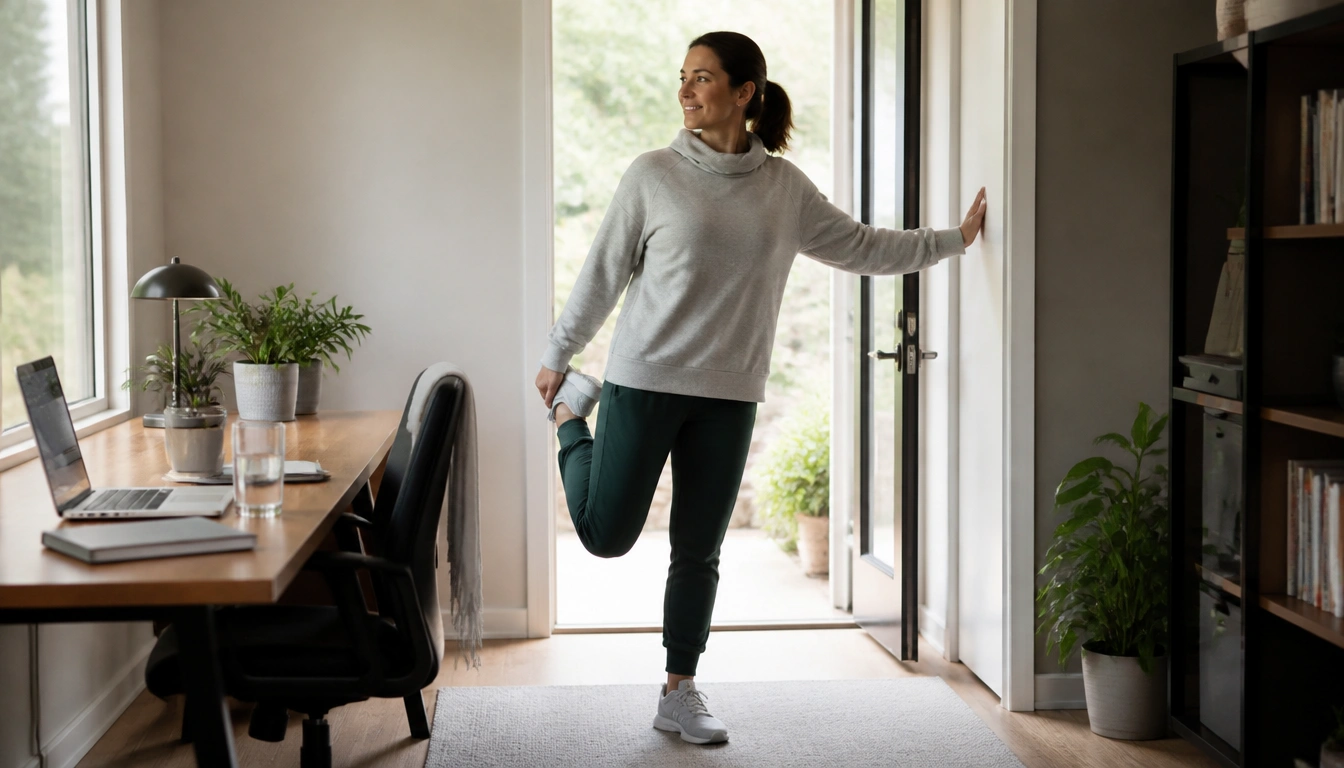
Right after a long walk, don’t sit down immediately if you can avoid it. Spend about 5 to 10 minutes cooling down with easy movement, drinking water, and a few gentle stretches for the calves, hips, and lower body. For people working from home, that short reset can reduce stiffness, help your breathing and heart rate settle, and make the shift back to desk work or rest feel smoother.
Key Takeaways
- A short cool-down after a long walk helps you avoid the stiff, “locked up” feeling that often shows up when you sit right away.
- For WFH routines, the most useful sequence is simple: rehydrate, move gently, stretch briefly, then change clothes before settling into a chair.
- Long walks can tighten the calves, hamstrings, quads, and hip flexors, especially if you go straight from motion to a desk posture.
- Older adults and people with osteoarthritis usually do better with slow, supported, non-bouncy stretches and a gentler pace.
- If you develop sharp pain, swelling, dizziness, chest discomfort, or worsening limp, stretching is not the answer—get medical help.
- You do not need a complicated routine: a repeatable 10-minute habit is usually easier to keep than a perfect one.
Why WFH walkers need a recovery routine after a long walk
A long walk is one of the easiest ways to meet activity goals, break up sitting, and clear your head during a work-from-home day. The problem is the transition. Your body has just spent time moving the calves, hamstrings, quads, glutes, and hip flexors in a repetitive rhythm, and then the usual next step is a desk chair, a couch, or a laptop on the kitchen table. That shift can be surprisingly rough on the body.
When you sit immediately, the hip flexors stay shortened, the lower back stops moving, and blood can pool more easily in the legs. That is one reason people feel stiff, heavy, or oddly tired after a walk even though the walk itself felt good. A short recovery routine bridges that gap between exercise mode and home-office mode.
Public-health guidance from the CDC and WHO supports regular moderate activity such as brisk walking, and institutional guidance commonly suggests a brief cool-down after endurance exercise. For WFH walkers, that cool-down does more than protect your muscles. It helps your body move from “walking” to “working” without a sudden drop into a slouched, unsupported posture.
The 3 biggest problems: stiffness, desk-posture rebound, and restless evenings
The first problem is simple stiffness. Walking is not “easy” in the sense of doing nothing; it still asks the muscles to repeat the same pattern over and over. After a long or brisk walk, those tissues can feel tight, especially if you live with mild joint stiffness or you were on your feet for a while after the walk ended.
The second problem is the desk-posture rebound. Many home workers go from a walk straight into a chair with rounded shoulders, a tucked pelvis, and the hips folded for another long stretch of time. That pattern can exaggerate lower-back tightness and make the front of the hips feel short or compressed. If you already spend much of the day seated, the body can react to that “back to sitting” moment more strongly than expected.
The third problem is the evening effect. A walk can help mood and sleep, but if the body stays irritated, under-hydrated, or overly tense, you may feel restless later. A brief cool-down supports the shift toward recovery instead of leaving you with that still-wired, physically uncomfortable feeling that lingers into the evening.
A simple 10-minute post-walk routine you can do at home
You do not need a full workout plan after every walk. A short, repeatable routine is enough for most people. The goal is to bring your body down gradually, restore a little mobility, and avoid dropping straight into a chair while everything is still tight.
Think of the first 10 minutes after you come home as a recovery window. Use it before you answer email, open a meeting, or sink into the couch. If your walk was casual and short, you may only need the lighter version of this routine. If it was brisk, long, hot, or hilly, use the full sequence.
A practical sequence:
- Take off shoes and loosen up.
- Drink water.
- Walk slowly around your home for a minute or two.
- Do a few gentle stretches without bouncing.
- Change clothes before you sit for work or rest.
That order matters. Rehydration and movement come before stillness, because they help your body settle more smoothly than a sudden stop does.
Phase 1: Rehydrate and decompress without sitting down immediately
Start with water. If you have been walking for a while, especially in warm weather or after sweating, a drink can help replace what you lost. Water is usually enough for a typical long walk. A more strenuous or heat-heavy walk may leave you needing a little more attention to fluids, but you do not need to overcomplicate the first step.
Next, keep moving gently for a minute or two. Pace around your home, stand near the counter, or step outside and back in if that feels better. The point is not to exercise harder. It is to prevent the abrupt switch from rhythmic movement to complete stillness.
If your feet feel beaten up, kick off your shoes and socks and let them recover too. Some people find that a few slow ankle circles or a gentle roll under the arch helps. Keep it easy. The body is cooling down, not getting a new workout.
Phase 2: Gentle lower-body mobility and short static stretches
Once your breathing is calmer, use brief stretches to ease the muscles that tend to tighten after walking. According to guidance commonly used by health organizations and clinical institutions, short static holds are enough for a cool-down. You do not need long, intense stretching sessions here.
Good options include:
- Calf stretch: Step one foot back, keep the heel down, and lean forward slightly until you feel a mild pull in the lower leg.
- Hip flexor stretch: Use a kneeling or supported lunge position and shift forward gently to open the front of the hip.
- Hamstring release: Place one heel forward with a soft knee and hinge lightly at the hips until the back of the thigh feels lengthened.
- Glute and lower-back relief: Lie on your back and draw one or both knees in toward your chest if that feels comfortable.
Keep each stretch brief and controlled. A short hold is enough to remind the muscles to relax. You should feel mild tension, not pain. If a stretch makes you wince, back off. The goal is to unwind, not to force a deeper range.
Phase 3: Re-entry into work or rest mode without locking into a chair
The last part of the routine is where many WFH habits break down. The walk is over, the body is warm, and the couch suddenly looks irresistible. Try not to collapse into an unsupported position too quickly. If you sit before the muscles have had a chance to settle, the hips and lower back can stiffen fast.
If you need to work right away, first change out of sweaty or constricting clothes so your body gets a clear signal that the walk phase is over. Then choose a seated setup that does not fold you in half. A firm chair, a supported seat, or even a standing work setup for a few minutes may feel better than a deep recliner.
If you have a meeting or a deadline, spend a few minutes standing, pacing lightly, or setting up your space before you sit. That transition helps protect the benefit of the walk instead of undoing it with an immediate slump.
When to use a longer cool-down after brisk or hot-weather walks
Some walks call for more than a quick reset. If you walked briskly, climbed hills, carried something, or spent extra time in heat, your heart rate and body temperature may stay elevated longer. In that case, give yourself a slower cool-down before computer work or a long seated stretch.
That can mean several minutes of easy indoor walking, slower breathing, and a little more time before you sit. Public-health and institutional guidance generally supports a 5-to-10-minute cool-down after endurance effort, but the exact routine can stay simple. Your own body gives the best clue: if you still feel winded, overheated, or heavily worked, you likely need a few more minutes of easy movement.
Hot-weather walks can also leave you more dehydrated, which may worsen fatigue or the feeling of tightness. A drink and a cooler indoor environment help. You do not need a special recovery product for this; a quieter pace and a little more time usually do the job.
Adjustments for older adults and people with joint stiffness or osteoarthritis
Older adults and people with osteoarthritis often do best with slower, more supported recovery. That does not mean skipping the cool-down. It means keeping the stretches gentle, avoiding bouncing, and giving the body a little extra time to settle.
Support can be as simple as holding onto a countertop, using a chair for balance, or doing floor stretches with a pillow or folded towel nearby. Slow transitions matter more than perfect positions. If the front of the hips, knees, or lower back feel sensitive, choose the version of each stretch that allows the least strain.
For some people, a longer low-intensity cool-down is helpful because the body takes more time to settle after sustained walking. That may be especially true if the walk was brisk, if you are returning from a period of inactivity, or if your joints feel better with gradual movement rather than abrupt stopping.
What to avoid after walking: aggressive stretching, bouncing, and instant couch collapse
After a long walk, more intensity is not better. Aggressive stretching can leave tissues irritated rather than relieved, especially if you try to force range that your body is not ready for. Bouncing into stretches tends to make the muscles guard instead of release, which can increase discomfort rather than reduce it.
Another common mistake is the “instant collapse” onto the couch. That can feel deserved, but it often leaves the hips flexed, the spine slouched, and the legs stiffening in place. If you need a break, take one after your body has had a few minutes to wind down first.
Avoid treating soreness like a challenge to push through. Mild tightness after walking is common. Sharp pain, a sense that something is being pulled, or discomfort that gets worse as you move are different and should not be ignored.
When post-walk discomfort is normal vs a red flag
Some mild fatigue, stiffness, or temporary heaviness after a long walk is normal. That usually settles with a cool-down, a little movement, hydration, and time. If you feel looser after walking around the house or doing gentle stretches, that is usually a good sign.
What is not normal is sharp or focal pain, swelling that appears suddenly, chest discomfort, dizziness, severe breathlessness, or a limp that does not ease. Those symptoms deserve medical attention rather than self-treatment through stretching. Persistent pain that worsens, lasts beyond the usual recovery window, or changes how you walk should also be evaluated by a healthcare professional.
If you are unsure whether a symptom is ordinary post-exercise soreness or something more serious, err on the cautious side. A recovery routine should help you feel better, not mask a problem that needs care.
Frequently Asked Questions
How long should I cool down after a long walk before sitting down to work?
A short cool-down of about 5 to 10 minutes is a practical target for many people. That usually means a few minutes of easy walking, hydration, and gentle stretching before you sit. If you feel especially winded, overheated, or tight, take a little longer.
What stretches are best after walking if I work from home all day?
The most useful stretches are usually the calves, hip flexors, hamstrings, and glutes. Keep them gentle and brief, with no bouncing. The aim is to ease the muscles that tighten during walking and sitting, not to force a deep stretch.
Should I drink water or eat something after a long walk?
Water is usually the first thing to focus on, especially if you sweated or the walk was warm. Eating depends on timing, hunger, and how long you walked. A normal meal or snack later is often enough unless you exercised for a much longer time or feel clearly depleted.
Is it bad to sit immediately after a long walk?
It is not dangerous for every person every time, but it can make you feel stiffer and more locked up, especially after a long or brisk walk. Sitting immediately shortens the hip flexors and can make the lower back feel tighter, so a short transition is better.
What should older adults or people with joint pain do differently after a long walk?
They should keep recovery slower, steadier, and more supported. Use non-bouncy stretches, hold onto a stable surface if needed, and allow a little more time for cooling down. If pain is sharp, worsening, or changes your walking pattern, get evaluated rather than pushing through it.
The Bottom Line
A long walk is a great habit for health and stress relief, but the minutes right after the walk matter just as much as the walk itself. A brief cool-down helps you avoid the stiff, compressed feeling that can show up when you go straight from movement to a desk chair or couch.
For most WFH adults, the best routine is uncomplicated: drink water, keep moving gently for a few minutes, do a few short stretches, then change clothes before you sit down. If you are older, have joint stiffness, or walked hard in heat, use a slower version of the same idea.
If your discomfort is mild and eases with movement, that is usually part of normal recovery. If you get sharp pain, swelling, dizziness, chest discomfort, or a limp, stop self-managing and seek medical advice.
Medical disclaimer
Medical disclaimer: This content is for educational and informational purposes only and is not a substitute for professional medical advice, diagnosis, or treatment. Dietary needs and supplement suitability vary by individual.
Sources
- National Health Service (NHS) — www.nhs.uk. Accessed November 2026.
- National Health Service (NHS) — www.nhs.uk. Accessed November 2026.
- Centers for Disease Control and Prevention (CDC) — cdc.gov. Accessed November 2026.
- Centers for Disease Control and Prevention (CDC) — cdc.gov. Accessed November 2026.
- National Health Service (NHS) — kentmedwaymentalhealth.nhs.uk. Accessed November 2026.
