
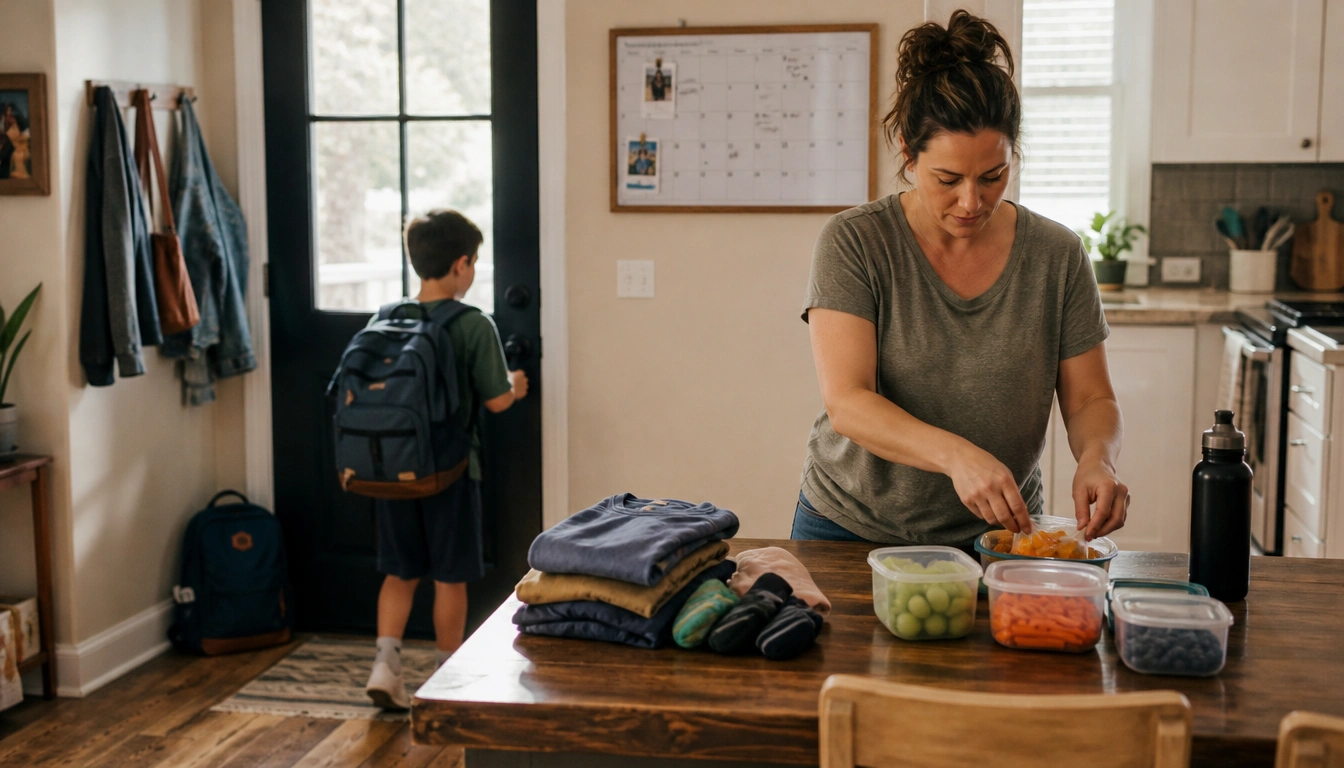
Build a school-week routine around a few repeatable anchors: a night-before reset, a simple morning checklist, a predictable after-school decompression window, and easy meal and snack backups. For busy families, consistency matters more than complexity. The goal is not a flawless schedule; it is a routine that reduces decisions, prevents late-day chaos, and still leaves room for sports, homework, and real-life delays.
Key Takeaways
- Focus on a few non-negotiables instead of trying to control every hour of the day.
- Use the night before to set up the morning: backpacks, clothes, forms, and breakfast basics.
- Plan an after-school snack and decompression time before homework to reduce meltdowns and food scrambling.
- Keep backup dinners on hand with frozen, canned, or batch-prepped ingredients for the busiest nights.
- Protect sleep, movement, and screen boundaries so the routine supports health, not just logistics.
- Adjust the routine by age and temperament: younger kids need more visual cues, while older kids can use checklists and more self-management.
Why predictable routines matter more than perfect routines
A school-week routine works best when it makes the day feel familiar, not rigid. Children usually handle transitions better when they know what comes next, and parents spend less energy repeating instructions or solving the same problems every morning. That predictability can lower stress for the whole household because the day has fewer surprises.
Behaviorally, routines work because they reduce the number of decisions everyone has to make. If backpacks, shoes, and lunch items always live in the same place, you remove a chunk of the morning scramble. If dinner follows a familiar pattern on busy nights, you are less likely to end up in a drive-thru line because no one could figure out what to eat.
The CDC and pediatric guidance from the American Academy of Pediatrics emphasize that sleep, movement, and regular habits support children’s health and learning. A routine does not need to be elaborate to help. In many families, the most effective version is a short list of repeated actions that happen almost automatically.
Think of the week as a set of guardrails, not a minute-by-minute script. Your routine should make school days calmer, not make parents feel like they are failing when practice runs late or homework takes longer than expected.
The few anchors that matter most on busy weeks
When life is packed, choose three to five anchors that protect the whole week. Everything else is optional. A useful set usually includes sleep, a night-before reset, a morning launch, an after-school transition, and a dinner plan that does not depend on fresh energy at 6 p.m.
Start with sleep, because a tired child is harder to wake, harder to feed, and harder to guide through the day. The AAP recommends 9 to 12 hours for school-age children and 8 to 10 hours for teenagers. You do not need to perfect bedtime, but you do need a consistent bedtime window that makes enough sleep possible on most school nights.
Next, protect one connected family anchor point. For some families that is dinner together. For others it is a short check-in after school or a few minutes of reading before bed. The point is not to force an idealized family evening; it is to keep at least one dependable moment of contact in the week.
Then choose one school-prep habit that happens every night. A launchpad by the door, a backpack check, or clothes laid out before bed can save far more time than trying to overhaul the whole morning. If you only keep a few anchors, the routine still holds when the week gets messy.
The night-before reset that saves the morning
The easiest school-morning routine is usually built the night before. A short reset lowers decision fatigue and cuts down on the hunt for missing items. Put a basket, hook, bin, or bench near the door and make it the family launchpad for backpacks, shoes, sports gear, forms, and library books.
At night, have each child place the essentials in that spot. For younger children, use visual reminders such as pictures or simple labels. For older kids and teens, a short checklist works better: backpack, charger, water bottle, homework, lunch items, and anything needed for practice. The more a child can follow the same steps independently, the less the parent becomes the alarm clock, coat rack, and school secretary all at once.
Clothes are another easy win. Pick them out before bed, including socks and shoes if those are frequent bottlenecks. If breakfast is always rushed, stage the simplest version possible: bowls, spoons, lunch containers, and shelf-stable breakfast foods in an easy-to-reach place. You are not trying to create a perfect morning. You are removing the small obstacles that trigger conflict.
A practical night-before reset only takes a few minutes if it is done every day. Many families find it helpful to do it right after dinner, before everyone is too tired to cooperate. If evenings are unpredictable, link the reset to a fixed cue such as clearing the table or brushing teeth.
A morning routine that lowers conflict, plus the after-school reset
Busy school mornings go more smoothly when the sequence is simple and repeated. Waking, dressing, eating, brushing teeth, packing up, and leaving should happen in the same general order every day. That consistency matters more than the exact timing. Children often resist when they have to guess what comes next, especially if they are still sleepy or rushed.
For younger children, use concrete prompts and visual cues instead of long reminders. A picture schedule on the wall or a short “first, next, then” routine can be easier to follow than a verbal lecture. For older children and teens, the goal is more self-management: checking a list, using a phone reminder if appropriate, and getting out the door with less parent prompting.
After school, resist the urge to send everyone straight into homework the second they walk in. Many children need a short decompression period first. That might mean quiet time, a snack, a short walk, or active play, depending on the child and the day. This pause helps the brain shift from school mode to home mode and can reduce after-school conflict.
After-decompression homework tends to go better because hunger, fatigue, and transition stress are less intense. If your child has a sport or an activity right away, the decompression window may be very brief. Even then, a predictable snack and a few minutes to reset can still help. The exact routine can vary, but the pattern stays the same: transition first, homework second.
Meal strategy for the busiest nights
Meal planning does not have to mean cooking from scratch every night. On the most chaotic school weeks, your best strategy is a backup system. Batch-cook when you have time, and keep frozen, canned, and ready-to-use ingredients available for nights when energy runs out.
Frozen vegetables, canned beans, canned tomatoes, and pre-cooked proteins can turn into a meal faster than starting from zero. You can also double a soup, stew, pasta sauce, or casserole on a calmer day and freeze half for later. That way, a hard night still ends with dinner at home instead of a last-minute run for convenience food.
Structured meals work well for families with sports or homework overload because they reduce the number of choices. A rotation of familiar dinners is often more realistic than a new recipe every week. Think in categories: one sheet-pan meal, one slow-cooker meal, one pasta meal, one breakfast-for-dinner option, and one emergency freezer meal. Repeating a short list is not boring when the household is busy; it is efficient.
Food safety matters with batch cooking. The CDC advises keeping perishable foods out of the temperature danger zone and refrigerating leftovers promptly. Thaw frozen foods safely in the refrigerator or microwave rather than leaving them on the counter. If you prep ingredients ahead, store them in clean containers and use them while they are still fresh enough to be safe and appealing.
It also helps to accept a realistic standard for some nights. A dinner built from leftover chicken, microwaved rice, pre-cut vegetables, and fruit is still a solid school-night meal. The goal is not culinary perfection. It is to make home food easier to choose than takeout when everyone is tired.
Snack planning that prevents the late-afternoon trap
Late afternoon is a common trouble spot because children come home hungry and parents are still trying to finish work or start dinner. Without a plan, the easiest option becomes whatever is fastest, which is often ultra-processed snack food or a trip to the store for impulse items. A structured snack can break that pattern.
Choose one reliable after-school snack rule. For example, snacks happen at a set time, at a set place, and from a small list of options. Good choices usually combine protein or healthy fat with fiber or fruit, such as cheese and crackers, yogurt and fruit, hummus and vegetables, apple slices with nut butter, or whole-grain toast with peanut butter.
Make the snack visible and easy to reach. Portioning snacks into clear containers, using a fridge shelf for grab-and-go options, or keeping a snack bin in the pantry can reduce the “nothing to eat” argument. If younger children are involved, place healthier choices at eye level and keep the most convenient options aligned with your goals.
It can also help to pair snack time with a transition cue. Some families use it as the bridge between arriving home and homework. Others use it before practice or while a parent finishes cooking. The best version is the one your household will actually repeat.
Sleep, screen time, activity, and age-appropriate flexibility
Sleep is one of the strongest supports for a workable school-week routine. The AAP’s guidance on sleep ranges gives parents a practical target, but the routine around bedtime matters too. A calmer evening, fewer late screen surprises, and a consistent wind-down all make it easier for children to get enough rest.
Screen habits can either support or undermine that goal. The AAP advises balanced media use that does not crowd out sleep, family connection, or physical activity. For school nights, that often means avoiding background screens during dinner and homework, and setting a predictable stopping point before bed. A small routine such as charging devices outside bedrooms or using a nightly media cutoff can make the next morning easier.
Physical activity belongs in the week as well. CDC guidance supports at least 60 minutes a day of moderate-to-vigorous activity for school-age children and adolescents. That does not mean an organized sport is required every day. Walking, biking, active play, dance, yard time, and short movement breaks all count toward the larger goal of helping children stay healthy and regulated.
Age and temperament change how the routine should look. Younger children often need more visual structure, more reminders before transitions, and shorter steps. Older children and teens can usually handle more responsibility if the expectations are clear and consistent. Children with ADHD, anxiety, or sensory sensitivities may do better with advance warnings, picture schedules, quieter downtime after school, or fewer abrupt transitions. Flexibility is not a failure; it is how you make the routine usable for the child you actually have.
How to keep the routine realistic for parents
A routine only works if the adults can sustain it. If your current plan depends on perfect mornings, gourmet meal prep, and a spotless house, it will probably collapse during the first busy week. Simplicity is not the backup plan; it is the real plan.
Use a “minimum viable week” mindset. Decide which parts are non-negotiable and let the rest be flexible. For many families, the essentials are enough sleep, a night-before reset, a predictable after-school snack, and one or two dependable dinner options. If the week gets harder, do less rather than trying to compensate with more effort everywhere.
Drop the pieces that create the most friction. If elaborate lunches are draining you, simplify them. If family cleanup is causing nightly arguments, reduce the number of steps. If homework time is a battle, shift the routine so the child can decompress first. The right routine should make the day feel easier, not turn every evening into a performance review.
Finally, notice what keeps breaking and fix only that piece. You do not need to redesign the whole school week each time something goes wrong. One stable habit at a time is enough to build a routine that survives sports seasons, work deadlines, and tired children.
Frequently Asked Questions
What is the easiest night-before routine for school mornings?
The simplest version is a five-minute reset: backpacks by the door, clothes laid out, forms signed, and breakfast basics ready. A launchpad near the entrance helps everyone know where school items belong. The goal is to remove the biggest morning bottlenecks, not to finish the whole day in advance.
How can I keep kids from getting overly hungry or grabbing junk food after school?
Offer a predictable after-school snack as soon as they get home or at a set time. Choose snacks with protein and fiber, such as yogurt and fruit or hummus and crackers, and keep them visible and easy to grab. A short decompression period before homework also helps reduce impulsive snacking.
How much sleep do school-age kids and teens really need during the school week?
The AAP recommends 9 to 12 hours for school-age children and 8 to 10 hours for teenagers. A consistent bedtime and wind-down routine matter because they make those hours more likely to happen on school nights. Even small changes in timing can help the whole morning run more smoothly.
What should a routine look like for a child who has ADHD, anxiety, or sensory sensitivities?
Keep the routine predictable, visual, and low-pressure. Picture schedules, advance warnings before transitions, and quiet decompression time after school can make the day easier. Many children do better when expectations are clear and the routine is flexible enough to avoid power struggles.
How can busy parents simplify meals without relying on fast food every night?
Build a short list of backup dinners using batch-cooked meals, frozen vegetables, canned beans, pasta, eggs, and other easy staples. Keep a few meals you can assemble quickly on the busiest nights. Planning one or two reliable backups often matters more than creating a full weekly menu.
The Bottom Line
A school-week routine does not need to be elaborate to help your family. The most useful version is predictable, repeatable, and built around a few anchors that protect sleep, mornings, meals, and after-school transitions.
If you are stretched thin, start with the smallest changes that save the most time: a night-before reset, a consistent snack, a simple dinner backup, and a bedtime that supports enough sleep. Keep the routine flexible enough to survive sports, homework, and the occasional rough day.
The best routine is the one your family can keep using when life gets busy. If it reduces conflict and decision fatigue without wearing down the adults, it is doing its job.
Medical disclaimer
Medical disclaimer: This content is for educational and informational purposes only and is not a substitute for professional medical advice, diagnosis, or treatment. Dietary needs and supplement suitability vary by individual.
Sources
- Centers for Disease Control and Prevention (CDC) — cdc.gov. Accessed November 2026.
- Centers for Disease Control and Prevention (CDC) — cdc.gov. Accessed November 2026.
- healthychildren.org — healthychildren.org. Accessed November 2026.
