
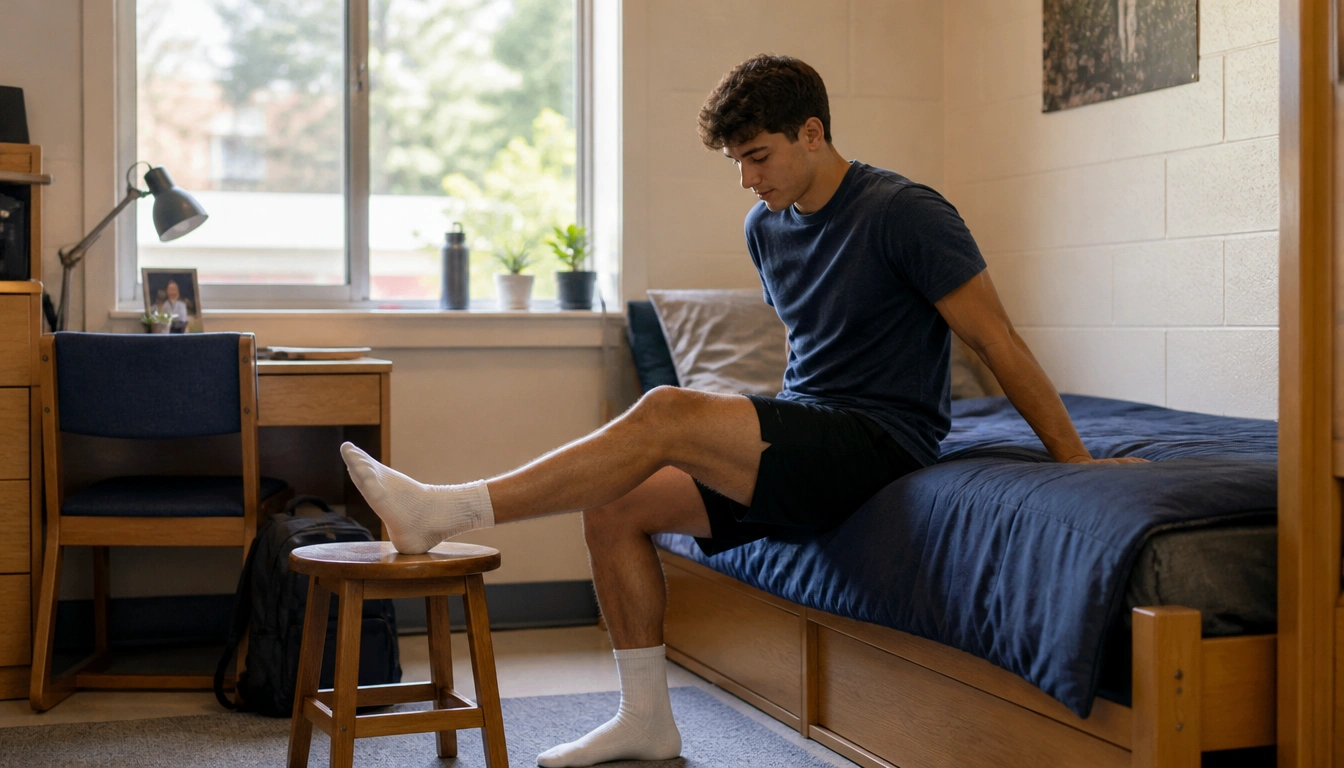
You can improve ankle mobility for walking by doing short, consistent drills that restore dorsiflexion, loosen tight calves, and improve balance. For most college students, the most useful routine is a few minutes of ankle alphabet, seated pumps, calf stretching, and single-leg balance spread through the day. If you have a history of sprains or your ankle feels unstable, balance and rehab work matter as much as stretching.
Key Takeaways
- Limited ankle dorsiflexion can change how you walk on stairs, hills, and concrete, sometimes shifting extra strain to the knees and lower back.
- Long lecture blocks followed by lots of steps, hills, and backpack carrying can make the calves and ankles feel stiff and tired fast.
- A short study-break routine works best: ankle alphabet, seated pumps, calf stretch, and single-leg balance.
- If you have recurrent sprains or chronic ankle instability, prioritize balance and control instead of forcing more stretching.
- Normal stretch tension feels like a mild pull; pain, swelling, bruising, or giving way means you should stop and get checked.
Why ankles matter on a campus walk
On a campus, walking is rarely flat and predictable. You may move from lecture halls to stairs, sidewalks, ramps, dining halls, and uneven paths in the same hour. That makes ankle mobility more than a flexibility topic. It affects how smoothly your body moves over the foot with each step.
The main motion to notice is dorsiflexion, which is when your toes move upward toward your shin as your body travels forward over the planted foot. According to physical therapy and university health guidance, enough dorsiflexion helps you take a cleaner step and absorb load more efficiently. If that motion is limited, your body often finds a workaround.
Common compensations include turning the foot outward, lifting the heel early, shortening the stride, or loading the next joint above the ankle more than usual. Over time, that can make stairs feel awkward and can contribute to extra stress at the knee and lower back. The ankle is a small joint, but its job affects the whole chain above it.
Why college routines make ankles feel stiff
College life is a perfect setup for stiffness. You may sit through long lectures, study for hours, then suddenly walk a mile across campus with a backpack. That pattern does not give the lower legs many chances to move through a full range of motion.
Long sitting blocks can leave the calves feeling shortened and the ankle joint feeling “stuck,” especially after a morning of little movement. Then the sudden jump to high step counts can expose that stiffness right away. Hills and stairs make it more obvious because they demand more ankle bend.
Backpacks add another layer. A heavy load can change posture and how force travels through the lower body. If you already feel tight, the extra carry can increase fatigue in the calves and make the foot and ankle feel less springy by the end of the day.
The best ankle mobility drills for walking
For students, the best ankle mobility exercises are the ones you can repeat without much setup. The goal is not to crush a workout. It is to remind the joint how to move and to keep the movement smooth enough for daily walking.
Ankle alphabet is a good place to start. Sit or lie down and “write” the letters with your big toe while the leg stays relaxed. Keep the motion controlled and small at first. This drill helps you move the ankle through multiple directions without forcing it.
Seated pumps are just as useful. With your heel down, pull the toes up toward your shin, then point them down like a gas pedal. This is easy to do between classes or while studying. It helps wake up the front and back of the ankle after sitting.
Controlled ankle circles can round out the routine. Move slowly in both directions without letting the whole leg twist. Circles are helpful, but they work best when they stay smooth rather than rushed or big and sloppy. According to academic exercise guidance, consistency matters more than intensity for these drills.
Pair mobility with calf flexibility and balance
Ankles do not move in isolation. Tight calves can limit dorsiflexion, so calf stretching is often the next useful step. A wall calf stretch can target the gastrocnemius with a straighter back knee, while a slightly bent back knee shifts more emphasis toward the soleus. Both matter for walking and stairs.
Hold a stretch only until you feel a steady pull in the calf. You should not feel sharp pain, pinching in the joint, or an aggressive strain. If you have to force the position, the stretch is probably too hard for the moment.
Balance work matters too. Single-leg balance helps train proprioception, which is your ability to sense where the ankle is in space. That is a major part of walking stability. It becomes especially important if you have had a sprain, because mobility without control can leave the joint feeling loose instead of reliable.
A simple campus-friendly routine can take about five minutes. Try a minute of seated pumps, a minute of ankle alphabet, a minute of calf stretching on each side, and then a short single-leg balance hold near a wall or desk. You can do it before class, between study blocks, or before bed.
When stretching is not enough
If you have had one ankle sprain, you may recover well with basic mobility work. If you have had repeated sprains, persistent “giving way,” or a history of chronic ankle instability, stretching alone is usually not the right main strategy. In that case, the joint often needs more neuromuscular control and balance training.
That does not mean flexibility has no value. It means the priority shifts. A looser ankle that does not know how to stabilize itself can still feel unreliable during walking, cutting, or even turning on stairs. Physical therapy guidance often emphasizes control and re-training after repeated sprains because instability can linger long after the first injury seems healed.
If your ankle feels wobbly, weak, or unpredictable, put more attention on balance, controlled loading, and gradual walking practice. Aggressive stretching is not the answer if the main issue is poor control rather than stiffness.
Footwear, backpack load, and campus terrain
Good shoes will not replace mobility work, but they can reduce the stress on your ankles while you build it. Supportive footwear with a stable base is often more helpful for long campus days than soft, unsupportive shoes that let the foot collapse or tire out faster.
Backpack weight also matters. A heavy load can make you lean, brace, or shorten your stride. If your route includes hills, stairs, or long concrete stretches, those changes can increase calf fatigue and make your ankles feel tight by the end of the day. If possible, lighten what you carry and distribute weight evenly.
Terrain matters too. Concrete is less forgiving than grass or a track, and hills demand more ankle motion than flat routes. If one route always leaves your calves and ankles feeling worse, it may be worth mixing in easier paths when you can.
| Situation | Likely effect on ankles | Helpful response |
|---|---|---|
| Long study block | Stiffness and reduced motion | Short seated pumps or ankle alphabet |
| Back-to-back classes with lots of walking | Fatigue and calf tightness | Calf stretch and light balance work |
| Hills or stairs | Higher dorsiflexion demand | Use mobility work consistently, not just after pain starts |
| Recent sprains | Instability risk | Prioritize balance and rehab progression |
How to tell whether you are making progress
You do not need a perfect ankle range to walk well. Progress is usually easier to notice in daily movement than in a mirror. A good sign is that stairs feel smoother, your heels stay down longer on inclines, and your walk feels less choppy after sitting.
Track your own baseline instead of comparing yourself with someone else. Some people have naturally more or less joint motion. What matters is whether your ankles are moving better than they did last week and whether walking feels easier, not whether you match a single ideal number.
Other useful signs include less morning stiffness, fewer complaints on the first hill of the day, and less calf fatigue after a long route across campus. If your mobility work is helping, you should notice that daily walking feels more automatic and less like work.
When ankle stiffness needs medical care
Stretch tension should feel like a mild pull, not a sharp jab or a deep bone pain. If you feel pain in the joint itself, swelling that is new or worsening, bruising, or a sense that the ankle is unstable, stop the exercise and get it evaluated.
Seek care promptly if you cannot bear weight after a twist or roll, if the ankle is very tender over the bone, or if the joint keeps locking, catching, or giving way during normal walking. Those signs can mean more than ordinary tightness. Campus health services, a clinician, or a physical therapist can help sort out whether this is a mobility problem, a sprain, or something more serious.
If the problem is mild tightness without red flags, a short consistent routine is a reasonable first step. If symptoms do not improve or they worsen with walking, do not keep pushing through it just because the campus pace is busy.
Frequently Asked Questions
What ankle mobility exercises are best for college students who walk a lot?
The most practical options are ankle alphabet, seated pumps, controlled ankle circles, calf stretching, and single-leg balance. These drills are easy to do in a dorm room or between classes and directly support walking mechanics rather than just general flexibility.
How often should I do ankle mobility work if I sit in class most of the day?
Short sessions work better than one long session. Many students do well with a few minutes during study breaks plus a short routine once a day. If you sit for long blocks, brief movement snacks during the day can help prevent stiffness from building up.
How do I know if tight ankles are affecting my walking mechanics?
Common signs include turning the foot out, lifting the heel early on hills or stairs, feeling stiff after sitting, or noticing that your knees or lower back feel more stressed during campus walking. If stairs feel awkward or you tire quickly, ankle motion may be part of the issue.
When should ankle mobility training be replaced with balance or rehab work after a sprain?
If you have recurrent sprains, a history of the ankle giving way, or ongoing instability, balance and neuromuscular control should move to the front of the plan. Stretching can still help, but it should not be the only focus after repeated injury.
What warning signs mean ankle stiffness is more than simple tightness and needs medical care?
Get evaluated if you have swelling, bruising, sharp pain, tenderness over the bone, inability to bear weight, or repeated locking or giving way. Those signs suggest something beyond routine stiffness and should not be treated as normal soreness.
The Bottom Line
For college students, better ankle mobility usually comes from small, repeatable habits rather than a big workout. A routine built around ankle alphabet, seated pumps, calf stretching, and single-leg balance can make campus walking feel smoother and less tiring.
If your history includes repeated sprains or unstable ankles, focus less on forcing range and more on control, balance, and gradual return to confident walking. And if you have swelling, bruising, sharp pain, or trouble bearing weight, get checked instead of trying to stretch through it.
Medical disclaimer
Medical disclaimer: This content is for educational and informational purposes only and is not a substitute for professional medical advice, diagnosis, or treatment. Dietary needs and supplement suitability vary by individual.
Sources
- National Institutes of Health (NIH) — nih.gov. Accessed November 2026.
- National Health Service (NHS) — northcheshireandmersey.nhs.uk. Accessed November 2026.
- National Health Service (NHS) — leicspart.nhs.uk. Accessed November 2026.
- National Health Service (NHS) — jpaget.nhs.uk. Accessed November 2026.
- Academic Research Institution — buffalo.edu. Accessed November 2026.
- Academic Research Institution — ucsf.edu. Accessed November 2026.
