
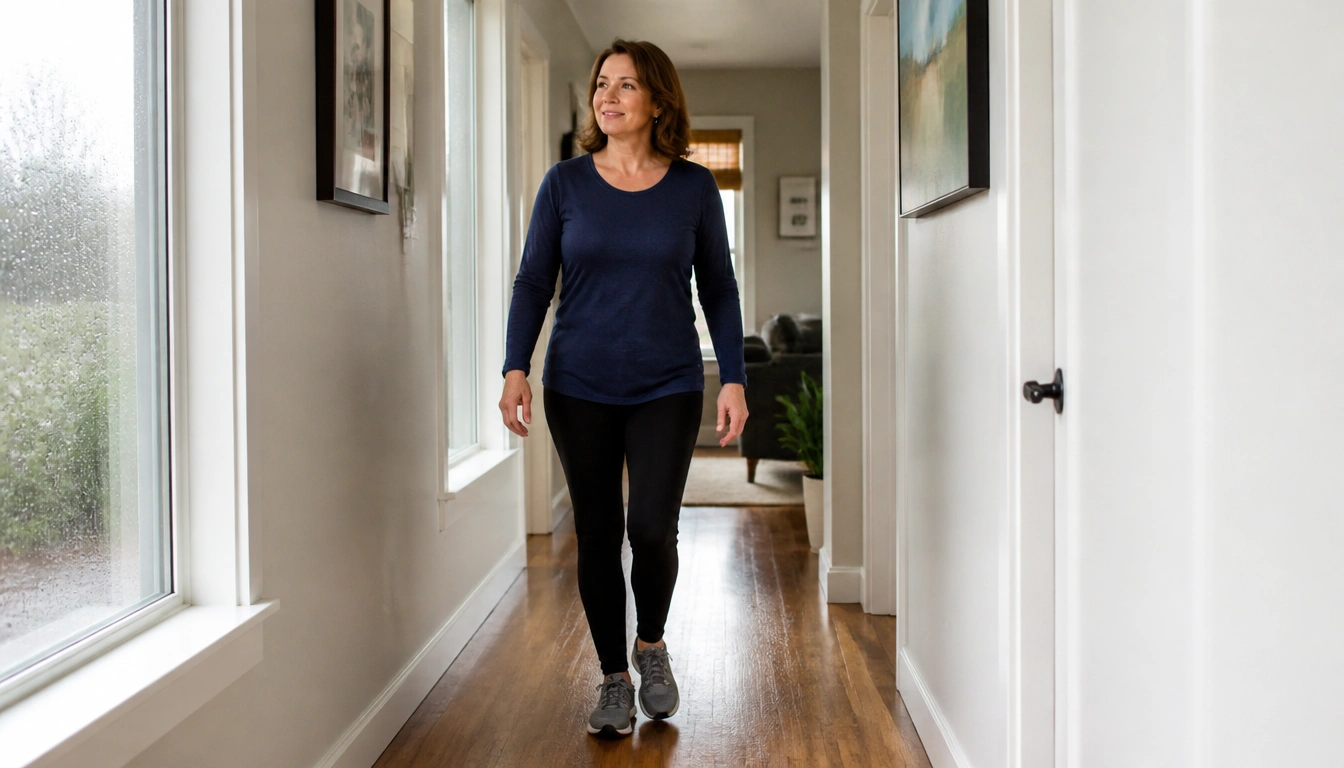
Yes—an indoor walking workout at home can be safe and effective for absolute beginners, even in short bouts. You do not need a treadmill or a long uninterrupted session. Start with a clear path, supportive shoes if your floors are hard, and a pace that lets you talk but not sing. Short walks of 5 to 10 minutes still count, and you can build from there.
Key Takeaways
- Indoor walking can support heart health and reduce sedentary time, even when bad weather keeps you inside.
- Moderate intensity is easy to check with the talk test: you can speak in sentences, but singing feels difficult.
- A beginner routine can start with a warm-up, a brisk walking interval, and a cool-down in about 15 minutes.
- If 15 minutes feels like too much, 5- to 10-minute bouts still count and are a smart place to begin.
- For joint comfort and balance, use supportive footwear, pace on hard floors, and keep a stable surface nearby.
- Music, podcasts, and habit stacking can make rainy-day walking feel less boring and easier to repeat.
Why indoor walking works when rain cancels your outdoor walk
Rainy-day indoor walking is more than a backup plan. It gives you a way to keep your body moving, protect your cardiovascular fitness, and avoid the all-day slowdown that often happens when weather interrupts normal routines. Public health guidance from the CDC and the World Health Organization supports moderate-intensity activity, such as brisk walking, as part of a healthy week.
For beginners, the biggest win is consistency. You do not need perfect conditions to move your body. A short indoor session can help you keep the habit alive on days when leaving home feels inconvenient or impossible. That matters because sedentary time tends to creep up when a walk gets skipped, and sitting too long often makes it harder to restart later.
Indoor walking is also flexible. You can do it in small spaces, around household tasks, or in short bursts between other responsibilities. That makes it especially useful for people who are starting from very little activity. The goal is not to replace every outdoor walk with a harder workout. The goal is to keep your routine intact in a form you can actually repeat.
How to tell if your indoor walk is moderate intensity
The easiest beginner check is the talk test. According to public health guidance, moderate intensity means your breathing and heart rate are clearly up, but you can still speak in full sentences. If you can sing comfortably, you are probably walking too slowly to reach moderate effort. If you cannot get out more than a few words, you may be pushing harder than a beginner needs to.
That self-check is useful because it does not require a watch, app, or heart-rate monitor. It helps you adjust the pace in real time. On a hallway loop or room lap, you may need to take quicker, shorter steps than you use outdoors. Arm swing can help you feel more engaged without needing to force speed.
Moderate intensity should feel purposeful, not punishing. If your form gets sloppy, your breathing becomes uncomfortable, or you feel unsteady, slow down. Beginners usually do best when they build up gradually and use effort you can sustain for several minutes at a time.
A simple 15-minute indoor walking routine you can start today
You can use this routine in a hallway, living room loop, or any clear path that lets you walk without weaving around obstacles. Keep it simple enough that you can start without overthinking it.
Warm-up: Walk slowly for 3 minutes. Let your shoulders relax, swing your arms lightly, and take easy steps so your body warms up before the faster part begins.
Brisk interval: Walk at a moderate pace for 9 minutes. Use the talk test to stay in the right zone. If needed, break that time into three shorter 3-minute efforts with a brief easy stroll between them.
Cool-down: Slow down for 3 minutes. Let your breathing settle before you stop completely.
If 15 minutes feels like too much, scale the same pattern down. Try 5 minutes total at first, or do two 5-minute walks later in the day. Short bouts still count toward weekly activity goals, and they can feel less intimidating for someone who has been inactive. Once that becomes comfortable, add a minute or two every few sessions.
Small-space setup without a treadmill
You do not need a large room to walk indoors. A straight hallway, a loop around the living room and kitchen, or a back-and-forth path between two open spaces can work well. The main job is to create a route that is predictable and free from sudden stops.
Before you begin, remove obvious trip hazards such as shoes, cords, bags, toys, and loose rugs. If the lighting is dim, turn on more lights so you can see your path clearly. For apartment living or tight spaces, it may help to map one route you can repeat without having to think about it.
Some people prefer room laps because they can turn easily at the corners. Others like hallway loops because the path feels structured. If you have to slow down to make safe turns, that is fine. Safety and repeatability matter more than speed.
Joint-friendly adjustments for hard floors, knee discomfort, or arthritis
Hard floors can feel less forgiving than outdoor surfaces, especially if you are used to walking on softer ground. Supportive shoes can help reduce the strain of repeated steps, and they usually feel better than socks on tile or wood. If a surface seems to aggravate your knees or feet, shorten the session and lower the pace rather than trying to push through discomfort.
Good pacing matters here. Faster is not always better for beginners, especially when joints are adapting. Take smooth, controlled steps and avoid stomping. If your home has very hard flooring, you may find that a slightly shorter stride feels kinder on your joints.
If arthritis or recurring joint discomfort makes walking unpleasant, pay attention to how you feel during and after the session. Mild muscle effort is expected; sharp pain is not. If pain builds as you walk, stop and reassess. On especially uncomfortable days, a shorter walk or several brief bouts may be a better choice than one longer session.
Balance and fall-safety tips for people who feel unsteady
If balance is a concern, use the environment to make the walk safer. Keep a sturdy wall, counter, or chair within arm’s reach so you have something stable nearby if you need it. This is especially helpful for older adults or anyone returning to movement after a long break.
Walk in a well-lit area, keep floors dry, and avoid routes that force you to turn sharply around clutter. Wear shoes that stay secure on your feet rather than slippers that slide. If you feel dizzy, lightheaded, or unusually unsteady, stop and sit down.
It can also help to keep your pace conservative at first. The point is to build confidence as well as fitness. A shorter, steadier walk is a better starting point than one that feels rushed or risky.
How to make indoor walking less boring
Rainy-day walking is easier to repeat when it feels pleasant, not tedious. Music, podcasts, audiobooks, or a favorite playlist can make the time pass faster and give your walk a clear start and finish. Many beginners do better when the audio matches the length of the session, because it turns the walk into a simple routine instead of a chore.
Habit stacking can help too. Pair your walk with something you already do each day, such as after breakfast, after a work call, or before your shower. That creates a reliable cue. You can also make the route feel less repetitive by changing direction occasionally, as long as the space stays safe.
If boredom is your biggest barrier, start with the easiest version you will actually repeat. A short walk with headphones is still a real workout. Consistency matters more than making every session feel exciting.
How to build indoor walking into a rainy-day schedule
Think of indoor walking as part of your day, not a special event you have to fit in perfectly. The CDC and WHO both support accumulating activity across the week, which means short sessions are useful even when they are spread out. That is especially encouraging for beginners who cannot yet tolerate a long workout.
A practical approach is to break up sitting time with short movement breaks. If you have been seated for a while, stand up and walk for 3 to 5 minutes around your home. Repeat that across the day when it feels realistic. These little bouts help interrupt long stretches of sitting and make it easier to reach weekly movement goals.
On a rainy day, you might use one longer walk in the morning and two shorter walks later on, or several brief laps around your home between tasks. The best schedule is the one you can keep using when the weather is bad and motivation is low. If you are just starting out, consistency beats perfection every time.
When to consult a healthcare professional: get medical advice before starting if you have a recent injury, heart or lung disease, uncontrolled blood pressure, or another condition that makes exercise uncertain. Stop walking and seek care if you have chest pain, faintness, severe shortness of breath, or new sharp pain.
Frequently Asked Questions
How long should a beginner indoor walking session be?
A good starting point is 5 to 10 minutes if that feels manageable, or about 15 minutes if you are comfortable. You can build gradually from there. The most useful session length is the one you can repeat safely and consistently.
What pace counts as moderate-intensity indoor walking?
Use the talk test. Moderate intensity means you can speak in sentences, but you cannot sing comfortably. Your breathing should be faster than normal, yet still under control.
Do short indoor walking breaks count toward weekly exercise goals?
Yes. Short bouts count, and they are especially helpful for beginners or on days when a full workout feels unrealistic. Several brief walks across the day can add up toward your weekly activity target.
What should I do if I have joint pain, arthritis, or balance concerns?
Use supportive shoes, keep your pace comfortable, and choose a clear path with a stable surface nearby. If pain is sharp or worsening, stop. If balance is limited, stay close to a wall, counter, or sturdy chair and keep the route simple.
How can I make indoor walking feel less boring on rainy days?
Try music, podcasts, or an audiobook, and pair the walk with a daily habit such as after breakfast or after work. Changing the route direction or breaking the walk into shorter sessions can also make it feel easier to repeat.
The Bottom Line
Rainy-day indoor walking is a practical way to stay active when outdoor plans fall apart. You do not need equipment, a lot of space, or a long session to get value from it.
Start with a clear path, a pace you can control with the talk test, and a routine you can repeat. If you need to begin with 5-minute bouts, that still counts and can help build confidence.
If joints, balance, or medical conditions are part of the picture, keep the walk conservative and ask for medical guidance when needed. The safest routine is the one that feels manageable enough to do again tomorrow.
Medical disclaimer
Medical disclaimer: This content is for educational and informational purposes only and is not a substitute for professional medical advice, diagnosis, or treatment. Dietary needs and supplement suitability vary by individual.
Sources
- National Health Service (NHS) — www.nhs.uk. Accessed November 2026.
- Centers for Disease Control and Prevention (CDC) — cdc.gov. Accessed November 2026.
- World Health Organization (WHO) — who.int. Accessed November 2026.
- National Health Service (NHS) — newcastle-hospitals.nhs.uk. Accessed November 2026.
