
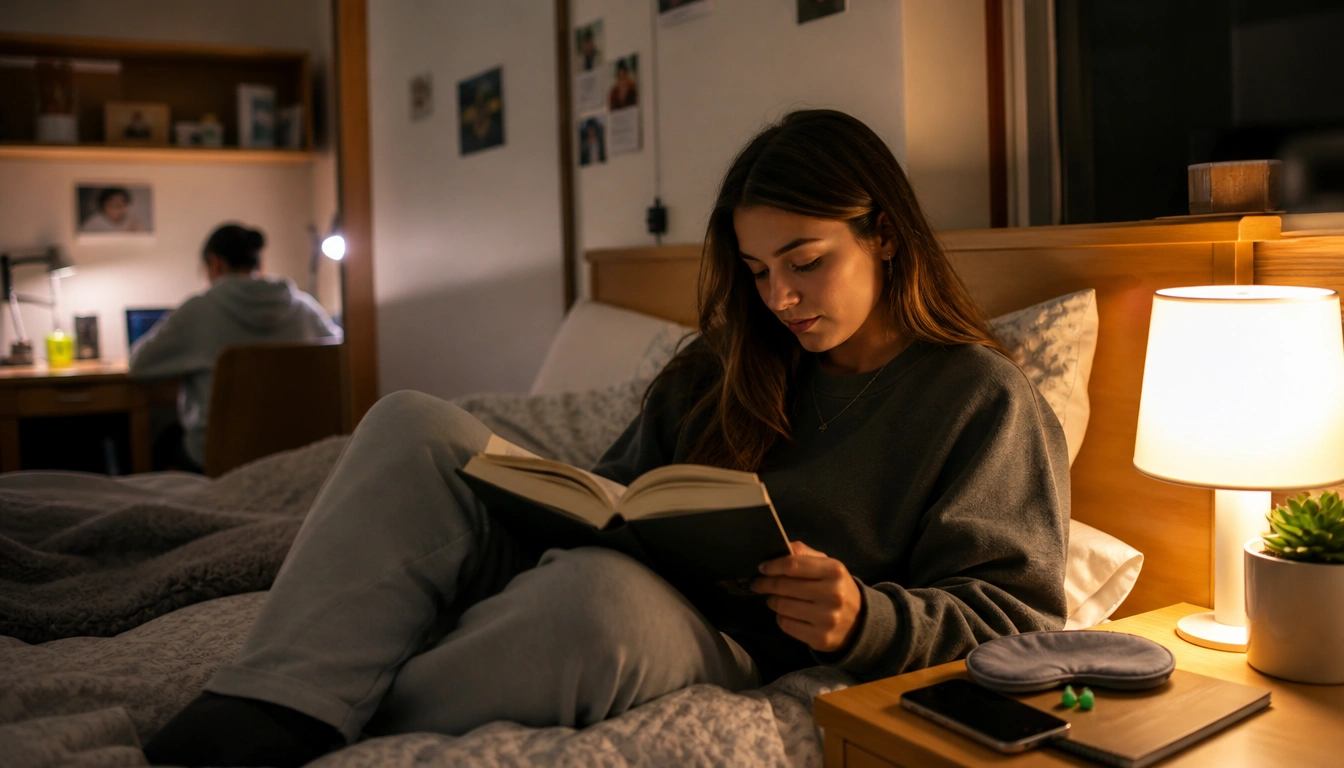
In the hour before bed, shift your room and your habits toward sleep: dim overhead lights, switch screens to night mode or put them away, do a quick brain dump of tomorrow’s tasks, and keep the last part of the evening quiet and low stimulation. If you share space with roommates, use warm lamps, eye masks, earplugs, or white noise rather than trying to force a perfectly dark room.
Key Takeaways
- Start lowering light and stimulation about 30 to 60 minutes before bed so your body gets a clear signal that sleep is coming.
- A realistic low-light routine matters more than a perfect one; dorms and shared apartments need practical workarounds.
- Caffeine, late alcohol, and mentally loaded scrolling can all push sleep later or make it lighter.
- If you are still awake after about 20 minutes, get out of bed briefly and reset in dim light instead of fighting sleep.
- Weekend sleep-ins that are dramatically later than weekday wake times can make Sunday night sleep harder.
- If insomnia lasts for months, or you have snoring, gasping, or daytime impairment, it is time to get medical help.
Why low-light evenings matter for college sleep
A low-light evening routine for college students works because sleep is not just about feeling tired. Your brain is timing a daily rhythm all day long, and light is one of its strongest signals. According to the NIH and other sleep authorities, bright evening light can delay melatonin release and make it harder to feel sleepy at your intended bedtime. That is especially relevant for students who already tend to stay up later because of class schedules, social plans, or late-night study habits.
Low light does more than reduce glare. It also helps your body make the transition from alertness to drowsiness. A softer environment tells the brain the day is winding down, which supports the natural drop in arousal that comes before sleep. That is why the last hour before bed matters: it is not a magic switch, but it is a useful buffer between campus life and rest.
For college students, the goal is not to create a perfect sleep lab. The goal is to make the evening feel meaningfully different from the afternoon. When your room gets dimmer, your screen use slows down, and your brain has fewer reasons to keep solving problems, sleep usually becomes easier to start.
A realistic 60-minute countdown to bed
About 30 to 60 minutes before sleep, begin shrinking the intensity of the evening. If you usually go to bed at midnight, that means starting your wind-down around 11:00 or 11:15 p.m. This timing is practical because it gives your brain enough notice to shift gears without making the routine feel like a chore.
Start by lowering bright light. Turn off overhead fluorescents if you can and switch to one warm bedside lamp or a small accent light. If you still need your phone or laptop briefly, use night mode, lower the brightness, and keep the screen farther from your face. Then move to a small closing ritual: finish the last task of the night, set out what you need for tomorrow, and stop open-ended work that tends to pull you into another hour of scrolling or studying.
Next, do a quick cognitive offload. Write down tomorrow’s top tasks, any deadlines, and anything you do not want to forget. This gives your brain permission to stop rehearsing them in bed. A few minutes later, shift into quiet, repetitive, low-stimulation activities such as showering, stretching, reading something dull and physical, or listening to calm audio at a low volume. Save intense conversations, problem sets, and emotionally charged content for earlier in the evening.
If you use caffeine, alcohol, or heavy food, that belongs in the same timing window. Caffeine late at night can keep your brain alert long after you feel normal again. Alcohol may make you sleepy at first, but it often fragments sleep later in the night. A low-light routine works best when it is paired with a quieter body and a quieter brain.
How to adapt the routine in a dorm or shared apartment
Dorms and shared apartments rarely give you full control over the environment, so flexibility matters. If you cannot dim the whole room, control your immediate area. A warm-toned lamp, a clip-on light with a shade, or an amber bulb can make your side of the room feel calmer without demanding that your roommate stop living their life. If the main light has to stay on, turning away from it or placing a small screen, pillow, or room divider between your bed and the brightest source can still help.
Screen settings are another useful compromise. Night modes and reduced brightness do not eliminate all alerting light, but they can soften the input enough to help. If you are studying late, try keeping your laptop at a lower brightness and avoiding full-screen video unless it is necessary. If you share a TV or game console, stop using it as part of your wind-down and move to a lower-stimulation activity instead.
Noise matters too. In campus housing, hallway sounds, alarms, and roommates moving around can wake you up even when the room is dark. Earplugs, a fan, or white noise can help smooth out those spikes. Eye masks are useful if you cannot control hallway light, someone comes home late, or a roommate keeps a desk lamp on. The best dorm sleep setup is usually not the darkest one; it is the one that reduces the main interruptions enough for your body to settle.
If your room is busy, try thinking in zones: a brighter study zone earlier in the evening, then a dimmer sleep zone closer to bedtime. That kind of separation helps your brain stop associating the bed with alert work.
What to do about studying, scrolling, and mental overload at night
College nights are often mentally noisy, not just physically bright. Late studying, social media, and group chats can leave your brain in a state of unfinished business, which is one reason you may feel tired but unable to drift off. The fix is not to demand that your mind “turn off.” It is to reduce what it has to keep holding.
One of the most useful habits is cognitive offloading. Keep a notebook near your bed and write down the next action for any assignment, exam, errand, or message you are worried about. If a thought keeps repeating, put it on paper instead of rehearsing it in your head. The point is not to solve everything before sleep; it is to stop your memory from working overtime.
For scrolling, set an end point before you start. Without one, phone use tends to expand into “just one more minute” loops that keep your attention activated. If you need a transition, choose something boring and predictable: packing your bag, laying out clothes, washing your face, or reading a few pages of a book you do not mind forgetting. These habits work because they lower stimulation, not because they are trendy.
If you are studying late because a deadline is real, keep the final stretch efficient. Focus on finishing, not perfecting. The more you can avoid last-minute high-intensity cognitive work, the easier it is for your body to match the environmental cue that sleep is near.
Food, caffeine, and alcohol timing that can make or break sleep
What you consume late in the evening can undo some of the benefit of a low-light routine. Caffeine is the most common issue for college students because it hides in coffee, energy drinks, pre-workout products, tea, soda, and some “focus” drinks. The NIH notes that caffeine can interfere with sleep, and many students underestimate how long it stays active. If you plan to sleep at midnight, an evening caffeine habit can still matter much earlier than that.
A useful rule is to stop caffeine well before bedtime rather than trying to judge it by how awake you feel in the moment. Students who are sensitive, anxious, or already sleep deprived may need an even earlier cutoff. Alcohol is not a sleep tool either. It may make you feel drowsy, but it tends to break up sleep later in the night and can make sleep feel less restorative.
Heavy, greasy, or very spicy meals right before bed can also make it harder to settle. You do not need a perfect dinner, but it helps to avoid making the last hour a time for large, stimulating, or uncomfortable eating. If you get hungry late, a small, simple snack is usually less disruptive than a heavy meal. The idea is to make your body feel calm enough to sleep, not overly full, wired, or uncomfortable.
For many students, the biggest win is not eliminating every evening habit. It is moving the disruptive ones earlier and making the final hour more predictable.
When you can’t fall asleep
If you are lying in bed awake for about 20 minutes and sleep is not coming, do not force it. Staying in bed frustrated teaches your brain to connect the bed with wakefulness, which can make the problem worse over time. A better approach is to get up briefly and reset in dim light.
Move to a chair or another quiet spot and do something low-stimulation. Good options include reading a physical book, listening to calm music at a low volume, or doing a simple breathing exercise. Avoid bright lights, phones, doomscrolling, and homework that requires active problem-solving. Those activities can wake you up more than they help.
Return to bed when you feel sleepy again, not when you feel annoyed that you should be asleep. If you do this consistently, you are teaching your brain that bed is for sleep, not for struggling. That association matters as much as the lighting itself.
This reset is especially useful for college students whose minds stay active after a stressful day. It gives your nervous system a chance to downshift without turning the night into a battle.
Weekend and schedule consistency
Sleeping in on weekends can feel like recovery, but dramatic schedule shifts often create a different problem. If you stay up much later and sleep much later on Friday and Saturday, you may move your body clock enough to make Sunday night sleep harder. That mismatch is often called social jetlag: your weekday and weekend rhythms stop lining up.
For students, the result is familiar. Monday feels like you are starting over, and Sunday night becomes a time when you are tired but not sleepy at the right hour. Keeping your wake time relatively stable is one of the most effective ways to protect your rhythm. That does not mean every weekend has to be identical. It means avoiding huge swings that confuse your internal clock.
If you need extra recovery, a short nap earlier in the day is usually less disruptive than sleeping half the morning away. You can also let yourself sleep a little later while keeping the difference modest. The goal is to rest without erasing the signals that keep your sleep schedule anchored.
A steady routine also makes your low-light wind-down easier to repeat. The more your sleep and wake times stay within the same range, the less effort it takes for your body to recognize bedtime.
When low-light routines are not enough
A low-light routine is helpful, but it is not a substitute for medical evaluation when sleep problems are persistent or severe. If trouble falling or staying asleep lasts for 3 months or longer, or if poor sleep is affecting your classes, mood, safety, or daily functioning, it is time to talk with a healthcare professional. Chronic insomnia can have more than one cause, and sleep hygiene alone may not solve it.
There are also red flags that deserve attention sooner. Loud snoring with gasping, witnessed breathing pauses, severe morning headaches, or sleep that never feels restorative despite enough time in bed can point to an underlying sleep disorder. Restless legs symptoms, significant anxiety, depression, or medication effects can also interfere with sleep in ways a lighting routine cannot fix.
That does not mean your habits are useless. It means they are part of a broader picture. A good evening routine can support treatment, but it should not be used to delay care when symptoms are persistent or clearly out of proportion to ordinary student stress. If you have tried consistent habits and sleep still is not improving, getting evaluated is a practical next step, not an overreaction.
For many students, the right routine makes sleep easier within days or weeks. If it does not, the goal shifts from self-help to figuring out what is actually driving the problem.
Frequently Asked Questions
How much time before bed should I dim lights and stop screens?
Aim to start dimming lights and reducing screens about 30 to 60 minutes before bed. That window gives your brain time to shift from alert mode into sleep mode without making the routine feel abrupt.
What can I do in a dorm or shared room if I can’t control the lighting?
Focus on your own space: use a warm lamp, lower your screen brightness, wear an eye mask, and add earplugs or white noise if the room is noisy. Small changes still help even when you cannot control the whole room.
Does blue light from phones and laptops really affect sleep?
Yes, evening screen light can contribute to sleep delay, especially when exposure is bright or prolonged. The effect is not only about blue light; it is also about stimulation, attention, and how long you stay engaged with the device.
How late can I drink caffeine and still sleep well?
There is no perfect cutoff for everyone, but caffeine late in the day can definitely interfere with sleep. If you plan to sleep at midnight, many students do better by avoiding caffeine well before the late evening, especially if they are sensitive to it.
What should I do if I’m lying awake in bed and can’t fall asleep?
If you are awake for about 20 minutes, get out of bed and do something quiet in dim light until you feel sleepy again. Do not turn on bright lights or start scrolling, because that can make it harder to fall asleep when you return.
The Bottom Line
A low-light evening routine helps college students sleep by reducing both physical light and mental stimulation in the hour before bed. The most useful habits are simple: dim the room, quiet the screens, offload tomorrow’s tasks, and keep the last part of the night predictable.
In dorms and shared apartments, you usually need workarounds rather than perfection. Warm lamps, night mode, eye masks, earplugs, and white noise can make a real difference. If sleep still is not improving after consistent effort, or you have snoring, gasping, or persistent insomnia, get evaluated rather than just trying harder.
Medical disclaimer
Medical disclaimer: This content is for educational and informational purposes only and is not a substitute for professional medical advice, diagnosis, or treatment. Dietary needs and supplement suitability vary by individual.
Sources
- National Institutes of Health (NIH) — nih.gov. Accessed November 2026.
- Academic Research Institution — ncsu.edu. Accessed November 2026.
- Academic Research Institution — uab.edu. Accessed November 2026.
- Academic Research Institution — colostate.edu. Accessed November 2026.
- Academic Research Institution — usc.edu. Accessed November 2026.
