
For students working shifts, the best bedtime routine is the one matched to your shift and sleep window, not a universal 10 p.m. rule. After nights, focus on light control, a short wind-down, and a daytime sleep setup. Before evening or early-morning shifts, stop caffeine well before sleep, dim light later in the day, and keep a partial anchor schedule on days off so your body clock does not swing wildly.
Key Takeaways
- Daytime sleep after a night shift is usually shorter and lighter, so protect it with blackout, quiet, and a predictable wind-down.
- If one long sleep block is impossible, split sleep can help students reach a workable total sleep amount across the day.
- Use caffeine as a timing tool: it can support alertness during the shift, but it should stop 5–6 hours before planned sleep.
- For overnight work, drowsy driving is a real safety issue; transit, carpooling, or a short nap before driving can reduce risk.
- A partial anchor schedule on days off can limit circadian whiplash without forcing an unrealistic full return to a normal daytime routine.
How shift work changes the sleep problem for students
A bedtime routine for students working shifts has to solve a circadian problem, not just a motivation problem. Standard advice such as “sleep at night” assumes your body is ready to switch off when the sun goes down. Night, evening, and early-morning work breaks that pattern. Your internal clock is still responding to light, temperature, and hormone rhythms that promote wakefulness at some times and sleep at others.
That is why a student can feel exhausted after a night shift and still struggle to fall asleep during the day. Morning light, noise, and an alerting body rhythm all push in the same direction. Sleep after overnight work is often shorter and more fragmented, which can reduce the kind of deep and REM sleep that supports memory, concentration, and learning. The result is not just feeling tired; it can show up in slower reading, weaker lecture retention, and more mistakes in labs, clinics, or part-time work.
For students, the practical goal is not perfect sleep every day. It is a routine that protects enough total rest, keeps alertness high enough for class and work, and reduces the most damaging swings between sleep and wake schedules.
Choose the right routine based on your shift type
The routine should match the shift you are coming off or going into. A post-night-shift day needs a different plan than a pre-evening-shift evening or an early-morning start. That is especially important for students who cannot simply sleep whenever they want because of lectures, seminars, lab blocks, or commuting.
After a night shift: get home with as little bright light exposure as possible, then move into a short wind-down and daytime sleep block. The priority is to reduce alerting signals fast enough that you can sleep before the day fully ramps up.
Before an evening shift: use the daytime for normal classes, errands, and study, then begin dimming light and reducing stimulation as the shift gets closer. The goal is to feel alert for work without borrowing too much sleep from the next day.
Before an early-morning start: your routine often has to begin earlier in the evening. This is where consistent sleep timing, a cut-off for caffeine, and an earlier wind-down matter most. Students who are natural night owls may tolerate evening work better than early starts, but even they usually need a deliberate bedtime routine to avoid sliding into sleep debt.
Build a 30–60 minute wind-down that matches your sleep window
Your wind-down should be brief, predictable, and built around the sleep window you are trying to protect. After a night shift, the nervous system is often still “on,” especially if you have been solving problems, taking exams, or managing patients and customers. A short routine helps the brain shift out of alert mode.
Start by lowering stimulation. Put away schoolwork, stop scrolling, and reduce notifications. If you need screens for a last-minute message or to check transit, keep the session short and dim the display as much as possible. Bright light in the last hour before daytime sleep can make it harder to fall asleep.
Food timing matters too. If you are hungry, a light snack is usually easier on sleep than a large meal. Heavy, greasy, or spicy food can lead to reflux or discomfort when you lie down. Avoid alcohol as a sleep shortcut; it may make you sleepy at first, but it tends to fragment sleep later.
Finally, use a quick mental offload. Spend 10 to 15 minutes writing down assignments, reminders, or worries that keep looping in your head. That makes it easier to stop rehearsing tasks once you lie down. For many students, the best wind-down is not elaborate; it is simply consistent enough that the brain learns what happens next.
Design the sleep environment for daytime recovery
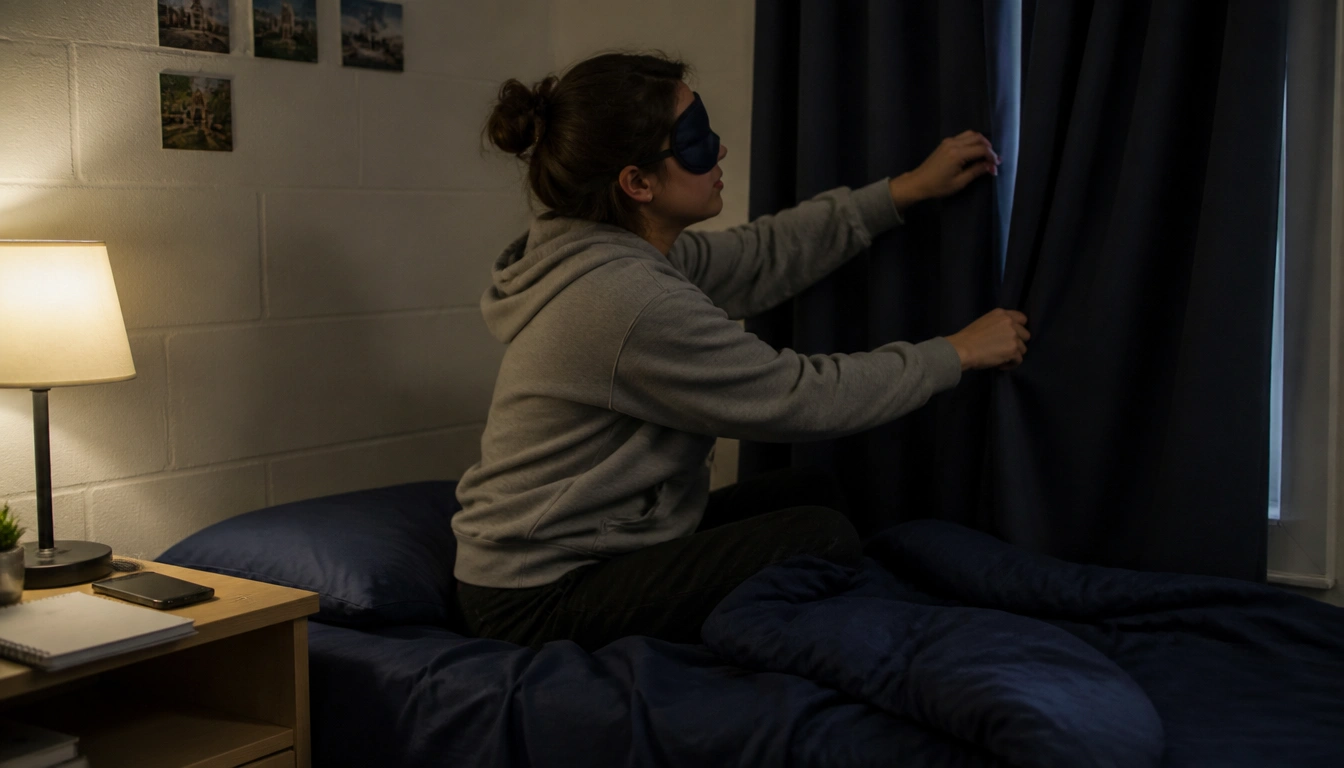
Daytime sleep works better when the room feels as close to nighttime as possible. Blackout curtains are the strongest option, but an eye mask can help if you live in shared housing or cannot fully darken the room. Small light leaks matter more than people expect, especially after an overnight shift when your body is already trying to stay awake.
Noise control is just as important. Earplugs, a white noise machine, a fan, or sound masking from a sleep app can reduce the impact of roommates, traffic, or daytime household activity. If you live in a noisy dorm or apartment, combine more than one strategy rather than hoping one fix will solve everything.
Temperature also matters. A cool room is usually easier to sleep in than a warm one, and a slightly cooler setup can help your body settle into rest. If you are coming home from a shift, a small practical step is to make your sleep space ready before you leave work: curtains closed, bed clear, alarms set, and phone on do-not-disturb. That way you are not building the room while your brain is already trying to stay alert.
If you commute home in bright morning light after a night shift, dark sunglasses can help reduce the signal that says “stay awake.” That small step can make a real difference in how quickly you fall asleep once you get home.
Use split sleep when classes make one long block impossible
Many students cannot get one uninterrupted sleep block because class schedules, labs, family responsibilities, or shift timing get in the way. In that case, split sleep is a reasonable strategy. The aim is to combine a main sleep period with a nap or second sleep period so your total rest is closer to what your brain and body need.
A common pattern is a shorter main sleep after the shift, followed by a later nap before class or work. For example, if you finish an overnight shift and have an early class, you may sleep for a core block as soon as you get home, then take another nap later in the day. The exact timing will depend on your commute and class load, but the principle is the same: do not treat the first sleep block as your only sleep opportunity if the day will be long.
Split sleep works best when both pieces are protected. That means keeping the nap short enough that it does not ruin the next sleep window, and keeping the main block dark and quiet enough that it is real sleep, not just lying in bed while your brain stays half-alert. Students sometimes worry that split sleep is “less healthy” than one long sleep. For shift workers, a practical split routine is often better than repeatedly falling short of total sleep.
The trade-off is that split sleep requires planning. Put the nap on your calendar, protect it like a class, and avoid filling the gap with caffeine too late in the day.
Manage caffeine strategically
Caffeine is not the enemy; mistimed caffeine is. For shift-working students, the useful question is not whether to drink caffeine, but when to use it so it supports the shift without sabotaging the next sleep window. Caffeine can improve alertness during the early part of a shift or during a long study block, but it should not be used as a late-shift rescue tool if sleep is coming soon.
A practical rule is to stop caffeine 5 to 6 hours before your planned sleep time. That matters more than a fixed clock time because your sleep window changes with your shift. If you plan to sleep at 8 a.m. after a night shift, caffeine late in the shift is likely to linger into the time you are trying to fall asleep. If you are starting an evening shift and plan to sleep near midnight, your caffeine cutoff needs to shift earlier too.
Try to place most of your caffeine in the first half of your wake period or first half of the shift. That gives you a better chance of staying functional without creating a cycle where you need more caffeine to recover from caffeine-related sleep loss. Energy drinks and pre-workout products can be especially easy to overuse because they are convenient during busy student days, but the same timing issue applies.
Think of caffeine as a schedule-based tool, not a default habit. If you regularly need it late in the shift just to stay safe, that is a sign the schedule, sleep opportunity, or workload needs adjustment.
Protect academic performance and safety
Sleep is not only about feeling rested. For students, it affects memory consolidation, attention, and decision-making. That is why the best study time is usually not the very end of a shift or the middle of a foggy commute. When possible, use your clearest alertness window for work that requires comprehension, recall, or careful problem-solving. For some students, that may mean studying shortly after waking rather than after several hours of fatigue.
Be especially careful with driving after overnight work. Drowsy driving is a safety issue, not just an inconvenience. If you are struggling to keep your eyes open, drifting in your lane, missing turns, or feeling mentally blank, do not assume you can “push through” safely. Public transit, a ride from a friend, carpooling, or a short nap before driving are all better options than driving while heavily sleepy.
If you do take a nap before getting behind the wheel, keep it brief enough to improve alertness rather than leave you groggy. The point is to reduce risk, not to force yourself through a dangerous drive because you feel guilty about being late.
Seek professional help if you have persistent insomnia, strong difficulty sleeping even when the schedule allows it, or signs that your shifts are causing ongoing problems with mood, concentration, or safety. A campus clinician, primary care clinician, or sleep specialist can help you sort out whether you are dealing with shift work sleep disorder, another sleep problem, or a schedule that needs modification.
Keep a partial anchor schedule on days off
Days off are where many shift-working students lose momentum. Sleeping at wildly different times on weekends or between class days can create circadian whiplash, making the next shift feel harder than it needs to be. A full reset to a normal daytime schedule may sound appealing, but it often makes the return to work more difficult.
A partial anchor schedule is usually more realistic. The idea is to keep one core sleep window anchored across most days, even if the rest of the day shifts around it. That might mean preserving a similar sleep midpoint or a similar block of time most days, then allowing some flexibility for social plans, assignments, or recovery naps.
For example, if you usually sleep after a night shift, you might keep a similar late-morning or early-afternoon sleep anchor on days off instead of switching all the way to a late-night, early-morning routine. This reduces the size of the circadian jump when you go back to work. It also makes it easier to protect enough sleep on days when your academic workload is heavy.
Students often want days off to feel “normal,” but a partial anchor gives you more usable energy across the week. It is less about perfection and more about avoiding large swings that leave you jet-lagged in your own schedule.
Frequently Asked Questions
How can I sleep during the day after a night shift without wrecking my class schedule?
Use a split-sleep plan if needed: a core sleep block after the shift, then a shorter nap before class or later in the afternoon. Protect both sleep periods by lowering light, blocking noise, and keeping caffeine earlier in the shift.
What should I do in the 30–60 minutes before daytime sleep after an overnight shift?
Keep it calm and predictable. Dim screens, avoid a heavy meal, skip alcohol, and spend a few minutes writing down tasks or worries so your brain is less likely to stay in problem-solving mode once you lie down.
How much caffeine is too late when you have to sleep after a shift?
A useful rule is to stop caffeine about 5 to 6 hours before your planned sleep time. If your sleep window changes from day to day, the cutoff should move with it rather than staying tied to a fixed clock time.
Is split sleep a reasonable option for students with lectures after a night shift?
Yes. If one long sleep block is impossible, split sleep can help you get closer to a healthy total sleep amount. It works best when the main sleep block and nap are both protected and the nap is timed so it does not push sleep later.
How can I protect sleep on days off without making my schedule even more chaotic?
Use a partial anchor schedule instead of switching completely. Keep one consistent core sleep window across most days, then add flexibility around it for classes, social time, and errands. That reduces circadian whiplash when work starts again.
The Bottom Line
A bedtime routine for shift-working students should be built around the shift, the class schedule, and the sleep window you actually have. The biggest upgrades usually come from controlling light, protecting the sleep environment, timing caffeine well, and using split sleep when a full block is not realistic.
You do not need a perfect routine to get better sleep. A consistent wind-down, a darker and quieter room, safer post-shift travel, and a partial anchor schedule on days off can make your week more stable and your sleep more usable for classes, work, and recovery.
Medical disclaimer
Medical disclaimer: This content is for educational and informational purposes only and is not a substitute for professional medical advice, diagnosis, or treatment. Dietary needs and supplement suitability vary by individual.
Sources
- National Health Service (NHS) — tims.nhs.uk. Accessed November 2026.
- National Institutes of Health (NIH) — nih.gov. Accessed November 2026.
- Centers for Disease Control and Prevention (CDC) — cdc.gov. Accessed November 2026.
- National Health Service (NHS) — uhs.nhs.uk. Accessed November 2026.
