
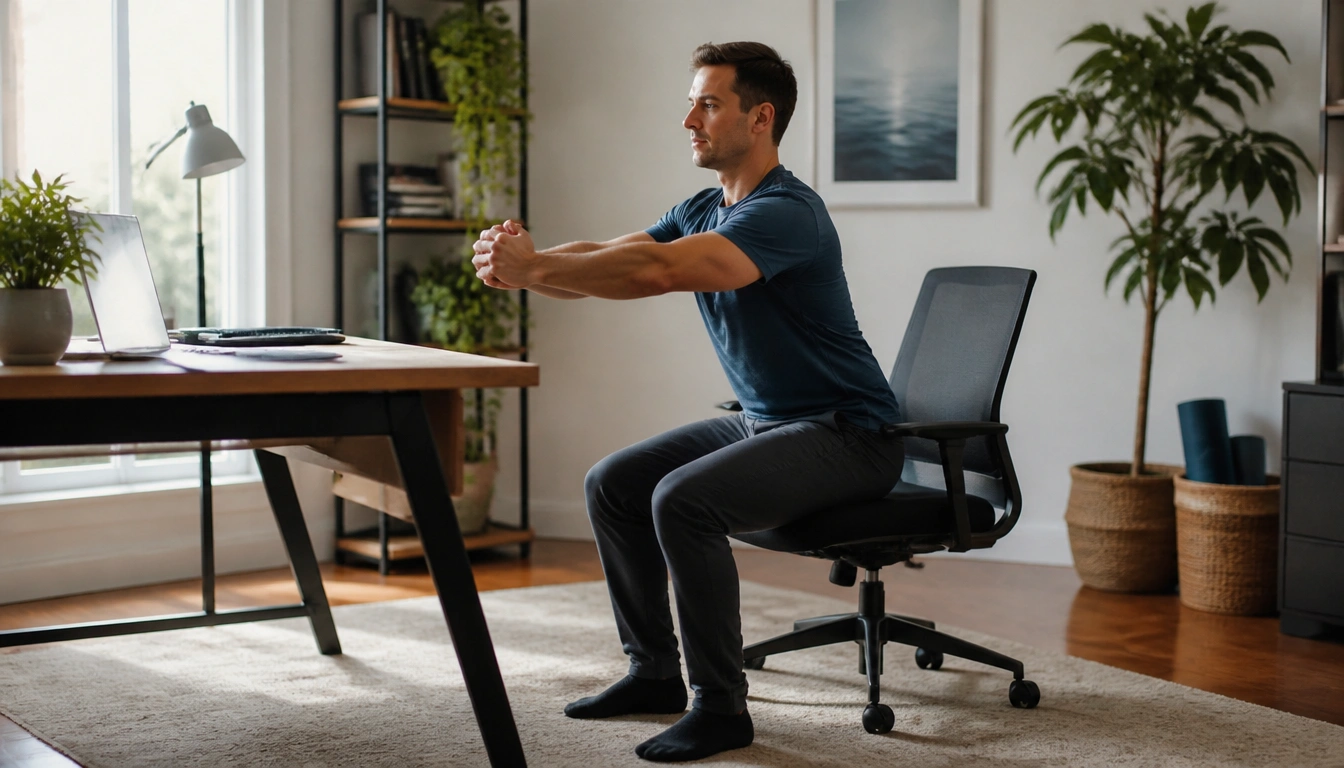
Use two non-consecutive 20- to 25-minute full-body strength sessions each week, then support them with small daily movement breaks and walking. For busy office workers, the simplest plan is not about doing more in one workout; it is about combining regular strength training with frequent movement so long sitting does not undo the rest of the week.
Key Takeaways
- Two strength sessions a week is a realistic beginner baseline, especially when the rest of the week includes short movement breaks and walking.
- A single workout cannot cancel out hours of sitting, so daily posture changes and brief walks still matter.
- Desk workers usually benefit most from squat, hinge, push, pull, and core exercises that strengthen the posterior chain and support posture.
- You do not need a gym to start: bodyweight moves and a resistance band can cover the basics well.
- Keep the plan sustainable by using short sessions, moderate effort, and gradual progression instead of trying to make each workout exhaustive.
Why office workers need both daily movement and dedicated strength sessions
A beginner strength schedule for busy office workers works best when you separate two goals: interrupting sedentary time and building strength. Sitting for long stretches keeps the hips bent, the upper back rounded, and the lower-body muscles quiet. That is one reason public health guidance emphasizes regular movement during the day as well as planned muscle-strengthening exercise.
Short movement breaks help your body more than waiting until evening to “make up” for sitting. Stand up during natural pauses, walk for a few minutes after calls, and change positions often. Those habits support circulation and reduce stiffness, but they do not replace dedicated training. For actual strength gains, your muscles still need direct challenge.
The practical takeaway is simple: daily movement keeps the workday from becoming one long sitting block, and strength sessions give your muscles a reason to adapt. The two jobs are related, but they are not the same.
How to use the 2-days-per-week baseline without overcomplicating it
The CDC, the U.S. Department of Health and Human Services, and other major public health bodies recommend muscle-strengthening activity for all major muscle groups on at least 2 days per week. For a beginner with a desk job, that is enough structure to start with. You do not need a complicated split routine or a long list of exercises.
A good beginner rule is to schedule two non-consecutive days, such as Tuesday and Friday or Wednesday and Saturday. Non-consecutive days give your muscles time to recover, which matters if you are new to resistance training or already feeling stiff from work.
Keep each session short enough that you can repeat it even during a busy season. Twenty to 25 minutes is a realistic target because it lowers the barrier to entry and still leaves room for the main movement patterns. If you can complete both weekly sessions consistently, that is a stronger foundation than a more ambitious plan you abandon after two weeks.
A simple weekly schedule for busy workers
The easiest way to fit strength training into a workweek is to give each type of movement a clear job. Strength sessions are your planned workouts. Walking and brief movement breaks are your daily maintenance.
One practical weekly rhythm:
- Monday: Stand and move for a few minutes every hour; add a short walk after lunch if possible.
- Tuesday: 20- to 25-minute full-body strength session.
- Wednesday: Walking break or another light activity day.
- Thursday: Short movement breaks through the workday; optional easy walk after work.
- Friday: 20- to 25-minute full-body strength session.
- Weekend: One or two longer walks, light recreation, or recovery days.
This is flexible on purpose. If your schedule is unpredictable, anchor the strength sessions to two days you can usually protect. Lunch hour, right after logging off, or before work can all work if you can repeat the pattern. The goal is a week that looks ordinary enough to sustain.
Walking still matters here. A few short walks across the day are easier to keep than one long, perfect session. If you enjoy it, try to build toward the general aerobic baseline recommended by public health agencies, but do not let that crowd out strength work. They serve different purposes.
Best beginner exercises for desk posture
Desk workers usually need more than chest and arm work. Sitting tends to tighten the front of the hips and encourage a rounded upper back, so the best beginner plan emphasizes the posterior chain and core as well as the basic push and pull patterns.
| Movement pattern | Beginner exercise | Harder option | Why it helps desk workers |
|---|---|---|---|
| Squat | Chair sit-to-stand | Bodyweight squat or goblet squat | Builds legs and glutes while training the body to stand and sit with control. |
| Hinge | Glute bridge | Hip hinge or Romanian deadlift with a band or light load | Targets glutes and the back side of the body, which often gets underused during sitting. |
| Push | Wall push-up | Incline push-up on a desk or counter | Builds chest, shoulders, and triceps without needing floor strength right away. |
| Pull | Band row | Two-arm or single-arm band row | Helps counter rounded shoulders and strengthens the upper back. |
| Core | Bird-dog | Modified plank or dead bug | Trains trunk stability without requiring a lot of equipment or floor time. |
If you only remember one thing, remember this: a desk worker’s routine should include both front-side and back-side work, but the back side often deserves extra attention. Glutes, upper back, and core stability matter because they help you move better after a day of sitting.
Start with movements that feel controlled and repeatable. The best exercise is not the fanciest one; it is the one you can perform with good form and come back to next week.
How to keep sessions short
Short sessions work when you focus on the minimum that still produces adaptation. For a beginner, that usually means 1 to 3 sets of each movement, moderate effort, and enough rest to keep form clean. You do not need to chase exhaustion.
A simple session might look like this:
- Chair sit-to-stand or squat
- Glute bridge or hip hinge
- Wall or incline push-up
- Band row
- Bird-dog or modified plank
Do each exercise for a small set of repetitions, rest briefly, then move to the next one. If a full circuit feels smoother, that is fine. If you prefer to finish all sets of one move before moving on, that works too. The main point is consistency.
Progress gradually. When you can complete the current version with good control and without feeling unusually strained, make one small change: add a few repetitions, use a slightly harder version, slow the lowering phase, or add a set. Avoid jumping from “easy” to “hard” too quickly, especially if your job already leaves you tired or stiff.
For many beginners, the right effort level is challenging but not punishing. You should feel that the muscles worked, but you should still be able to recover and return to your desk life without feeling wrecked.
How to reduce friction and make the plan stick
The biggest barrier for busy office workers is usually not knowledge. It is friction. The plan has to fit into a real week, with meetings, fatigue, commutes, and interruptions. That is why the easiest routine is often the one that requires the fewest decisions.
Make the setup almost automatic:
- Keep a resistance band in your bag or at your desk.
- Choose two standing appointment times on your calendar.
- Pair workouts with an existing habit, such as after your morning coffee or before your evening shower.
- Use phone or calendar reminders to prompt movement breaks.
- Keep a spare workout option for very busy days, such as a 10-minute version of the same session.
That last point matters. On a chaotic day, doing a shortened version is better than skipping the routine entirely. If you can reliably show up for something small, you keep the habit alive long enough to build progress later.
Equipment-light plans also help. Bodyweight training lowers the barrier to entry, and bands are a useful next step because they add resistance without requiring a gym. The less you have to prepare, the more likely you are to repeat the session.
How to adjust for stiffness, older age, or joint discomfort
Not every beginner starts from the same place. If you already feel stiff from sitting, have had a long exercise break, or are older and want to protect your joints, the best approach is to start conservatively and let the routine earn your confidence.
Reduce the range of motion if a movement feels awkward. Use a higher chair for sit-to-stands, keep push-ups on a wall instead of the floor, and choose supported rows with a band. If balance feels unsteady, stand near a counter or wall for support. These changes are not “cheating”; they are how beginners make the exercises usable.
Older adults can benefit from the same 2-day baseline, but balance and stability deserve attention as well. Controlled movements, slower tempo, and careful posture tend to be more valuable than speed. If stiffness is related to a recent flare-up or a known joint problem, choose the least irritating version and progress only when symptoms settle.
For general soreness, mild muscle fatigue that improves over a day or two is different from joint pain that worsens during movement. That distinction matters when you are deciding whether to modify, rest, or ask for advice.
Safety notes: when to stop and seek medical advice
Beginner strength training should feel manageable, not reckless. Stop the session and seek medical advice if you have sharp or worsening joint pain, chest discomfort, dizziness, faintness, unusual shortness of breath, numbness, tingling, or pain that radiates down an arm or leg. Those are not signs to push through.
You should also speak with a healthcare professional before starting if you have a diagnosed heart condition, significant joint injury, balance problems that are not explained, or another medical issue that makes exercise uncertain. Pregnancy and other individual situations may also call for tailored guidance.
If your stiffness feels normal but lingers longer than expected, reduce the workload and check your form before you add more. If a movement consistently aggravates the same area, swap it for an easier version instead of trying to tough it out. The aim is steady progress, not proving tolerance.
For office workers, the safest plan is usually the one that respects fatigue, starts modestly, and builds gradually. That is how you get stronger without turning a busy week into a recovery problem.
Frequently Asked Questions
How often should a beginner office worker do strength training each week?
A good starting point is 2 non-consecutive days per week. That matches public health guidance for muscle-strengthening activity and gives you enough recovery time between sessions. If you are also walking and taking movement breaks during the week, that combination is usually more realistic than trying to do a longer workout every day.
What is the minimum effective strength workout if I only have 20 minutes?
Use a short full-body session with 4 to 5 movements: squat or sit-to-stand, hinge or glute bridge, push-up variation, row, and a core exercise. Keep the effort moderate, use brief rest, and focus on form. A short, repeatable session done consistently is more useful than an occasional perfect workout.
Can I do strength training at home with no equipment?
Yes. Chair sit-to-stands, wall push-ups, glute bridges, bird-dogs, and split-stance holds can cover the main movement patterns without equipment. A resistance band is helpful, but not required to begin. Home training works well if it is simple enough that you can repeat it on busy days.
How should I progress if my job already leaves me stiff or tired?
Progress slowly. Start with easier exercise versions, fewer sets, and moderate effort. Add one small change at a time, such as a few more repetitions or a slightly harder variation, only when the current level feels controlled. If fatigue is high, keep the session short instead of trying to force more volume.
When should a desk worker avoid exercising and get medical advice instead?
Get medical advice if you have sharp or worsening pain, chest discomfort, dizziness, fainting, numbness, tingling, or pain that shoots into an arm or leg. Also check with a clinician before starting if you have a known heart condition, major joint injury, or another condition that makes exercise uncertain.
The Bottom Line
A beginner strength schedule for busy office workers does not need to be elaborate. Two non-consecutive full-body sessions each week, plus small daily movement breaks, is a practical place to start and easier to maintain than a complicated plan.
Choose simple exercises that work the squat, hinge, push, pull, and core patterns. For desk-bound adults, extra attention to glutes, upper back, and trunk stability can help offset the posture demands of sitting all day.
If you keep the plan short, use equipment-light options, and progress gradually, it becomes much more likely to survive a demanding workweek. If pain or unusual symptoms show up, slow down and get medical advice instead of pushing through.
Medical disclaimer
Medical disclaimer: This content is for educational and informational purposes only and is not a substitute for professional medical advice, diagnosis, or treatment. Dietary needs and supplement suitability vary by individual.
Sources
- National Institutes of Health (NIH) — nih.gov. Accessed November 2026.
- National Health Service (NHS) — www.nhs.uk. Accessed November 2026.
- Centers for Disease Control and Prevention (CDC) — cdc.gov. Accessed November 2026.
- American College of Sports Medicine (ACSM) — acsm.org. Accessed November 2026.
