
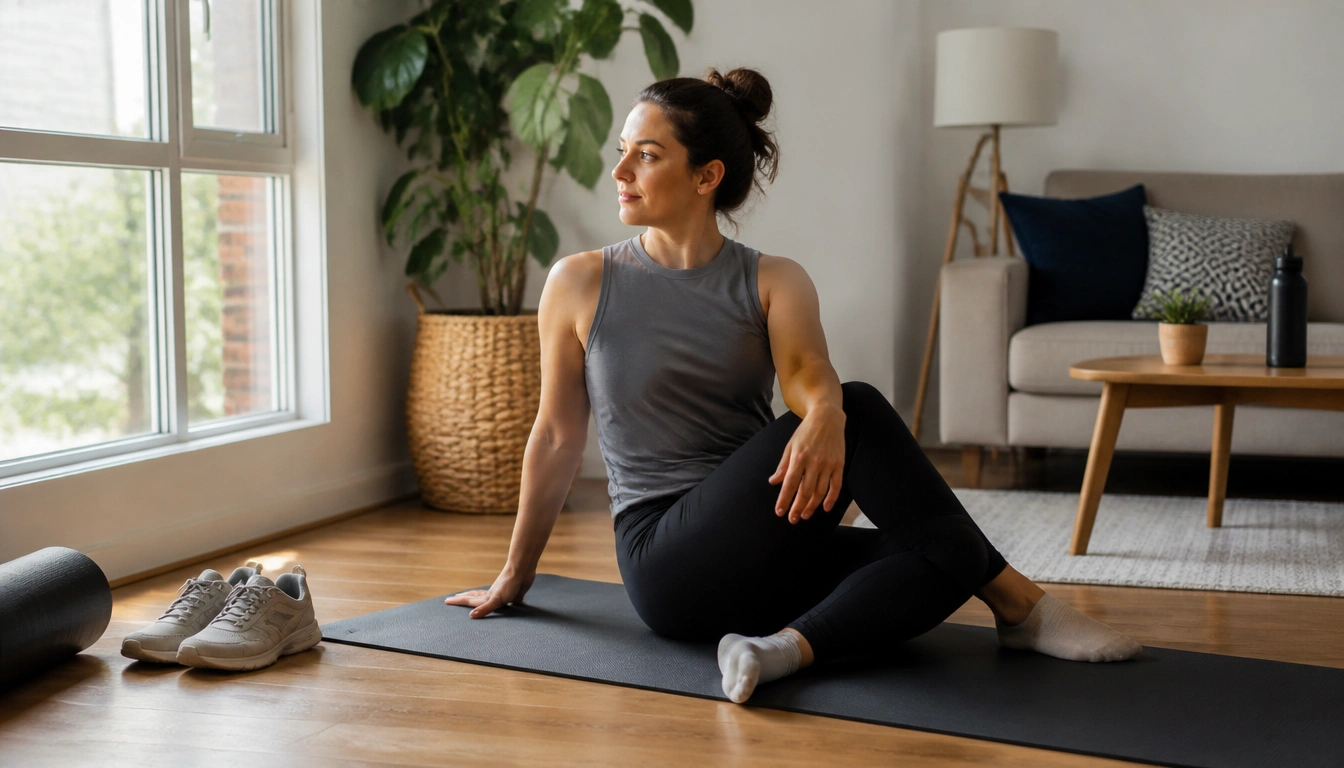
On a rest day at home, choose low-intensity movement that helps you recover instead of training harder. Good options include easy walking, gentle mobility work, restorative yoga, light chores, or pacing around the house at a conversational pace. If the movement leaves you more tired, more sore, or less ready for your next workout, it is probably too much.
Key Takeaways
- Active rest is not a workout. It should feel easy, leave room to talk, and support your next session rather than compete with it.
- Home-based recovery can be simple: a short walk, a mobility flow, restorative yoga, easy cycling, or relaxed chores all count if the effort stays light.
- The right amount depends on your baseline fitness. What feels like recovery for one person may feel like exercise for another.
- Mild soreness and stiffness often improve with gentle movement. Sharp pain, swelling, or altered movement patterns are warning signs to stop.
- If recovery activity increases anxiety or feels mentally draining, complete rest may be the better choice for that day.
What active rest day means for home exercisers
An active rest day is a low-effort day that helps your body recover while you keep moving a little. For people who train at home, that might mean a short walk, easy mobility work, or light chores done at a relaxed pace. The goal is to support circulation, reduce stiffness, and maintain the habit of daily movement without creating new fatigue.
That is different from passive rest, where you intentionally do very little physical activity. Passive rest can be useful after a very hard session, during illness, or when pain or burnout is building. The American College of Sports Medicine and the CDC both support regular movement as part of a healthy routine, but recovery days should still match your needs and not feel like hidden training.
A useful way to think about active rest is this: you should finish feeling better than when you started. If the activity feels like exercise, raises your breathing too much, or leaves your muscles more drained, it has crossed the line into a workout.
How to judge recovery intensity at home
You do not need equipment or exact heart-rate targets to judge active rest well. Start with effort markers you can feel in real life. A recovery session should stay at a conversational pace, meaning you can speak in full sentences without gasping. It should also stay low on perceived effort, closer to “easy” than “moderate.”
Another useful test is the readiness check. After the movement, ask yourself whether you feel looser, calmer, and more prepared for your next workout. If the answer is yes, the session probably stayed in the right zone. If you feel wiped out, unusually sore, or less eager to move tomorrow, the session was too demanding.
Fitness level matters here. A brisk walk may be true recovery for a regular exerciser, while a beginner or someone coming off a hard bodyweight session may need something gentler, such as a few minutes of mobility and standing breaks. According to the NHS, it is sensible to build activity gradually and match it to your current ability rather than forcing a one-size-fits-all target.
Best active rest day ideas without gym equipment
Home recovery works best when it is simple enough to do even on low-motivation days. Dynamic mobility flows are a strong option because they move joints through a comfortable range without loading them heavily. Think cat-cow, thoracic rotations, ankle circles, hip openers, shoulder rolls, and easy spinal twists. Keep the pace smooth and unhurried.
Easy walking is another reliable choice. A casual neighborhood loop, a few laps around your block, or even several short indoor walking breaks can increase blood flow without taxing sore muscles. If weather or space is an issue, pacing while taking a phone call can still count as light recovery movement.
Light cycling, if you have a stationary bike or a safe easy route, can also work well because it is low impact. Restorative yoga and gentle stretching can help when stiffness is the main issue, especially after long sitting or strength work. The best version is one that feels restorative, not intense.
Household movement can count too. Slow tidying, light gardening, folding laundry, or carrying out small chores at an easy pace can break up sedentary time. The point is not to “make chores into cardio”; it is to use normal movement as a recovery-friendly way to stay loose and avoid sitting all day.
How to match the activity to your training type and fitness level
Different exercisers need different recovery doses. Beginners often benefit from the simplest version: brief walks, basic mobility, and a little extra standing or gentle movement throughout the day. That is usually enough to reduce stiffness without adding more strain to tissues that are still adapting.
Regular home exercisers can usually tolerate a bit more, especially after moderate bodyweight routines, yoga flows, or light cardio. For them, active rest might be a 20- to 30-minute easy walk, a relaxed mobility circuit, or light cycling at a pace that feels almost too easy. Research and professional guidance from organizations such as ACSM support the idea that recovery should match training load and individual fitness rather than follow a rigid formula.
Older adults and people with joint wear-and-tear often do best with low-impact, balance-friendly movement. That may include short walks, gentle range-of-motion drills, seated or supported mobility work, and carefully chosen yoga poses. After heavier training days, keep the next day very light. Recovery should help muscles settle down, not repeat the stress of the previous session.
When active rest helps most
Active rest tends to help most when the main issue is mild soreness, stiffness, or a sluggish feeling after sitting too long. Gentle movement can make tissues feel less tight and can help you work through ordinary delayed-onset muscle soreness, especially when the soreness is general rather than sharp or pinpointed. The National Institutes and public health guidance commonly emphasize staying active while avoiding long stretches of sedentary time.
It can also be useful on sedentary workdays. If you train at home but spend much of the day at a desk, recovery movement can keep your hips, back, and shoulders from locking up. A few short movement breaks may do more for how you feel than a single long stretch session.
There is also a habit-maintenance benefit. A very easy active rest routine helps many people keep a daily rhythm without sliding into an all-or-nothing mindset. That matters for home exercisers, where the line between “rest day” and “skip everything” can get blurry.
When to skip active recovery and choose full rest
Active rest is not the right choice for every situation. If pain is sharp, localized, worsening, or different from typical soreness, stop and rest. Swelling, warmth, visible inflammation, sudden weakness, or movement that changes your gait or form are warning signs. Those symptoms are more consistent with injury or another medical issue than with normal post-workout stiffness.
Full rest is also reasonable when movement makes you feel worse rather than better. If even gentle walking increases pain, or if a mobility drill irritates a joint, back off. The same is true when you are exhausted from poor sleep, illness, or several demanding training days in a row.
There is a mental-recovery exception too. If active recovery creates anxiety, guilt, or mental fatigue, passive rest may be the healthier choice. Recovery is not only physical; it also includes giving your nervous system a break. If you have a chronic condition, recurrent pain, or ongoing joint symptoms, the CDC and other health authorities recommend talking with a healthcare professional about the safest way to stay active.
A simple at-home active rest day template
Use this as a flexible template rather than a fixed prescription. In the morning, start with a few minutes of gentle movement after you get up: shoulder rolls, ankle circles, cat-cow, hip hinges, or a short walk around the room. The purpose is to reduce morning stiffness and wake up the body without “starting the workout.”
Midday, choose one easy movement break. That could be a relaxed neighborhood walk, light gardening, pacing while on the phone, or a short mobility flow. If you already sat for a long time, this is a good time to stand up, move your joints, and reset your posture. Keep the effort so low that you could repeat it later without dreading it.
In the evening, pick the calmest option that still feels good: restorative yoga, easy stretching, a very slow walk, or simply a few minutes of gentle mobility before bed. If you feel loose and rested, stop there. If you feel more tired than recovered, scale back the next time. The best active rest day is the one that helps you train again tomorrow without paying for it today.
Frequently Asked Questions
How intense should an active rest day be for home workouts?
It should feel easy enough to hold a conversation throughout. Think low effort, light breathing, and a finish that leaves you looser rather than drained. If it feels like training, it is probably too intense for a recovery day.
What are the best low-impact movements for muscle soreness and stiffness?
Easy walking, gentle mobility flows, restorative yoga, and light cycling are all useful options. Short household movement breaks can help too. Choose the version that improves comfort without increasing soreness or joint irritation.
How is active recovery different from a regular workout?
A regular workout is meant to challenge your body and create adaptation. Active recovery is meant to support recovery, circulation, and mobility without adding much stress. It should help you feel ready for your next workout, not replace it.
When should I choose complete rest instead of active recovery?
Choose complete rest if you have sharp pain, swelling, altered movement, unusual weakness, illness, or strong mental fatigue from training. If even gentle movement makes symptoms worse, rest is the better choice for that day.
Can active rest help if I work out at home with bodyweight routines, yoga, or fitness apps?
Yes. Home exercisers can use the same recovery ideas as gym users: easy walking, mobility work, restorative yoga, and light chores. The only difference is that you can keep it very simple and equipment-free.
The Bottom Line
An active rest day at home should feel restorative, not demanding. Easy walking, gentle mobility, restorative yoga, and relaxed chores can all help reduce stiffness and keep your routine intact.
Use effort markers rather than rules: can you talk comfortably, do you feel better afterward, and are you ready for the next session? If not, scale back or choose full rest. Pain, swelling, altered movement, and mental burnout are signs to stop and recover more fully.
Medical disclaimer
Medical disclaimer: This content is for educational and informational purposes only and is not a substitute for professional medical advice, diagnosis, or treatment. Dietary needs and supplement suitability vary by individual.
Sources
- National Health Service (NHS) — www.nhs.uk. Accessed November 2026.
- Centers for Disease Control and Prevention (CDC) — cdc.gov. Accessed November 2026.
- American College of Sports Medicine (ACSM) — acsm.org. Accessed November 2026.
- Academic Research Institution — cuny.edu. Accessed November 2026.
