
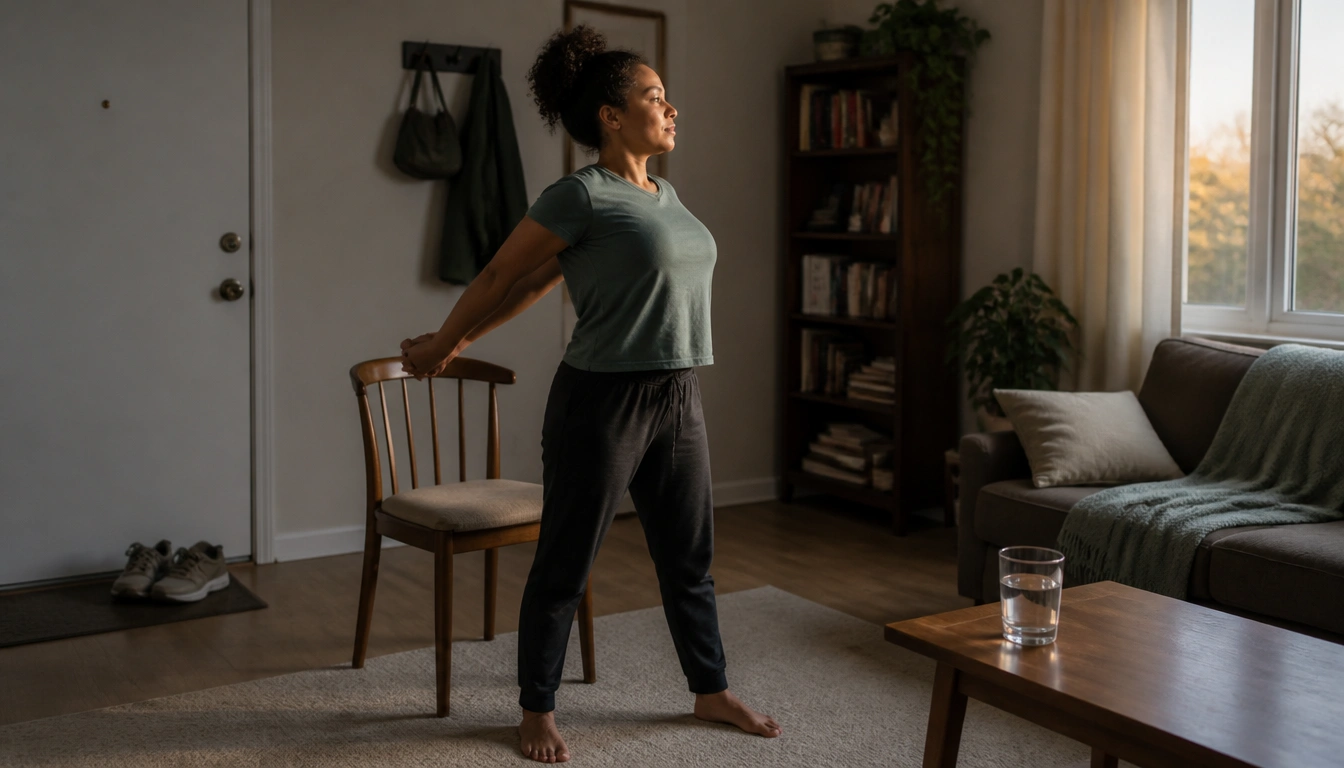
If you are a complete beginner, the best after-work movement routine is a short, low-friction one: a few minutes of mobility, a few simple strength moves, and a short walk. Keep it easy enough that you can start before sitting down, and scale up only when the habit feels automatic. If you feel physically unwell, choose gentle mobility or rest instead.
Key Takeaways
- A 10–15 minute routine is enough to start building the habit after work.
- Use a simple transition: arrive home, drink water, and move before sitting down.
- Gentle mobility, chair squats, wall push-ups, and walking are beginner-friendly choices.
- If you have not eaten for hours, a small snack can help you feel steadier before moving.
- Normal mental fatigue can improve with light movement; illness, dizziness, or sharp pain are reasons to stop.
Why after work feels harder than exercise itself
For many beginners, the hardest part is not the workout. It is the switch from work mode to movement mode. After a long day of sitting, thinking, and making decisions, your energy is often more mental than physical. That is one reason a high-intensity plan tends to fail: it asks for too much planning and effort at the exact time your willpower is lowest.
A better starting point is a routine that removes choices. Instead of asking, “Do I feel like exercising?” you follow the same small script every day: change shoes, drink water, move for a few minutes, then decide whether to do a little more. Public health guidance from the CDC, NHS, and World Health Organization all supports the idea that movement does not have to be long or perfect to matter. For a beginner, consistency matters more than ambition.
Prolonged sitting also leaves many people feeling stiff rather than strong. Hips, upper back, neck, and ankles can feel tight simply from being still. A short routine after work is useful because it does two jobs at once: it breaks the sitting pattern and makes exercise feel less intimidating the next day.
The after-work movement routine that is easiest to stick with
The goal of an after-work routine is not to “burn off” the day. It is to create a repeatable bridge between sitting and moving. A low-effort routine works best when it feels almost too easy to skip. That lowers the mental barrier and makes it much more likely that you will actually do it on tired evenings.
A practical structure is 10 to 15 minutes total. Think of it as three small parts. First, a few minutes of mobility to loosen up. Second, a few simple strength movements to wake up your legs, chest, shoulders, and core. Third, a short walk or other low-impact aerobic activity to lift your breathing a little and help the day feel finished.
This format fits a sedentary day because it does not require equipment, a gym trip, or a complicated plan. It also lines up with official activity guidance: adults are encouraged to move regularly across the week, build up gradually, and include both aerobic and muscle-strengthening activity over time. A beginner does not need to meet weekly targets on day one. The point is to start where you are.
What to do before you start
When you get home, try not to sit down first. That one habit can make the whole routine harder to start. If you sit on the couch, open notifications, or start scrolling, your body and brain usually settle into “done for the day” mode. Instead, create a small rule: put your bag down, change shoes, and move right away.
If you have gone many hours without eating, a small snack can help. A piece of fruit, a few crackers, or another light carbohydrate snack may make movement feel steadier if you are low on energy. Pair it with a glass of water. The idea is not to load up before exercise; it is to avoid starting a routine while hungry, dry, and sluggish.
If you just finished a large meal, give yourself more time before anything brisk. A gentle walk may still feel fine, but harder movement can be uncomfortable. Use common sense here: the routine should feel manageable, not forced.
A simple 10-minute after-work routine for beginners
This routine is designed to be low-pressure and easy to remember. It works well for people with no exercise habit, little equipment, or a long gap since their last workout. Move slowly, keep breathing comfortably, and stop each exercise before form falls apart.
Gentle mobility for stiff desk posture
Spend 3 to 4 minutes on light mobility. Choose movements that open the chest, move the spine, and loosen the hips. Good options include shoulder rolls, gentle neck turns, arm circles, standing chest openers, torso twists, and easy hip circles. You can also do ankle circles or a few slow marches in place if your legs feel sleepy.
The goal is not to stretch aggressively. Think of this as a reset after sitting, not a flexibility test. Mobility should feel smooth and unforced.
Easy strength without equipment
Spend 4 to 5 minutes on basic strength. Two of the most beginner-friendly options are chair squats and wall push-ups. For chair squats, sit back to a sturdy chair and stand up again with control. For wall push-ups, place your hands on a wall and bend and straighten your elbows slowly. Both exercises can be scaled by changing how far you move or how many repetitions you do.
If you are very deconditioned, start with just a few reps of each. Quality matters more than volume. Keep your knees tracking comfortably, use a stable surface, and avoid holding your breath. The aim is to remind your body how to move, not to prove anything.
A short walk to finish the day
Spend the last 5 to 10 minutes walking at a pace that slightly raises your breathing but still allows you to speak in full sentences. This is a good place to use the talk test from public health guidance: you should feel warmer and a little more worked, but not breathless.
If walking outdoors is not practical, you can walk indoors, march in place, or use another low-impact option such as easy cycling. What matters is that the movement feels sustainable. For beginners, a short brisk walk is often enough to make the routine feel complete without leaving you drained for the evening.
How to build the routine over weeks
Once the routine feels familiar, make changes slowly. A good progression is to add a little time to the walk first, then add a few repetitions to the strength work, and only later make the movements more challenging. That order helps you avoid the common beginner mistake of changing too many things at once.
For example, you might keep the mobility the same for a week or two while extending the walk by a couple of minutes. Later, you could add a second short set of chair squats or wall push-ups. The weekly context from major guidelines is important here: adults need regular movement across the week, but the exact path to that goal can be gradual.
If the routine starts feeling like a burden, scale back temporarily instead of quitting. A shorter version is still useful. A five-minute routine done often is more valuable than a perfect routine you avoid. That is especially true for people trying to rebuild fitness after a long sedentary stretch.
Low-impact options for stiff joints, extra body weight, or low fitness
Beginners with stiff joints, extra body weight, or a long break from exercise usually do better with low-impact movement first. That means avoiding jumping, running, or deep loaded squats at the start unless those feel clearly comfortable. Low-impact choices reduce strain on joints while still helping you build confidence and a basic fitness base.
For chair squats, you can make the movement easier by using a higher seat, holding onto the chair lightly, or doing only a partial stand. For wall push-ups, stand closer to the wall to reduce the load. For walking, start with a slower pace and a shorter route. If standing is uncomfortable, marching in place or a gentle indoor walk can be a useful substitute.
If you have been inactive for a long time, the first goal is tolerance, not performance. You are training your body to accept movement again. That often means leaving the session feeling a little better than when you started, not wiped out.
How to tell normal fatigue from too much
Normal mental fatigue after work often feels like reluctance, heaviness, or low motivation. In many cases, light movement helps. Once you start, your body may feel looser and your mind may feel clearer. That is a sign the routine is doing its job.
Physical exhaustion is different. If you feel drained in your whole body, unusually weak, light-headed, feverish, or not like yourself, use gentle mobility or rest instead of pushing through. The same is true if soreness feels sharp, if you are recovering from illness, or if you slept very poorly and feel unsteady.
One helpful check is this: if you can do the first minute of the routine and feel a little better, you were probably dealing with ordinary fatigue. If movement makes you feel worse, stop and reassess. Your routine should support recovery from a sedentary day, not add stress to a body that is already under strain.
When to stop and get medical advice
Stop exercising right away if you get chest pain, dizziness, faintness, severe shortness of breath, or sharp pain in a joint or muscle. These are not signs to push through. They are signs to stop and get medical advice.
You should also speak with a GP or physician before starting a new routine if you have not exercised in a long time and also have cardiovascular disease, diabetes, unexplained joint instability, severe back pain, or another medical condition that could affect safe exercise. If you take medication that changes your energy, heart rate, balance, or appetite, a clinician can help you set the right starting point.
For everyone else, the safest beginner approach is steady and boring. Start easy, keep the first sessions short, and build only when your body is tolerating the routine well. That is how a habit becomes sustainable.
Frequently Asked Questions
How long should an after-work routine be for a beginner?
Start with 10 to 15 minutes. That is long enough to include mobility, a little strength, and a short walk without making the routine feel overwhelming. If that still feels too much, begin with 5 minutes and build from there.
What kind of movement is best after a sedentary workday?
Low-impact movement is usually the best choice: mobility work, chair squats, wall push-ups, and walking. These exercises help undo stiffness, wake up the muscles that support posture, and raise your activity level without a big recovery cost.
Should I eat before exercising after work?
If you have gone several hours without eating, a small snack and some water can help. A piece of fruit or a few crackers is often enough for a short beginner routine. If you have just eaten a large meal, wait a bit before doing anything brisk.
How do I know if I’m just tired versus too exhausted to work out?
Normal tiredness usually feels like low motivation or mental heaviness, and light movement may help. If you feel weak, dizzy, feverish, unusually short of breath, or physically unwell, skip the workout and choose rest or gentle mobility instead.
What exercises are safe for beginners with stiff joints or extra body weight?
Chair squats, wall push-ups, gentle walking, marching in place, and light mobility are usually good low-impact starting points. Use smaller ranges of motion, slower pacing, and supportive surfaces so the routine feels stable and joint-friendly.
The Bottom Line
For absolute beginners, the best after-work movement routine is short, simple, and easy to start before you sit down. A few minutes of mobility, a few basic strength moves, and a short walk is enough to build momentum without draining you further.
If you are tired but otherwise well, light movement often helps more than trying to force a hard workout. If you are physically unwell, dizzy, or in sharp pain, rest and get medical advice. The safest routine is the one you can repeat tomorrow.
Over time, you can add a little more walking or a few more repetitions, but the habit comes first. Start small, stay low-impact, and let consistency do the work.
Medical disclaimer
Medical disclaimer: This content is for educational and informational purposes only and is not a substitute for professional medical advice, diagnosis, or treatment. Dietary needs and supplement suitability vary by individual.
Sources
- National Health Service (NHS) — www.nhs.uk. Accessed November 2026.
- Centers for Disease Control and Prevention (CDC) — cdc.gov. Accessed November 2026.
- World Health Organization (WHO) — who.int. Accessed November 2026.
- National Institutes of Health (NIH) — nih.gov. Accessed November 2026.
