
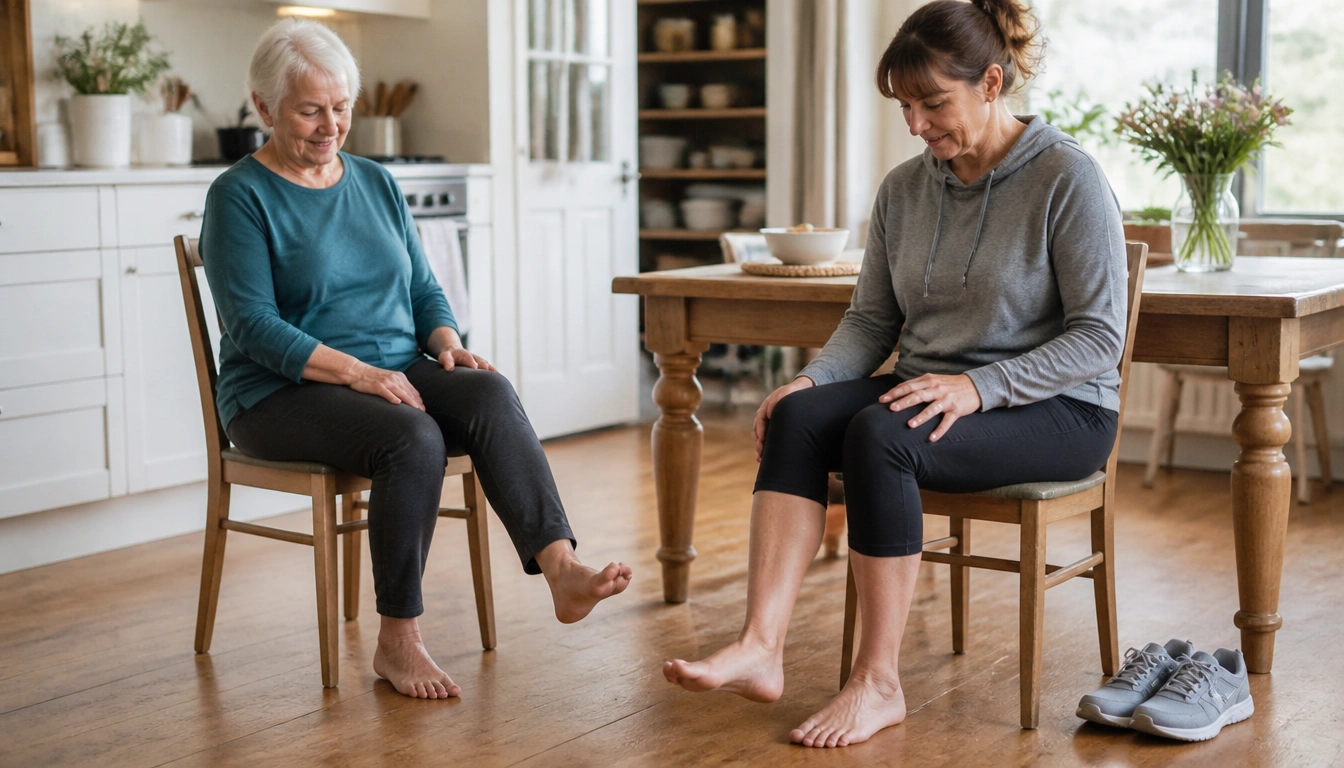
Yes—absolute beginners can safely start with a few low-effort ankle mobility exercises that support walking, such as ankle circles, ankle alphabet, foot pumps, and a gentle calf stretch after walking. The goal is not to force a perfect range of motion, but to help your ankles bend more smoothly so walking feels easier and more natural. If movement causes sharp pain, swelling, or instability, stop and get checked.
Key Takeaways
- Ankle dorsiflexion is the motion that lets your shin move forward over your foot during a step; limited motion can shorten stride or change how you load the leg.
- Begin with seated or supported drills so balance is not a barrier: ankle circles, ankle alphabet, and foot pumps are beginner-friendly.
- A post-walk calf stretch can help when the muscles are warm, but stretching should feel like mild tension, not pain.
- Older adults and desk-bound beginners usually need a slower buildup because stiffness and stretch tolerance change over time.
- Shoes matter too: a roomy toe box and a shoe that lets the midfoot move naturally can make walking feel smoother.
- Progress by function, not by chasing a specific visible range of motion; the real goal is a more comfortable walk.
Why ankle mobility matters for walking mechanics
Your ankles do more than move your feet up and down. They help absorb impact, shift your body weight forward, and adapt to uneven ground. When ankle motion is limited, the rest of your lower body often has to help out. That can change your walking pattern and make the knees, hips, or lower back work harder than they should.
That is why ankle mobility for walking is not just about “loose joints.” It is about making the whole step smoother. If the ankle does not move well, you may notice a shorter stride, a stiffer push-off, or a heavier landing. Those changes are often small at first, but over time they can make walking feel less efficient and less comfortable.
According to the NHS and Mayo Clinic, staying mobile and active helps preserve function, balance, and comfort as you age. For beginners, the practical goal is to restore enough motion that walking feels more natural, not to force extreme flexibility.
The one motion beginners need most: dorsiflexion and what it changes during a step
The ankle motion beginners usually need most is dorsiflexion. That is the movement where your shin comes forward over your foot as you move through a step. You use it when your heel lands, when your body passes over the foot, and when you transition toward toe-off.
If your calf muscles or Achilles tendon are tight, dorsiflexion can feel restricted. You may notice that your heel wants to lift early, your stride feels short, or your foot seems to slap down more than it should. Some people also feel a pull in the calf or a sense that their ankle “won’t bend enough” when walking downhill, climbing stairs, or standing up from a chair.
Limited dorsiflexion does not always mean something is wrong, but it can change how you move. When the ankle does not bend enough, the body may compensate by turning the foot out, leaning forward, or borrowing motion from the knee or hip. That is one reason ankle mobility exercises can help walking feel smoother from the ground up.
How to tell if your ankles are affecting your walk
One of the easiest signs is a walking pattern that feels guarded or stiff. You may feel like you take short steps, land heavily, or need extra effort to roll from heel to toe. Some beginners also notice a “tight calf” feeling first thing in the morning or after sitting for a long time.
You do not need a perfect self-test to begin. If your walks feel better after a few minutes of gentle ankle movement, that is already useful information. If you notice stiffness when you start moving but it eases as you warm up, that often points to a mobility and tissue-tolerance issue rather than a major problem. If the ankle feels unstable, gives way, or causes pain with normal walking, that deserves a professional opinion.
A simple beginner routine
Start seated if balance is a concern. Lift one foot slightly off the floor and make slow ankle circles in both directions. Then try the ankle alphabet: trace the letters in the air with your big toe as if it were a pen. Finish with foot pumps by moving the foot up and down like a gentle accelerator pedal. These moves are easy to do at a desk, on a couch, or before you head out for a walk.
If you are very stiff, keep the range small at first. If you feel ready, make the circles a little wider or trace the alphabet more fully. The point is to move the joint through comfortable directions, not to chase a dramatic stretch.
The post-walk calf stretch
A gentle calf stretch after walking can help because your muscles are already warm. Stand facing a wall with your hands supported, step one foot back, keep the back heel down, and bend the front knee until you feel a mild stretch in the back leg. Keep your back leg straight and your body steady.
Hold the stretch for about 30 seconds, then switch sides. Repeat a few times if it feels good. You do not need to bounce, force the heel down, or push into pain. A steady, comfortable pull is enough.
This stretch is useful for walkers because calf tightness often limits dorsiflexion. If the back leg feels cramped or the heel lifts immediately, shorten your stance and reduce the intensity. The stretch should feel like a controlled release, not a battle.
How often to practice for walking comfort
For most beginners, short and consistent beats long and occasional. A few minutes a day is usually easier to maintain than one big session that leaves you sore or frustrated. Think of this as a walking-support habit, not a workout that needs to be “won.”
A practical approach is to pair ankle mobility with something you already do. Do seated ankle circles while coffee brews, while watching a short video, or after you sit down at your desk. Do the calf stretch after your walk while your muscles are still warm. Habit pairing makes the routine feel smaller, which often makes it more sustainable.
That consistency matters. Mobility changes usually come from repeated exposure over time, not from forcing a big stretch once. For absolute beginners, the main win is showing up often enough that your body gets used to moving in a smoother pattern.
How to progress safely if you are older, sedentary, or returning after a long break
Older adults and desk-bound beginners often need a slower pace because tissues adapt more gradually. Long periods of sitting can make the calves and ankles feel less tolerant of movement, and that does not improve best with aggressive stretching. Start with small, easy motions and increase only when the previous level feels comfortable.
If you are returning after a long break, begin with supported positions. Seated drills are a smart starting point because they remove balance demands. Once those feel easy, you can do the same movements standing with a counter or wall nearby. Then you can add the post-walk calf stretch and longer walks in small steps.
For many beginners, the right progression is less about doing more and more right away and more about keeping the body calm while it adapts. If you wake up more stiff the next day, reduce the range or frequency a little. Progress should feel steady, not punishing.
When ankle mobility is not enough
If you have had repeated ankle sprains, chronic instability, or a fracture in the past, mobility work alone may not be the full answer. Prior injury can leave the ankle less reliable, especially when you step on uneven ground. In that case, balance work and guidance from a physical therapist can matter as much as stretching.
Simple balance practice may include standing near a countertop or wall and holding a single-leg stand for a short time. That kind of work helps the ankle learn to support you, not just bend. For some people, improved control is what makes walking feel safer.
Shoes matter too. A walking shoe with enough room in the toe box and a supportive midfoot can help your foot move naturally. Very stiff, cramped, or overly worn shoes can make walking feel less fluid. The goal is not a special shoe trend; it is a setup that lets your foot and ankle work without unnecessary restriction.
Safety checks: stretch sensation, red flags, and when to get help
Stretching should feel like mild tension or a gentle pull. It should not feel sharp, pinchy, burning, or unstable. If a movement causes pain in the joint itself, if the ankle swells, or if it feels like it might give way, stop and get medical advice.
According to the Mayo Clinic and NHS guidance, you should seek professional help if you cannot bear weight, notice significant bruising or swelling, or have sudden worsening pain. If you are recovering from a recent injury, surgery, or a diagnosed condition, follow your clinician’s instructions rather than a general routine.
Comfort matters here. If you are unsure whether a sensation is normal, scale the movement back. A smaller, easier version is usually a better choice than pushing through symptoms. For absolute beginners, safe practice means staying within a tolerable range and watching how the ankle responds over the next day or two.
If you want a simple rule to remember, use this: mild stretch is acceptable, pain is not. Smooth walking is the goal, and the routine should help you get there without provoking symptoms.
Frequently Asked Questions
How do I know if my ankles are stiff enough to affect my walking?
Common signs include shorter steps, a stiff first few minutes of walking, early heel lift, heavy foot landing, or a feeling that your calf is tight when you move. If a few minutes of gentle mobility makes walking feel smoother, stiffness is probably part of the picture.
Which simple ankle mobility exercises are best for beginners?
The most beginner-friendly options are seated ankle circles, ankle alphabet tracing, and foot pumps. These movements are low risk, easy to do without equipment, and useful if your balance is limited or you spend a lot of time sitting.
How often should I do ankle mobility work for walking?
Short daily practice usually works better than occasional long sessions. A few minutes once or twice a day is a realistic starting point. Many people pair the exercises with coffee, desk time, or the end of a walk so the habit sticks.
Should I stretch before walking or after walking?
For most beginners, light ankle movement before walking and a calf stretch after walking is a practical split. The warm-up should stay gentle. The longer stretch is often more comfortable after the muscles are warm from walking.
When is ankle stiffness a sign I should see a physical therapist or doctor?
Get checked if you have sharp pain, swelling, bruising, instability, difficulty bearing weight, or symptoms that keep worsening instead of easing. If you have a history of repeated sprains or a recent injury, professional guidance is especially useful.
The Bottom Line
For absolute beginners, ankle mobility for walking is best approached as a small daily habit: move the joint gently, stretch the calf after walking, and build consistency before intensity. The most useful motion is dorsiflexion, because it helps your shin move forward over your foot during a step.
You do not need perfect flexibility to benefit. Focus on smoother walking, less stiffness, and better comfort. If the ankle hurts, swells, or feels unstable, stop and get evaluated. That is the point where a simple routine should give way to individualized care.
Medical disclaimer
Medical disclaimer: This content is for educational and informational purposes only and is not a substitute for professional medical advice, diagnosis, or treatment. Dietary needs and supplement suitability vary by individual.
Sources
- National Health Service (NHS) — northcheshireandmersey.nhs.uk. Accessed November 2026.
- National Health Service (NHS) — uhs.nhs.uk. Accessed November 2026.
- Mayo Clinic — mayoclinic.org. Accessed November 2026.
- orthoinfo.org — orthoinfo.org. Accessed November 2026.
