
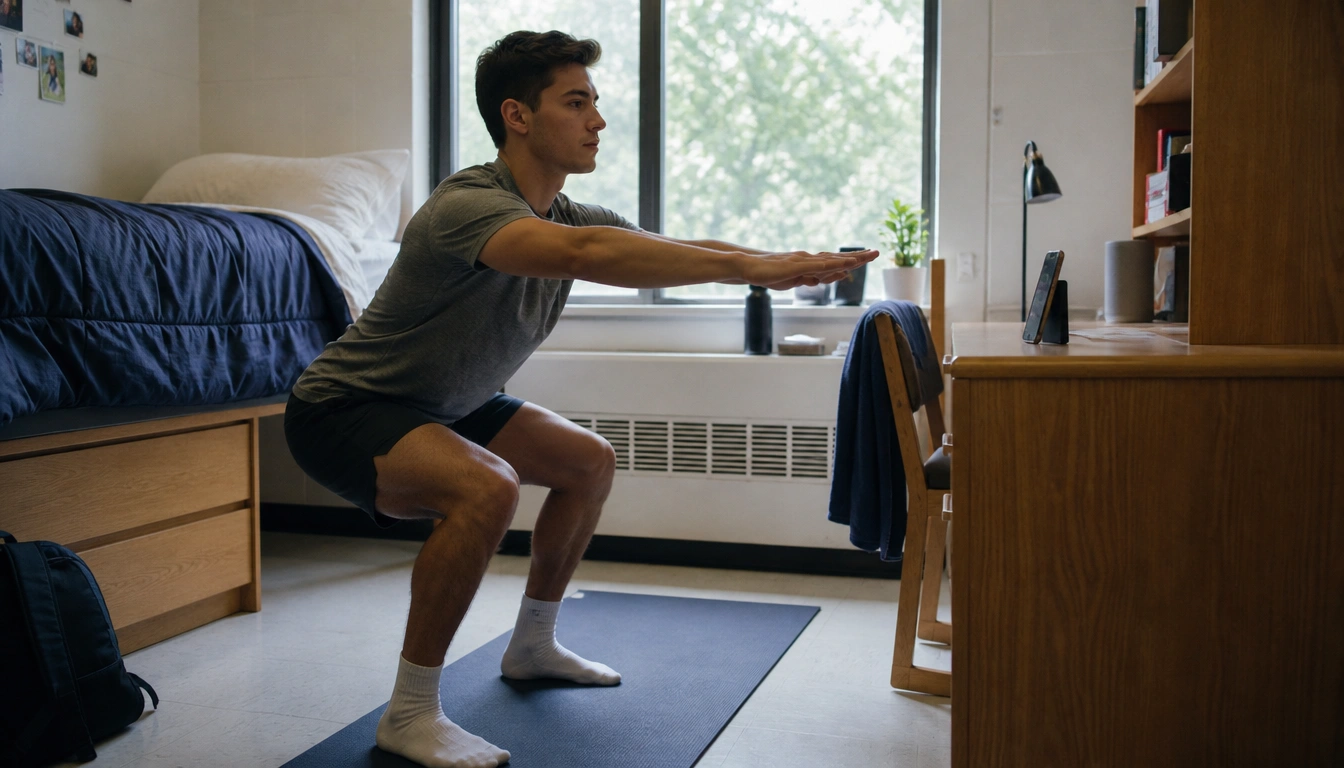
You can check and correct your form by using a few repeatable cues: keep your trunk braced, move with control, and choose a variation that lets you stay aligned. For college students, bodyweight exercise form checklist habits matter most on squats, push-ups, glute bridges, and planks because those four moves build a reliable base. Aim to train major muscle groups at least 2 days per week, and progress by improving leverage, range, or tempo before adding more volume.
Key Takeaways
- Bodyweight training fits college life because it needs little space, no equipment, and can be done in short sessions between classes.
- Good form matters more when you train without weights because your own body position creates the resistance and determines where stress goes.
- For squats, push-ups, glute bridges, and planks, check stance, trunk position, joint tracking, and control before chasing reps.
- Normal effort feels like muscle fatigue or a burn in the working muscles; sharp pain, joint pain, locking, or numbness means stop.
- You can progress safely by changing leverage, slowing the lowering phase, increasing range of motion, or adding a cleaner set—not by rushing harder variations.
- Sleep, hydration, and regular food with protein and carbohydrates help you recover and adapt to training during busy school weeks.
Why bodyweight training fits a college schedule
Bodyweight exercise works well for college students because it is fast, flexible, and cheap. You do not need a gym membership or a full block of free time to build a useful routine. A few focused sets in a dorm room, empty common area, or quiet corner of campus can still support strength, movement quality, and consistency.
Public health guidance from the World Health Organization and the American College of Sports Medicine supports muscle-strengthening activity for the major muscle groups at least 2 days per week. That does not mean you need a huge workout every time. It means your routine should be regular enough to keep the habit alive through exams, labs, late nights, and changing class schedules.
A good college version is simple: train the basics, keep the sessions short enough that you will actually do them, and make every rep technically honest. If your schedule is chaotic, that is a reason to simplify the plan, not to abandon it.
As a movement goal, think less about “destroying” a workout and more about repeating high-quality patterns. Squat, push, hinge, and brace are enough to start. Once those movements feel reliable, you can make them harder without needing weights.
Form matters more when you train without equipment
Bodyweight movements are usually closed-kinetic-chain exercises, which means your hands or feet are fixed against the floor or a stable surface. That setup demands coordination from the ankles, knees, hips, shoulders, and trunk at the same time. If one part is off, the whole movement often shifts, and the mistake shows up as poor balance, joint stress, or wasted effort.
Core bracing is especially important. Your trunk acts like a bridge between the upper and lower body, helping transfer force smoothly while protecting the spine. If your midsection is loose during a push-up or plank, the lower back often compensates. If your torso folds during a squat, the hips and knees may lose clean tracking.
Leverage also matters. With bodyweight work, you usually progress by changing the angle of your body, the speed of each rep, or the range of motion. That is why form is not just about looking neat. It is how you control the load.
Quick form rule: if a variation makes you lose alignment, shorten the lever or reduce the depth until you can repeat the movement cleanly.
Squat and push-up checklist
Bodyweight squat: Start with feet about shoulder-width apart, or slightly wider if that feels more natural. Point the toes slightly outward. As you descend, send the hips back and down together, keep the whole foot planted, and let the knees track in line with the toes. A neutral spine and a lifted chest matter more than forcing a deep range you cannot control. If your heels lift, your knees cave inward, or your lower back rounds early, reduce depth and slow down.
For many students, stance width is a comfort and anatomy issue, not a moral one. A slightly wider stance may help if your hips feel crowded. A slightly narrower stance may work better if your knees drift or your balance feels unstable. The best stance is the one that lets you squat without pain and without the knees collapsing inward.
Push-up: Place your hands a little wider than shoulder width, roughly under the chest or shoulders. Keep a straight line from head to heels or knees, and brace the abdomen and glutes so the hips do not sag. Lower with the elbows angled about 30 to 45 degrees from the torso rather than flaring straight out. Touching the chest closer to the floor is useful only if you can keep the body rigid on the way down and up.
If a standard push-up is too hard, raise your hands on a desk, sturdy table, or wall. That shorter lever reduces the load while keeping the same pattern. As you get stronger, lower the hand position step by step instead of jumping straight to the floor.
Glute bridge and plank checklist
Glute bridge: Lie on your back with knees bent and feet flat, about hip-width apart. Place the feet close enough that your fingertips can nearly touch your heels. Before lifting, lightly brace the trunk. Then drive through the heels and squeeze the glutes to raise the hips until the body forms a line from shoulders to knees. The work should feel like the glutes and hamstrings, not the low back.
A common mistake is finishing the bridge by arching the spine instead of extending the hips. If your ribs flare up or the lower back pinches, lower the hips a little and focus on glute squeeze rather than height. A smaller bridge done well is better than a bigger bridge done poorly.
Plank: Set the elbows under or slightly in front of the shoulders. Press the forearms into the floor, squeeze the glutes, and gently draw the belly in so the torso stays long and steady. The neck should stay neutral, with the eyes on the floor a short distance ahead. Your goal is not to “hang out” in the position; it is to maintain tension without letting the hips sag or the shoulder blades collapse.
If your lower back feels like it is doing the work, shorten the hold or elevate your forearms on a bench or desk. If your wrists bother you in a straight-arm version, use forearm planks until the position feels easier to control.
How to self-check form without a coach
You do not need a trainer watching every rep to improve. A mirror, a phone camera, or even a few focused mental cues can tell you a lot. Film from the side for squats and bridges to check spine angle and hip position. Film from the front for squats and push-ups to check symmetry, knee tracking, and elbow path.
Use one cue at a time. Too many reminders make the movement feel stiff and confusing. For example, on a squat you might cue “feet stay heavy” or “knees follow toes.” On a push-up you might cue “ribs down, body long.” Once that cue is consistent, add another one.
Rep-by-rep checking works well for beginners. Ask: Did I stay balanced? Did the target muscles do the work? Did anything pinch, click, or feel unstable? If the answer is no, reduce the range, slow the pace, or switch to an easier variation.
Stop signs during self-check: sharp pain, a joint that feels unstable, or a movement pattern that keeps breaking down even after you simplify it.
How to progress safely without weights
Progression in bodyweight training should be gradual and obvious. The cleanest ways to make an exercise harder are leverage, tempo, range of motion, and set quality. Those options help you keep the movement pattern while increasing the challenge in a controlled way.
Leverage changes: Move from wall push-ups to desk push-ups, then to floor push-ups. Move from a partial squat to a deeper squat only if the spine and knees stay controlled. For planks, move from elevated forearms to floor forearms before trying longer holds.
Tempo changes: Slow the lowering phase so each rep lasts longer under control. A slower descent makes the same exercise more demanding without forcing you into sloppy reps. That can help you build strength and body awareness at the same time.
Range of motion: Increase depth only if you can keep good alignment. More range is useful when your joints and mobility can support it, but a bigger range is not automatically better. Clean, repeatable reps matter more than chasing maximum depth.
Set quality: End a set when your form starts to break. You do not need to grind every set to failure. Stopping a little early often gives you better technique and more consistent training across the week.
Dorm-room and campus adaptations
College life often means small spaces, privacy concerns, and unpredictable gaps in the day. That is exactly where short bodyweight sessions help. A micro-session can be as simple as a few sets of squats, push-ups, glute bridges, and planks between classes or after you return to your room.
Use environment-friendly options when needed. Wall push-ups work in a dorm hallway or quiet room. Desk push-ups can fit a study break if the surface is stable. Squats and glute bridges need only a small patch of floor. A forearm plank on a towel or mat can make hard floors more comfortable.
If privacy is an issue, keep the routine quiet and low-profile. Slow tempo, controlled reps, and a small number of sets are often more realistic than a loud, high-energy workout. The goal is to fit movement into student life instead of waiting for a perfect setup.
Short sessions can still count if they are repeated often enough to build a weekly routine. A 10-minute block is useful when done consistently.
When to stop and how recovery supports progress
Normal muscle work can feel like effort, local fatigue, or a burning sensation in the muscles you are using. That is different from sharp pain, joint pain, a catching or locking feeling, or numbness and tingling. Those warning signs are not a cue to push through. They are a reason to stop and reassess.
Seek help from a healthcare professional if pain persists, if a joint feels unstable, if you have recurring clicking or locking with discomfort, or if you have a history of injury that makes the exercise feel risky. Students with a medical condition, recent surgery, or unresolved pain should get individualized advice before pushing a new routine.
Recovery also matters. Sleep is one of the biggest supports for adaptation, especially when academic stress is high. Hydration helps you tolerate training and recover normally, and food choices matter too. A practical student approach is to eat regular meals that include protein and carbohydrates, rather than treating recovery as an afterthought.
If you want bodyweight training to stick, connect it to a normal routine: after breakfast, between classes, or before studying. Consistency beats intensity for most college schedules.
Frequently Asked Questions
How often should college students do bodyweight strength training each week?
A practical target is at least 2 days per week for muscle-strengthening activity, which matches public health guidance from the WHO and CDC-style recommendations used in fitness planning. More days can be fine if the sessions stay manageable and recovery is good, but consistency matters more than doing long, exhausting workouts.
What are the most important form cues for squats, push-ups, glute bridges, and planks?
For squats, keep the feet grounded, knees tracking with the toes, and chest and spine controlled. For push-ups, keep a straight line, brace the core, and keep the elbows from flaring too wide. For bridges, lift with the glutes instead of arching the low back. For planks, keep the neck neutral and the torso tense.
How can I modify bodyweight exercises if I’m a beginner or working out in a dorm room?
Use wall or desk push-ups, shorten squat depth, and elevate your hands or forearms if needed. Micro-sessions work well in dorm rooms because they need very little space and can be done quietly. The goal is a version you can repeat with good control, not the hardest variation available.
What counts as normal muscle fatigue versus a sign I should stop exercising?
Normal fatigue usually feels like muscle burn, heaviness, or effort in the working muscles. Stop if you feel sharp pain, joint pain, numbness or tingling, a catching or locking sensation, or a form breakdown that you cannot fix by simplifying the movement. Those are safety signals, not training signals.
How do I progress bodyweight exercises without adding weights?
Make the movement harder by changing leverage, slowing the lowering phase, increasing range only when you can control it, or using stricter reps. For example, move from wall push-ups to desk push-ups, then to floor push-ups. Progression should look clean, not rushed.
The Bottom Line
A solid bodyweight routine for college students does not need special equipment or a lot of time. If you can check your squat, push-up, glute bridge, and plank against a few clear cues, you can train safely in a dorm room, apartment, or campus space.
The best results usually come from repeatable basics: at least 2 strength days per week, controlled reps, and honest self-checks. When form starts to slip, simplify the exercise, adjust the setup, or stop the set. That is how you build strength without turning a short workout into a bad one.
Recovery matters too. Sleep, hydration, and regular meals with protein and carbohydrates help your body adapt to the work you are doing. For most students, the winning plan is the one you can keep up during busy weeks.
Medical disclaimer
Medical disclaimer: This content is for educational and informational purposes only and is not a substitute for professional medical advice, diagnosis, or treatment. Dietary needs and supplement suitability vary by individual.
