
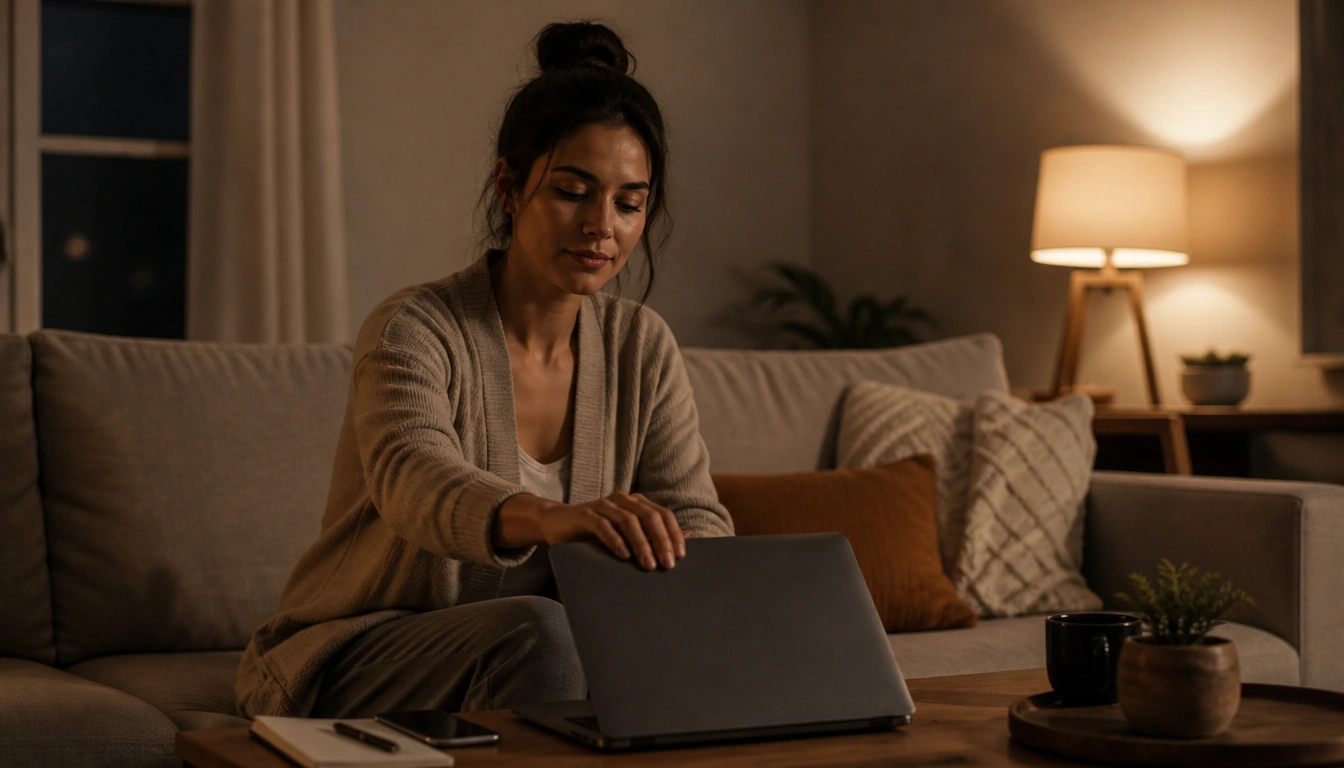
A low-light evening routine helps because remote work removes the natural buffer that a commute once created. Start dimming lights and easing off screens 1–2 hours before bed, then switch to low-stimulus activities in the final 30–60 minutes. Pair that with a clear work shutdown ritual, a cool dark bedroom, and consistent sleep timing. If sleep problems persist or you snore, gasp, or feel unrefreshed despite enough time in bed, get evaluated.
Key Takeaways
- Remote workers often need a deliberate shutdown ritual because work and home spaces blend together, keeping the brain in work mode longer.
- Blue-light filters can help, but they are not enough on their own; brightness, overhead lighting, and overall stimulation also matter.
- A phased routine works best: first dim lights and close work, then switch to quiet activities, then prepare a cool, dark sleep space.
- If you are a night owl, prioritize consistency and gradual timing shifts rather than forcing an unnaturally early bedtime.
- If you lie awake for about 20 minutes, get out of bed and do something quiet and dim until you feel sleepy again.
- Persistent insomnia, loud snoring, gasping, or breathing pauses deserve medical evaluation, not just a better bedtime routine.
Why remote work makes evening wind-down harder than office work
People who work from home often lose the natural break that used to separate work from sleep. A commute, a walk to the train, changing clothes, or even arriving home after leaving an office all help the brain shift gears. Without that transition, the laptop can close while your mind is still answering messages, finishing tasks, or replaying the day.
That blurring matters because your evening routine is not just about comfort. It is about giving your nervous system a clear signal that work has ended. If your desk is in the living room or bedroom, the room itself can keep you mentally “on” unless you create a specific shutdown ritual. According to the National Institutes of Health, light and daily timing cues help regulate the body clock, which is one reason a deliberate evening pattern can make sleep easier.
For remote workers, the goal is not a perfect nighttime transformation. It is a reliable sequence that marks the change from output, alerts, and decisions to lower stimulation, slower breathing, and less problem-solving.
The science in plain English: light, melatonin, circadian timing, and body temperature
Your brain uses light to estimate the time of day. Specialized cells in the eye are especially responsive to blue-enriched light, and evening exposure can tell the brain that it is still daytime. That can delay melatonin’s natural rise and keep the body clock shifted later than you want it to be. The CDC and NIH both emphasize that regular sleep timing and lower evening light exposure support healthy sleep.
Light is only part of the story. Bright overhead lighting can also maintain a sense of alertness, especially if you spend the whole evening under ceiling lights while moving between work and home tasks. At the same time, sleep onset depends on a small drop in core body temperature. A warm, overstimulating environment can work against that shift, while a cooler bedroom and a gentle wind-down help the body move toward sleep.
That is why a screen filter alone usually falls short. Night mode may reduce blue light, but it does not solve brightness, mental stimulation, or the habit of staying in work mode until the moment you get into bed.
A practical low-light evening routine for work-from-home workers
A useful routine works in phases. Start with a buffer period before bed, then taper stimulation, then prepare the bedroom. The timing does not need to be exact down to the minute, but it should be consistent enough that your body learns the pattern.
Phase 1: 1–2 hours before bed. Begin your digital sunset here. Close work tabs, send any final messages, and write down the next day’s first tasks so your brain does not keep rehearsing them. Put work devices away if possible. If you need to keep using a screen, reduce brightness, avoid overhead lights, and choose a warmer, lower-light setting in the room. The point is to make the whole environment feel less like a workday.
Phase 2: 30–60 minutes before bed. Shift from productive tasks to low-stimulus activities. Good options include reading on paper, simple stretching, a short journal entry, light tidying, a warm shower, or listening to calm audio. This is the period to stop scrolling, checking email, or starting “just one more” task. If your home is noisy or your thoughts get louder in silence, calming audio can be better than complete quiet.
Phase 3: set up the sleep space. Keep the bedroom as dark, cool, and quiet as you can. Use blackout curtains, an eye mask, a fan, or white noise if needed. If your bedroom is also your office, protect the bed from becoming an extension of work by leaving work materials out of reach when the day is done.
How to make your routine work when your office is your living room or bedroom
If your home has limited space, the best strategy is to build symbolic boundaries. A small apartment may not allow a separate office, but you can still create a clear shift. Put the laptop in a drawer, cover the desk, or place work items in a basket at the end of the day. Changing clothes can also help signal that work is over, even if you never left the house.
Use the environment itself to reduce stimulation. Swap bright white bulbs for softer lamps where possible. Turn off ceiling lights first, then use the lowest practical light level that still feels safe and functional. If other people are awake in the household, ask for a shared quiet hour before bed or agree on a specific “wind-down” cue, such as dimming lamps together.
The aim is not to create a spa. It is to make the home feel less like a command center and more like a place where the nervous system can stand down.
How to adapt the routine if you are a night owl or work irregular hours
Not everyone should try to force an early bedtime. Night owls often do better with consistency and gradual changes than with a sudden attempt to become a morning person overnight. If your natural schedule runs later, keep your sleep and wake times as stable as your life allows and shift them slowly rather than abruptly. A low-light routine still helps, but the timing should fit your biology rather than fight it.
People who work evening shifts or support global teams need a different approach. The clock matters less than your designated sleep window. Treat your personal “night” as the time when light and stimulation need to drop, even if it is 2 a.m. or 4 a.m. Blackout curtains, a sleep mask, and stricter control of bright screens become even more important when your sleep happens outside the usual nighttime hours.
Some common mistakes keep the brain in work mode longer than people realize. These include checking work email after shutdown, leaving the laptop open on the table, brightening the whole room again for chores, answering “quick” messages from bed, and using the bed for both work and problem-solving. Another mistake is assuming a blue-light filter solves everything. It can be one part of the routine, but it is not a substitute for lowering brightness and reducing mental load.
When a low-light routine helps and when it is not enough
A well-built routine can make it easier to fall asleep, especially when your main issue is that your brain stays activated after work. It is a practical first step, and public health guidance from the CDC and NHS supports limiting evening screen use and keeping sleep habits regular.
It is not a full treatment for chronic insomnia or other sleep disorders. If you are in bed and still awake after about 20 minutes, get up and do a quiet, dim activity until sleepiness returns. That protects the bed from becoming a place where you associate lying down with frustration, worrying, or scrolling.
Get professional evaluation if poor sleep is persistent, if you are sleepy during the day despite enough time in bed, or if someone notices loud snoring, gasping, choking, or pauses in breathing. Those signs can point to sleep apnea or another condition that needs more than sleep hygiene alone.
Simple routine templates for different schedules and home setups
Standard daytime remote worker: close work 90 minutes before bed, dim lamps and lower screen brightness, have a warm shower or short stretch session, then read or listen to calm audio for the last half hour. Keep the bedroom cool and dark.
Small apartment with shared space: use one lamp in the evening, put work items away in a box or bag, change out of work clothes, and create a no-email rule after shutdown. If your bed is visible from your workspace, physically cover the laptop or move it out of sight.
Late worker or night owl: keep your wind-down relative to bedtime, not the wall clock. Use the same sequence every day, and shift sleep time gradually if you want it earlier. Avoid a sudden, drastic bedtime change that leaves you lying awake and frustrated.
Anxiety-prone sleeper: do not rely on silence alone if silence makes your thoughts race. Use a calm voice recording, white noise, or brief mindfulness before bed. The goal is a lower-stimulation environment, not forced stillness.
If you want the shortest version, it is this: close work on purpose, lower light before you lower energy, protect the last 30–60 minutes from input-heavy tasks, and keep the bedroom dark and cool. That sequence gives your brain a cleaner signal that the workday is over.
Frequently Asked Questions
How long before bed should I start dimming lights and stopping screen use?
A good starting point is 1–2 hours before bed for dimming lights and stepping away from work tasks, then 30–60 minutes before bed for low-stimulus activities. Official guidance from the CDC and NHS supports turning off screens close to bedtime, but a gradual wind-down is often easier to maintain than an abrupt cutoff.
What should a work-from-home shutdown routine look like if my office is also my living room or bedroom?
Make the end of work visible and repeatable. Close tabs, write tomorrow’s top tasks, put devices away, change clothes, and lower the room lighting. If the bed is part of the same space, avoid using it for email or problem-solving so it stays linked to sleep, not work.
Do blue-light filters and night mode actually help, or do I need to dim the whole room too?
Filters can help a little, but they are not enough by themselves. Brightness, overhead light, and mental stimulation also affect how alert you feel. A lower-lit room plus reduced screen brightness is usually more effective than night mode alone.
What can I do if low light makes me anxious or my thoughts get louder at night?
You do not have to sit in complete silence if that makes things worse. Try calm audio, white noise, a short guided relaxation, or a brief journaling exercise to offload worries. The goal is to reduce stimulation without creating extra stress.
How is this different for night owls or people with irregular evening work hours?
Night owls usually do better with consistency and gradual timing shifts rather than forcing a very early bedtime. If your work hours are irregular, treat your sleep window as your own “night” and use the same light-dimming, screen-limiting routine whenever that window begins.
The Bottom Line
A low-light evening routine is most useful when work and home blend together. The routine should create a clear handoff: close work deliberately, dim the environment, replace scrolling with quieter activities, and keep the bedroom cool and dark.
For many remote workers, the biggest win is not a perfect bedtime trick but a repeatable sequence that reduces stimulation before sleep. If sleep remains hard despite a solid routine, or if you have snoring, gasping, or persistent daytime fatigue, it is time to look beyond sleep hygiene and get checked.
If you are a night owl or work odd hours, adapt the same principles to your schedule instead of forcing a mismatched sleep time. Consistency, lower evening light, and a quieter last hour before bed usually matter more than a flawless routine.
Medical disclaimer
Medical disclaimer: This content is for educational and informational purposes only and is not a substitute for professional medical advice, diagnosis, or treatment. Dietary needs and supplement suitability vary by individual.
Sources
- Centers for Disease Control and Prevention (CDC) — cdc.gov. Accessed November 2026.
- National Institutes of Health (NIH) — nih.gov. Accessed November 2026.
- National Health Service (NHS) — uhs.nhs.uk. Accessed November 2026.
- National Health Service (NHS) — www.nhs.uk. Accessed November 2026.
- National Institutes of Health (NIH) — nih.gov. Accessed November 2026.
