
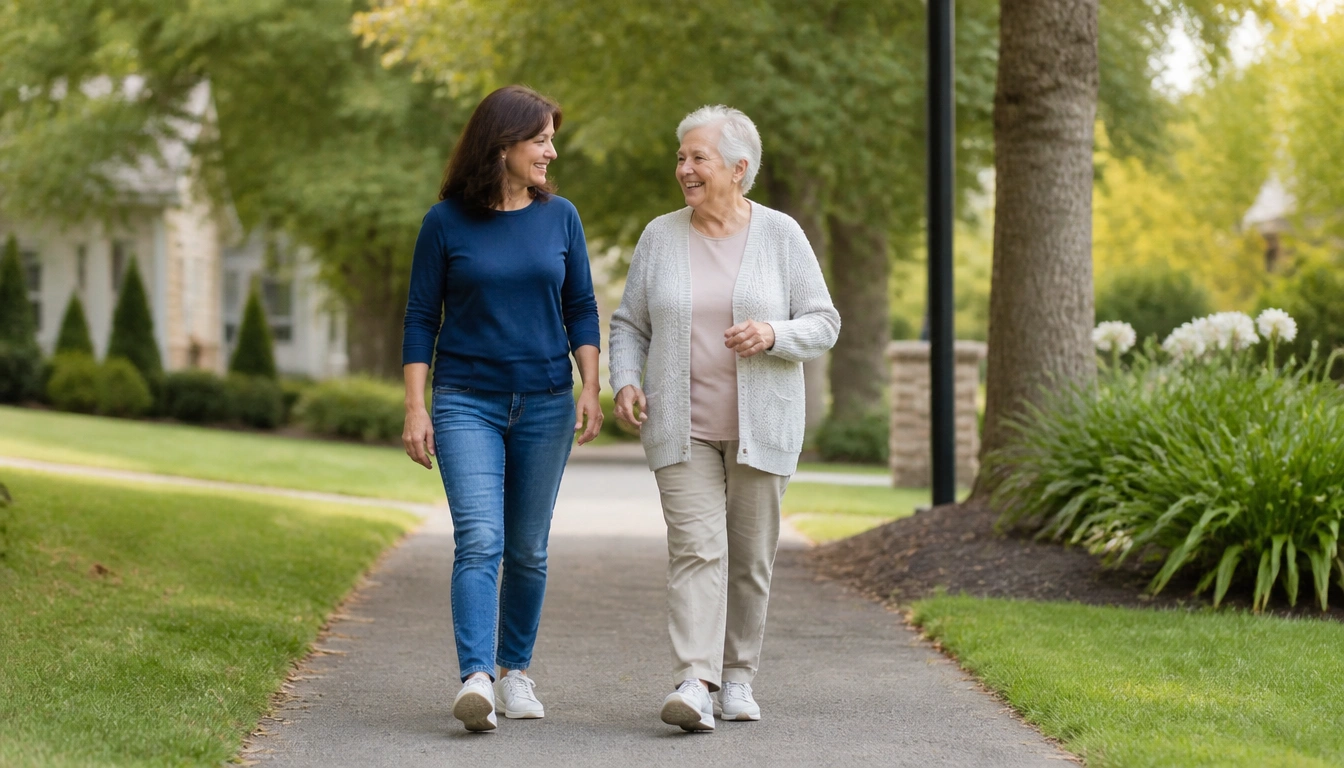
For many adults over 60, a reasonable daily step goal is one that reflects your current baseline and moves upward gradually, rather than chasing a fixed number on day one. Research suggests that around 8,000 steps a day is associated with better health outcomes in older adults, but total daily step volume matters more than speed. If you are starting lower, even a smaller consistent increase can be meaningful.
Key Takeaways
- A slower, steady walk still counts. For older adults, total daily step volume appears more important than walking speed for many health benefits.
- There is no single perfect step target for everyone over 60. Your safest goal depends on your starting point, health conditions, balance, and current activity level.
- A realistic step ladder usually works better than a big jump. Small weekly increases are easier to sustain and less likely to trigger pain or burnout.
- Walking is only one part of healthy aging. Strength and balance work still matter for fall prevention, muscle support, and independence.
- Indoor walking, mall walking, and short supported movement breaks can keep the habit going when weather, sidewalks, or pain make outdoor walking difficult.
Why daily steps matter more after 60
Daily walking supports the things many older adults care about most: getting around safely, staying independent, and keeping everyday tasks manageable. Step habits can also help with blood pressure, blood sugar control, mood, and the kind of stamina that makes errands, travel, and social plans feel less tiring. According to the CDC and WHO, regular movement is a core part of healthy aging, not an extra.
Walking is appealing because it is familiar, low-cost, and easy to adapt. You do not need special equipment or a gym membership to begin. A step habit also helps reduce long stretches of sitting, which matters because long inactive periods can make joints stiffer and muscles less ready for movement. For adults over 60, the goal is not just exercise for its own sake; it is keeping the body ready for daily life.
That is also why consistency matters so much. A short walk done most days is usually more useful than a hard workout that only happens once in a while. The best routine is the one you can repeat safely.
What the research suggests about step counts for older adults
Research in older adults shows a clear pattern: more daily steps are generally linked with better health outcomes, including lower mortality risk. One important finding is that around 8,000 steps per day is associated with better outcomes than lower daily totals in older adults, though the exact benefit varies by person and study design. That makes 8,000 a useful reference point, not a universal requirement.
Equally important, the total number of steps per day seems to matter more than how fast those steps are taken. In practical terms, a slower but steady walk still counts. You do not need to push into vigorous pace for your movement to be worthwhile. For many older adults, the more realistic win is building a regular walking pattern they can maintain without soreness, fear, or exhaustion.
Public health guidance from the CDC, WHO, and ACSM still emphasizes time-based activity goals, such as about 150 minutes a week of moderate-intensity aerobic activity for older adults. A step goal can help translate that advice into something easier to track day to day. But the number should still be adjusted to the individual, not treated like a test to pass.
How to think about your own baseline and set a realistic step ladder
If you are sedentary, recovering from illness, or living with pain, your starting point matters more than any headline number. A person who averages 2,000 steps a day and gradually rises to 3,500 has made a meaningful change. Someone who starts at 5,000 steps may have a different target than someone who already walks several thousand steps daily.
A practical first step is to measure your usual movement for a few typical days without trying to change it. That gives you a baseline. From there, a modest weekly increase is often easier to sustain than a sudden leap to 8,000 steps. In many cases, adding a small amount each week is enough to build confidence, improve tolerance, and reduce the chance of flare-ups.
A realistic step ladder might look like this: start with your current average, then add a little more each week only if your body tolerates it well. The right pace is the one that leaves you able to recover by the next day. If pain, breathlessness, or fatigue linger, the increase was probably too large.
Think in terms of progress, not perfection. The habit should feel repeatable, not punishing.
How to build steps into the day without one long workout
You do not need one long walk to make a walking habit work. For many older adults, dividing movement into short bouts is more realistic and less intimidating. Three 10-minute walks can be easier on joints, balance, and energy than one long session, and the total still adds up.
One useful approach is to attach walking to something that already happens every day. Walk after breakfast, pace while waiting for coffee, do a lap indoors after reading the mail, or add a short stroll before lunch. This kind of routine stacking reduces the need for motivation because the cue is already in place.
Short walks after meals can be especially practical. They may help lower the post-meal rise in blood sugar and can feel gentler than a longer workout. If standing or moving for long periods is hard, even a few minutes at a time can break up sitting and keep the habit alive.
The goal is not to force exercise into a perfect schedule. The goal is to make walking part of ordinary life.
Using errands, after-meal walks, and routine stacking to make it stick
Errands can count. Parking a little farther from the door, taking an extra lap through the grocery store, or walking the long way through a shopping center all add steps without requiring a separate workout mindset. This is often easier to maintain because it feels useful, not scripted.
After-meal walks are another simple anchor. A short walk after breakfast, lunch, or dinner can help you spread activity through the day and avoid long sedentary stretches. If you are caring for a spouse, grandchild, or dependent adult, these short loops can also fit around the flow of household life more easily than a fixed exercise block.
If you like structure, use a few predictable walking moments instead of trying to “find time.” For example, walk once after your morning beverage, once after lunch, and once before evening television. That kind of habit stacking is often more sustainable than relying on willpower alone.
What to do when walking is limited by pain, frailty, or illness
Some adults over 60 cannot safely build steps in the same way others can. Arthritis, frailty, balance problems, neuropathy, heart or lung disease, and chronic pain may all change what is realistic. In those situations, the best plan is not to give up movement, but to adapt it.
If outdoor walking feels risky, try indoor options such as mall walking, an indoor track, hallway laps, or short walks at home. A treadmill can also work for some people if balance is good and the setup is safe. If even walking is difficult, breaking sitting time with short supported movement bouts may still help. Standing up from a chair, walking a few steps with support, or gently moving around the room can interrupt long sedentary periods.
For people with mobility limits, functional movement matters. The aim may be less about hitting a specific step total and more about preserving range of motion, daily independence, and the ability to move confidently around the home. That is still worthwhile progress.
If pain or fatigue is persistent, back off and reassess rather than forcing the plan. A smaller, steadier routine is often better than repeated overexertion.
Safety first: footwear, routes, fall prevention, and medical clearance
Safety should shape every walking plan for an older adult. Supportive shoes with non-slip soles are important, especially if sidewalks are uneven or indoor floors are slick. Choose routes with good lighting, few obstacles, and places to rest if needed. Avoid cracked pavement, loose rugs, cluttered hallways, or any route that makes you feel rushed or unsteady.
Using a cane or walker is not a failure; it is a safety tool if it improves stability. It is also smart to think about weather, temperature, and visibility. Ice, heat, wind, and poor sidewalk conditions can all increase fall risk and make the routine harder to keep up.
Before starting or increasing a walking plan, older adults should talk with a healthcare professional if they have chest discomfort, shortness of breath with mild effort, frequent dizziness, unstable joints, new or unexplained pain, or another condition that makes walking feel unsafe. Medical guidance is especially important when chronic illness or frailty is part of the picture.
How to balance walking with strength and balance work
Walking is valuable, but it does not replace strength and balance training. For complete older-adult fitness, the CDC and other public health bodies recommend muscle-strengthening work on at least two days per week, along with balance practice when appropriate. That combination supports posture, fall prevention, and the ability to keep walking comfortably.
Strength work does not need to be complicated. Chair stands, heel raises, wall push-ups, and other simple movements can help maintain muscle function. Balance work can be as basic as standing near a sturdy surface while shifting weight, practicing heel-to-toe steps, or doing a brief supported single-leg stance if it is safe for you.
The pairing matters because walking and strength support different parts of movement. Steps build endurance and daily activity. Strength and balance help you use those steps safely and efficiently. Together, they form a more complete routine than walking alone.
If you are just getting started, keep the strength and balance piece small and manageable. A few minutes done regularly is more useful than a complicated plan you never repeat.
Frequently Asked Questions
Is 8,000 steps a day necessary for adults over 60?
No. Around 8,000 steps a day is a useful reference point from research, but it is not a requirement for every older adult. Your baseline, health status, and tolerance matter more than a universal target. Many people benefit from smaller increases that they can keep up consistently.
What if I can only walk a few thousand steps a day because of arthritis, frailty, or chronic illness?
That still counts. For people with joint pain, frailty, or chronic illness, the safer goal may be to maintain movement, reduce long sitting periods, and build gradually from a low baseline. Small increases, supported walking, and indoor movement can still support function and independence.
How can I increase my steps without doing one long workout?
Break walking into shorter bouts. You can add a few minutes after meals, use errands as walking opportunities, or take brief indoor laps during the day. Short sessions are often easier on joints and balance, and the steps add up over time.
Are indoor walking options like mall walking or treadmill walking as effective as outdoor walking?
They can be very effective for building a daily step habit. The main advantage is consistency and safety, especially when weather, darkness, or uneven sidewalks make outdoor walking difficult. The best option is the one you can do regularly with confidence.
When should an older adult ask a doctor before starting a walking program?
Seek medical advice before starting or increasing walking if you have chest discomfort, unusual shortness of breath, dizziness, unstable joints, active pain, or another condition that makes exercise feel unsafe. A clinician can help you choose the safest starting point.
The Bottom Line
For adults over 60, the most useful step goal is usually the one that fits your real life and can grow slowly. Research suggests that higher daily step counts are linked with better outcomes, but consistency matters more than chasing speed or jumping straight to a big number.
If you are starting from a low baseline, build in small weekly increases, use short walks after meals or errands, and choose indoor or supported options when weather or balance gets in the way. Pair walking with strength and balance work so the routine supports mobility from more than one angle.
If pain, dizziness, breathlessness, or instability is part of the picture, get medical guidance before pushing the plan forward. A safe routine that you can repeat is more valuable than an ambitious one that leaves you discouraged or sore.
Medical disclaimer
Medical disclaimer: This content is for educational and informational purposes only and is not a substitute for professional medical advice, diagnosis, or treatment. Dietary needs and supplement suitability vary by individual.
Sources
- National Institutes of Health (NIH) — nih.gov. Accessed November 2026.
- Centers for Disease Control and Prevention (CDC) — cdc.gov. Accessed November 2026.
- World Health Organization (WHO) — who.int. Accessed November 2026.
- National Institutes of Health (NIH) — nih.gov. Accessed November 2026.
- Centers for Disease Control and Prevention (CDC) — cdc.gov. Accessed November 2026.
- Centers for Disease Control and Prevention (CDC) — cdc.gov. Accessed November 2026.
- American College of Sports Medicine (ACSM) — acsm.org. Accessed November 2026.
