
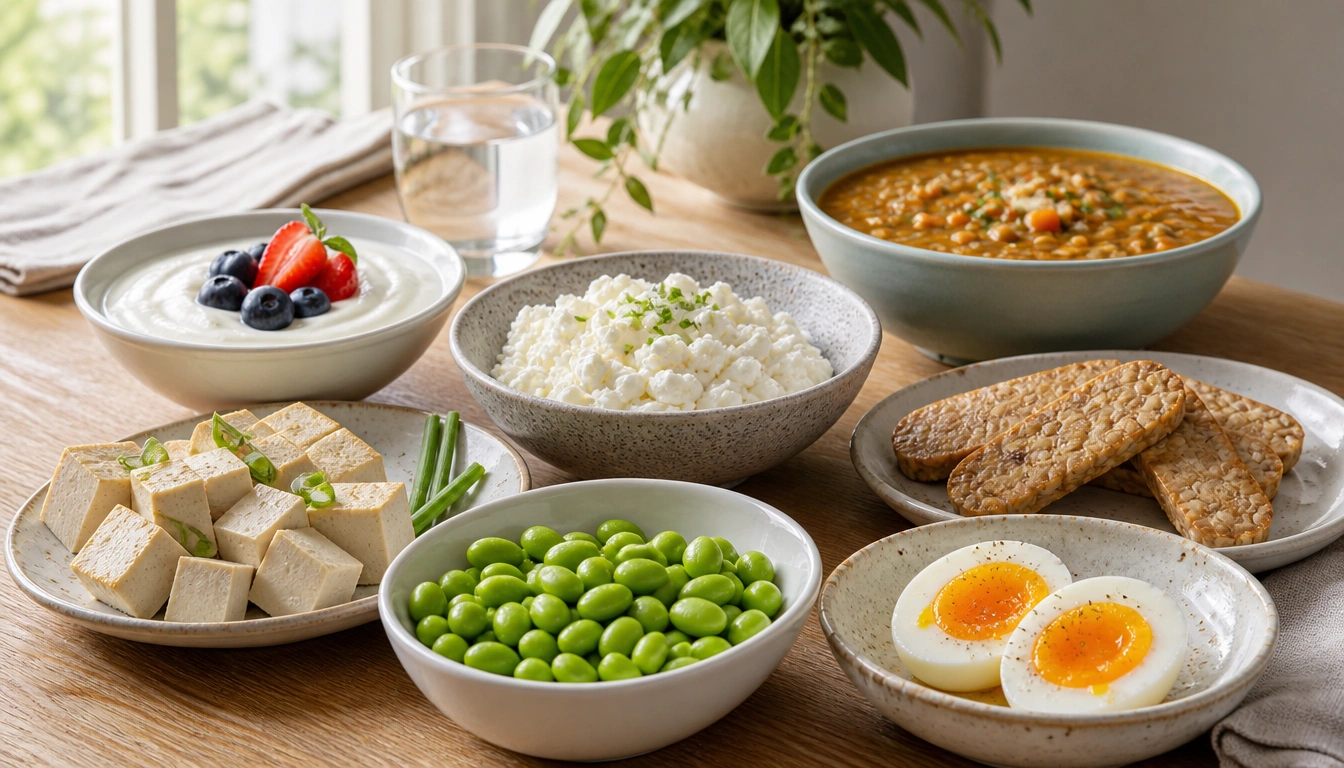
The easiest vegetarian protein sources for adults over 50 are foods that are soft, high in protein, and simple to use: Greek yogurt, cottage cheese, tofu, tempeh, lentils, split peas, edamame, and eggs. For many older adults, the bigger shift is not just daily protein, but getting enough protein at each meal—often about 25 to 30 grams—so muscles get a stronger signal to maintain and rebuild.
Key Takeaways
- Adults over 50 often benefit from spreading protein across the day instead of saving most of it for dinner.
- Plant proteins do not need strict food combining at every meal; variety across the day is enough to cover essential amino acids.
- Soft, low-prep options like Greek yogurt, cottage cheese, tofu, tempeh, lentils, edamame, and eggs are practical for many older adults.
- If beans and lentils cause bloating, start with smaller amounts and use gentler forms such as tofu, tempeh, soups, and purees.
- The higher-protein approach is not the same for everyone, especially people with chronic kidney disease or reduced kidney function.
Why protein needs change after 50
As people age, the body does not respond to protein quite the same way it did earlier in life. Muscles become less sensitive to the muscle-building signal from food and exercise, a pattern often called anabolic resistance. That means a small amount of protein may be enough to meet basic needs, but not always enough to support muscle maintenance, strength, and recovery in the same way.
For that reason, adults over 50 often do better when they think about protein in terms of meals, not only daily totals. A modest breakfast and lunch, followed by one large protein-heavy dinner, may leave too long a gap between useful protein doses. A more even pattern can be easier for the body to use and easier to sustain day to day.
This matters because preserving muscle is about more than appearance. Muscle supports balance, mobility, independence, and healthy aging. Protein also plays a role in bone health and healing, which is especially relevant when appetite drops or activity levels change.
Vegetarian eating can absolutely support these goals. The main task is choosing foods that are both protein-rich and realistic for older adults to eat regularly.
How much protein older adults should aim for per day and per meal
The standard Recommended Dietary Allowance for adults is 0.8 grams of protein per kilogram of body weight per day, but that is best understood as a minimum to help prevent deficiency. Reviews and expert guidance for healthy older adults often suggest a higher range, around 1.0 to 1.2 grams per kilogram per day, especially when the goal is to maintain lean mass and function.
For many adults over 50, the more practical target is about 25 to 30 grams of protein per meal. That does not mean every meal must be exact, and smaller people may need less while larger or more active people may need more. The point is to avoid clustering protein into just one meal.
Here is the simplest way to think about it: breakfast, lunch, and dinner all matter. If a person gets only a small amount at breakfast and lunch, it becomes harder to reach the daily target without overeating at night. A steadier pattern tends to work better for appetite, digestion, and muscle support.
If you want a food-first approach, aim to build each meal around one clear protein anchor. Then add fruit, vegetables, whole grains, or healthy fats around it. That structure can make vegetarian eating feel less like guesswork and more like a repeatable routine.
The easiest vegetarian protein sources for older adults: food by food practical comparison
Some vegetarian proteins are easier to eat and use than others, especially when appetite is smaller or chewing is harder. The best options are usually soft, quick to prepare, and rich enough in protein that a normal portion actually helps.
| Food | Why it is useful | Practical notes |
|---|---|---|
| Greek yogurt | Soft, high in protein, and no cooking required | Good at breakfast, as a snack, or blended into smoothies. Choose plain varieties if you want less added sugar. |
| Cottage cheese | High-protein and easy to chew | Works with fruit, tomatoes, herbs, toast, or crackers. A useful option when appetite is low but protein needs stay high. |
| Tofu | Very soft, versatile, and easy to flavor | Silken tofu works well in smoothies, soups, and sauces; firmer tofu can be baked, pan-seared, or scrambled. |
| Tempeh | Fermented soy food with a firmer, nutty texture | Often easier to digest than many whole beans for some people. Slice thinly if chewing is a concern. |
| Lentils and split peas | Affordable, filling, and protein-rich | Best in soups, dals, stews, or purees. Cooking them until very soft improves tolerance. |
| Edamame | Frozen and convenient, with strong protein content | Easy to steam, microwave, or add to salads and grain bowls. Shelled edamame is especially convenient. |
| Eggs | Complete protein and very flexible | Boiled, poached, scrambled, or baked into dishes. Soft textures are useful when chewing is difficult. |
Dairy foods like Greek yogurt and cottage cheese are often the easiest place to start because they require almost no prep and are naturally soft. Tofu is another strong choice because it can be changed to fit many textures and meals. Tempeh offers a different texture and flavor and can be helpful for people who want more variety without relying only on beans.
Beans and lentils are excellent vegetarian proteins, but they are not always the easiest starting point for older adults with sensitive digestion. They are still valuable foods, especially when cooked until very soft, but some people do better easing into them gradually.
Best protein choices for low appetite, chewing issues, or limited cooking energy
When appetite is small, the best protein foods are usually the ones that give a lot of nutrition in a small volume. That is one reason Greek yogurt, cottage cheese, and tofu are so useful. A person can get a meaningful protein serving without having to eat a large plate of food.
For chewing problems, softer foods are usually better than dry or tough proteins. Scrambled eggs, yogurt bowls, cottage cheese, silken tofu, lentil soup, and well-cooked split peas are all practical choices. If a food is hard to chew, it often ends up being eaten too slowly or not at all, which makes it less useful even if it looks nutritious on paper.
For limited cooking energy, convenience matters. Frozen edamame, pre-cooked lentils, canned beans, shelf-stable tofu, and plain yogurt can keep protein within reach on days when cooking feels like too much. A low-energy meal can still be a strong meal if it includes one clear protein source.
When beans cause bloating or gas, start small. Add a few spoonfuls to soup, mix lentils into casseroles, or choose smoother options like blended split pea soup, tofu, or tempeh. Increasing fiber-rich foods gradually often helps the digestive system adapt better than making a sudden jump.
Fermented or processed soy foods can be especially helpful here. Tempeh is often easier for some people to tolerate than a large bowl of beans, and tofu is usually gentle because it is soft and relatively low in chewing demand.
How to spread protein across the day without strict food combining
Older adults do not need to combine every plant protein perfectly at every meal. A varied vegetarian diet across the day easily provides essential amino acids. That means you do not have to micromanage rice and beans, bread and peanut butter, or other pairings at each sitting to make the diet work.
Instead, focus on the larger pattern. If breakfast includes yogurt and oats, lunch includes lentils or tofu, and dinner includes tempeh, eggs, or cottage cheese, the body still receives the amino acids it needs. Variety over the day is enough for most healthy adults.
This approach also makes meals less stressful. You can build around what is easiest to eat rather than trying to create a perfect amino acid formula every time. That matters for real life, especially if appetite changes from day to day.
A good rule is to make one item on the plate the protein anchor, then let the rest of the meal be flexible. For example, yogurt with fruit and nuts, tofu with vegetables and rice, or lentil soup with toast can all fit a balanced vegetarian pattern without special rules.
Simple meal-building ideas using pantry, freezer, and dairy staples
If your goal is to make protein easier, keep the building blocks obvious. Think in terms of meals you can assemble quickly from foods that last well and do not require much effort.
Breakfast ideas can be as simple as Greek yogurt with berries and oats, cottage cheese with fruit and whole-grain toast, or scrambled eggs with soft vegetables. These combinations are useful because they are easy to chew, easy to digest for many people, and fast to prepare.
For lunch, a bowl of lentil soup, split pea soup, or a tofu grain bowl can work well. Frozen edamame can be added to salads, soups, or microwaved as a snack. If you keep pre-cooked lentils in the refrigerator or freezer, they can be stirred into almost anything.
Dinner can be built around tempeh stir-fry, tofu curry, egg-based dishes, or a bean-and-vegetable soup made very soft. If appetite is low, a smaller meal with a protein-rich side may work better than trying to finish a large entrée.
These foods also work well as “protein boosters.” Add cottage cheese to a bowl of fruit, blend silken tofu into a sauce, stir lentils into tomato soup, or use yogurt as a creamy base for a savory dip. Small additions can make a meaningful difference across the day.
When higher protein needs extra caution: kidney disease, digestive tolerance, and red flags
The higher-protein approach for older adults does not apply in the same way to everyone. People with chronic kidney disease or reduced kidney function should not increase protein on their own. In that case, protein targets need to be individualized by a clinician or registered dietitian because kidney needs and nutrition goals have to be balanced carefully.
Digestive tolerance also matters. A sudden jump in beans, lentils, or very high-fiber meals can cause bloating, gas, or discomfort. That does not mean these foods are a bad choice; it usually means they need to be introduced more slowly or prepared in softer forms. Hydration and gradual changes often help.
Seek medical guidance if appetite has dropped sharply, weight is falling without trying, weakness is worsening, or balance is becoming harder to maintain. Those changes can have many causes, and nutrition advice works best when it is matched to the full clinical picture.
It is also worth getting help if you are unsure whether your current vegetarian pattern is actually meeting your needs. A health professional can help connect food choices, muscle health, kidney status, and exercise into one plan that fits your life.
Frequently Asked Questions
How much protein do adults over 50 need per day?
For many healthy older adults, expert guidance often points to about 1.0 to 1.2 grams of protein per kilogram of body weight per day. The usual RDA of 0.8 grams per kilogram is a minimum standard, but it may not be enough to fully support muscle maintenance in aging adults.
How much protein should older adults aim for at each meal?
A practical target is often about 25 to 30 grams per meal. That amount may help older muscles respond better to protein than a very small serving would. The goal is not perfect math at every meal, but a steadier spread across the day.
Which vegetarian proteins are easiest to digest for older adults?
Soft, low-prep foods are often the easiest: Greek yogurt, cottage cheese, tofu, tempeh, eggs, and well-cooked lentils or split peas. If beans cause bloating, tofu, yogurt, and eggs may be gentler starting points.
Do older adults need to combine plant proteins at every meal?
No. Strict food combining is not necessary for most people. A varied vegetarian diet across the day supplies the essential amino acids the body needs, so you can focus on overall pattern instead of pairing every meal perfectly.
What if I have kidney disease or reduced kidney function?
Do not raise protein targets on your own if you have chronic kidney disease or reduced kidney function. Protein needs should be individualized with a clinician or registered dietitian, because the right amount depends on your kidney status and overall health.
The Bottom Line
For adults over 50, the easiest vegetarian protein foods are usually the ones that are soft, familiar, and quick to prepare. Greek yogurt, cottage cheese, tofu, tempeh, lentils, split peas, edamame, and eggs can all help you reach protein goals without a lot of cooking.
The most useful shift is often spreading protein across breakfast, lunch, and dinner instead of relying on one large evening meal. For many healthy older adults, a meal pattern that includes about 25 to 30 grams of protein at a time is more practical than chasing only a daily total.
If beans bother your stomach, if your appetite is small, or if you have kidney disease, the right plan may need adjustment. Food choices should fit your digestion, your schedule, and your medical situation—not just a generic protein target.
Medical disclaimer
Medical disclaimer: This content is for educational and informational purposes only and is not a substitute for professional medical advice, diagnosis, or treatment. Dietary needs and supplement suitability vary by individual.
Sources
- National Institutes of Health (NIH) — nih.gov. Accessed October 2026.
- National Institutes of Health (NIH) — nih.gov. Accessed October 2026.
- U.S. Government / Health Authority — acl.gov. Accessed October 2026.
- Academic Research Institution — harvard.edu. Accessed October 2026.
