
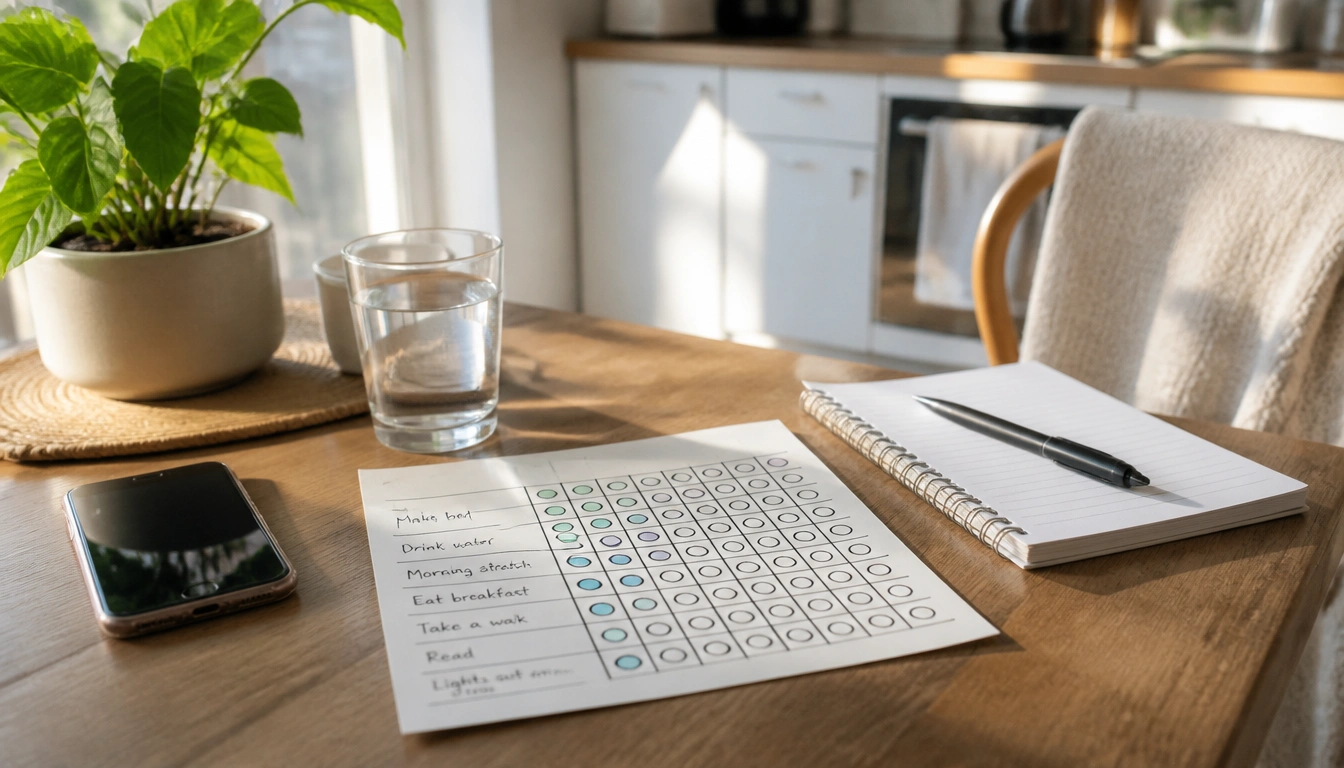
A healthy habit tracker works best when it is simple, visible, and tied to real life. For absolute beginners, the safest setup is to track just 1–3 micro-habits at first, choose an easy format you will actually use, and connect each habit to an existing routine. Keep the goal consistent, not perfect: missing a day does not erase progress, and the tracker should support your life rather than add pressure to it.
Key Takeaways
- Start with 1–3 habits only so your tracker stays manageable and you do not overload your attention.
- Choose habits tied to public-health basics such as movement, hydration, and sleep before adding anything advanced.
- Use habit stacking: “After I [current habit], I will [new habit]” makes the next step easier to remember.
- Pick the simplest tracking medium you will open daily: paper, notes app, spreadsheet, or a basic habit app.
- Track progress as consistency over time, not perfection, streaks, or a flawless record.
- If tracking begins to feel stressful, scale back, simplify, or switch to a more flexible approach.
Why beginners fail when they try to track everything at once
The fastest way to burn out is to build a tracker that tries to monitor every part of life on day one. A long list of habits may feel motivating for a day or two, but it quickly creates decision fatigue. Instead of supporting change, the tracker becomes one more thing to manage.
Beginner habit tracking works better when it focuses on a few foundations that matter most for daily health: moving more, drinking enough fluids, eating more balanced meals, and protecting sleep. Public-health guidance from organizations such as the CDC and the NHS emphasizes those basics because they support energy, recovery, and long-term routine-building.
A practical rule is to start with 1–3 micro-habits. That might mean one movement habit, one hydration habit, and one sleep habit. Keep each one so small that it feels almost too easy. The point is not to prove discipline; it is to make the behavior repeatable on ordinary days, not only on your best days.
If you are choosing which habits to start with, ask: Which change would make the biggest difference in my real life right now? Pick the habit you are most likely to do with your current schedule, energy, caregiving load, or work demands. A tracker should fit the life you actually have.
Picking the easiest tracker format: paper, notes app, spreadsheet, or habit app
The best habit tracker is the one you will open without resistance. For some beginners, a paper grid on the fridge is easiest because it is visible and requires no password, charging, or notifications. For others, a notes app or simple spreadsheet is better because it lives on the phone they already carry everywhere.
Paper works well if you like visual reminders and want a low-tech system that is easy to glance at. A notes app is useful if you prefer typing and want something you can edit quickly. A spreadsheet can be helpful if you enjoy structure, but only if it stays simple. A habit app can offer reminders, but it can also become cluttered if you add too many features.
Choose the format that reduces friction, not the one that looks most impressive. If updating the tracker feels like a task in itself, it is too complicated. Beginners usually do best with a format that takes only a few taps or a quick mark once a day.
You do not need a perfect design. A weekly table with habit names on one side and days across the top is enough. Keep the layout plain, readable, and easy to maintain during busy or tired moments.
Designing a frictionless tracking routine that takes under a minute
Tracking works best when it is attached to an existing routine, not added as a separate project. The ideal version is fast enough that you can do it in less than a minute. That means the tracker should live where you already spend time: on a bedside table, near the coffee maker, in your bag, or on your phone’s home screen.
A useful setup has three parts: the habit itself, the cue, and the quick mark. For example, after breakfast, you might check off “drank water.” After brushing your teeth at night, you might mark “set out walking shoes.” The fewer steps between the habit and the log, the easier it is to keep going.
Keep your tracking marks simple. A checkmark, dot, or short note is enough. You do not need paragraphs, charts, or a long reflection session every day. Save deeper review for the end of the week if you want it.
If your routine is still being built, make the tracker part of the routine you already have. The routine should be the anchor, and the tracker should follow naturally from it.
Turning a goal into a micro-habit you can actually repeat
Large goals are easier to sustain when they are translated into tiny behaviors. Instead of tracking “exercise more,” track a smaller action such as putting on walking shoes after waking up, walking around the block, or doing a short stretch. Instead of “eat healthier,” track adding one serving of vegetables to dinner or swapping one sugary drink for water.
This is where identity-based framing helps. Instead of only saying, “I want to walk more,” try, “I am someone who moves each day.” Instead of, “I need to drink more water,” try, “I am someone who takes care of hydration.” Identity language is useful because it supports motivation even when the excitement of a new goal fades.
Habit stacking makes the next step easier to remember. Use the formula: “After I [current habit], I will [new habit].” For example: “After I pour my morning coffee, I will drink a glass of water.” Or: “After I brush my teeth at night, I will place my exercise shoes by the door.”
Make the habit visible with environmental prompts. Put the water bottle where you will see it, lay out clothes for a short walk, or keep a notebook on the counter. Visible cues reduce the need to remember and make the behavior feel like part of the room, not a separate chore.
How to measure progress without obsessing over streaks or perfection
A healthy tracker measures consistency, not moral success. The goal is to notice patterns, not to judge yourself for imperfect days. A streak can be motivating for some people, but for beginners it can also create all-or-nothing thinking: one missed day feels like failure, even when the overall routine is improving.
A better measure is whether the habit is becoming easier to start, easier to remember, or easier to recover after interruption. You may not see dramatic change in one week, but you may notice that you reach for water more often, remember your walk more consistently, or recover from a missed day without abandoning the whole plan.
For beginners, the best question is not “Was I perfect?” It is “Did I show up often enough for this to matter?” That keeps the focus on momentum rather than punishment.
If you like numbers, keep them simple. Count completed days, not every detail of performance. If you do not like numbers, a yes/no checkmark is enough. The tracker is there to help you notice habits, not to turn everyday health into a report card.
What to do when you miss a day or your week falls apart
Missing one day is not a reset button. Research-informed habit guidance supports the idea that one missed day does not erase progress, as long as you return to the habit without turning the slip into a larger drop-off. A useful beginner mindset is “never miss twice.”
If you miss a day, treat it as information, not failure. Ask what got in the way: a late work shift, caregiving demands, poor sleep, travel, stress, or simply forgetting. The answer helps you adjust the system instead of blaming yourself.
When a week falls apart, simplify immediately. Return to the smallest version of the habit you can manage. If your original goal was a long walk, the fallback might be putting on shoes and stepping outside for two minutes. If your original goal was a full morning routine, the fallback might be one glass of water after waking up.
Do not wait for the “perfect” Monday. Restart on the next ordinary moment you have. The habit tracker should make restarting easier, not more dramatic.
How to adjust your tracker during stressful periods, illness, or schedule changes
Stress, illness, travel, and caregiving can all change how much energy you have for self-care. That is normal. A tracker should flex with your life rather than become a source of guilt when your schedule changes.
During busy weeks, cut the tracker down to the minimum that still feels useful. One or two habits may be enough. If a habit is usually daily but becomes unrealistic for a while, reduce the target rather than forcing the old version. The aim is to preserve continuity, not to insist on the same pace in every season.
This is especially important for sleep, movement, and nutrition habits. Public-health guidance supports regular movement, hydration, and sleep, but those needs may look different when you are sick, recovering, or under heavy strain. A shorter walk, extra rest, or a simpler meal may be the right version for that period.
If you know a stressful season is coming, pre-plan a lighter tracker. You might switch from full checklists to one daily question: “Did I do one small thing for my health today?” That approach keeps attention on maintenance instead of perfection.
When tracking becomes too much: warning signs and safer alternatives
Habit tracking should make life feel clearer, not heavier. If the tracker starts causing anxiety, guilt, compulsive checking, or obsession with streaks, it is time to step back. The same is true if you find yourself ignoring your body because you are focused on logging every detail.
Another warning sign is when the tracker becomes more demanding than the habit itself. If you spend more energy updating the system than doing the behavior, the system is too complex. Beginners often do better with a simpler format, fewer habits, or a shorter review period.
If tracking is making you feel worse, use a lighter alternative. You can keep a weekly note with just a few checkmarks, use a “did I do one helpful thing today?” approach, or stop tracking for a short period and focus on routine alone. The goal is health, not a perfect record.
Seek professional guidance if new habits trigger dizziness, pain, severe fatigue, disordered eating patterns, or strong psychological distress. If you have a chronic condition, are starting exercise after a long break, or are making major diet changes, a healthcare professional can help you choose safer starting points and realistic boundaries.
A tracker should support sustainable behavior, not pressure you into extremes. If it no longer feels helpful, simplify until it does.
Frequently Asked Questions
What 1–3 habits should a beginner track first?
Start with the habits most likely to support daily health without adding much burden. Good first choices are one movement habit, one hydration or nutrition habit, and one sleep habit. Keep each one small enough to repeat on ordinary days, not just on high-energy days.
Should I use a paper tracker or a digital app?
Use the format you will actually keep up with. Paper is often best for visibility and simplicity; a notes app or spreadsheet may be easier if you prefer your phone. A digital habit app can help with reminders, but only if it stays simple.
How do I make a habit stick to an existing routine?
Use habit stacking: “After I [current habit], I will [new habit].” For example, after brushing your teeth, you might floss or set out walking shoes. Tying the new behavior to an automatic cue makes it easier to remember.
How do I avoid burnout or obsessing over streaks?
Focus on consistency, not perfection. A missed day does not erase progress, and a streak is only one way to measure momentum. If tracking starts to feel stressful, remove extra metrics and keep only the smallest useful version.
What should I do if I miss a day?
Treat it as a normal interruption, not failure. Restart at the next cue and aim for a “never miss twice” mindset. If needed, shrink the habit temporarily so it fits your current energy and schedule.
The Bottom Line
A healthy habit tracker for beginners should be small, visible, and easy to repeat. Start with 1–3 micro-habits tied to real-life routines, then make the tracking itself so simple that it takes only a few seconds.
Choose a format that reduces friction, use habit stacking to link the habit to an existing cue, and judge progress by consistency over time rather than flawless streaks. If your tracker starts feeling punitive, simplify it or step back. The best system is the one that helps you keep going.
For most people, the safest foundation is not a long list of goals but a few steady habits around movement, hydration, sleep, and routine. That is usually enough to build momentum without overwhelm.
Medical disclaimer
Medical disclaimer: This content is for educational and informational purposes only and is not a substitute for professional medical advice, diagnosis, or treatment. Dietary needs and supplement suitability vary by individual.
Sources
- Centers for Disease Control and Prevention (CDC) — cdc.gov. Accessed October 2026.
- National Health Service (NHS) — oxfordhealth.nhs.uk. Accessed October 2026.
- National Health Service (NHS) — www.nhs.uk. Accessed October 2026.
- National Health Service (NHS) — scot.nhs.uk. Accessed October 2026.
- National Health Service (NHS) — humber.nhs.uk. Accessed October 2026.
