
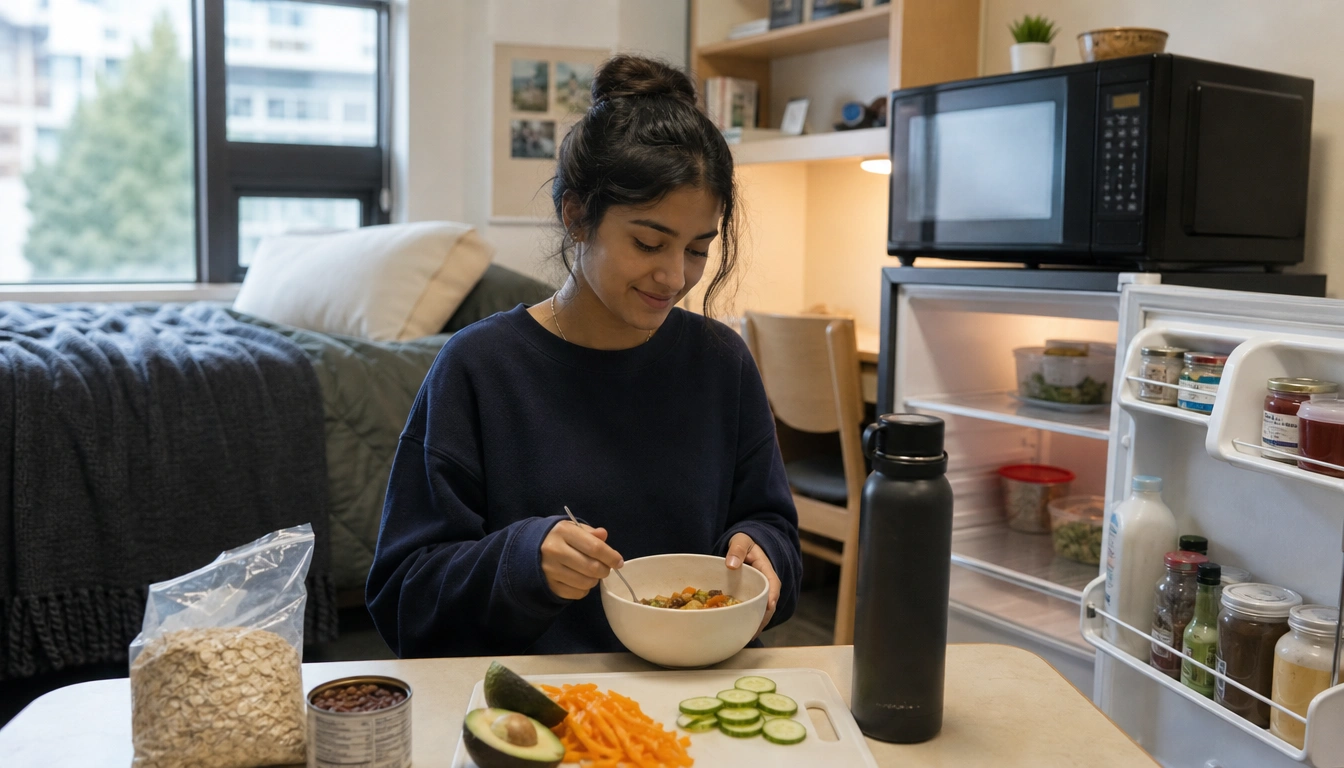
You can eat healthy in college without much time, money, or kitchen access by building meals from shelf-stable staples, frozen produce, and easy protein sources, then matching your choices to the appliances you actually have. A healthy convenience food strategy for college students is less about cooking from scratch and more about combining simple foods that keep you full, energized, and able to study without crashing.
Key Takeaways
- Build meals around a few flexible staples: oats, rice, tortillas, beans, frozen vegetables, fruit, yogurt, nut butter, and canned fish or tofu.
- Choose convenience foods that still give you fiber, protein, and micronutrients so you are not living on salty, sugary, ultra-processed defaults.
- Use the setup you have: no-cook, microwave-only, mini-fridge, or dining hall-based meals can all be balanced with the right framework.
- Keep portable snacks and water with you so long gaps between classes do not turn into energy crashes and fast-food detours.
- Food safety matters in dorms: keep cold foods cold, cover leftovers, and do not let shared spaces become a reason to ignore storage basics.
- Healthy eating should stay flexible; rigid “clean eating” rules can increase stress and may worsen disordered eating patterns.
College life makes convenience eating the default
A healthy convenience food strategy for college students starts with a simple reality: school days are irregular. Classes may be spread across campus, meals get pushed late, sleep is inconsistent, and the easiest food is often the least balanced. That is why many students end up relying on ramen, drive-through food, pastries, energy drinks, or snack foods that keep them going for a short time but do not hold them over for long.
The problem is not that convenience foods exist. The problem is that many convenient choices are low in fiber and protein and high in refined starch, sugar, or sodium. Those combinations can leave you hungry again quickly and may make concentration feel harder. Research on dietary patterns consistently supports the value of steady energy from foods that include whole grains, fruits, vegetables, and protein sources. Federal guidance from the USDA and other public-health frameworks also emphasizes variety, balance, and hydration rather than perfect eating.
The goal is not to eat like you have a chef, a stocked pantry, and free time. The goal is to create a system that is realistic on a busy campus and sustainable when your schedule changes.
Build meals from shelf-stable, microwave-friendly, and assembly-only foods
The easiest way to eat well with limited kitchen access is to think in parts rather than recipes. If you keep a few reliable foods on hand, you can combine them into meals with almost no effort. This is sometimes called assembly cooking: taking ready-to-eat or quick-cook items and putting them together in a balanced way.
A practical framework is to anchor most meals with three pieces: a carbohydrate base, a protein source, and a fruit or vegetable. Whole grains and higher-fiber carbs help with satiety, while protein supports fullness and steadier energy. Frozen vegetables, bagged greens, canned beans, and fruit are useful because they are convenient and usually more budget-friendly than ordering out.
For students, the easiest versions are often the best versions. Canned beans, microwave rice, baby carrots, apples, hummus, yogurt, peanut butter, and canned tuna or salmon can become lunch, dinner, or a study snack with minimal effort. If you have a little more room, tofu, edamame, pre-cooked chicken, and frozen vegetables make the pattern even easier to repeat.
Keep a dorm room grocery starter kit by food group
A smart grocery list helps you avoid starting from zero every time you get hungry. Think in categories so your food can mix and match.
Protein: canned tuna or salmon, canned beans, chickpeas, tofu, Greek yogurt, string cheese, eggs if you have safe storage, nut butter, and low-sugar protein bars when needed.
Carbohydrates: instant oats, whole-grain bread, tortillas, microwave rice or quinoa cups, whole-grain cereal, and lentil or whole-wheat pasta if you have access to a hot plate or shared kitchen.
Produce: bananas, apples, oranges, grapes, baby carrots, cherry tomatoes, bagged salad greens, frozen berries, and microwave steam-in-bag vegetables.
Fats and flavor: olive oil, nuts, seeds, hummus, guacamole packs, salsa, mustard, and low-sodium sauces or seasonings.
The budget-first version is especially important. Shelf-stable staples, frozen produce, and low-cost protein foods usually stretch much farther than meal delivery or single-use convenience meals. If money is tight, base your shopping list on foods that can reappear in multiple meals instead of buying one-off specialty items. That way, the same can of beans might work in a grain bowl, a wrap, and a salad over several days.
Fast meal formulas that beat fast food defaults
Having formulas is easier than memorizing recipes. You do not need a new meal every time; you need repeatable combinations that are quick and satisfying.
Grain bowl: microwave rice or quinoa + beans or chicken or tofu + greens or frozen vegetables + salsa, dressing, or avocado. This works well when you need a real meal after class but only have a microwave.
Wrap: tortilla + hummus or nut butter + greens + tuna, egg, beans, or turkey. Wraps are portable and can be eaten between commitments.
Overnight oats: oats + milk or a dairy-free alternative + yogurt or nut butter + fruit. This is useful for breakfast, but it also works as a snack or late-night study fuel.
Snack plate meal: crackers or whole-grain bread + cheese or hummus + fruit + nuts + vegetables. This is especially helpful when your appetite is low but you still need something balanced.
These formulas are valuable because they reduce decision fatigue. They also make it easier to choose better convenience foods without turning every meal into a cooking project. If your usual default is fast food, the easiest improvement is often not perfection. It is replacing one ultra-processed meal with a simple assembled meal you can repeat.
If you are choosing between convenience options, look for foods with more protein and fiber and fewer added sugars. That does not mean you must eliminate packaged foods. It means you should use the label as a tool, not as a source of stress. Some packaged options are useful, especially when your schedule is packed. The main question is whether the food helps you feel steady for the next few hours.
Adjust the plan for a mini-fridge, microwave, or dining hall
Your best strategy depends on what equipment you actually have. A full kitchen opens more options, but you can still eat well with less.
Mini-fridge only: focus on foods that hold safely and can be eaten cold or with minimal preparation. Yogurt, hummus, cheese, washed produce, deli turkey, hard-boiled eggs, tofu, and cooked leftovers kept cold properly are useful. Pair them with bread, tortillas, or whole-grain crackers.
Microwave only: lean on steam-in-bag vegetables, microwave rice cups, oats, canned beans, and pre-cooked proteins. Many frozen vegetables and grains cook well this way, and the microwave can turn a few groceries into a real meal in minutes.
Dining hall reliance: if the dining hall is your main food source, use the plate as your planning tool. Start with vegetables or salad, add a protein, then include a whole-grain or starchy side, and finish with fruit or milk if available. This approach fits USDA MyPlate-style guidance and is often easier than trying to build the “perfect” plate from every station.
Students with a full kitchen can of course cook more, but the same logic still helps. A little more access should make your routine simpler, not more complicated.
Protect food safety in dorms and shared kitchens
Healthy convenience food strategy for college students also includes basic food safety. Shared spaces can make it tempting to guess, but storage mistakes can lead to stomach upset and wasted money.
Keep cold foods cold. Perishable foods should stay refrigerated, and leftovers should be covered and eaten or discarded within a safe window. If you are using a dorm mini-fridge, make sure it is actually cold enough and do not overpack it to the point that air cannot circulate. Use sealed containers so spills and cross-contamination do not become the norm.
If you share a kitchen, label your food and check it often. Shared fridges can get crowded, and leftovers disappear easily if they are not marked. Clean containers, prompt refrigeration, and a simple “use first” shelf can save money and reduce waste.
Food safety also includes being realistic about what you can store. If you do not have reliable fridge space, buy smaller amounts of perishable items and choose more shelf-stable foods. That is not a downgrade; it is a smarter fit for your environment.
Make the system stick with hydration, backpack snacks, and planning
Habits are what keep healthy convenience eating from falling apart during a busy week. The easiest habits are the ones that happen almost automatically.
Hydration is one of the most overlooked supports. Carry a water bottle and refill it during the day. Mild dehydration can make fatigue and headaches feel worse, and that can push you toward extra caffeine or sugary drinks. Water does not need to be fancy to help.
Backpack snacks are another useful tool. Keep shelf-stable items like trail mix, nuts, granola bars with lower added sugar, roasted chickpeas, crackers, or nut-butter packets in your bag. That way, a long gap between classes does not become an emergency that sends you to the nearest vending machine.
Planning should stay simple. Before a long class block or study session, ask two questions: What food will I have access to, and what will I wish I had later? A little foresight helps you avoid the pattern of getting too hungry, then grabbing whatever is closest. That is also why the best student food plans are flexible. They need to survive exams, late nights, canceled meals, and schedule changes.
Know when healthy convenience is not enough
Sometimes food stress is not just about convenience. If you are losing weight without trying, feeling chronically fatigued, having ongoing stomach issues, or noticing that food rules are taking over your mood and schedule, it is worth checking in with a healthcare professional. Campus health services, a registered dietitian, or a mental health professional can help if eating patterns are becoming unsafe or overwhelming.
It is also important to watch for rigid “clean eating” rules. A practical eating pattern allows for flexibility, budget changes, and imperfect days. If you find yourself skipping meals, avoiding many foods, or feeling intense guilt after eating convenience food, that can be a sign to slow down and get support. Healthy eating should make college life more manageable, not more stressful.
For most students, the goal is straightforward: keep food available, keep it balanced enough, and keep the system easy enough to repeat. That is what makes it sustainable.
Frequently Asked Questions
What are the best healthy convenience foods to keep in a dorm room or mini-fridge?
Good dorm staples include yogurt, cheese, hummus, hard-boiled eggs, pre-washed greens, baby carrots, fruit, tortillas, whole-grain bread, canned beans, and nut butter. These foods are flexible, relatively affordable, and easy to combine into meals or snacks without much cooking.
How can I make balanced meals with only a microwave or no stove?
Use a simple pattern: a grain or carb, a protein, and a fruit or vegetable. Microwave rice with beans and frozen vegetables is one example. Oatmeal with nut butter and fruit is another. If you have no stove, lean on microwave-safe, ready-to-eat foods and assembly meals.
What cheap convenience foods are still nutritious for college students?
Budget-friendly options include oats, brown rice, pasta, beans, lentils, frozen vegetables, bananas, apples, peanut butter, eggs, canned fish, and plain yogurt. These foods tend to give more fiber, protein, and staying power than typical fast-food meals or snack-only eating.
How do I avoid relying on ramen, fast food, and energy drinks all week?
Make a backup plan before you get too hungry. Keep portable snacks in your bag, stock a few fast meal ingredients in your room, and drink water regularly. Even replacing one convenience meal a day with a simple bowl, wrap, or dining hall plate can reduce the cycle of energy crashes.
What should I do if my campus dining hall is my main food source?
Use the dining hall strategically by scanning first, then building a plate with vegetables or salad, a protein, and a whole-grain or starchy side. Add fruit when available. This approach helps you get more balanced meals without needing a kitchen or extra prep.
The Bottom Line
You do not need a perfect kitchen or a perfect schedule to eat well in college. A healthy convenience food strategy works best when it is built around flexible staples, easy proteins, frozen or fresh produce, and a few repeatable meal formulas.
The most useful changes are usually small: keep snacks in your backpack, drink water through the day, use the dining hall with a plate-building plan, and stock foods that can become multiple meals. That approach is cheaper and more realistic than trying to live on fast food or strict rules.
If eating is becoming stressful, restrictive, or physically unsatisfying, ask for help from campus health or a registered dietitian. The right plan should support your classes, energy, and wellbeing—not add another burden.
Medical disclaimer
Medical disclaimer: This content is for educational and informational purposes only and is not a substitute for professional medical advice, diagnosis, or treatment. Dietary needs and supplement suitability vary by individual.
Sources
- National Institutes of Health (NIH) — nih.gov. Accessed November 2026.
- Academic Research Institution — fiu.edu. Accessed November 2026.
- Academic Research Institution — stjohns.edu. Accessed November 2026.
- Academic Research Institution — lsuhsc.edu. Accessed November 2026.
- Academic Research Institution — ufl.edu. Accessed November 2026.
