
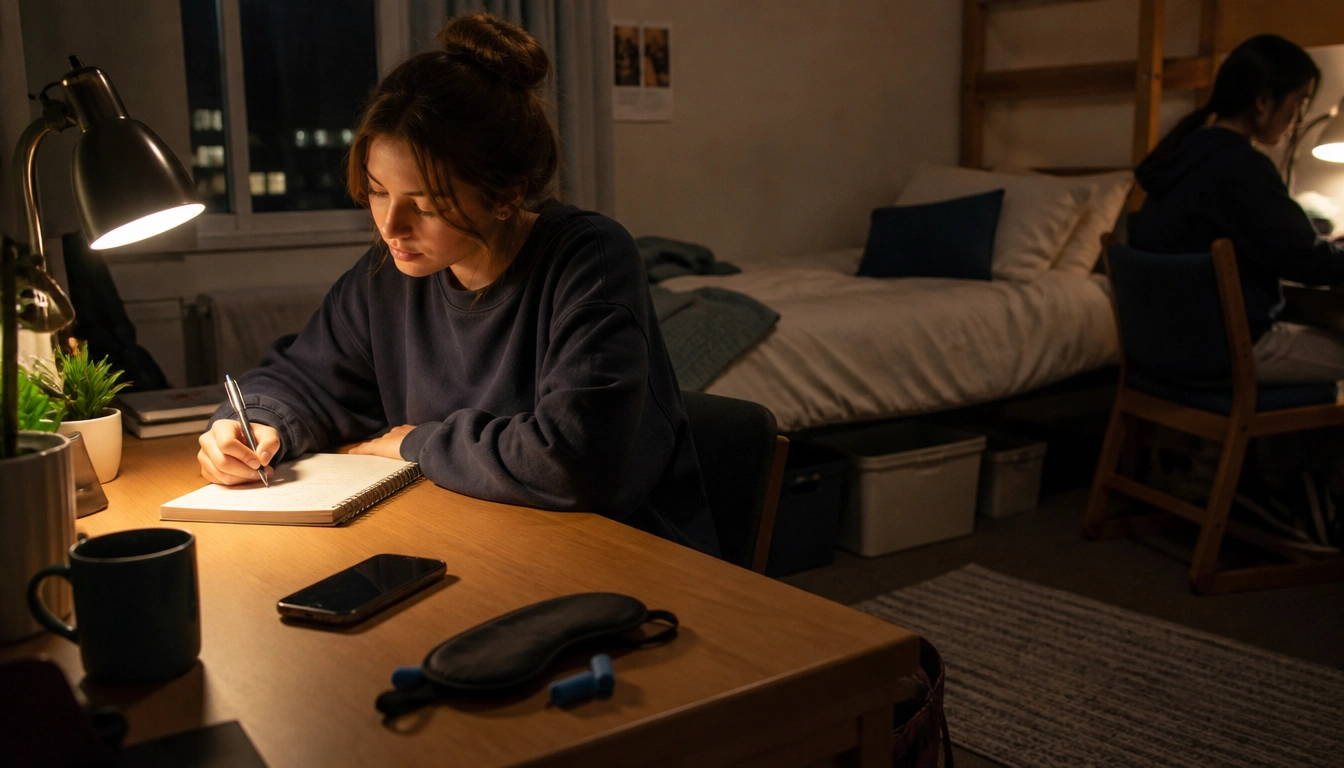
A college student should spend the evening lowering stimulation, clearing tomorrow’s mental clutter, and protecting sleep time. That usually means finishing caffeine early, avoiding heavy food and alcohol close to bed, dimming light, reducing screens, and using a short routine that fits dorm life. Consistency matters most: a regular wake time and a realistic bedtime cue your body to sleep better over time.
Key Takeaways
- A steady wake time and bedtime matter more for circadian stability than sleeping in on weekends to “catch up.”
- A wind-down routine does not need to be long; 30 to 60 minutes is ideal, and even 15 to 20 minutes can help on busy nights.
- Late caffeine, alcohol, and heavy meals can fragment sleep, delay sleep onset, or cause more awakenings overnight.
- Dorm sleep improves with practical tools like a sleep mask, blackout curtains, earplugs, a white-noise machine, or a bedside fan.
- A brain-dump list can reduce racing thoughts by moving school tasks out of working memory and onto paper.
- If sleep problems last for weeks, cause daytime impairment, or come with snoring, gasping, or worsening mood, campus health or a clinician should evaluate them.
Why an evening routine matters for college students
For college students, the evening routine is not just a comfort habit. It is a way to protect sleep, which supports memory consolidation, attention, mood, and stress recovery. The CDC and sleep medicine experts recommend 7 to 9 hours of sleep for most young adults, and that only happens consistently when the evening gives your brain time to switch gears.
College life pulls in the opposite direction. Late classes, jobs, athletics, social plans, and screen time can keep the nervous system in an alert state long after the day is over. A structured evening routine gives your body repeated cues that the day is ending. Over time, those cues make it easier to fall asleep and to get better-quality sleep once you are there.
Sleep also affects how the next day feels. When sleep is short or fragmented, students often notice worse focus, slower thinking, more irritability, and more stress reactivity. That can create a cycle: poor sleep makes school feel harder, and school stress makes sleep harder. A routine is a way to interrupt that loop.
Core principles of a college-friendly routine
The best routine is one you can repeat most nights, even during busy weeks. Three principles matter most: consistency, low stimulation, and enough time to wind down. Consistency means aiming for a regular wake time and a regular bedtime cue, even if the exact bedtime shifts by a small amount. Low stimulation means moving away from tasks that keep the brain “on,” such as doomscrolling, intense studying, argument-heavy texting, or fast-paced content. Enough time to wind down means giving yourself a buffer instead of trying to fall asleep immediately after a high-energy activity.
A realistic college routine can be thought of in time blocks. In the 1 to 2 hours before bed, start closing the academic loop. Finish the most mentally demanding work, then write down tomorrow’s tasks so they are not circling in your head. In the 2 to 3 hours before bed, focus on food and caffeine boundaries. In the 30 to 60 minutes before bed, switch to low-light, low-stimulation activities that feel repetitive and calm.
A simple sequence might look like this: finish classwork early enough to avoid using bed as a desk, eat a lighter evening meal if needed, set out clothes and supplies for tomorrow, dim the room, silence notifications, wash up, and choose one calm activity such as reading a few pages, stretching, or breathing slowly. That structure matters more than whether your exact routine looks identical to someone else’s.
Dorm and shared-space adaptations
Shared housing makes sleep harder because you do not control light, sound, or other people’s schedules. The answer is not to wait for perfect conditions. It is to make the room work better for sleep with small, practical changes. If light is the problem, use a sleep mask or blackout curtains when possible. Even a temporary room-darkening setup can help if hallway light or a roommate’s lamp stays on late.
If noise is the problem, try earplugs, a white-noise machine, or a bedside fan. These options do different jobs: earplugs reduce sound directly, white noise can mask unpredictable noises, and a fan can create steady background sound while also making the room feel more comfortable. Many students do best with one main noise tool plus a backup.
Privacy also matters. If you share a room, create a small bedtime signal that helps others know you are winding down, such as turning on a warm lamp, putting away your laptop, or keeping your side of the room in “sleep mode.” If your roommate keeps a different schedule, talk early about quiet hours, alarm habits, and light sources. Dorm life rarely allows total control, so the goal is to reduce disruption enough that your brain can still associate the space with sleep.
For commuter students, “shared space” may mean a loud household, a busy commute, or a room where work and rest overlap. In that case, the same principle applies: create a clear sleep cue and a clear end to the day, even if the environment is imperfect.
What to avoid at night
Evening choices can change sleep quality, not just sleep timing. Caffeine is the most common issue. Coffee, energy drinks, black tea, some sodas, and pre-workout products can stay active for hours. The grounded guidance here is to avoid caffeine for 4 to 6 hours before bed, and for some students, an even earlier cutoff works better. The reason is not only that caffeine can make it harder to fall asleep; it can also make sleep lighter and more fragmented.
Alcohol is another common trap. It may make you feel drowsy at first, but it often breaks up sleep later in the night and can reduce sleep quality overall. Some students fall asleep faster after drinking and assume that means it helps. Usually, the later-night wakeups and poorer sleep architecture tell a different story.
Heavy meals close to bedtime can also backfire. Large, high-fat, very spicy, or rich meals can cause discomfort, reflux, or restlessness when you lie down. If you are hungry, a light snack is less likely to disrupt sleep than a large late meal. The point is not to fear food; it is to avoid giving your digestive system extra work right before bed.
Late-night studying in bed is another habit worth changing. Bed should be a sleep cue, not a place for stressful reading, laptop work, or scrolling through assignments. If you regularly work in bed, your brain can start linking the mattress with alertness. Studying at a desk, then moving to bed only when you are ready to sleep, strengthens that boundary.
A minimum viable routine for busy nights
Some nights, a full 30 to 60 minute wind-down is unrealistic. Late labs, practices, shifts, club meetings, and long commutes can leave almost no buffer. In those cases, a short routine is better than abandoning the idea entirely. A 15 to 20 minute version can still tell your brain that the day is over.
Start by doing one fast “closure” step for tomorrow: write down the top tasks, pack your bag, or set out what you need for the morning. Then reduce stimulation by silencing notifications, dimming lights, and putting the phone out of reach. Finish with one calming body-based cue such as washing your face, changing clothes, light stretching, or a few slow breaths. If you have time for only one more thing, choose the one that feels most repeatable.
The goal is not to perform a perfect routine. It is to keep a consistent pattern that can survive demanding weeks. For students who work evenings or train at night, this smaller routine can be the difference between “I have no sleep habits” and “I always do the same three things before bed.” That consistency is valuable even when the time block is short.
One useful rule: do not let a busy night turn into an all-night screen session or a guilt spiral. If the schedule is compressed, simplify the routine instead of deleting it.
How to adjust for chronotype without sacrificing sleep
Some students naturally feel sleepy earlier, while others feel more alert late at night. That difference is often called chronotype. A later chronotype does not automatically mean something is wrong. What matters is whether the schedule still protects enough total sleep and stays stable enough to support your classes and responsibilities.
If you tend to feel sleepy later, do not force an extreme bedtime shift that you cannot maintain. Instead, move your evening routine a little later while still keeping the same structure: a closing task, a food or caffeine cutoff, and a wind-down period with reduced light and stimulation. That helps your body recognize the pattern without pretending you are a different person.
The bigger problem is often a highly variable schedule. Sleeping very late on weekends and very early during weekdays can create “social jetlag,” which makes Monday mornings feel like a time-zone change. A more stable wake time is usually more helpful for circadian rhythm than trying to catch up with a long lie-in. If you need extra sleep, aim to build it into your week rather than relying on dramatic weekend swings.
Students with evening chronotypes may also benefit from morning light exposure and a predictable wake time, since those cues help anchor the body clock. The routine should fit your biology and your schedule, not fight both at once.
Common mistakes students make when trying to fix sleep
One common mistake is treating sleep as a single problem instead of part of a system. Students sometimes buy one sleep product, use it once, and expect everything to change. Real improvement usually comes from a few linked habits: less late caffeine, less screen stimulation, a better wind-down, and a steadier sleep schedule.
Another mistake is assuming weekend recovery will erase weekday sleep loss. Extra sleep can help you feel better, but it does not fully undo the effects of repeated schedule shifts. It is usually more effective to keep sleep and wake times reasonably steady, then use weekends for modest recovery rather than a complete reset.
Students also overestimate how much they can do in the final hour before bed. A high-intensity study session, a long phone conversation, a big meal, and several cups of coffee do not combine into a relaxing evening. If your routine feels too ambitious, shrink it. Fewer steps done consistently beat a perfect routine that fails after three nights.
Finally, many students miss the mental side of sleep. If your brain keeps replaying assignments, social stress, or unfinished tasks, a brain-dump list can help. The act of writing down next steps can reduce the sense that everything must stay active in memory. That small off-loading step often makes the rest of the routine work better.
Warning signs that need campus health or medical care
Not every sleep problem is just a bad habit. If you have trouble falling asleep or staying asleep for more than a few weeks despite making real changes, it is worth checking in with campus health or another clinician. Persistent insomnia symptoms can have medical, mental health, or schedule-related causes that need more than routine tweaks.
Get evaluated sooner if daytime sleepiness is affecting driving, classes, or safety. Loud snoring, gasping, or pauses in breathing during sleep should also be taken seriously, since they can point to sleep apnea or another sleep disorder. If sleep problems are tightly linked with worsening anxiety, depression, or other mood symptoms, that is another reason to seek help rather than trying to push through alone.
Sleep hygiene can help most students, but it is not a cure-all. If the problem is severe, persistent, or affecting function, the right next step is professional evaluation, not more self-blame. That is especially true if you are already doing the basics and still not sleeping well.
Frequently Asked Questions
How long should a college student’s wind-down routine be before bed?
A good target is 30 to 60 minutes, because that gives the brain time to shift out of school mode. If your schedule is packed, even 15 to 20 minutes of consistent wind-down steps is better than none.
What are the best screen and blue-light habits before sleep?
The strongest habit is to reduce screen use in the last part of the evening and keep the phone out of reach. Blue-light filters may help a little, but they do not replace lowering stimulation, dimming lights, and stopping the scroll loop.
What should college students avoid eating or drinking at night?
Avoid caffeine late in the day, since it can make sleep lighter and harder to start. Also try not to have heavy meals or alcohol close to bed, because both can worsen sleep quality and cause more awakenings later.
How can students build an evening routine in a noisy dorm or shared room?
Use tools that change the sleep environment: a sleep mask or blackout curtains for light, and earplugs, white noise, or a fan for sound. It also helps to set a roommate-friendly quiet cue, like dimming lights and putting away devices.
What can a student do if they have late classes, a job, or athletics and only have a short bedtime window?
Use a minimum routine: write tomorrow’s top tasks, silence notifications, dim the room, and do one calming action such as washing up or stretching. A short routine is still useful if it happens the same way most nights.
The Bottom Line
A healthy evening routine for college students is less about perfection and more about repeatable cues that help your body slow down. The best routines protect sleep, lower evening stress, and fit real college life, including dorm noise, roommates, work shifts, and athletics.
If you want the biggest payoff, focus on a steady wake time, an earlier caffeine cutoff, less light and screen stimulation at night, and a quick brain-dump before bed. Those habits often do more than trying to overhaul everything at once.
If sleep stays poor for weeks, affects daytime function, or comes with snoring, gasping, or mood changes, campus health or a clinician should evaluate it. A routine is a strong foundation, but it should not replace medical care when warning signs are present.
Medical disclaimer
Medical disclaimer: This content is for educational and informational purposes only and is not a substitute for professional medical advice, diagnosis, or treatment. Dietary needs and supplement suitability vary by individual.
Sources
- Centers for Disease Control and Prevention (CDC) — cdc.gov. Accessed October 2026.
- Centers for Disease Control and Prevention (CDC) — cdc.gov. Accessed October 2026.
- Academic Research Institution — carleton.edu. Accessed October 2026.
- Academic Research Institution — gatech.edu. Accessed October 2026.
- Academic Research Institution — osu.edu. Accessed October 2026.
