
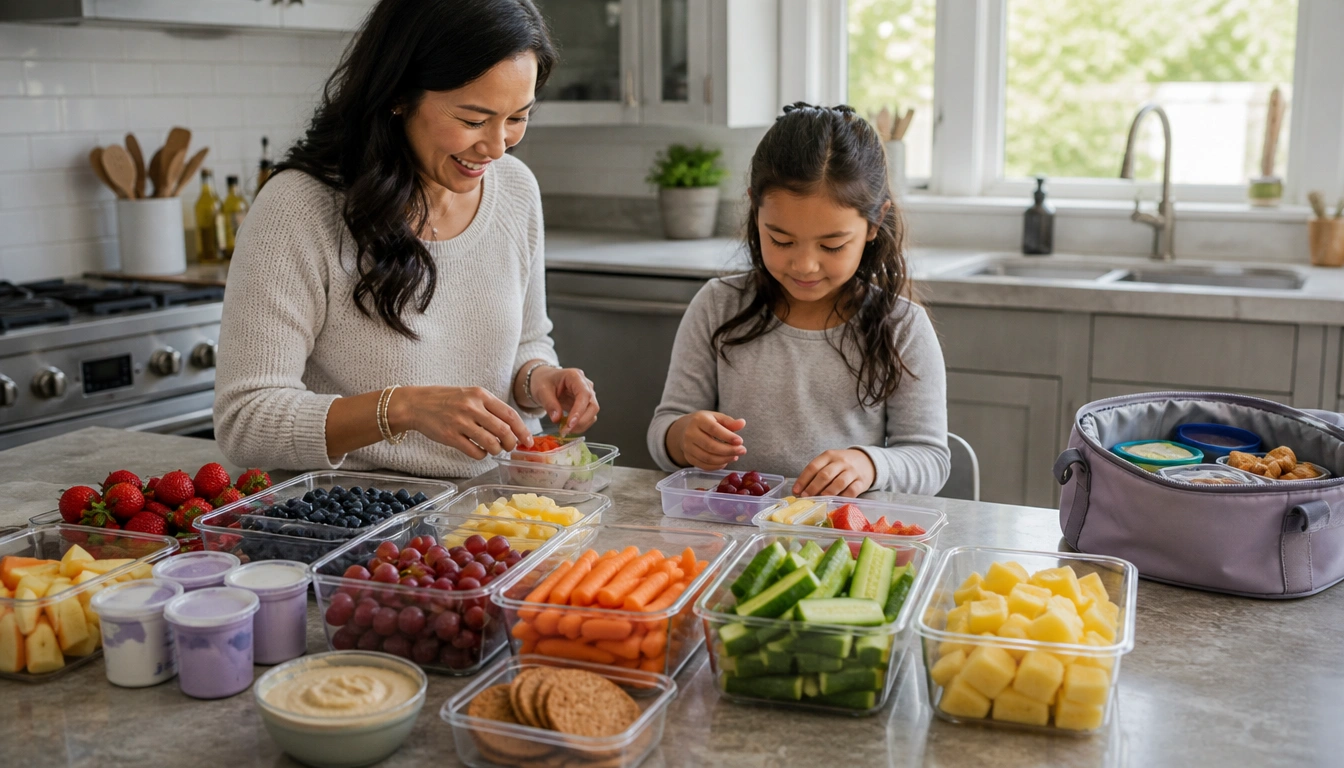
The easiest healthy snack planning strategy is to keep a short list of repeatable, food-first combinations ready to go: fruit or whole grains plus yogurt, cheese, hummus, nuts, seeds, or another protein source. That helps snacks feel filling instead of random. For busy families, the best system is usually not more recipes—it is a stocked pantry, a prepared fridge shelf, and a few make-ahead options that fit your children’s ages and your schedule.
Key Takeaways
- Pair fiber-rich carbohydrates with protein or healthy fats to slow digestion and improve fullness between meals.
- Use a small grab-and-go system in the fridge, pantry, and freezer so healthy choices are easier than last-minute takeout or vending-machine snacks.
- For toddlers and preschoolers, snack safety matters as much as nutrition: modify choking hazards and use age-appropriate textures.
- Packaged snacks can be useful, but the label should help you choose lower added sugar, sodium, and saturated fat.
- Snacks are a chance to fill nutrient gaps with calcium, potassium, fiber, and vitamins—not just to quiet hunger.
- A little planning can reduce mindless eating, cut down on food waste, and make after-school or workday snacking less stressful.
Why healthy snack planning matters for busy families
For many families, snack time happens at the edges of the day: after school, between meetings, in the car, or right before dinner. That is exactly when energy tends to dip and patience runs thin. Without a plan, people often reach for whatever is fastest, which may be packaged foods that are low in fiber or high in added sugar and sodium. A little structure helps snacks do a better job.
The goal is not to “cut out” snacks. For children, especially younger ones, snacks can help fill the gap between meals. For adults, a planned snack can prevent the crash-and-grab cycle that happens when lunch was too small or dinner is still far away. The CDC and other public health guidance support choosing foods that combine more than one food group, because that tends to be more satisfying and steadier than a lone sweet or crunchy item.
A useful food-first formula is simple: pair a fiber-rich carbohydrate with protein or healthy fat. Think apple slices with peanut butter, whole-grain crackers with cheese, carrots with hummus, or yogurt with fruit. Fiber slows digestion and protein or fat helps keep you full, so the snack works with your body instead of giving you a quick bump and a quick drop. That pattern matters for mood, focus, and the odds that everyone arrives at the next meal reasonably hungry, not ravenous.
Snacks can also help families meet nutrient needs that are easy to miss during busy days. Dairy, fruit, vegetables, whole grains, nuts, and seeds can contribute calcium, potassium, fiber, and vitamins. That is one reason snacks should be treated as part of the day’s nutrition, not as “empty calories” that only cause problems.
Build a family snack system that works on weekdays
The easiest system is one that removes decision-making. Instead of trying to invent a new snack every day, create a few permanent zones: a pantry shelf, a fridge shelf, and a freezer stash. Keep the options visible, portioned, and easy to reach. When healthy food is the most convenient food, it gets chosen more often.
In the fridge, make one shelf or bin the grab-and-go zone. Pre-wash produce, cut vegetables into snack-size pieces, and place them beside dip, string cheese, yogurt, or hummus. In the pantry, keep single-serve or pre-portioned items where kids can see them without digging through bigger packages. In the freezer, keep batch-prepped items such as muffins, oat bars, or thaw-and-eat fruit portions for especially busy mornings.
Portioning matters because it lowers friction. It is much easier to hand someone a small container than to debate serving sizes at 4 p.m. You do not need elaborate containers or a meal-prep marathon. A few reusable bins and a weekly reset are enough for most families. Many parents find it helpful to restock on the same day each week so the system becomes routine rather than a project.
If space is tight, start with one category only. Even a single refrigerator bin labeled for snacks can make a difference. The point is to make the next good choice obvious.
Best snack formats for school, work, and after-activity days
Busy family snacks usually fall into three practical categories: no-cook, minimal-prep, and make-ahead. No-cook snacks are the best fallback for hectic days. Examples include fruit plus cheese, vegetables plus hummus, yogurt plus berries, or whole-grain toast with nut or seed butter. These require almost no assembly but still follow the food-first formula.
Minimal-prep snacks are useful when you have a few extra minutes. You might slice apples, portion trail mix for older children, hard-cook eggs ahead of time, or build simple wraps with tortilla, hummus, and vegetables. Make-ahead snacks are the safety net for mornings, car rides, sports practice, and late workdays. Muffins made with whole grains, overnight oats, freezer-friendly bars, and other batch-prepped options can bridge the gap without a drive-through stop.
Age also changes snack planning. Toddlers and preschoolers often need smaller, more frequent snacks because their stomachs are small and their energy needs are high. Under age 5, safety becomes a top priority: whole nuts, popcorn, hard candies, and hard round foods can be choking hazards and should be avoided or modified. For children under 2, full-fat dairy can be appropriate because it provides energy and supports rapid growth and brain development. Older children and teens can usually handle more variety and can help choose from a prepared snack list if options are clearly available.
For older kids, keep the snack formula simple enough that they can assemble it themselves: fruit and yogurt, crackers and cheese, toast and avocado, or vegetables and dip. The more independent the child, the more important it is that the ingredients are already set up for success.
Safety first with choking hazards, allergies, and texture changes
Healthy snack planning has to fit the child in front of you, not just the recipe. For young children, texture matters. Foods should be cut, mashed, thinly spread, or softened as needed. Grapes, cherry tomatoes, and similar round foods should be modified for small children. Thick spoonfuls of nut butter can also be risky; spread it thinly on toast or pair it with a soft food instead.
Allergy awareness matters at home, in school, and in shared spaces. Tree nuts, peanuts, dairy, eggs, soy, and other allergens may need to be avoided depending on your child’s needs or the rules of a classroom or daycare. If you are packing snacks for a group setting, check the policy first rather than assuming a standard safe snack will work everywhere.
For children who are picky or have chewing difficulties, use texture as a tool. Soft fruit, shredded cheese, yogurt, oatmeal cups, mashed avocado, and smooth dips can be easier than crunchy or sticky foods. The safest choice is not always the flashiest one, and that is fine. The goal is a snack that can be eaten comfortably and safely, not one that looks impressive online.
If a child has extreme food selectivity, growth concerns, or repeated choking issues, get individualized advice from a pediatrician or dietitian. That kind of problem is not something to solve by trial and error alone.
Choose packaged snacks with a simple label-reading checklist
Packaged snacks are not automatically “bad.” They are often part of real life, and they can be useful when the brand and label are chosen well. The trick is to use the Nutrition Facts panel and ingredient list rather than the front-of-package marketing, which often highlights only the best-sounding feature.
A quick label check can keep you focused. First, look at the serving size and ask whether it matches a realistic snack portion for your child or yourself. Then check added sugars, sodium, and saturated fat. The best choice is usually the one lower in those nutrients compared with similar products. Also look for fiber and protein, because those can make a snack more satisfying.
Ingredient lists can be helpful too. Shorter is not automatically better, but it is useful to notice whether whole grains, nuts, seeds, fruit, or dairy appear near the top. If a snack is mostly refined starch plus sweeteners, it may be less filling than it looks. According to the USDA MyPlate approach, snacks that combine food groups are often a better fit than single-item snacks that disappear in minutes.
For many families, the simplest rule is this: choose the packaged snack that helps you add something, not just something that fills space. A bar with some fiber and protein is usually more useful than a candy-like snack dressed up with health language. And if a packaged item is only occasionally useful, that is still okay; it just should not be your only plan.
Involve kids in snack prep without turning it into a chore
Children are more likely to eat what they help prepare, and that is useful when time is limited. The job should match the child’s age and coordination. Younger children can rinse fruit, place items into bowls, tear lettuce, or choose between two fruits. Older kids can spread toppings, portion crackers into containers, or assemble simple snack boxes. Teens can take on more independence, including packing a snack for school or practice.
Keep the tasks small enough that they feel manageable. A child does not need to cook dinner to contribute to snack planning. Even tiny jobs can reduce resistance and give children some ownership. That can be especially helpful for after-school snacking, when tired kids are more likely to accept food they had a hand in choosing.
One practical approach is to create a build-your-own snack station with a few prepped ingredients: washed fruit, sliced vegetables, cheese, yogurt, whole-grain crackers, hummus, and seed butter if allowed. Children can pick one item from each group. This keeps the snack balanced without requiring a custom meal every time.
When kids are involved, keep the structure loose. You are aiming for participation and familiarity, not a perfect food education project. The best snack systems are the ones children can repeat.
Keep snacking from becoming mindless eating
Snacking works best when it responds to hunger rather than habit. A brief hunger check can help: is this a true physical need, or am I bored, stressed, thirsty, or trying to finish the day on autopilot? That question matters for both adults and older kids who can talk through what they are feeling.
Screen-free snacking also helps. Eating in front of a tablet, TV, or phone makes it easier to miss fullness cues and easier to keep eating past the point of satisfaction. Public health guidance from organizations such as the CDC and NHS-style nutrition resources often encourages paying attention to the eating environment because distraction can work against natural appetite signals.
Portion cues can help without becoming rigid. Put snacks on a plate or in a bowl instead of eating directly from the package. Combine one or two items rather than grazing across the kitchen. If dinner is close, a smaller snack may be enough; if there is a long gap, a more substantial snack can make sense. The point is to match the snack to the need.
This approach also supports steadier energy. When snacks are chosen thoughtfully, people are less likely to arrive at the next meal overly hungry and more likely to make calm food choices.
Stretch staples to save money and prep time
Budget-friendly snack planning does not require exotic ingredients. It starts with a few staples that can be used in more than one way across the week. For example, a tub of yogurt can become a dip, a fruit topping, or part of a breakfast-style snack. A bag of apples can be eaten fresh, sliced with nut or seed butter, or paired with oatmeal. Hummus can go with carrots, crackers, pita, or cucumber slices. Eggs, cheese, beans, oats, and whole grains can also work in several combinations.
Think in components instead of single recipes. If you prep a vegetable tray once, it can show up in three different snacks. If you bake a batch of muffins, they can be paired with fruit or yogurt. If you portion nuts, seeds, or trail mix for older children and teens, they can serve as a fast add-on for school bags or practice days.
Another low-cost strategy is to use leftovers as snacks. Roasted vegetables, extra rice with beans, half a sandwich, or yesterday’s fruit can all become a useful bridge between meals. The more you normalize snack leftovers, the less food you throw away and the less pressure you put on yourself to always prepare something new.
Start small. Pick three snack combinations you know your family will eat, keep the ingredients visible, and rotate them through the week. That is often enough to reduce stress and make healthy snacking feel much more manageable.
Frequently Asked Questions
What snack combinations keep kids and parents full the longest?
The most filling snacks usually combine fiber-rich carbohydrates with protein or healthy fats. Good examples are fruit with yogurt, whole-grain crackers with cheese, vegetables with hummus, or toast with nut or seed butter. Those pairings tend to digest more slowly than a sweet snack alone.
How can I prep healthy snacks for the whole week in under an hour?
Choose a short list of repeat snacks and batch the parts: wash fruit, cut vegetables, portion dips, and stock one fridge bin, one pantry bin, and one freezer option. Repeat the same combinations all week instead of making a new snack each day.
Which snacks are safest for toddlers and young children?
For children under 5, choose soft, age-appropriate textures and avoid choking hazards such as whole nuts, popcorn, hard candies, and hard round foods. Thinly spread nut butter, soft fruit, yogurt, avocado, cheese, and well-cut vegetables are usually easier to manage.
How do I choose packaged snacks with less sugar, sodium, and saturated fat?
Check the Nutrition Facts panel first, then compare similar products. Look for lower added sugar, sodium, and saturated fat, and prefer options with some fiber and protein. The ingredient list can also help you spot whether whole grains, nuts, seeds, fruit, or dairy are part of the snack.
How can I avoid turning snacking into mindless eating or blood-sugar spikes?
Use snacks only when there is a real need, and eat them away from screens when possible. Put the food on a plate or in a bowl, choose a balanced snack instead of a sugary-only option, and pay attention to whether you are actually hungry or just tired, bored, or stressed.
The Bottom Line
Healthy snack planning for busy parents works best when it is simple, repeatable, and built around a few reliable combinations. Pair fiber-rich foods with protein or healthy fats, and keep those options visible in the fridge, pantry, and freezer.
For young children, snack safety is just as important as nutrition, so adjust textures, avoid choking hazards, and check allergy rules for school or daycare. For older kids and adults, label reading and portion cues can keep packaged snacks useful without making them the whole plan.
The easiest system is the one you will actually use: a short list of snacks, a weekly reset, and a low-pressure routine that saves time while keeping everyone fed and steady.
Medical disclaimer
Medical disclaimer: This content is for educational and informational purposes only and is not a substitute for professional medical advice, diagnosis, or treatment. Dietary needs and supplement suitability vary by individual.
Sources
- Centers for Disease Control and Prevention (CDC) — cdc.gov. Accessed October 2026.
- U.S. Government / Health Authority — medlineplus.gov. Accessed October 2026.
- U.S. Government / Health Authority — govinfo.gov. Accessed October 2026.
- National Health Service (NHS) — cuh.nhs.uk. Accessed October 2026.
