
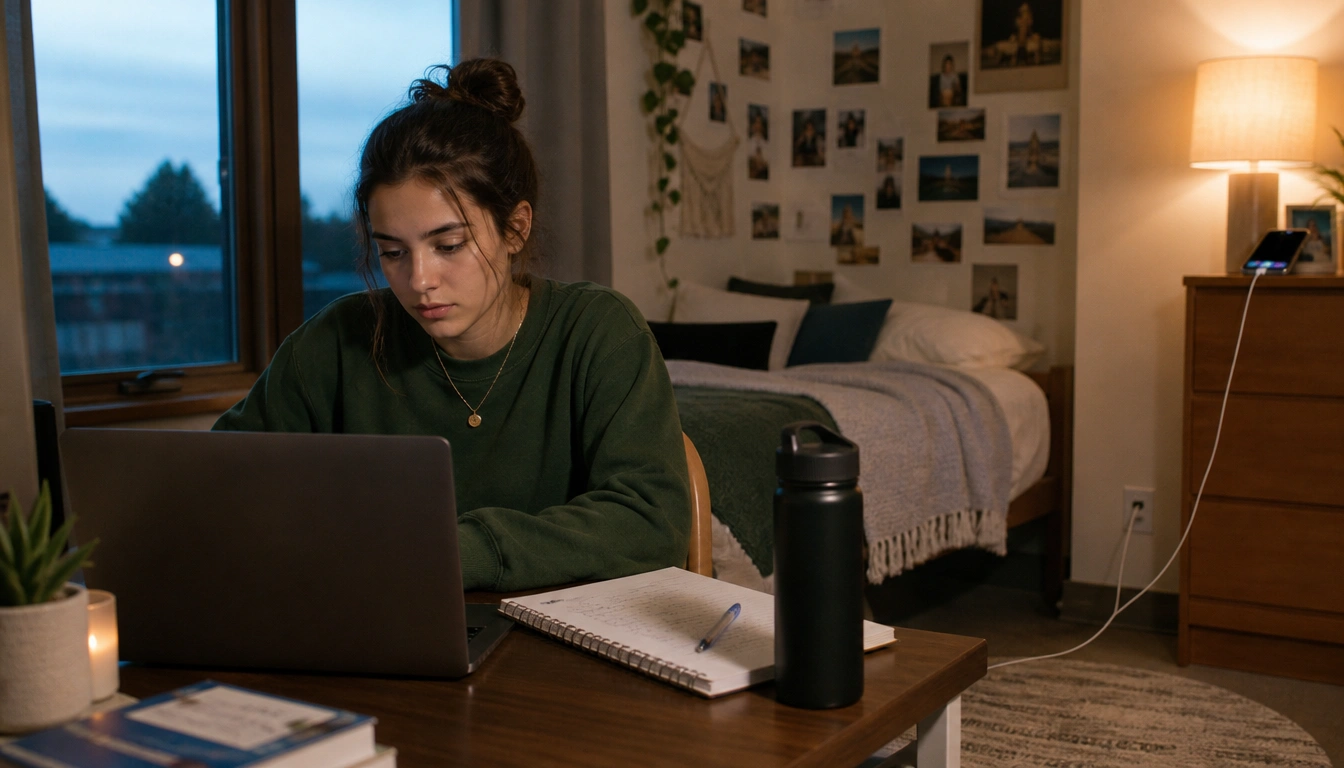
The most effective social media rules for college students are the ones that protect sleep, study time, and emotional energy without cutting you off from campus life. Start with a few clear habits: keep your phone out of reach during class and deep work, turn off nonessential notifications, charge your device away from the bed, and limit the accounts or feeds that leave you drained. The goal is intentional use, not a strict ban.
Key Takeaways
- Use social media on purpose, not by default. Ask whether each app is helping you connect, learn, or relax—or just pulling your attention.
- Protect sleep first. Put your phone away before bed and keep it out of arm’s reach overnight to reduce late-night scrolling.
- Create focus zones for class, meals, and study blocks so short checks do not become constant task-switching.
- Curate your feed. Muting, unfollowing, or restricting stressful accounts can lower comparison, body-image pressure, and hostile content.
- If social media keeps interfering with grades, sleep, or mood despite your efforts, campus counseling or another professional support option may help.
Why boundaries matter during the college transition
College changes almost everything at once: your schedule, your living situation, your academic pressure, and often your social circle. That is why healthy social media boundaries for college students are less about discipline and more about stability. According to the U.S. Department of Health and Human Services and NIH-supported guidance, repeated sleep loss, stress, and attention fragmentation can quickly affect mood, learning, and daily functioning.
Social media can be useful in this stage of life. It helps students find clubs, roommates, study partners, campus events, and long-distance support. The problem is not social media itself. The problem is when it becomes the default way to fill every gap in the day. A sustainable goal is to keep the connection benefits while reducing the parts that crowd out rest, focus, and real-life relationships.
The social comparison loop in student life
College is already full of evaluation: grades, internships, appearance, relationships, and social status. Curated feeds can make all of that feel louder. You usually see the best moments, the funniest photo, the most polished routines, or the most impressive-looking productivity. That can create upward social comparison, which may affect self-esteem and increase anxiety or body-image distress.
This matters because students often compare their behind-the-scenes reality to everyone else’s highlight reel. If scrolling leaves you feeling behind, unattractive, lonely, or less successful, that is useful information. It does not mean you must quit every platform. It means you may need to edit what you see and how often you see it. A feed that consistently triggers stress is not neutral entertainment; it is part of your environment.
How social media affects focus and sleep
Late-night scrolling is one of the most common ways social media interferes with college life. The issue is not only time lost. Screen use close to bedtime can delay sleep by keeping the brain stimulated and making it harder to settle down. Sleep is not optional recovery time for students; it supports memory, emotional regulation, and attention the next day.
Task-switching also has a cost. Checking a notification during studying may feel brief, but it breaks concentration and makes it harder to re-enter the task. For students already juggling classes, work, and deadlines, those interruptions add up fast. Research and public health guidance from federal sources support a simple pattern: the more often attention is split, the harder it becomes to sustain deep work.
At the same time, social media can support belonging. For students living far from home, joining a campus group chat or checking in with friends online may be genuinely helpful. The tradeoff appears when online contact replaces offline connection. If you are spending more time passively scrolling than actually talking with people, you may be feeding loneliness instead of easing it.
A practical boundary system you can start today
A workable system starts with values, not punishment. Instead of asking, “How do I use social media less?” ask, “What do I want social media to do for me?” That may include staying connected, finding events, or keeping in touch with family. Once you know that, set rules that protect those goals.
Sleep protection: charge your phone away from the bed, ideally across the room or outside the sleeping area. If you rely on it for alarms, use a separate alarm clock or place the phone far enough away that checking it takes effort.
Focus zones: keep the phone out of reach during class, meals with other people, and deep-study blocks. A backpack, locker, or another room works better than willpower alone.
Notification hygiene: turn off nonessential push notifications. Keep alerts only for truly important messages, not every like, comment, or suggested video.
Intentional use rules: decide when you will check platforms instead of reacting to every impulse. For example, you might check messages after class, after lunch, and in the evening, rather than throughout the day.
Values check: after using an app, notice whether you feel more connected and informed—or more tense, distracted, or depleted. That feeling is part of the feedback loop.
How to curate your feed and account list
Curating your feed is one of the easiest ways to lower stress without deleting every app. You do not need to make a dramatic public statement. Quiet adjustments often work better.
Unfollow accounts that reliably trigger comparison, body-image concerns, political outrage, or campus drama. Mute people or topics that are useful occasionally but too noisy day to day. Restrict or limit accounts that keep showing up in ways that leave you irritated or pulled into comment-section conflict. If a platform gives you “not interested” or content controls, use them.
This is especially important for students who use social media for campus updates. You may need some feeds for practical reasons, but that does not mean you need unlimited exposure to everything those feeds produce. A smaller, calmer information stream is usually easier to manage than a constant firehose.
If hostile content, cyberbullying, or identity-based harassment is part of your experience, protecting your feed becomes a safety issue, not just a preference. Students should not have to choose between community and peace of mind. In many cases, targeted curation is the most realistic middle path.
What healthy boundaries look like in real college routines
Boundaries work best when they fit ordinary student life. For example, during a study block, you can put your phone on Do Not Disturb and keep it in your bag. If you are studying with friends, agree that devices stay off the table unless someone needs one for classwork. During meals, decide to check messages only after you finish eating and talking.
At night, build a short wind-down routine that does not involve feeds. Charge the phone away from the bed, set your alarm, and then switch to something low-stimulation such as stretching, showering, journaling, or reading a few pages of a book. That small buffer makes it less likely that one more scroll turns into another hour.
Finals week often needs a more protective version of the same plan. You may not need to disappear from social media, but a temporary limit on the most tempting apps can preserve attention when you need it most. Think of it as a short-term academic support, not a permanent rule. The aim is to reduce friction, not create perfection.
Special situations that call for flexible boundaries
First-year students often need social media to locate friends, clubs, and practical campus information. For them, complete avoidance can backfire by increasing isolation. A better approach is to use social platforms for connection on purpose while still keeping sleep and study rules in place. If you are new to campus, small check-in windows may be better than open-ended scrolling.
Students with ADHD or strong distractibility may need external structure, not just good intentions. That can mean app blockers, time limits, removing short-form video apps from the home screen, or keeping the phone in another room during work sessions. Because fast, repetitive content is especially sticky, the environment should do some of the regulating for you.
For marginalized students, online spaces can be essential. They may provide belonging, identity affirmation, and access to community that is hard to find locally. The goal is not to shut those spaces down. It is to keep the supportive parts while reducing exposure to hostility, doomscrolling, or accounts that leave you emotionally raw.
When social media use becomes a problem
Everyday overuse and a deeper problem are not the same thing. Many students occasionally scroll too long or procrastinate before an assignment. That alone does not mean you need treatment. Warning signs appear when you repeatedly try to cut back and cannot, or when social media starts interfering with daily life in a serious way.
Watch for missed classes, falling grades, skipped sleep, or ongoing conflict because you cannot stop checking. Another concern is using social media as your only way to cope with stress, loneliness, or anxiety while offline relationships shrink. If online interactions consistently leave you more upset, hopeless, ashamed, or preoccupied, that is a reason to take it seriously.
Campus counseling services, student health centers, or another licensed mental health professional can help you sort out whether the issue is habit, stress, anxiety, depression, ADHD-related impulsivity, or something else. Getting support does not mean social media is the only problem. It means the pattern is affecting your functioning enough to deserve attention.
When you want a quick self-check, ask: Is this habit costing me sleep, grades, relationships, or peace of mind? If the answer is yes, and simple boundary changes are not enough, it is time to reach out for help.
Frequently Asked Questions
How much social media is too much for a college student?
There is no universal number. It becomes too much when it regularly displaces sleep, studying, meals, exercise, or in-person relationships, or when you keep using it even after deciding to stop. The better question is whether the habit is helping your life or quietly taking over parts of it.
What are the best social media boundaries for studying and sleep?
The most useful boundaries are simple: keep your phone out of reach during study blocks, use Do Not Disturb for classes and deep work, and charge your device away from the bed at night. Those steps reduce task-switching and make it easier to avoid accidental late-night scrolling.
How can first-year students avoid isolation without overusing social media?
Use social media as a bridge, not a substitute. Check group chats, campus accounts, and event pages on a schedule, then move the real connection offline when you can. Joining clubs, study groups, or meal plans with others can help you build local relationships while still staying informed online.
What should students with ADHD or strong distractibility do differently?
They often need more structure than average. Remove tempting apps from the home screen, use app limits or blockers, keep the phone in another room while working, and turn off nonessential alerts. The goal is to make the healthy choice easier before attention gets pulled away.
How can college students curate their feeds to reduce comparison and stress?
Unfollow, mute, or restrict accounts that reliably trigger insecurity, body-image pressure, outrage, or campus drama. Keep the accounts that are genuinely useful or supportive. If a feed repeatedly leaves you tense or worse about yourself, it is worth trimming even if the account belongs to someone you know.
The Bottom Line
Healthy social media boundaries for college students work best when they protect the basics: sleep, focus, and emotional energy. You do not need to quit every platform to get those benefits. Often, the biggest improvements come from a few low-friction changes such as quieter notifications, device-free study time, and a phone that stays away from the bed at night.
If social media is helping you find community, keep that connection. If it is starting to replace real rest, real conversation, or steady attention, tighten the rules before the habit gets harder to manage. And if you cannot cut back despite trying, or your grades, sleep, or mood are suffering, campus mental health support is a sensible next step.
Medical disclaimer
Medical disclaimer: This content is for educational and informational purposes only and is not a substitute for professional medical advice, diagnosis, or treatment. Dietary needs and supplement suitability vary by individual.
Sources
- U.S. Government / Health Authority — hhs.gov. Accessed October 2026.
- National Institutes of Health (NIH) — nih.gov. Accessed October 2026.
- Academic Research Institution — harvard.edu. Accessed October 2026.
- Academic Research Institution — unc.edu. Accessed October 2026.
- Academic Research Institution — ohio.edu. Accessed October 2026.
