
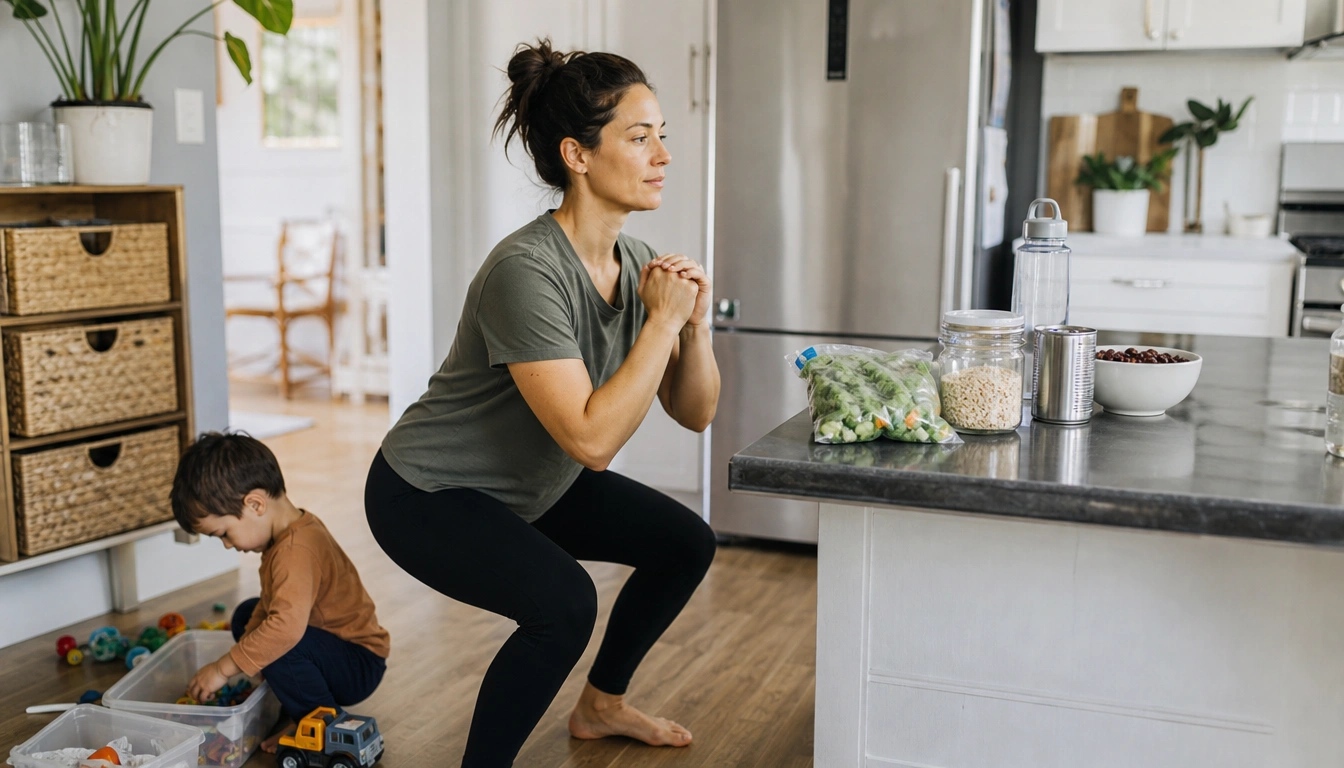
You can stay healthy as a busy parent by building a low-cost wellness routine around short bouts of movement, simple budget meals, and small recovery habits that fit into things you already do. Public health guidance supports weekly activity goals being accumulated across the week, so you do not need long workouts or a gym to make progress. The most sustainable plan is usually the one tied to your daily routine, not the one that requires extra time.
Key Takeaways
- You can reach weekly activity goals in 10- to 15-minute bouts, which is often more realistic than one long workout.
- Habit stacking reduces decision fatigue by attaching wellness actions to routines you already do, such as coffee brewing, bath time, or meal prep.
- Frozen vegetables, canned beans or lentils, and batch-cooked grains are low-cost staples that can help steady energy without complicated cooking.
- Sleep, stress, and mental load matter too; a brief wind-down and a screen boundary can support recovery when life is chaotic.
- If you are postpartum, injured, dizzy, in significant pain, or severely fatigued, back off and get individualized medical advice instead of pushing through.
Why low-cost wellness has to look different for busy parents
For busy parents, the barrier is rarely a lack of motivation alone. More often it is time poverty, interrupted sleep, shifting schedules, childcare demands, and a budget that already feels stretched. A wellness plan that depends on ideal conditions will usually fail long before it becomes a habit.
A low-cost wellness routine for busy parents works best when it assumes the day will be messy. That means using activities that do not require a commute, paid classes, or special gear. It also means thinking in smaller pieces: a quick walk, a few strength moves, a simple meal made from staples, and a short wind-down at night. According to the CDC and NHS, healthy adults can build meaningful activity across the week without needing every session to be long or perfect.
The goal is not to chase an athlete’s schedule. The goal is to protect energy, mobility, and mood with routines that can survive real family life.
The 3 pillars of a sustainable routine: movement, food, and recovery
Most parent-friendly wellness plans fall apart when they focus on only one piece. Exercise helps fitness, but it is harder to keep up if meals are chaotic and sleep is thin. Food helps energy, but it is harder to sustain if the day is completely sedentary and stress keeps building. Recovery matters because without enough rest, even good habits can feel like another job.
Think of the routine as three supports:
- Movement to preserve heart health, strength, and day-to-day stamina.
- Food to keep energy steadier and prevent the crash-and-crave cycle that often follows skipped meals.
- Recovery to help the body and mind reset, especially when parenting demands never really stop.
This three-part approach is practical because each pillar can be adjusted. On a good week, you may do more. On a hard week, you can still keep the routine alive with smaller actions instead of abandoning it entirely.
How to reach weekly activity goals with micro-workouts and active parenting
Public health guidance for adults recommends at least 150 minutes of moderate-intensity aerobic activity each week, plus muscle-strengthening activity on 2 days. For parents, the useful part is that those minutes can be accumulated. You do not need a 30- or 60-minute block every day to count.
Short bouts of 10 to 15 minutes are often the easiest way to fit movement into a crowded day. A brisk stroller walk, a fast walk around the block, a kitchen dance break, or a quick bodyweight circuit can all contribute. Moderate activity usually means your breathing is deeper and your heart rate is up, but you can still talk.
Active parenting can also count. Carrying groceries, walking to school, playing tag, or doing park laps while your child is on the playground all add up. For strength work, use simple movements such as squats, wall push-ups, step-ups on a sturdy stair, glute bridges, or carrying laundry baskets. The point is not intensity for its own sake; it is consistency that fits the day you actually have.
Habit stacking ideas that fit real parent schedules
Habit stacking works because it lowers decision fatigue. Instead of asking, “When will I fit this in?” you attach the new habit to something that already happens automatically. That makes the new behavior easier to remember and less likely to get skipped when the day goes sideways.
Try linking one small wellness action to a fixed cue:
- Do calf raises or counter push-ups while coffee brews.
- Drink a glass of water while packing lunches.
- Put on supportive shoes and walk for 10 minutes after school drop-off.
- Do squats during bath time or while waiting for the tub to fill.
- Prep tomorrow’s breakfast while dinner cooks.
- Set out walking shoes beside the door so leaving the house triggers movement.
The best stacks are almost boring. They are simple enough that you can do them on autopilot. If a habit needs a special setup, it is probably too hard for a high-chaos season.
Budget-friendly food habits that support steady energy all week
Cheap food does not have to mean low-quality food. For energy that stays steadier through a long day, the most useful staples are often the least glamorous: frozen vegetables, canned beans or lentils, oats, eggs, peanut butter, yogurt, rice, potatoes, and whole-grain bread or pasta if your family uses them.
Frozen vegetables are especially useful because they keep well, usually cost less than fresh produce, and can be added to soups, grain bowls, eggs, or pasta without prep. Canned beans and lentils are similarly practical; rinsing them can reduce sodium, and they work in salads, wraps, stews, or quick skillet meals. Batch-cooked grains such as brown rice or oats can become breakfast, lunch, or a side dish with almost no extra effort.
One simple strategy is to build meals around a low-cost base, a protein source, and a produce item. For example: rice, beans, and frozen vegetables; oats with yogurt and fruit; eggs with toast and a side of vegetables. This is not a strict diet plan. It is a way to keep meals predictable enough that you are less likely to skip them or rely only on convenience snacks.
Hydration matters too. Mild dehydration can feel like fatigue or brain fog, so keeping water visible on the counter or in the car can help more than it seems.
A simple no-gym sample routine for weekdays and weekends
A sample routine should feel repeatable, not impressive. On weekdays, try one 10- to 15-minute walk, one short strength block, and one low-effort recovery habit. On weekends, add a longer family walk, a playground circuit, or an active chore session like yard work, deep cleaning, or a neighborhood loop.
Weekday example:
- Morning: 5 minutes of mobility while coffee brews.
- Midday: 10-minute brisk walk, stroller walk, or indoor march.
- Evening: 10 minutes of strength work after dinner or before a shower.
- Night: 5-minute tidy-up, then a screen cutoff and wind-down.
Weekend example:
- Walk to the park instead of driving if that is realistic.
- Use playground time for step-ups, squats, or a lap around the field.
- Cook one batch item, such as rice, roasted potatoes, or beans, to reduce weekday friction.
If you want a structure, keep it loose: three movement days, two strength touches, and daily recovery cues. The routine should support your household, not compete with it.
How to adapt the routine when sleep is poor, energy is low, or life is chaotic
Some weeks are not good weeks for pushing harder. Poor sleep, illness in the house, travel, deadlines, and endless night wakings all change what is realistic. In those periods, the right move is usually to shrink the routine rather than abandon it.
If sleep is poor, lower the intensity. A gentle walk, stretching, or a few minutes of mobility may be enough. If energy is low, focus on a meal with protein, fiber, and water before trying to “power through” with caffeine alone. If life is chaotic, choose the smallest version of the habit: five squats, a short walk to the mailbox, or one bagged salad with beans and toast.
A brief wind-down helps here too. A few minutes of journaling, a shower, dimmer lights, or a screen boundary before bed can reduce the mental spillover that keeps parents feeling wired. The National Health Service emphasizes sleep-friendly routines that make bedtime more predictable, even when the evening itself is not.
When to scale back or get medical clearance before exercising
Some situations call for caution rather than determination. If you are postpartum, recovering from surgery or an injury, or returning after a long break, it is wise to ask a healthcare professional what level of activity is appropriate before you ramp up. That is especially important if you plan to return to higher-impact exercise or core work.
Stop exercising and seek medical advice if you have chest pain, dizziness, severe shortness of breath, faintness, or sharp joint or muscle pain. Those are not symptoms to push through. Severe fatigue that is out of proportion to your usual sleep loss also deserves attention, especially if it is new or worsening.
For postpartum parents, individualized guidance matters because recovery is not the same for everyone. The same is true after injury, when pain can signal that a movement is too much or too soon. A sustainable wellness routine should make you feel more stable over time, not leave you more depleted.
Common mistakes that make parent wellness routines fail
One common mistake is making the plan too ambitious. If the routine depends on perfect mornings, a child-free workout window, or elaborate meal prep, it will probably collapse during a normal week. Another mistake is trying to overhaul everything at once. That often creates more mental load than progress.
Other problems include waiting for motivation instead of using cues, treating sleep as optional, and skipping meals until you are too hungry to choose well. Parents also tend to forget that recovery is part of wellness, not a reward for finishing every task. If you are constantly exhausted, the answer may be to simplify, not to add more willpower.
A useful test is this: can you do the routine on a bad Tuesday? If not, it is probably too complicated. The best routines are flexible, low-cost, and easy to restart after disruptions.
Quick implementation plan: start with one movement cue, one food swap, and one recovery habit
Start small enough that the routine feels almost too easy. Pick one movement cue, one food swap, and one recovery habit you can repeat this week. For movement, choose a daily trigger such as coffee brewing or bath time. For food, swap one convenience food for a cheaper staple, such as frozen vegetables or canned beans. For recovery, choose a screen cutoff, a 5-minute wind-down, or a short walk after dinner.
Then let repetition do the work. After a week or two, add only one new piece if the first one is sticking. This keeps the routine from turning into another source of stress.
The most effective plan is usually not the fanciest one. It is the one that respects your budget, your energy, and the reality of parenting.
Frequently Asked Questions
How can parents meet exercise guidelines with short workouts at home?
Break activity into short bouts across the day. Ten- to 15-minute walks, bodyweight circuits, stair climbing, or active play can all add up toward weekly goals. The CDC and NHS support building activity through the week, not only in one long workout.
What are the cheapest healthy foods that support steady energy?
Frozen vegetables, canned beans or lentils, oats, eggs, peanut butter, yogurt, rice, potatoes, and whole-grain basics are often affordable and useful. They help make quick meals that include fiber, protein, and enough carbohydrates to keep energy steadier.
How can habit stacking make wellness routines easier to keep up?
Habit stacking ties a new action to something you already do automatically, like making coffee or starting bath time. That reduces the need to remember or decide, which is why it often works better than relying on motivation alone.
What should busy parents do when sleep deprivation or stress makes routines harder?
Scale the routine down instead of quitting. Choose gentler movement, simpler meals, and one recovery habit such as a screen boundary or a short wind-down. If stress or poor sleep is persistent, it may help to talk with a clinician or mental health professional.
When is it unsafe to push through fatigue, pain, or postpartum recovery?
Do not push through chest pain, dizziness, faintness, severe shortness of breath, or sharp pain. If you are postpartum, recovering from an injury, or returning after surgery, ask for individualized medical guidance before increasing exercise.
The Bottom Line
A low-cost wellness routine for busy parents works best when it is built around real life: short movement bouts, cheap staple foods, and recovery habits that fit between responsibilities. You do not need a gym or a perfect schedule to make progress.
Focus on repeatable cues instead of perfect motivation. A walk after drop-off, beans and frozen vegetables for dinner, and a short wind-down at night can do more for long-term consistency than a complicated plan you cannot maintain.
If you are postpartum, injured, dizzy, in severe pain, or unusually exhausted, stop and get medical advice rather than pushing ahead. Sustainable wellness should leave you more able to handle parenting, not more depleted.
Medical disclaimer
Medical disclaimer: This content is for educational and informational purposes only and is not a substitute for professional medical advice, diagnosis, or treatment. Dietary needs and supplement suitability vary by individual.
Sources
- Centers for Disease Control and Prevention (CDC) — cdc.gov. Accessed November 2026.
- National Health Service (NHS) — www.nhs.uk. Accessed November 2026.
- National Health Service (NHS) — hee.nhs.uk. Accessed November 2026.
