
Yes—a realistic social media break in college can help if you keep it specific and workable. Most students do better with a short reset or a daily time cap, while keeping essential communication apps for class, work, and safety. The goal is not perfect abstinence; it is to reduce mindless scrolling, protect sleep and focus, and keep the connections you still need.
Key Takeaways
- A college-friendly social media break usually means pausing entertainment apps, not every messaging tool you rely on for school, work, or family contact.
- A 7-day reset and a daily time cap are both reasonable options; choose the one you can actually follow during your current workload.
- Sleep gets hit hard by late-night scrolling, so a no-phone-before-bed rule and moving your phone away from the bed or desk can make a real difference.
- If the urge to scroll shows up when you are bored, lonely, or stressed, swap in a specific replacement like walking, journaling, campus recreation, or offline connection.
- If reducing social media does not improve anxiety, depression, panic, or functioning, campus counseling, student health, or crisis support may be needed.
- For students who rely on social media for belonging or community support, a total cutoff can be counterproductive; a targeted reduction is often safer and more sustainable.
Why a social media break can help college students right now
College life can overload your attention before you even notice it. Classes, group projects, job applications, roommate issues, and the pressure to stay socially available all compete for the same mental space. According to the American Psychological Association and research summarized by the National Institutes of Health, heavy or passive social media use is often linked with more anxiety, lower mood, loneliness, and sleep disruption in young adults.
Part of the problem is not just time spent online, but how platforms are built. Infinite feeds, alerts, and unpredictable rewards keep you checking “just one more time.” That can train the brain toward automatic opening, especially during stress or boredom. Social comparison can also make campus life feel like everyone else is doing more, looking better, or having more fun. For students already stretched thin, that can worsen self-doubt and make focus harder.
A break is not meant to punish you or prove discipline. It is a way to lower the background noise so you can notice how social media affects your mood, sleep, and concentration. For many students, even a short change in habits creates more mental room for studying, rest, and real-life connection.
Choose the format that fits your semester
The two most practical options are a 7-day reset or a daily time cap. Both can work. The better choice depends on how automatic your scrolling has become and how much structure you need.
A 7-day reset works well if you keep opening apps without thinking, especially at night or between tasks. A short reset can interrupt the habit loop and give you a clean picture of what changes when the feed is off. It may feel intense at first, but the temporary nature makes it easier to commit to.
A daily time cap is often better if you still need social apps for a few meaningful uses and do not want a full pause. The cap should be simple enough to remember and strict enough to matter. Research on digital behavior change suggests that self-monitoring and clear boundaries matter more than perfect willpower. If a limit is too vague, it usually gets ignored.
If you are unsure which to pick, start with the format you can follow during your current week. During finals, a time cap may be more realistic. During a lighter week, a 7-day reset may be easier. The point is to make the plan match your life, not to chase an ideal version of control.
Decide what to pause and what to keep
A social media break for college students should separate entertainment scrolling from functional communication. Those are not the same thing, even if the apps sometimes overlap. Instagram, TikTok, X, and similar feeds are usually the first places to pause because they are designed for endless browsing and comparison.
Messaging tools are different. Slack, Discord, WhatsApp, group texts, campus portals, and school-related group chats may be essential for class, work, student organizations, or housing. Keeping them is not “cheating.” It is smart boundary-setting. If a professor, supervisor, or team uses one of those tools, leaving it active protects your academics and reduces unnecessary conflict.
You may also need to keep apps that support family contact, caregiving responsibilities, transportation, safety, or disability accommodations. If you are unsure, sort your apps into three groups: pause, keep for logistics, and keep for safety or support. That simple filter helps you avoid an all-or-nothing plan that would be hard to maintain.
For some students, the safest plan is to remove the most attention-grabbing apps while keeping the communication channels that actually help them function. A break should reduce noise, not isolate you from the people and systems you rely on.
Set up the break so it is easier to follow
The best plans reduce friction in the right direction. Start by turning off nonessential notifications. Alerts are engineered to pull you back in, and every buzz or banner makes it easier to break concentration. Removing those cues is often more effective than relying on motivation alone.
Next, add small barriers. Move distracting apps off your home screen, log out, or place them in a folder that takes a few extra taps to open. If you are using a daily cap, set the limit in your phone’s screen-time tools and ask a friend, roommate, or sibling to hold the passcode. That extra layer of accountability can matter when stress or boredom weakens self-control.
It also helps to name your reason for the break in one sentence. For example: “I want fewer late-night scroll sessions and better focus during class.” A clear reason makes it easier to notice whether the plan is working. Self-monitoring matters here more than perfection. If you slip, you do not need to restart your whole life; you just return to the boundary you chose.
Finally, decide how you will measure success. You might track sleep quality, study focus, mood, or how often you open apps without meaning to. That gives you a better read than just counting minutes.
Protect sleep and study time with clear phone boundaries
Sleep is one of the most common areas where social media use spills over into college life. Late-night scrolling can delay bedtime, keep your mind activated, and expose you to bright light right when your brain should be winding down. Over time, that can affect concentration, irritability, and academic performance.
A strong boundary is “no phone before bed.” You do not need to be perfect to benefit. Start with a realistic window, such as the last part of your evening, and treat it as protected time. Put the phone away from your bed so you are not reaching for it while half-asleep. If you study in your room, move the phone farther from your desk during work blocks too. Physical distance creates useful friction.
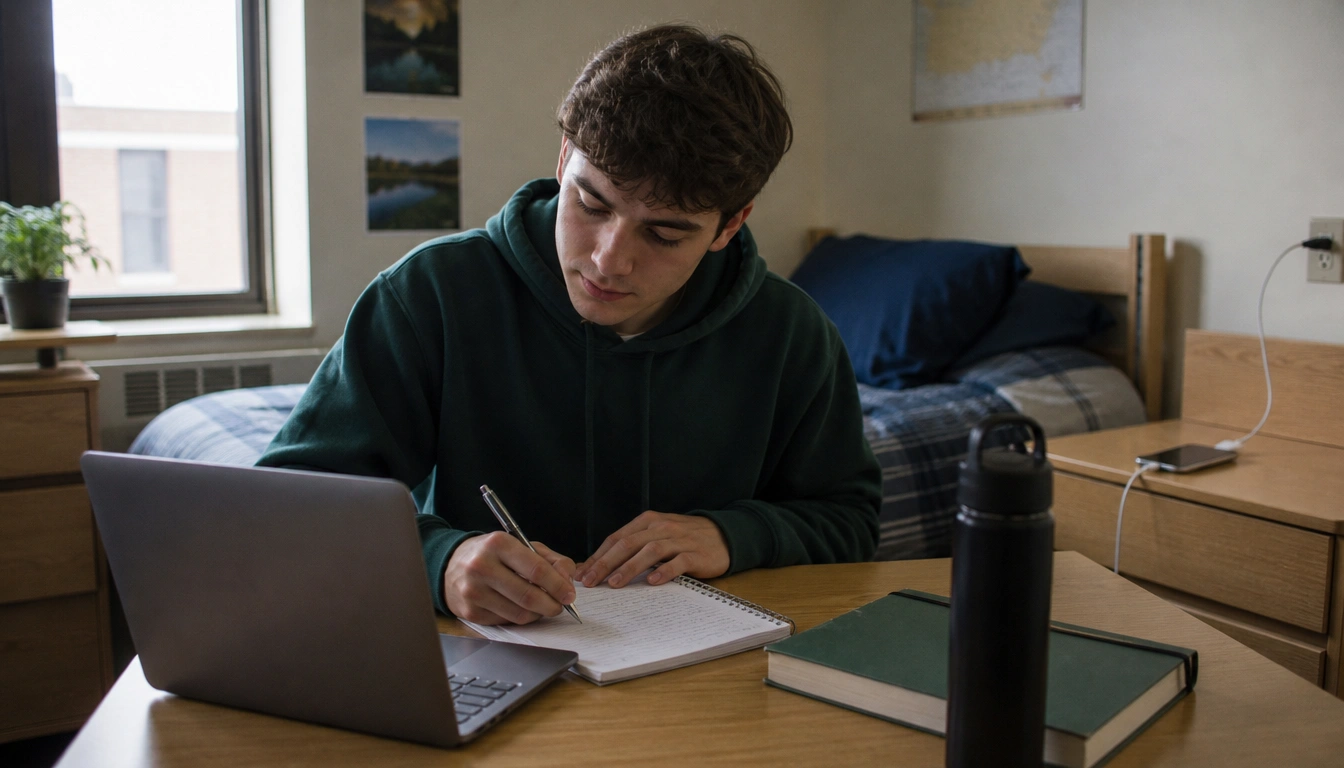
Students in dorms often need extra structure because the room itself is where relaxing, studying, and sleeping all happen. Try charging your phone across the room or outside the bedroom area if possible. If the bed and desk are too close together, use a specific cue—like closing the laptop or switching on a lamp—to signal that the work block or wind-down period has started.
If you want a middle ground, pair the boundary with a calming routine: wash up, prep for tomorrow, read something physical, or write a few lines in a notebook. The goal is to replace the bedtime scroll with a transition your brain can actually repeat.
Replace the urge to scroll with something concrete
The urge to scroll is often less about social media itself and more about a feeling you are trying to regulate. Boredom, loneliness, anxiety, and academic overwhelm all make the feed feel tempting because it is immediate and effortless. That is why a substitution plan works better than trying to “just stop.”
Pick replacements ahead of time so you are not deciding in the moment. Good options are simple and low-friction: take a ten-minute walk, text one friend to meet offline, sit with a hallmate, journal without editing yourself, or go to the gym, climbing wall, rec center, or another campus space that changes your environment. Physical movement helps break the trance of endless checking, and real conversation can satisfy the need for connection in a way scrolling usually does not.
If the problem is stress rather than boredom, choose a reset that changes body state. Step outside, stretch, drink water, or do a short task that gives you a visible finish line. If the problem is loneliness, aim for contact, not just distraction. A voice call or in-person study session often works better than another feed.
Think of this as building a menu, not a single magic habit. Different triggers need different replacements. The more specific your options are, the easier it is to follow through when your brain wants the easiest path.
Adjust the plan if social media is part of your support system
Some students cannot afford a total cutoff, and many should not try one. If social media is your main way to stay in touch with family, long-distance friends, a cultural community, or a marginalized peer group, it may be doing important emotional work. For students who feel isolated on campus, those spaces can be a lifeline rather than a distraction.
In that situation, aim for selective reduction instead of elimination. Keep the accounts or group chats that provide belonging, information, or safety. Pause the feeds that trigger comparison, doomscrolling, or time loss. You might also limit the times you check supportive spaces so they do not spill into every free moment of the day.
This is where the idea of “all social media is bad” becomes unhelpful. What matters is the function of each app in your life. If one platform helps you talk to family after class, that is different from a platform that leaves you feeling worse every time you open it. You can protect your mental health without cutting off the people who matter to you.
If you are using online spaces to cope with discrimination, homesickness, or identity-related stress, keep those supports in mind as part of your plan. A thoughtful break should reduce harm, not remove your sense of belonging.
Know when a break is not enough
Social media reduction can help with habits, but it is not a treatment for deeper mental health problems. If you are still struggling with persistent sadness, intense anxiety, panic, worthlessness, or burnout after changing your phone habits, it is time to reach out for support. The same is true if your sleep, classes, attendance, eating, or basic self-care are sliding.
Campus counseling centers, student health services, and licensed mental health professionals can help you sort out whether social media is a cause, a trigger, or just one part of a larger problem. That kind of support is especially important if stress is leading to avoidance, if you feel unable to start tasks, or if online conflict is feeding into broader mental health symptoms.
If you are dealing with cyberbullying, stalking, harassment, or other targeted abuse, document what is happening and involve the right campus office as well as support services. And if you ever have thoughts of self-harm or suicide, get immediate help. In the U.S. and Canada, call or text 988 for 24/7 crisis support. If you are elsewhere, use your local emergency or crisis line right away.
A social media break is a useful tool when it helps you reclaim attention and rest. It is not a substitute for care when your symptoms are bigger than a habit change.
Frequently Asked Questions
How long should a social media break be for college students?
A short, specific period is usually easier to follow than an open-ended promise. Many students do well with a 7-day reset or a daily time cap for a few weeks, then they reassess. The best length is the one you can actually maintain without harming school, work, or safety needs.
What’s the difference between quitting social media and reducing it to a daily limit?
Quitting usually means pausing entertainment apps completely for a set time, while a daily limit keeps the apps available but constrained. A reset can interrupt automatic habits more strongly. A cap may be better if you need limited access for community, class, or family contact.
Which apps should I pause or delete, and which ones do I need to keep for class or work?
Usually pause the apps that invite endless scrolling, comparison, or late-night checking. Keep the ones you genuinely need for class, student jobs, group projects, housing, or family coordination, such as Slack, Discord, WhatsApp, or group texts. The goal is to remove the feed, not essential communication.
How do I stop late-night scrolling from ruining my sleep?
Set a no-phone-before-bed boundary and make the phone physically less convenient to reach. Charge it away from the bed or desk, turn off nonessential alerts, and replace the bedtime scroll with a repeatable wind-down routine. Sleep usually improves when the phone is out of arm’s reach and the routine is consistent.
What should I do instead of scrolling when I feel bored, lonely, or stressed?
Use a planned substitute so you are not deciding in the moment. Try a walk, journaling, a voice call, an in-person hangout, studying in a shared space, or campus recreation. The best replacement depends on the trigger: movement for restlessness, connection for loneliness, and a simple reset for stress.
The Bottom Line
A realistic social media break in college is usually selective, temporary, and tied to a clear goal. For many students, the most effective version is to pause entertainment apps, keep essential communication tools, and add friction around the moments that trigger mindless scrolling.
If sleep, focus, or mood improve, that is useful feedback. If you are still feeling stuck, disconnected, or overwhelmed, reduce the plan to something more sustainable and consider campus counseling or student health support. A break should make college life more workable, not more isolated.
Medical disclaimer
Medical disclaimer: This content is for educational and informational purposes only and is not a substitute for professional medical advice, diagnosis, or treatment. Dietary needs and supplement suitability vary by individual.
Sources
- National Institutes of Health (NIH) — nih.gov. Accessed November 2026.
- National Institutes of Health (NIH) — nih.gov. Accessed November 2026.
- U.S. Government / Health Authority — hhs.gov. Accessed November 2026.
- Academic / Medical Research Institution — apa.org. Accessed November 2026.
- Johns Hopkins Medicine — hopkinsmedicine.org. Accessed November 2026.
