
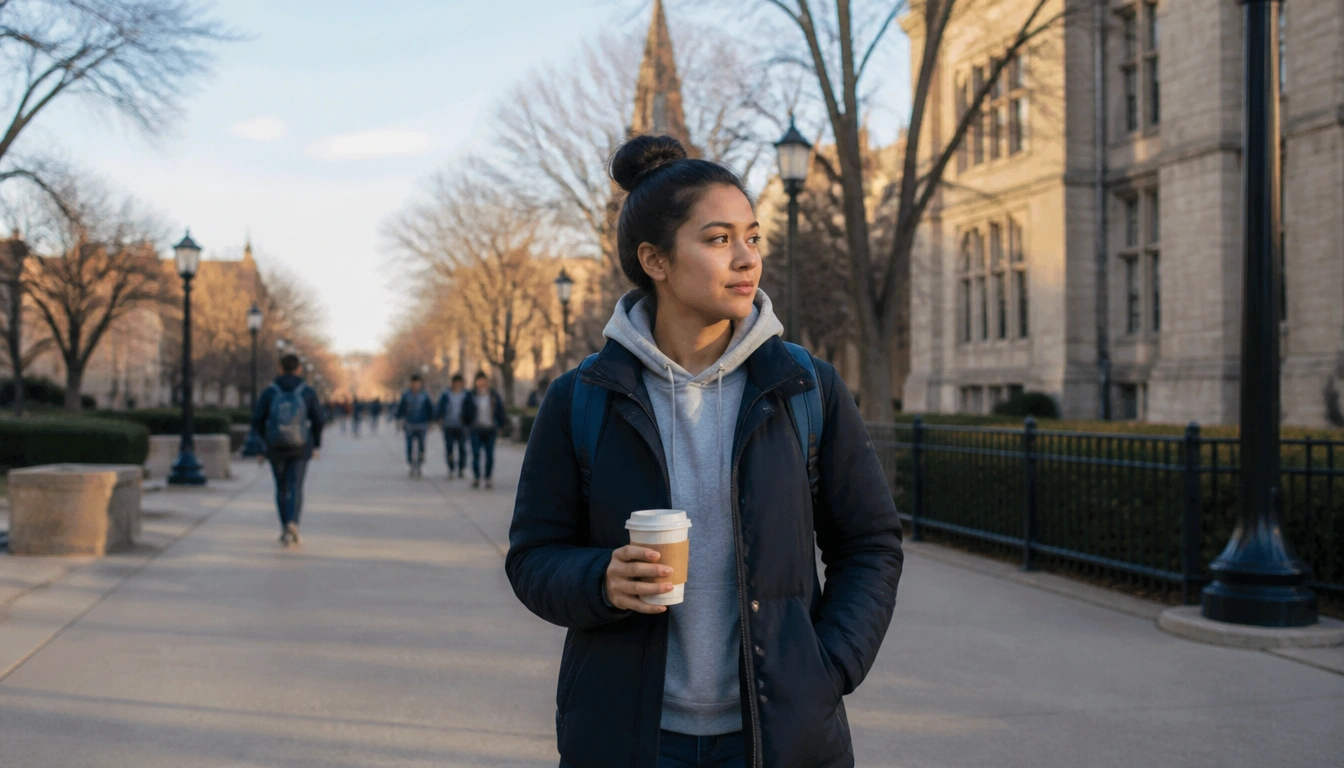
Most college students do best with morning light soon after waking, ideally within the first hour, and it works better outside than by a window. A practical target is to get into outdoor daylight as part of your normal routine, even for a short walk or commute. The exact amount depends on weather and season, but consistency matters more than perfection.
Key Takeaways
- Morning light helps tell your circadian clock that the day has started, which can make it easier to fall asleep earlier later that night.
- For students, the best routine is usually light soon after waking, not late in the morning after classes have already started.
- Outdoor daylight is much stronger than indoor light, so sitting by a window is helpful but not the same as going outside.
- Cloudy, winter, and high-latitude conditions reduce light intensity, so you may need more time outside on darker days.
- Pairing light with walking to class, coffee, or a campus commute makes the habit easier to keep.
- If insomnia, delayed sleep timing, or mood symptoms persist, light habits alone may not be enough and student health evaluation can help.
Why morning light matters for sleep timing in college students
Morning light for college students is one of the simplest ways to push sleep timing in a healthier direction. Many students naturally drift later because of late studying, social schedules, and screen use at night. That pattern can create social jetlag: feeling more like one person on weekdays and another on weekends. A strong light cue early in the day helps pull the body clock back toward a steadier schedule.
Light is the main signal that sets the circadian clock in the brain. When you get daylight after waking, your body interprets that as the start of daytime. That helps reduce leftover sleepiness, supports alertness, and starts the sequence that makes it easier to feel sleepy at night at a more regular hour. Research in university students has also linked consistent morning bright light with better sleep efficiency, less sleep fragmentation, and less next-morning fatigue.
College students are especially prone to later sleep timing, so the benefit of morning light is not just general wellness advice. It is a practical countermeasure for a student schedule that often pulls sleep later than the body prefers.
How the circadian clock uses light to set your wake-sleep rhythm
Your internal clock sits in the brain and responds to light as a timing cue. Morning light tends to advance the clock, meaning it nudges sleep and wake timing earlier. Evening light tends to delay it, meaning it pushes sleep later. That direction matters because many students already have a built-in tendency to stay up late.
Public health guidance and sleep experts describe the circadian system as especially sensitive in the hour or so after your usual wake time and again in the evening before bed. That is why early daylight can help while bright light late at night can work against sleep. The pattern is not about a single magic minute. It is about repeated exposure at the right part of the day.
Morning light also helps suppress lingering melatonin, the hormone that supports sleep. In plain terms, it tells your body to shift out of night mode. If you want a more regular bedtime, that early-day signal is often more useful than trying to force sleepiness at night with willpower alone.
What a practical morning light routine looks like on a campus schedule
A good routine should fit around classes, dorm life, and campus geography. The easiest version is: wake up, get daylight, then move on with your day. Open the blinds right away, then try to reach outdoor light within the first hour after waking. That may mean stepping outside for a few minutes before class, eating breakfast on the way to your first building, or walking the long way across campus.
There is no need to create a separate wellness project. The routine should attach to something you already do. If you have an 8 a.m. class, daylight exposure can happen during the walk there. If your mornings start later, use a coffee run, library commute, or dorm courtyard break. The goal is repeated exposure soon after waking, not a perfect sunrise ritual.
Students who wake at different times on weekdays and weekends should try to narrow that gap as much as possible. Huge weekend sleep-ins can make Monday mornings feel like a jet-lag reset. A steadier wake time gives morning light a better chance to anchor the clock.
How long to stay outside and why outdoor light beats indoor light
Outdoor daylight is far stronger than typical indoor lighting. Most indoor spaces are only a few hundred lux, while outdoor daylight is much brighter even on an overcast day. That difference is why sitting near a window is helpful but usually not equal to actually going outside. Glass reduces the exposure you get, and indoor lighting often does not provide enough signal to anchor the circadian system well.
Because the light gap is so large, even a short outdoor break can help more than staying inside for longer. Many students can build a realistic routine with a brief walk, a stop on a bench, or part of a commute outdoors. On brighter mornings, less time may be enough. On darker mornings, more time outside becomes more important.
You do not need to stare at the sun. The aim is simply to get ambient daylight into your eyes while doing normal activities. That is a safety-friendly, practical way to use light as a timing cue without turning it into a special exercise.
How to adapt the routine for cloudy weather, winter, shaded campuses, and early classes
Weather and geography matter. Cloud cover lowers light intensity, and winter mornings in northern locations can be much darker than people expect. Shaded campuses, tall buildings, and tree cover can also reduce available daylight. On those days, a short outdoor exposure may still help, but you may need longer or more consistent time outside to get a similar effect.
The adjustment is not complicated: when the sky is dimmer, treat outdoor daylight as something to collect more deliberately. Step out earlier, stay out longer, or build in a second brief outdoor stop later in the morning. If you know your campus is especially shaded, make outdoor time part of the route itself rather than something you hope to squeeze in afterward.
Students in high-latitude winters or consistently overcast climates may need to be especially consistent. The routine works best when it is repeated daily, not only on bright days. Even when the light is weak, the habit of getting outside soon after waking still supports the body clock better than staying under indoor lighting.
How to combine morning light with movement and a consistent wake time
The easiest routines are the ones that stack habits. Morning light is easier to keep when it is attached to walking to class, picking up coffee, taking out trash, or heading to the dining hall. That way, you are not trying to add a brand-new chore to an already full schedule. You are using an existing one to solve two problems at once: getting daylight and getting moving.
Movement can make the routine feel more natural and help you stay awake after a rough night. A short walk outside also gives you a better chance of staying in the light long enough to matter. If you tend to wake up groggy, think about the route before you sleep so the decision is automatic in the morning.
Consistency matters just as much as the activity itself. If your wake time swings widely from day to day, light timing becomes less effective. A stable wake time does not need to be rigid, but it should be close enough that your body can learn the pattern. That is especially important for students balancing weekday classes with weekend social plans.
How evening light habits can support the morning routine
Morning light works best when evening light does not cancel it out. The circadian system is most sensitive again late in the day, which means bright light and screens near bedtime can push sleep later. That does not mean every screen use is a problem, but it does mean the hour or two before bed matters.
A realistic student strategy is to dim room lights later in the evening, reduce especially bright screen exposure when possible, and avoid turning the last part of the night into a second daytime. If you study late, even small changes help: lower screen brightness, use warmer lighting if available, and stop trying to make the room bright at the same time you are trying to get sleepy.
This is not about strict perfection or eliminating technology. It is about protecting the morning signal you are trying to build. If mornings are meant to move your clock earlier, late-night brightness should not keep dragging it back.
When morning light is not enough and you should seek professional help
Morning light is a useful habit, but it is not a cure for every sleep problem. If you still have persistent insomnia, ongoing exhaustion, or a sleep schedule that stays very delayed despite regular light exposure, a student health clinician or sleep specialist can help sort out what is going on. That matters especially if your pattern is severe enough that you cannot keep morning obligations without major distress.
Professional evaluation is also important if poor sleep is paired with depression, anxiety, or strong mood changes. Sleep timing and mental health often affect each other, and it is better to check for both than to assume one habit will fix everything. Students with suspected delayed sleep-wake phase disorder may need more structured treatment than a general morning light routine.
If you have eye disease, take photosensitizing medications, or notice discomfort with light, it is wise to ask a clinician before making major changes. And if you are thinking about staring at sunlight directly, stop: that is not how light routines work and it can be harmful.
Frequently Asked Questions
How long should a college student stay outside in the morning for light to help sleep?
There is no single exact number that fits everyone. A short outdoor exposure soon after waking is often a good start, and darker days usually call for more time than bright days. The most useful approach is to make it consistent and attach it to a daily task like walking to class.
Is indoor daylight from a window enough, or do I need to go outside?
A window is better than a dark room, but it is usually not as effective as going outside. Typical indoor light is much dimmer than outdoor daylight, and glass reduces the signal further. If you can, get actual outdoor exposure soon after waking.
What should I do on cloudy, winter, or high-latitude mornings when it’s darker?
On darker mornings, try to spend longer outside and be more consistent from day to day. Cloudy skies and winter reduce light intensity, so the same routine may need more time outdoors to work well. Even then, being outside is usually better than staying indoors.
Can morning light help if I stay up late or have a delayed sleep schedule?
Yes, morning light can help move your clock earlier, which is useful if you tend to fall asleep and wake up late. But if the delay is persistent or severe, light alone may not be enough. In that case, student health or sleep medicine evaluation is a better next step.
Should I avoid sunglasses or screen time to make the routine work better?
For routine daylight exposure, sunglasses can reduce the light signal, so many students prefer to skip them for a short morning walk if it is safe and comfortable. At night, reducing bright screen exposure can help protect the sleep signal that morning light is trying to build.
The Bottom Line
For college students, morning light works best when it is early, outdoor, and repeatable. The goal is not a perfect sunrise ritual. It is to give your body clock a reliable cue soon after waking so sleep timing becomes less random and more stable.
Build it into something you already do: walk to class, pick up coffee, or cross campus without making it a separate chore. Adjust for clouds, winter, and shaded routes by staying out a little longer, and keep evenings dimmer so the morning signal can do its job.
If you still have persistent insomnia, very delayed sleep timing, or mood symptoms, get evaluated instead of trying to solve everything with light alone. A student health clinician or sleep specialist can check whether a sleep disorder or mental health concern is part of the problem.
Medical disclaimer
Medical disclaimer: This content is for educational and informational purposes only and is not a substitute for professional medical advice, diagnosis, or treatment. Dietary needs and supplement suitability vary by individual.
Sources
- National Institutes of Health (NIH) — nih.gov. Accessed October 2026.
- Centers for Disease Control and Prevention (CDC) — cdc.gov. Accessed October 2026.
- Centers for Disease Control and Prevention (CDC) — cdc.gov. Accessed October 2026.
- National Institutes of Health (NIH) — nih.gov. Accessed October 2026.
- Centers for Disease Control and Prevention (CDC) — cdc.gov. Accessed October 2026.
- National Institutes of Health (NIH) — nih.gov. Accessed October 2026.
- Centers for Disease Control and Prevention (CDC) — cdc.gov. Accessed October 2026.
- Academic Research Institution — stanford.edu. Accessed October 2026.
