
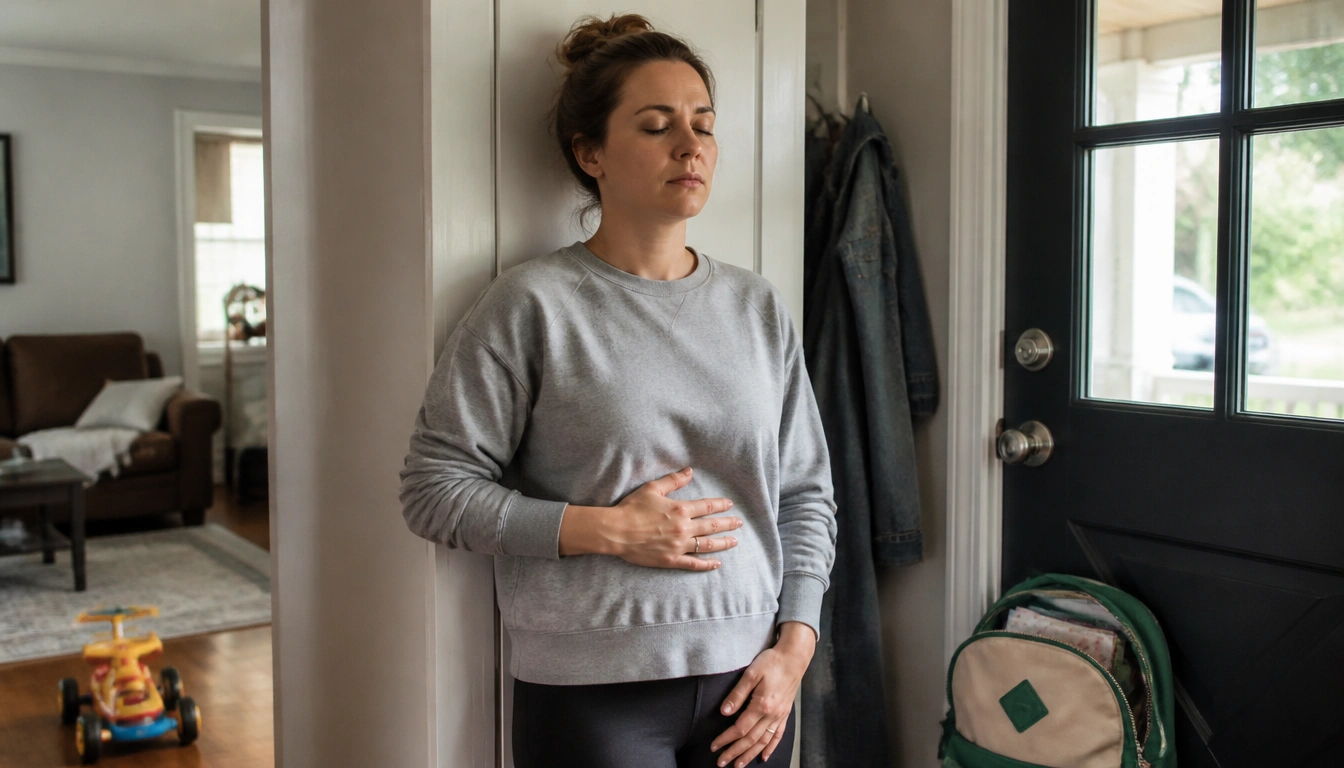
The simplest breathing exercise for a busy parent is gentle belly breathing: inhale softly through the nose for a few counts, let the belly rise, then exhale slowly and comfortably for a few counts. Do that for one to two minutes. Keep it easy, not forceful. If counting helps, try about 4 to 5 counts in and 4 to 5 counts out; if counting feels distracting, focus on the rise and fall of your abdomen.
Key Takeaways
- A one- to two-minute breathing pause can be enough to interrupt a stress spiral and reduce the feeling of being on edge.
- Belly breathing is usually the easiest place to start, but counted breathing or gentle paced breathing may fit some parents better.
- Habit stacking works: link breathing to an existing trigger like the front door, a red light, or coffee brewing.
- Keep the practice gentle. Forced breathing, breath-holds, and fast hyperventilation can make you feel worse.
- If breathing makes you dizzy, panicky, or more restless, shorten it, open your eyes, or stop and try a simpler version later.
- Breathing tools help with everyday stress, but ongoing panic, severe anxiety, depression, or burnout may need professional support.
Why a minute of slow breathing can help when parent stress spikes
Busy parenting can flip the body into a fight-or-flight state fast: shoulders tighten, thoughts speed up, and the urge to react takes over. Slow breathing gives the nervous system a different signal. According to the CDC and the NHS, calming breath practices can help lower tension and support relaxation by shifting the body away from that stress response.
That matters because stress is not only emotional. It is physical. When breathing stays shallow and hurried, the body tends to stay revved up. When breathing slows down and becomes steadier, many people notice a small but meaningful change: the mind has a little more room, the body feels less braced, and the next decision is easier to make. This is not a cure for chronic anxiety or burnout, but it can be a practical reset during an ordinary hard moment.
For parents, the best breathing exercise is usually the one that is easy enough to repeat. A short pause before the next demand is often more useful than waiting for a perfect quiet moment that never comes.
The simplest breathing exercise: gentle belly breathing
Start with a position that feels stable. You can sit, stand, or remain in a parked car. Let your jaw unclench and drop your shoulders if that feels natural. One hand can rest on the belly and the other on the chest so you can notice the movement, but you do not need to monitor every breath closely.
As you breathe in through the nose, let the air move down into the belly as comfortably as it can. The belly should rise a little; the chest may move some too. Then exhale slowly and smoothly, without pushing the air out or trying to empty the lungs. The NHS describes this as breathing deeply into the belly without forcing it.
A simple rhythm is a soft inhale for about 4 or 5 counts and a soft exhale for about 4 or 5 counts. If that feels awkward, make the exhale a touch longer than the inhale. Keep the breath gentle enough that you could still speak in a normal voice if you needed to. The goal is calm, not performance.
If you only have 60 seconds, take three to five slow breaths. If you have two minutes, keep the same easy rhythm for a little longer. Small repetitions matter more than a long session you cannot realistically repeat.
Three parent-friendly places to use it right now
At the front door: Before grabbing bags, answering a question, or checking your phone, pause for two or three breaths. This can help create a small transition between outside stress and home demands. The trick is to use the doorway itself as the cue, not your mood.
At a red light: If you are not driving actively through traffic, a stopped light can become a brief reset. Keep both hands steady and focus only on slow breathing. Do not add breath-holds, and do not let the exercise pull your attention away from driving conditions when the light changes. If you feel rushed, one slow exhale is still useful.
While coffee brews: Morning routines work well because they happen every day. While waiting for the kettle or coffee maker, place one hand on your abdomen and take a few gentle breaths. This kind of small, repeatable anchor is often easier than trying to schedule formal meditation later.
These moments are not meant to be dramatic. They are tiny interruptions that remind the body it does not have to stay stuck in high alert.
How to make the habit stick when your day is already full
The most reliable approach is habit stacking: attach the breathing practice to something you already do. Rather than saying, “I should breathe more,” choose a fixed trigger such as opening the front door, sitting in the car, starting the kettle, or waiting for school pickup. Then decide in advance what happens next. For example: “If I stop at a red light, then I take three slow breaths.”
That kind of if-then plan reduces decision fatigue. It also keeps the practice realistic when your day is broken into fragments. Parents rarely get uninterrupted quiet. A habit that works in noisy, messy, imperfect conditions is more valuable than an ideal routine that only happens once a week.
It can also help to choose one method for a few days before experimenting. Constantly switching techniques can make the habit harder to remember. Start with one trigger and one style of breathing, then repeat it until it feels familiar.
Micro-sessions are the point. A minute here, another minute later, and another one before bed often fit real caregiving life much better than a long block of time.
How to adapt when you are exhausted, distracted, or overstimulated
Some parents feel calmer with breath work right away. Others feel more restless the moment they sit still. That does not mean you are doing it wrong. It may just mean you need a smaller dose, a different focus, or a more active version.
If quiet makes you uneasy, keep your eyes open and notice a simple visual anchor, such as the dashboard, a wall, or the sink in front of you. If counting feels annoying, shift attention to the sensation of air moving in and out. If body awareness feels too intense, use a short phrase such as “in” and “out” instead of detailed tracking.
When you are severely sleep-deprived, one long breathing session can feel frustrating. Shorten it to two or three breaths and stop there. The goal is not to force relaxation. It is to give your system a gentler signal without adding another task to your day.
Noisy environments are fine. You do not need silence. What matters is slowing the breath enough that it is easier to notice than the surrounding noise. Even a brief pause while the house is loud can still be useful.
Safety limits and when breathing should be modified or skipped
Gentle slow breathing is usually safe for healthy adults, but some styles are not appropriate in every situation. Avoid intense hyperventilation, forceful breathing, or prolonged breath-holds. Those approaches can cause lightheadedness, tingling, or fainting, and they are not a good fit for busy parents who need to stay alert.
Do not practice breathwork that alters your attention while driving, supervising children around water, or using equipment. If you are in a situation that requires full attention, keep the practice to something extremely light, or wait until you can safely pause.
If breathing makes you feel dizzy, panicky, shaky, or more disconnected, stop and return to normal breathing. Try a shorter version later, with your eyes open and without counting. Discomfort is a signal to simplify, not to push harder.
Breathing exercises are a self-care tool, not a substitute for clinical care. If stress, anxiety, low mood, panic, or overwhelm keeps interfering with daily life, reaches crisis level, or makes it hard to care for yourself or your children, it is reasonable to contact a healthcare professional or mental health provider for additional support.
Choosing between counted breathing and belly breathing
Belly breathing and counted breathing overlap, but they are not exactly the same. Belly breathing focuses on where and how the breath moves: low, soft, and diaphragmatic. Counted breathing focuses on rhythm: steady counts in and out. Either one can be useful, and either one can be kept gentle.
| Approach | Best for | Why it may help |
|---|---|---|
| Belly breathing | Parents who like physical cues or feel soothed by noticing the body | Simple, grounding, and easy to do with minimal mental effort |
| Counted breathing | Parents who like structure or get distracted easily | Gives the mind a light job to do and can make pacing more consistent |
| Gentle paced breathing | Parents who want a calm rhythm without overthinking the details | Supports slow, regular breaths that are often easier to sustain for a minute or two |
If you are unsure where to start, choose belly breathing first. If you keep losing track of the breath, switch to counting. If counting starts to feel rigid, return to sensation. The best technique is the one you can repeat during a real parenting day.
Frequently Asked Questions
How do I do belly breathing step by step?
Sit or stand comfortably, relax your shoulders, and place one hand on your belly if that helps. Breathe in gently through your nose so the belly rises a little, then breathe out slowly and comfortably. Keep it soft and unforced for one to two minutes.
How many breaths per minute are best for calming stress?
Research on paced breathing often uses slow rhythms around 5 to 6 breaths per minute, but you do not need to count that precisely. For most busy parents, a gentle 4- to 5-count inhale and exhale is a practical place to start if it feels comfortable.
Can I use breathing exercises while driving or caring for kids?
You can use very light breathing only when it does not interfere with safety. A brief, gentle breath or two at a stoplight may be okay, but avoid anything that changes your attention, and never do breath-holds or intense exercises while driving or supervising children near water.
What if breathing exercises make me feel more anxious or dizzy?
Stop the exercise, return to normal breathing, and try a shorter or simpler version later. Keep your eyes open, stop counting if that adds pressure, and avoid deep or fast breathing. If dizziness or anxiety keeps happening, ask a clinician for guidance.
How often should a parent practice breathing for stress relief?
Brief practice repeated through the day is usually more realistic than one long session. Many parents do best with micro-pauses tied to daily triggers, such as the front door, the coffee maker, or school pickup. Consistency matters more than duration.
The Bottom Line
The simplest breathing exercise for a busy parent is a gentle, steady belly breath for one to two minutes. Keep it soft, keep it brief, and attach it to something you already do, like a doorway, a red light, or the coffee maker.
If belly breathing does not feel natural, use counted breathing or a lighter paced rhythm instead. If the exercise makes you dizzy, more anxious, or too restless, shorten it or stop. Breathing practice should make the moment easier, not harder.
For everyday stress, tiny repeated pauses are often more useful than perfect technique. For ongoing panic, severe anxiety, depression, or burnout, breathing can be one support, but it should not be the only one.
Medical disclaimer
Medical disclaimer: This content is for educational and informational purposes only and is not a substitute for professional medical advice, diagnosis, or treatment. Dietary needs and supplement suitability vary by individual.
Sources
- Centers for Disease Control and Prevention (CDC) — cdc.gov. Accessed October 2026.
- National Health Service (NHS) — www.nhs.uk. Accessed October 2026.
- National Health Service (NHS) — berkshirehealthcare.nhs.uk. Accessed October 2026.
