
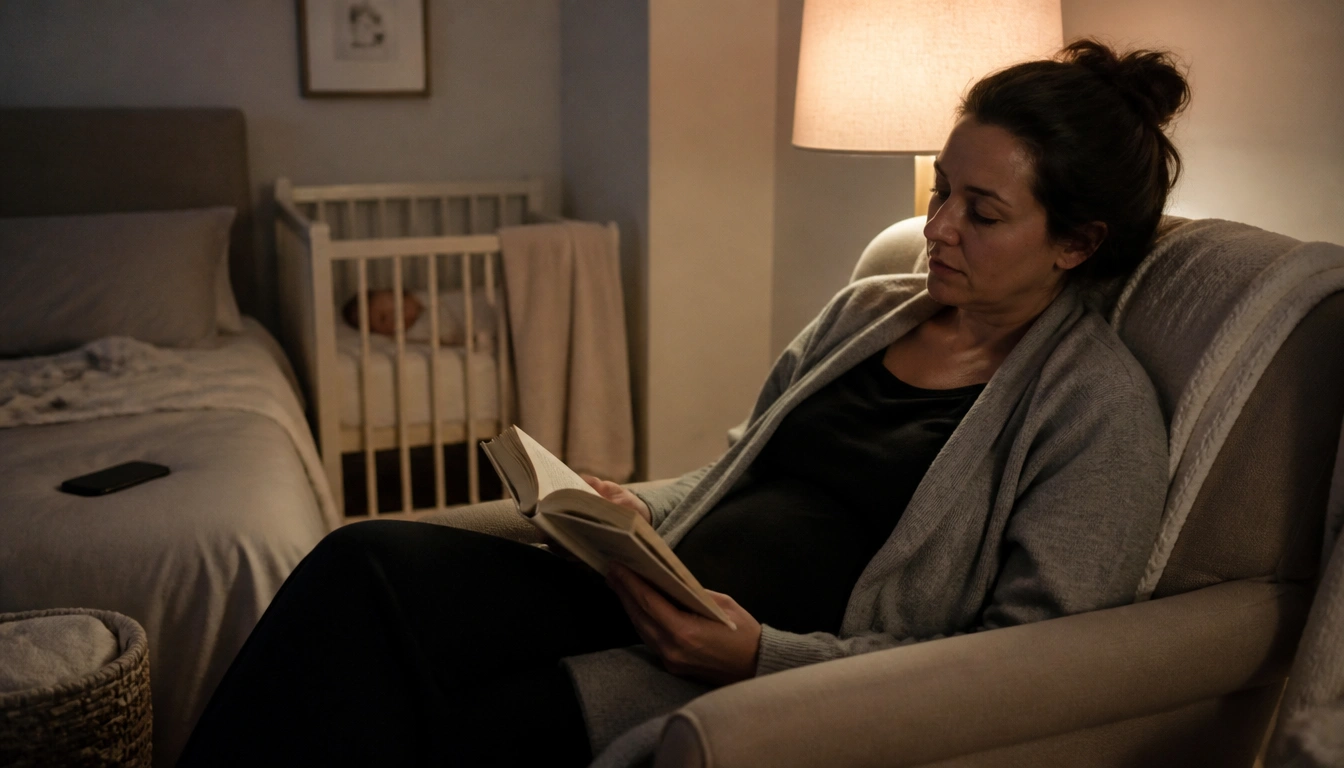
A realistic nighttime reading routine for busy parents is a short, repeatable wind-down: park the phone, sit in one designated spot, and read a calm, low-stakes book for 10 to 15 minutes before bed. That brief transition can help the brain move out of parenting mode without stealing sleep time. The routine works best when it is tied to an existing habit, kept low-light and screen-light aware, and protected from chores or scrolling.
Key Takeaways
- A short reading session can work better than an ambitious wind-down that never happens. For many parents, 10 to 15 minutes is enough to start relaxing.
- Reading helps because it gives the brain a low-stimulation task that can interrupt the “still on duty” feeling after childcare and chores.
- The easiest routine is built around habit-stacking: kids’ lights out, kitchen reset, phone parked, then reading in the same spot every night.
- Choose material that is calming and easy to put down. Dense work content, stressful news, and highly suspenseful stories can keep the brain alert.
- A paper book is usually the simplest option at night, but an e-reader with warm light and no notifications can also work.
- If sleep problems keep happening even with better habits, the issue may be insomnia, sleep apnea, restless legs, postpartum depression, or burnout.
Why reading helps busy parents shift out of hyperarousal
After a long day of managing meals, school forms, bedtime routines, laundry, and the mental checklist that never seems to end, many parents are physically tired but mentally switched on. Sleep scientists describe part of that state as hyperarousal: the body stays in a more alert, ready-for-action mode than it should at night. A nighttime reading routine can help because it gives the mind a gentle exit ramp.
Reading is useful not because it is magical, but because it is specific. It occupies attention without demanding decisions, messages, or problem-solving. That matters because the transition from “parenting mode” to sleep is partly a nervous-system shift. The sympathetic system, which supports alertness and stress response, needs to quiet down so the parasympathetic system can take over. A calm book can support that shift by lowering cognitive noise and reducing the urge to keep monitoring everything else.
This is also why reading often works better than scrolling. A phone invites novelty, interruptions, blue light, and emotional triggers. Even if the content feels harmless, the brain keeps checking for the next update. A physical book gives the mind one track to follow instead of a stream of fresh stimulation.
Public health guidance from the CDC and NIH also supports the broader sleep principle here: adults need enough sleep, and consistent pre-bed habits help protect it. If reading becomes a stable cue that the day is over, it can help your body recognize that bedtime is actually bedtime.
The 10-to-15-minute version: a realistic wind-down routine for time-poor evenings
Busy parents often imagine a nighttime routine as something long, serene, and carefully staged. That version sounds nice, but it can become one more reason to delay sleep. A better goal is a small routine that is easy to repeat even on messy nights. Ten to 15 minutes is enough to create a transition without pushing bedtime later.
A practical version might look like this: kids are settled, the kitchen is reset enough to stop thinking about it, and your phone is parked. Then you sit down with a book and read until your timer or your natural sleepiness tells you to stop. If you are too tired to read for long, that is fine. The point is not page count; it is giving your brain a predictable off-ramp.
If you want a structure, keep it simple:
- Finish the last child task and make a clean stop.
- Do one quick household closeout, such as wiping the counter or setting up tomorrow’s essentials.
- Put your phone in its parking place.
- Read in low light for 10 to 15 minutes.
- Turn out the light and go to bed before the routine turns into a second wind.
This is especially helpful for parents who tend to “steal back” time after the kids are asleep. That urge is understandable, but it can create bedtime procrastination: a late-night window that feels restorative in the moment and costly the next morning. A short reading routine gives you a small sense of ownership without turning bedtime into a late-night project.
How to set it up so it actually happens
The easiest routine is one that does not require fresh motivation every night. Habit-stacking works well here. Attach reading to something that already happens at the end of the evening, such as the children’s room lights going out or the kitchen being reset. The more consistent the trigger, the less you have to negotiate with yourself.
Environment matters too. If the book is buried under bills or toys, the routine will feel optional. Keep the book where your hand expects it to be: on a bedside table, in a basket near your chair, or next to a lamp you use only at night. A dedicated reading spot also helps the brain learn that this place means “decelerate.”
Device boundaries are just as important as the book itself. Put the phone on silent, enable do-not-disturb mode, and park it outside the bedroom if possible. If that is not realistic, place it face down across the room so it is not the first thing you see when your attention wanders. According to public health guidance from the NIH and CDC, reducing bright screen exposure before bed can help protect melatonin release and keep the sleep clock from drifting later.
Lighting matters as well. Use a warm, low lamp rather than bright overhead light. The goal is not darkness so total that you strain your eyes, but enough softness that your brain does not interpret the room as a daytime workspace. If you share space with a partner, agree on a shared “lights-down” cue so one person’s reading routine does not keep the other person in active mode.
What to read before bed
Not all reading is equal at night. The best material is calming, familiar, and easy to pause. Think of the category rather than the genre: light fiction, essays, memoir chapters, poetry, gentle nonfiction, or re-reading a book you already know you like. The ideal book engages you enough to pull attention away from chores and worry, but not so much that you feel compelled to finish one more chapter.
Some reading choices are more likely to keep the brain activated. Dense work reading, emotionally charged news, argumentative social commentary, highly suspenseful thrillers, and anything that triggers planning mode can all backfire. If a book makes you think, “I need to look that up” or “I have to finish this tonight,” it may not be a good bedtime book.
A useful test is to ask: does this book help me settle, or does it make my mind more busy? If it adds pressure, turns into research, or pulls you into problem-solving, save it for earlier in the day. For bedtime, the best material is usually interesting enough to hold attention and boring enough to let go of.
Parents sometimes worry that “light” reading is a waste of time. It is not. At night, the goal is not intellectual achievement; it is lowering arousal. A calm book that helps you sleep is more useful than a brilliant one that keeps you awake.
Physical book vs. e-reader at night
A physical book is often the simplest nighttime choice because it does not ping, glow like a phone, or tempt you into one more notification check. It also creates a clearer separation between reading and the rest of your digital life. For many parents, that separation is the whole point.
An e-reader can still be a good option if it is set up carefully. Warm-light settings, low brightness, and notifications fully disabled make it more sleep-friendly than a tablet or phone. Standard tablets and phones are harder to recommend for bedtime reading because they combine brighter light with a higher risk of distraction. Even if you intend to read only, the device itself often invites multitasking.
If you like digital books, ask a practical question: can I use this device without being pulled into anything else? If the answer is no, paper may be the better default. If the answer is yes, the e-reader can be a reasonable compromise. The best format is the one that helps you read calmly and then stop.
You do not need to make this choice into a purity test. The sleep benefit comes less from the format itself and more from the surrounding behavior: no alerts, low light, and a clear end point before you are overtired.
How to protect sleep when evenings are fragmented
Many parents do not get one neat uninterrupted wind-down window. They get fragments: a child calling out, a forgotten water bottle, a work email that has to wait, a load of laundry, a partner asking what tomorrow’s schedule is. The routine has to survive interruptions without becoming all-or-nothing.
One useful adjustment is to define the reading routine as a minimum dose, not a perfect ritual. If the best you can do is 10 minutes after the house goes quiet, that still counts. If the evening goes off track, reset the routine when you can instead of abandoning it completely. The consistency of returning to the book matters more than the exact start time.
Another strategy is to make the routine part of a larger closeout sequence. For example, when the kids are in bed, you do the kitchen reset, fill a water glass, and then read. That way you are not trying to fit reading in after every other task is finished; the reading becomes the transition between “work still happening” and “the day is over.”
If child wake-ups are frequent, protect the part of the routine that you can control. A short reading session before sleep may help you enter the night with less tension, even if sleep itself is still broken. It will not solve every wake-up, but it can make the first part of the night less wired.
Also pay attention to the habits that quietly undercut sleep: caffeine too late in the day, heavy meals right before bed, alcohol as a sleep shortcut, and the temptation to scroll “just for a minute.” The reading routine works best when it is one part of a broader sleep-protective evening, not a stand-alone fix.
Warning signs that a reading routine is not enough
A reading habit can support sleep, but it cannot fix every sleep problem. If you still have trouble falling asleep, wake often, snore loudly, gasp during sleep, feel unrefreshed in the morning, or have persistent daytime sleepiness, the issue may be more than a routine problem. Conditions such as insomnia, sleep apnea, or restless legs syndrome may need professional evaluation.
There are also mental health signals to watch for. If sleep problems come with ongoing low mood, anxiety, irritability, loss of interest, or a sense of overwhelm that feels bigger than normal stress, postpartum depression or parental burnout may be part of the picture. Those situations deserve care, not just better bedtime habits.
According to NHS guidance and other public health sources, sleep difficulties that keep happening over time, especially when they affect daytime functioning, are worth discussing with a clinician. That is especially true if you are relying on caffeine to get through the day, dreading bedtime every night, or sleeping poorly despite trying basic sleep hygiene consistently.
Reading should feel like a support, not a test. If it helps you unwind, great. If it becomes one more thing you cannot manage, the goal is not to try harder; it is to look more closely at what is actually disrupting your sleep.
Frequently Asked Questions
Why does reading help the brain switch from parenting mode to sleep mode?
Reading can work like a cognitive circuit-breaker. It gives the mind one quiet task to focus on instead of the stream of decisions, noise, and alerts that often follow childcare. That can help the body move out of a stress-ready state and into a more restful one.
How long should a parent read at night for it to help without cutting into sleep?
For many busy parents, 10 to 15 minutes is a realistic and useful minimum. The goal is not a long reading session; it is a repeatable cue that helps you unwind without turning bedtime into another reason to stay up later.
What should busy parents read before bed to avoid getting more alert?
Choose calm, low-stakes material such as gentle fiction, memoir, essays, or poetry. Avoid work reading, stressful news, and suspenseful books that make you want to keep going. If the book pushes you into problem-solving, it is probably too activating for bedtime.
Is it better to use a physical book or an e-reader at night?
A physical book is usually easiest because it avoids notifications and extra light. An e-reader can also work if the brightness is low, warm light is on, and notifications are fully off. Phones and regular tablets are more likely to interfere with sleep.
When do sleep problems mean this is more than a bad routine and should be checked by a clinician?
If sleep trouble is frequent, lasts for weeks, affects daytime function, or comes with loud snoring, gasping, restless legs, persistent low mood, or severe fatigue, it is worth talking with a healthcare professional. A routine can help, but some sleep problems need evaluation.
The Bottom Line
A nighttime reading routine can help busy parents unwind, but it works best when it is short, repeatable, and protected from scrolling and chores. Think of it as a 10- to 15-minute bridge from “on duty” to sleep, not a perfect self-care project.
The most useful version is simple: finish the kids’ bedtime, park the phone, use warm light, and read something calm in the same spot each night. If reading helps you feel less wired and you fall asleep more easily, that is a good sign the routine is doing its job.
If sleep stays poor despite better habits, or if you have symptoms that suggest insomnia, sleep apnea, restless legs, postpartum depression, or burnout, get checked by a clinician rather than trying to solve it with routine changes alone.
Medical disclaimer
Medical disclaimer: This content is for educational and informational purposes only and is not a substitute for professional medical advice, diagnosis, or treatment. Dietary needs and supplement suitability vary by individual.
Sources
- National Health Service (NHS) — eput.nhs.uk. Accessed November 2026.
- National Institutes of Health (NIH) — nih.gov. Accessed November 2026.
- Centers for Disease Control and Prevention (CDC) — cdc.gov. Accessed November 2026.
- National Health Service (NHS) — uhs.nhs.uk. Accessed November 2026.
