
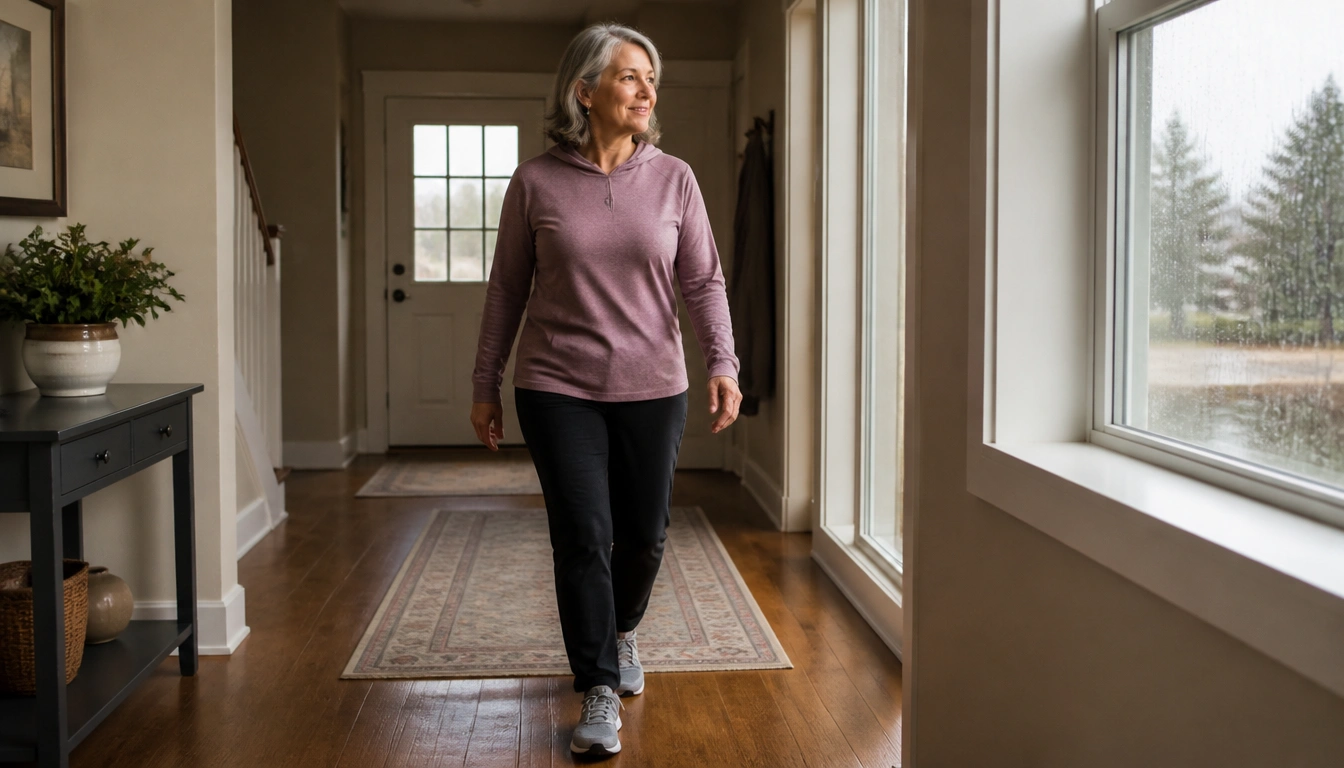
Yes—indoor walking can be a safe, effective rainy-day routine for adults over 50 if you keep it moderate, comfortable, and practical for your space and fitness level. A good plan is a brief warm-up, a steady walk at a pace where you can talk but not sing, and a short cool-down. You can scale it down with shorter bouts, hallway loops, or seated breaks and still make it count.
Key Takeaways
- Use the talk test: moderate indoor walking should leave you breathing a little harder, but still able to speak in full sentences.
- If you are deconditioned or stiff, start with a lighter pace and shorter bouts, then build gradually.
- Indoor walking can fit into small spaces with hallway loops, room-to-room routes, or marching in place.
- Supportive shoes, clear floors, and secure rugs matter even when you never step outside.
- Indoor walking can contribute to the weekly 150-minute aerobic goal, especially when combined with balance and strength work.
Why indoor walking works especially well after 50
Rainy-day indoor walking is one of the most practical ways to keep moving after 50 because it is low impact, easy to repeat, and easy to adjust. The Centers for Disease Control and Prevention and the National Institute on Aging both recommend regular physical activity for healthy aging, and walking fits that advice well. It supports heart health, helps maintain mobility, and can be easier on the joints than higher-impact exercise.
That matters because many older adults want movement that feels useful, not complicated. Indoor walking can help maintain stamina for daily life tasks such as shopping, climbing stairs, carrying groceries, or getting up and down from a chair. It also works well on days when weather, darkness, ice, or uneven sidewalks make outdoor walking less appealing.
Another advantage is flexibility. You do not need a treadmill to get benefits. A hallway loop, a route through several rooms, or a steady march in place can all be enough to raise your heart rate. For adults who are just getting back into exercise, the most important feature is consistency, not perfection.
How to judge intensity without overcomplicating it
You do not need a monitor or a complicated formula to know whether your indoor walking is on target. A simple talk test works well: during moderate-intensity walking, you should be able to talk, but singing should feel difficult. On a 0-to-10 effort scale, that often feels like a 5 or 6 for many people.
Briskness is relative. For one person, a brisk pace may mean steady steps through a hallway with a purposeful arm swing. For another, especially if they are rebuilding fitness or dealing with stiffness, brisk may begin as a slower pace that still feels a little challenging. The goal is not to force the same speed every day; it is to find a pace you can repeat safely.
A useful cue is body awareness. If you feel warm, your breathing is deeper, and your heart is beating faster but controlled, you are probably in a good range. If you are gasping, feeling unsteady, or unable to speak comfortably, slow down. If your effort feels too easy, lengthen the session first, then add a slightly quicker stretch later.
A simple rainy-day indoor walking routine
A session that includes a warm-up, main walk, and cool-down is easier on the body than starting fast and stopping suddenly. It also helps you use a limited space more comfortably. The outline below is simple enough for home use but still structured enough to feel like real exercise.
Warm-up
Begin with 3 to 5 minutes of easy movement. March slowly in place, roll your shoulders, gently swing your arms, and shift your weight from side to side. If your joints feel stiff in the morning, take a few extra minutes before you increase the pace. The purpose is to prepare the muscles and joints, not to tire yourself out.
Main walk
Walk for 10 to 20 minutes at a pace that feels steady and controlled. If you have more space, use a loop through connecting rooms or a hallway circuit. If space is tight, march in place for a minute, walk to the next room, then turn and repeat. You can also break the session into two or three shorter bouts across the day if that feels more realistic.
To keep the pace from feeling dull, vary the pattern lightly. Try a few minutes of normal walking, then a shorter stretch with slightly bigger arm swings or a more purposeful stride. Keep the movement smooth rather than jerky. The aim is to lift your effort without creating unnecessary strain.
Cool-down
Finish with 3 to 5 minutes of slower walking. Let your breathing settle, then do gentle calf, hamstring, and hip stretches only if they feel comfortable. A cool-down helps avoid stopping abruptly, which can leave some people feeling lightheaded or unusually tight.
Ways to adapt the routine for arthritis, stiffness, back pain, or low stamina
Indoor walking should fit your body, not the other way around. If you have mild arthritis, back pain, or low stamina, shortening the session is often more useful than trying to push through discomfort. Many people do better with several brief bouts instead of one long stretch.
For joint stiffness, start with a slower warm-up and a flatter, more even walking pattern. Keep steps small and controlled, especially if your knees or hips are sensitive. Supportive shoes can reduce foot fatigue and help you feel more stable on hard floors.
If your back is easily irritated, stay tall without leaning forward, and avoid quick twists when turning. A room-to-room route with gentle turns is often easier than pacing back and forth in a narrow space. If standing for long periods feels hard, use seated breaks between walking bouts, then resume when your body feels ready.
If you are deconditioned, reduce the pace first, then build time gradually. A five-minute walk repeated several times can be a smart starting point. Consistent, manageable movement usually beats a session that is so hard you avoid repeating it tomorrow.
How to make indoor walking practical in small spaces and avoid common home hazards
Small spaces can still support a solid indoor walking routine. Many people use a hallway loop, a route around the dining room and living room, or a lap through the kitchen, hall, and bedroom doorway. If you live in an apartment or condo, a short circuit repeated several times can work well. Public indoor spaces such as malls or community centers can also be helpful when the weather is poor and home space is limited.
It helps to clear a walking path before you begin. Move shoes, cords, pet bowls, loose baskets, and other low obstacles out of the route. Pay special attention to area rugs, slippery tile, and thresholds. If a rug slides, secure it or walk around it rather than trying to “be careful” over and over.
For people who prefer routine, pick one route and use it often. Repetition lowers decision fatigue and makes it easier to remember where the turns are. If you need variety, you can change direction after each lap, use a different room combination, or alternate walking with marching in place.
If you live in a crowded home, choose times when foot traffic is lower. Even 10 minutes of focused walking can be worthwhile if it is done safely and without distractions underfoot.
How to build consistency: habit stacking, timing after meals, and indoor public spaces
Consistency often matters more than session length. One of the easiest ways to make indoor walking stick is to attach it to something you already do. You might walk during the morning news, after brushing your teeth, or while listening to a podcast. This kind of habit stacking removes the need to decide from scratch each day.
Some adults also like to walk after meals. A short, comfortable indoor walk after breakfast, lunch, or dinner can be a practical way to add movement to the day and may be especially appealing if it helps you avoid sitting too long. The point is not to force a rigid schedule; it is to create a repeatable cue.
When home feels too cramped or boring, public indoor spaces can help. Shopping malls, community centers, and some large stores offer climate-controlled walking routes that remove weather barriers and provide a change of scene. If you use a public space, go at off-peak times when possible so you can walk without constantly dodging crowds.
Keeping a simple rhythm also helps. For example, you might choose three short walks on busy days and one longer walk when you have more time. That approach can be easier to sustain than trying to make every day look the same.
How indoor walking fits into the weekly activity goal for older adults
According to the CDC, older adults should aim for at least 150 minutes of moderate-intensity aerobic activity each week, along with muscle-strengthening activity on 2 or more days and regular balance work. Indoor walking is a straightforward way to contribute to that weekly aerobic goal.
You do not need to earn the whole 150 minutes in one pattern. A few 10-minute sessions across the day can add up, and shorter bouts can still be meaningful if they are done at a moderate effort. For many people, this makes indoor walking much more realistic than waiting for one large block of free time.
It also works best as part of a broader routine. Walking supports the aerobic side of healthy aging, but balance exercises and muscle-strengthening work fill in other important pieces. That might mean simple sit-to-stands, heel raises, or standing balance drills on non-walking days. The combined approach is what supports everyday function over time.
If you are just starting, focus on regularity first. Once that feels comfortable, you can slowly add minutes, increase pace a little, or include more purposeful walking intervals. Progress should feel gradual enough that you can recover well and repeat the routine several times a week.
Safety checks before you start
Safety begins with the basics. Wear supportive shoes with good traction rather than socks or slippery house slippers. Walk on a surface that feels stable and uncluttered. If your home has polished floors, throw rugs, pets, or loose cords, deal with those before you begin.
Use caution when turning, especially in tight hallways or around furniture corners. Smooth direction changes are easier on the knees, hips, and back than sharp pivots. If you need to stop suddenly, do so gradually when possible.
Stop the session and seek medical attention if you develop chest pain, severe shortness of breath, dizziness, sudden lightheadedness, or sharp joint or muscle pain. If you have been sedentary, have recently fallen, or manage a complex medical condition, it is wise to check with a healthcare professional before starting a new routine. A physical therapist can also help if pain, balance, or mobility issues make you uncertain about what is safe.
Frequently Asked Questions
How long should an indoor walking workout be for adults over 50?
There is no single best length. Many adults over 50 do well with 10 to 30 minutes total, including warm-up and cool-down, and shorter bouts can still be useful. If you are returning to exercise, start small and add time gradually so the routine stays manageable.
What intensity should indoor walking feel like if I am over 50?
Moderate indoor walking should feel like you are breathing a bit harder and your heart rate is up, but you can still talk in full sentences. If you can sing comfortably, it is probably too easy; if you cannot speak without gasping, slow down.
What are safe indoor walking options if I have arthritis, back pain, or mild balance issues?
Use shorter bouts, slower pace, supportive shoes, and clear walking paths. Hallway loops, room-to-room walking, and marching in place can all work. If balance is a concern, keep turns smooth, avoid clutter, and consider a seated break between bouts.
Can indoor walking count toward the 150 minutes of weekly aerobic activity?
Yes. Indoor walking can count as moderate aerobic activity if the effort is brisk enough for your current fitness level. It can be done in several shorter sessions across the week and still contribute to the CDC’s weekly activity goal for older adults.
What should I do if I do not have much space at home for walking?
Use a small loop through connected rooms, walk a hallway circuit, or march in place for short intervals. If home space is too limited or crowded, try a mall, community center, or another climate-controlled indoor space where walking is easy and safe.
The Bottom Line
Rainy-day indoor walking is a practical way for adults over 50 to stay active without depending on good weather. Keep it moderate, use a warm-up and cool-down, and choose a route that fits your space.
The best routine is the one you can repeat. Start at a comfortable pace, make safety a priority, and build gradually with short walks, seated breaks, and supportive footwear when needed.
If pain, dizziness, chest symptoms, or balance problems show up, stop and get medical guidance. For most people, though, indoor walking is a simple, low-impact habit that can support healthy aging all year long.
Medical disclaimer
Medical disclaimer: This content is for educational and informational purposes only and is not a substitute for professional medical advice, diagnosis, or treatment. Dietary needs and supplement suitability vary by individual.
Sources
- Centers for Disease Control and Prevention (CDC) — cdc.gov. Accessed November 2026.
- National Institutes of Health (NIH) — nih.gov. Accessed November 2026.
- Centers for Disease Control and Prevention (CDC) — cdc.gov. Accessed November 2026.
- Centers for Disease Control and Prevention (CDC) — cdc.gov. Accessed November 2026.
- National Institutes of Health (NIH) — nih.gov. Accessed November 2026.
- National Institutes of Health (NIH) — nih.gov. Accessed November 2026.
