
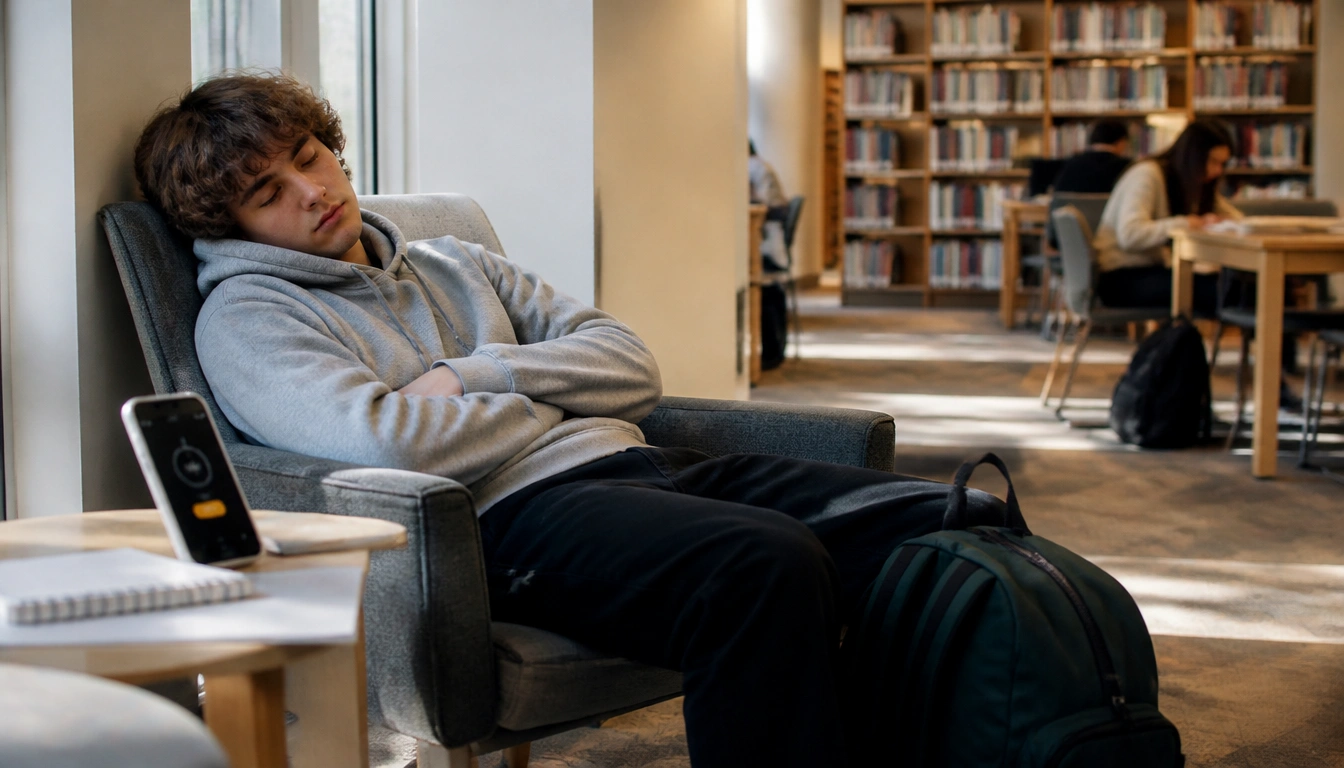
Yes—college students can nap in a way that helps without making them groggier or hurting nighttime sleep, but the routine matters. The safest default is a brief nap of about 15 to 30 minutes in the early afternoon, with a hard stop before late afternoon. Keep it quiet, dim, and time-limited so you wake up refreshed instead of sleep inertia creeping in.
Key Takeaways
- Short naps usually work best: aim for 15 to 30 minutes to reduce grogginess and avoid drifting into deep sleep.
- Early afternoon is the best nap window for most students; naps after about 3 PM can make it harder to fall asleep at night.
- Frequent, long, or late naps are associated with worse nighttime sleep quality and delayed sleep onset.
- A simple campus setup—alarm, dim space, eye mask, and earplugs—can make a brief nap more effective.
- A caffeine nap can help some students, but only if afternoon caffeine does not interfere with sleep later that night.
Why college fatigue is so common
College students often run on a mix of early classes, late-night studying, social plans, jobs, and inconsistent bedtimes. That pattern can leave you sleepy even when you still have work to do. A simple nap routine for college students can help bridge the gap on a rough day, but it should support nighttime sleep rather than replace it.
Sleep scientists describe alertness as a balance between sleep pressure and the body clock. Many students feel a natural dip in the early afternoon, which makes that time a reasonable nap window. The goal is not to “catch up” on all lost sleep in one stretch. It is to restore enough alertness to get through class, studying, or a long evening without pushing your bedtime later.
According to the CDC and NIH, young adults generally need 7 to 9 hours of sleep per night. If your sleep schedule is regularly short or chaotic, naps can help with daytime function, but they work best as a backup tool while you keep working on night sleep.
The best nap formula for students
For most students, the best nap formula is simple: short, early, and bounded. A brief nap in the early afternoon helps you recover some alertness without creating a second sleep period that steals from the night.
Most public health and sleep guidance points to a nap of no more than 20 to 30 minutes. That length is short enough to lower the chance of waking from deep sleep, which is when grogginess tends to hit hardest. It also makes the nap easier to fit between classes, work, and dinner.
Timing matters too. A midday or early-afternoon nap fits the natural circadian dip better than a late-day nap. As a practical cutoff, avoid napping after about 3 PM if you can. Later naps can reduce sleep drive, making bedtime harder and sleep lighter.
Think of the nap as a scheduled reset, not an open-ended sleep opportunity. If you need much more than a brief nap to function, that is a sign to look at your nightly sleep pattern, not just the nap itself.
How to build a simple nap routine step by step
A reliable nap routine does not need special equipment. It needs a few guardrails that prevent your “quick rest” from turning into a two-hour sleep session.
- Set a hard alarm. Choose 20 minutes as your default so you do not drift into deeper sleep.
- Pick a quiet, dim place. A dorm room, library carrel, or quiet campus lounge can all work if distractions are limited.
- Block light and noise. Use an eye mask, earplugs, or both if your space is bright or busy.
- Wake up on purpose. When the alarm goes off, get up, sit up, and expose yourself to brighter light so you do not keep dozing.
If you regularly oversleep your alarm, place your phone across the room, set one timer only, and avoid lying down with the intention of “just resting your eyes.” That pattern often leads to unplanned sleep and a worse wake-up.
For students who like structure, the routine can be as short as this: bathroom break, water, set alarm, lie down, nap, stand up, light exposure, back to work. The consistency makes it easier for your body to recognize the nap as a brief pause rather than a full sleep episode.
Why shorter naps usually work better
Short naps are usually the safest default because they reduce the chance of sleep inertia. Sleep inertia is the heavy, foggy feeling that can happen after waking from deeper sleep. It can make you feel worse for a while, even if the nap was meant to help.
In many people, a 15 to 30 minute nap stays in lighter sleep stages, which is why it tends to improve alertness with less grogginess. Longer naps can be useful in some situations, but they are more likely to move into deeper slow-wave sleep. Waking from that stage is often what creates the “why am I more tired now?” feeling.
A 90-minute nap represents roughly a full sleep cycle, so some people prefer it over an awkwardly timed middle-length nap. Even so, it is usually not the first choice for students because it uses a lot more daytime and can still interfere with nighttime sleep, especially if it happens too late or too often.
Frequency matters too. Research on student sleep patterns suggests that frequent, long, or late-evening naps are associated with worse nighttime sleep quality and delayed sleep onset. If you find yourself napping most days, for long stretches, or in the evening, your routine may be masking a bigger sleep problem.
Campus-friendly nap setups
One reason students skip naps is that campus life does not always offer ideal conditions. The good news is that a useful nap can happen in imperfect spaces if you control the basics.
Dorm room: This is often the easiest option. Close curtains, silence notifications, and use an eye mask if sunlight or roommate schedules are an issue. If your room is noisy, earplugs can make a brief nap much more realistic.
Library: A quiet study carrel or secluded chair can work for a short nap between classes. Keep your backpack under control so you do not oversleep or risk valuables. Set a louder alarm if the space is unusually quiet.
Quiet zone or lounge: Some campuses have meditation rooms, wellness spaces, or quiet lounges. These are useful when you need a clean break from dorm chaos.
Study break: If you nap between tasks, choose a time when you can wake up and transition back into work without rushing. A nap that lands right before an exam review session or late-night assignment can leave you disoriented if it runs too long.
The best setup is the one you can repeat. If a location routinely leads to oversleeping or stress, change the environment instead of trying to force the same plan again.
Should you use caffeine before a nap?
A small caffeine dose right before a brief nap can help some students feel clearer on waking. The idea is simple: you nap briefly while caffeine is still taking effect, then wake up as the caffeine begins to kick in, which may reduce sleep inertia.
This strategy is optional, not required. It can be useful before an afternoon class, a study session, or a commute home if you know caffeine usually helps you. But it only makes sense if afternoon caffeine does not keep you awake later. If coffee, tea, or energy drinks regularly push your bedtime back, skip the caffeine nap and keep the nap brief instead.
Also remember that caffeine is not a substitute for sleep. If you are relying on it to survive every day, your routine probably needs a nighttime fix, not just a smarter nap.
When naps are not the answer
Naps are not the right fix for every type of fatigue. If you have trouble falling asleep, wake often at night, or feel wired at bedtime, daytime napping may be making the cycle worse. Students with chronic insomnia often do better with consistent sleep timing and a professional sleep plan than with more daytime sleep.
Persistent sleepiness is another reason to pay attention. If you are getting enough nighttime sleep but still feel exhausted, unrefreshed, or unable to stay awake in class, a nap routine alone is not enough. Ongoing fatigue can come from sleep disorders, circadian rhythm problems, mental health concerns, medication effects, or medical issues such as anemia or thyroid problems.
Seek professional evaluation if daytime sleepiness is persistent, severe, or affecting school, work, or driving. That is especially important if you snore loudly, stop breathing during sleep, or wake with headaches or unrefreshing sleep.
For students with occasional sleep loss, a brief nap can be a smart patch. For students with chronic exhaustion, the bigger question is why the sleep problem keeps happening.
How to protect nighttime sleep after napping
The easiest way to keep naps helpful is to protect your nighttime sleep around them. That means keeping a consistent wake time when possible, avoiding very late naps, and treating the nap as a supplement rather than a replacement for the night.
After a nap, get some light, move around, and resume a normal daytime routine. Avoid turning the nap into a pre-bedtime habit, especially if you already struggle to fall asleep at night. If you need a nap every day to function, review your evening habits first: late screens, heavy meals, evening caffeine, irregular bedtimes, and all-nighters can each chip away at sleep quality.
A helpful rule is to ask whether the nap is restoring your day or stealing from your night. If it helps you get through classes and still fall asleep on time later, it is probably working. If it leaves you groggy, late to bed, or awake at midnight, the routine needs to be shorter, earlier, or skipped altogether.
Frequently Asked Questions
How long should a college student nap to avoid sleep inertia?
A short nap of about 15 to 30 minutes is the usual recommendation. That length is less likely to push you into deep sleep, which lowers the chance of waking up foggy or disoriented.
What is the best time of day for a nap if I have classes and studying?
Early afternoon is usually best, often around the natural midday dip in alertness. Try to avoid naps after about 3 PM, because later naps can make it harder to fall asleep at night.
Is it okay to nap every day during college?
It can be, if the naps are short, earlier in the day, and not replacing needed nighttime sleep. But frequent long or late naps may signal that your sleep schedule needs attention.
Can a nap help if I only slept a few hours last night?
Yes, a brief nap may help you function better the same day. It will not fully replace lost sleep, though, so you still need to prioritize a solid night of sleep as soon as you can.
Should I use caffeine before a nap, and if so, how?
Some students find that a small caffeine dose right before a brief nap helps reduce grogginess on waking. Skip it if caffeine already makes it hard for you to fall asleep later in the day or at night.
The Bottom Line
A good nap for college students is brief, earlier in the day, and protected by a hard alarm. That approach can improve alertness without turning into the kind of sleep that leaves you foggy or makes bedtime harder.
If you keep waking up groggy, needing long naps, or sleeping badly at night, the nap is probably not the real solution. Look at your overall sleep schedule, and get evaluated if persistent sleepiness continues despite enough nighttime sleep.
Medical disclaimer
Medical disclaimer: This content is for educational and informational purposes only and is not a substitute for professional medical advice, diagnosis, or treatment. Dietary needs and supplement suitability vary by individual.
Sources
- National Institutes of Health (NIH) — nih.gov. Accessed November 2026.
- Centers for Disease Control and Prevention (CDC) — cdc.gov. Accessed November 2026.
- National Institutes of Health (NIH) — nih.gov. Accessed November 2026.
- Centers for Disease Control and Prevention (CDC) — cdc.gov. Accessed November 2026.
- Academic Research Institution — uga.edu. Accessed November 2026.
