
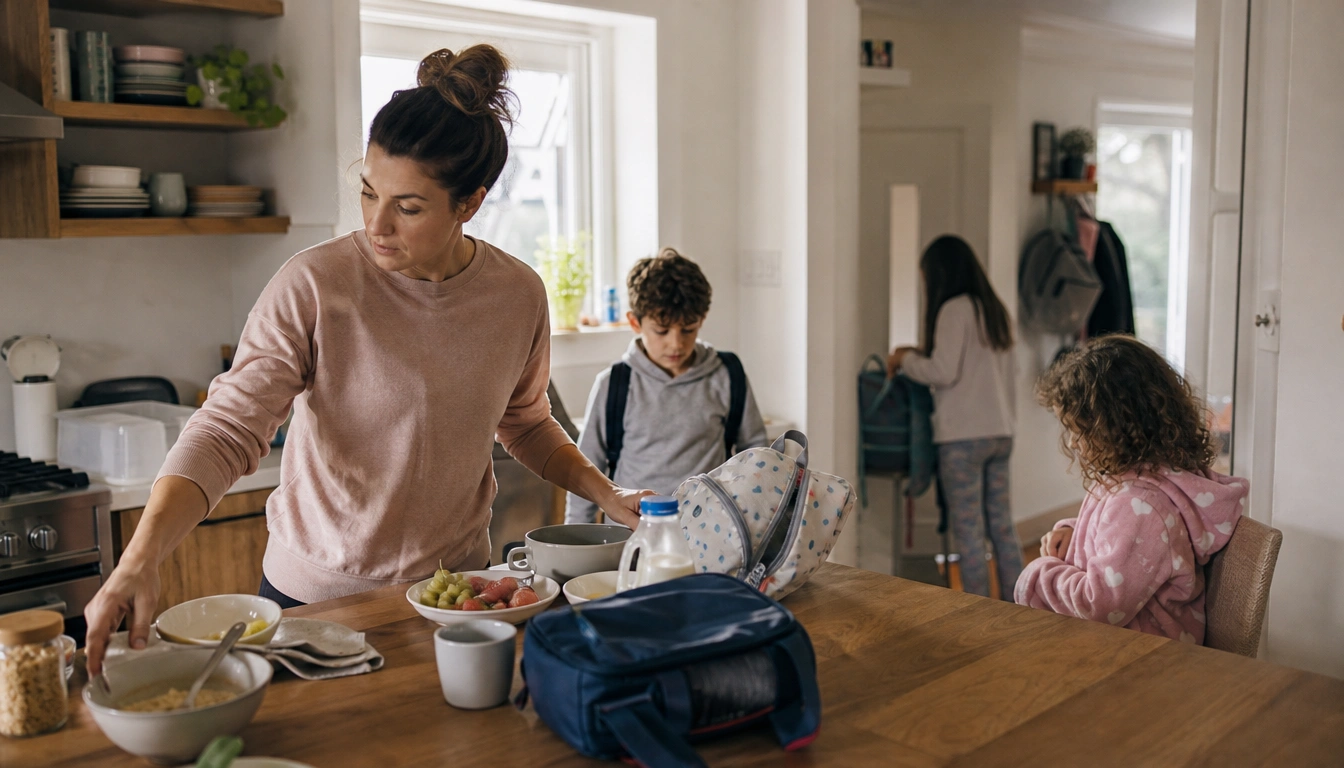
A realistic morning routine for busy parents is short, repeatable, and mostly set up the night before. Focus on three things: reduce decisions, make the child sequence predictable, and use a simple parent reset before the day starts. For most families, that means clothes, bags, and breakfast prep are handled ahead of time, while the morning itself stays simple and consistent.
Key Takeaways
- Front-load decisions the night before so the morning starts with fewer choices and less cognitive strain.
- A predictable routine helps children know what happens next, which can reduce resistance and parent stress.
- The best morning routines are age-specific: infants, toddlers, school-aged children, and teens need different levels of support.
- Visual schedules and closed choices can make mornings smoother for children with ADHD, autism, or sensory differences.
- Fast breakfasts should be practical, balanced, and easy to repeat on busy days.
- If morning stress feels like dread, panic, rage, or exhaustion most days, it may be more than normal parenting stress.
Why busy-parent mornings feel chaotic, and how to set up the night before
Busy-parent mornings often feel hard because they stack three kinds of stress at once: decision fatigue, sleep debt, and transition pressure. By the time everyone is awake, the parent is already making dozens of tiny decisions about clothing, food, timing, backpacks, and emotional negotiation. Cognitive load rises fast, and that makes even small delays feel bigger than they are.
A more realistic morning routine for busy parents starts the evening before. Lay out clothes for children and adults, pack bags, gather school papers, and decide what breakfast will be. If you use a “launch pad” near the door for shoes, keys, backpacks, and permission slips, you remove several bottlenecks before the day begins.
The goal is not perfection. It is to make the first 15 minutes of the day boring enough that no one has to think very hard. That is usually more effective than trying to add a long morning wellness routine after everyone is already tired, hungry, and late.
Helpful night-before tasks include:
- Putting out full outfits, including socks and shoes if possible.
- Prepping lunch ingredients or packing lunchboxes in advance.
- Setting the breakfast table or placing quick breakfast items where they are easy to reach.
- Charging devices and placing schoolwork, sports gear, or work materials by the exit.
The 10-minute parent head-start
If you can wake up even 10 minutes before the children, use that time to lower your own stress before the noise starts. This does not need to be a self-care ritual. It can be a glass of water, a bathroom break, and two minutes of slow breathing. That small buffer can make the morning feel less reactive.
Rehydrating first thing is a practical place to start because the body loses fluid overnight. A short pause can also help with sleep inertia, the groggy feeling that makes problem-solving harder right after waking. If gentle stretching feels good, add it; if not, keep it simple. The point is to enter the morning from a steadier nervous system, not a sprint.
For parents with very little time, a head-start can be as small as sitting up, drinking water, and taking a few slow breaths before checking messages or starting tasks. That small boundary keeps the morning from beginning in full emergency mode.
Make the child sequence predictable
Children usually move more smoothly when they know what comes next. Predictable routines reduce uncertainty, which can lower anxiety and cut down on repeated reminders. That helps the child and the parent at the same time. Instead of negotiating each step, the household follows a familiar order.
A simple sequence works better than a long list. For many families, the order is: wake, bathroom, dress, breakfast, teeth, shoes, out the door. The exact order can vary, but it should stay consistent most days. Children do better when the sequence is familiar enough that they can begin moving without waiting for repeated direction.
Visual checklists can help, especially for children who need more concrete cues. A picture list on the wall, a sticky note on the mirror, or a simple board by the door can reduce nagging and remind children what to do next. Closed choices also help. “Blue shirt or red shirt?” is easier than “What do you want to wear?” because it limits the amount of decision-making required.
If your child resists transitions, use brief warnings and one-step directions. Keep language short and calm. Long explanations often create more friction, especially when everyone is tired and the clock is moving.
Age and stage adjustments that keep mornings realistic
A realistic routine for infants and toddlers looks very different from one for school-aged children or teens. With babies and young toddlers, the morning is less about independence and more about pacing the caregiver. Feeding, diapering, getting dressed, and leaving on time may happen in small waves. Flexibility matters more than a fixed checklist.
Preschoolers can begin learning a simple routine, but they still need close supervision and reminders. Use pictures, short instructions, and a consistent order. Expect some pushing back. Their job is to test boundaries; your job is to keep the rhythm steady without turning every step into a debate.
School-aged children can handle more responsibility. They may dress themselves, brush teeth with reminders, and follow a visual checklist with less direct supervision. Teens need less micromanaging and more expectations around wake time, prep, and respect for the household schedule. They often do better when sleep is protected at night, because morning friction is worse when they are chronically underslept.
If your household includes multiple children, build the routine around what the youngest child can manage, then give older children extra independence where possible. That reduces bottlenecks without making the morning feel like a project management meeting.
Neurodiversity-friendly morning supports
Children with ADHD, autism, or sensory processing differences may experience mornings as especially disruptive. Transitions can feel abrupt, instructions can pile up too quickly, and unexpected noise or touch can increase distress. The best support is usually structure that is visible, predictable, and broken into smaller steps.
Visual schedules are often useful because they reduce the need to hold multiple instructions in working memory. A child can check what comes next instead of relying on repeated verbal reminders. Step-by-step sequencing also helps: one task at a time, with the next step only introduced after the current one is done.
Sensory needs matter too. Some children are overwhelmed by certain fabrics, loud sounds, bright light, or rushed physical contact. Adjust the environment where you can. Give extra time, reduce background noise, and avoid stacking too many instructions at once. If a child needs movement to regulate, build in a short transition such as carrying the bag to the door or doing five wall pushes before getting dressed.
The most useful supports are usually small and repeatable, not elaborate. A morning routine works better when the child can see it, anticipate it, and complete it in the same order most days.
Fast breakfast options that are actually realistic on school mornings
Breakfast does not have to be elaborate to be useful. On busy mornings, the best choices are usually fast, repeatable, and easy to eat. A food-first approach works best when it fits real life rather than an ideal schedule.
Examples that are often practical include whole-grain toast with nut or seed butter and fruit, yogurt with berries, hard-boiled eggs with toast, oatmeal made ahead, or a smoothie with fruit, milk or a fortified plant milk, and a protein source. These options are not about perfection. They are about giving the family something nourishing without creating another morning project.
It can help to pre-portion a few staples so breakfast is mostly assembly, not cooking. Keep fruit washed and visible. Put bowls, spoons, and breakfast items in the same place each morning. If a child does not eat much early in the day, focus on what they reliably will eat and continue to build from there. A calm, dependable routine matters more than an elaborate menu.
If food allergies, swallowing concerns, or medical needs affect breakfast, follow individualized guidance from the child’s clinician or dietitian.
Single-parent and dual-working-household adaptations
Single-parent households and dual-working households often need a simpler system than families with more flexibility. The main goal is to remove bottlenecks. If one parent leaves early, divide responsibilities in a way that matches the household’s actual schedule rather than an ideal version of it.
For example, one adult may handle breakfast while the other handles clothing, backpacks, or drop-off prep. If you are parenting alone in the morning, the routine should be built around the fewest possible handoffs. Set up as much as you can the night before, and keep the morning order extremely stable.
Some families benefit from assigning each child a small job, such as putting shoes by the door or placing their water bottle in their bag. That can reduce the parent’s load, but only if the task is age-appropriate and not another source of conflict.
The most efficient routines are not the most ambitious ones. They are the ones that work on tired days, late days, and the days when everything goes a little off script.
When morning stress is no longer just normal stress
Some morning stress is common. Persistent dread, panic, rage, or exhaustion is different. If mornings regularly leave you feeling flooded, hopeless, physically tense, or unable to function, the issue may be more than scheduling. Chronic sleep deprivation, anxiety, depression, or burnout can all show up most clearly in the early hours.
The CDC and sleep medicine organizations emphasize that adults generally need at least 7 hours of sleep per night for better emotional regulation and daily functioning. Children also need enough sleep for their age, and chronic sleep loss can make mornings harder for the whole family. If sleep is consistently short, no routine will fully fix the problem until rest improves.
Seek support if morning stress is affecting work, relationships, parenting, or health, or if you are having frequent physical symptoms such as chest tightness, headaches, or persistent agitation. A primary care clinician, mental health professional, or family counselor can help sort out whether the main issue is sleep, anxiety, burnout, or something else that deserves direct care.
It is also worth reaching out sooner if a child’s behavior suddenly changes, sleep problems become severe, or the morning routine becomes unworkable despite reasonable adjustments.
Frequently Asked Questions
How can parents cut morning decision fatigue before the day starts?
Move as many choices as possible to the night before: clothes, bags, lunch, breakfast items, and the day’s exit order. A simpler morning means fewer decisions when everyone is tired and rushed.
What should a parent do the night before to make mornings easier?
The biggest time-savers are laying out outfits, packing bags, preparing breakfast basics, and placing shoes, keys, and school items by the door. The goal is to remove the first morning bottlenecks.
What is a realistic morning routine for toddlers or young children?
Keep it short, repetitive, and hands-on. A young child usually needs help waking, dressing, eating, brushing teeth, and transitioning out the door, with fewer words and more consistent steps.
How can parents support mornings when a child has ADHD or autism?
Use visual schedules, one-step directions, and a predictable sequence. Reduce sensory overload when possible and avoid piling on multiple instructions at once. Predictability usually works better than repeated verbal reminders.
What if one parent works early or the household is single-parent?
Build the routine around the smallest number of handoffs. Divide jobs clearly when two adults are available, or simplify the system even further when one adult is managing the morning alone.
The Bottom Line
A realistic morning routine for busy parents is not long or fancy. It is a repeatable system that protects energy, reduces choices, and helps children know what happens next.
The most useful changes are usually small: prepare the night before, use a simple child sequence, keep breakfast easy, and adjust the plan for age, sleep needs, and neurodiversity. If mornings regularly feel overwhelming rather than merely busy, treat that as a signal to look at sleep, stress, and support needs more directly.
Medical disclaimer
Medical disclaimer: This content is for educational and informational purposes only and is not a substitute for professional medical advice, diagnosis, or treatment. Dietary needs and supplement suitability vary by individual.
Sources
- Centers for Disease Control and Prevention (CDC) — cdc.gov. Accessed October 2026.
- healthychildren.org — healthychildren.org. Accessed October 2026.
- aap.org — aap.org. Accessed October 2026.
- rhc.nhsggc.org.uk — nhsggc.org.uk. Accessed October 2026.
