
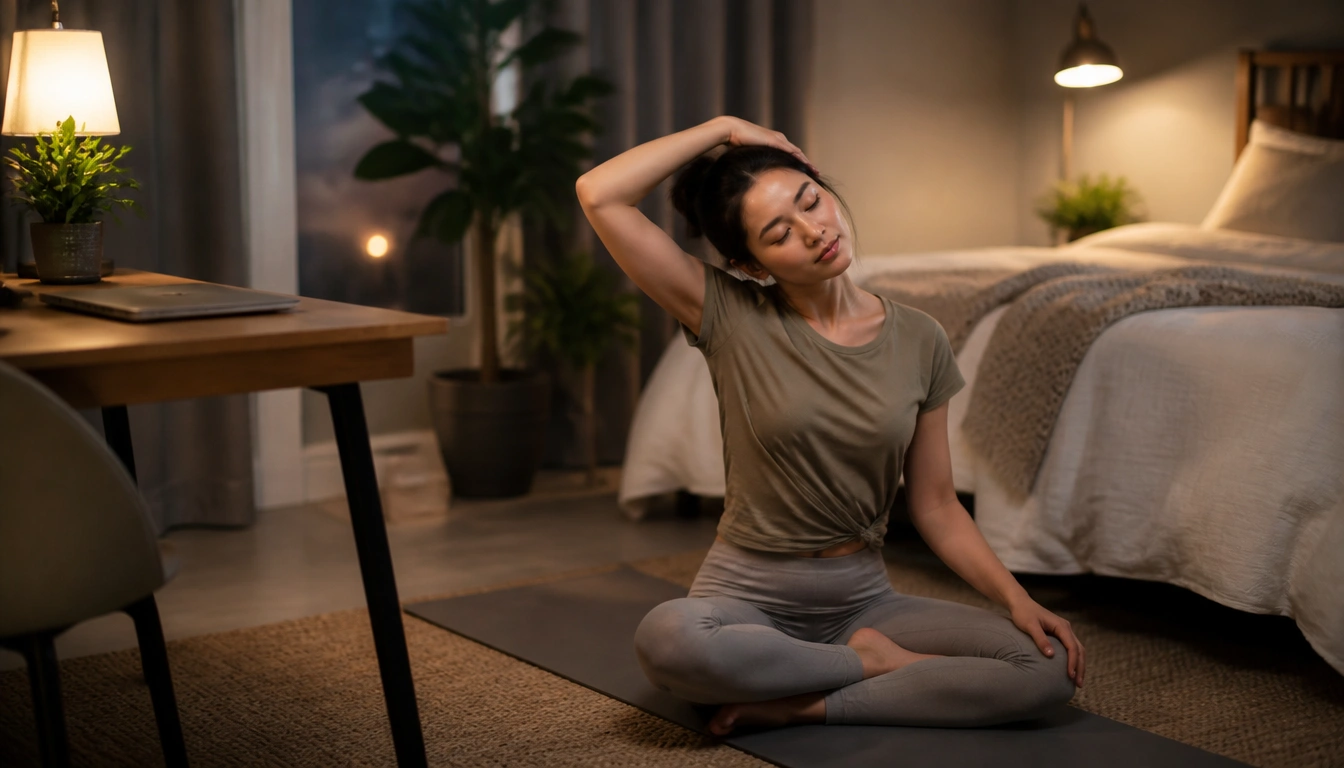
A relaxing pre-bed stretch routine for people working from home should be gentle, slow, and done about 30 to 60 minutes before sleep. Focus on the neck, shoulders, upper back, hips, hamstrings, and lower back, and keep the effort light enough that you feel looser, not worked out. Pair each stretch with slow breathing and avoid vigorous exercise close to bedtime.
Key Takeaways
- Remote work can leave the neck, shoulders, hips, hamstrings, and lower back feeling stiff by bedtime, especially after long periods of sitting.
- Slow stretching before bed may help sleep readiness by calming the body and supporting a parasympathetic, rest-and-digest state.
- A short routine works best when it happens 30 to 60 minutes before bed, after screens are off and work is fully done.
- Gentle stretching is different from exercise: the goal is to reduce tension, not raise heart rate or create a workout.
- Older adults, pregnant people, and people with chronic pain or sciatica may need seated, supported, or modified versions of common stretches.
Why working from home makes bedtime recovery harder
Working from home can make it harder to notice when the day is over. Without a commute, a change of scenery, or the usual break between office time and evening time, many people go from laptop to couch to bed with no real transition. That can leave the nervous system feeling “on,” even when the body is tired.
Desk work also creates a predictable tension pattern. The neck and shoulders often creep upward, the upper back rounds forward, the hips stay folded, and the hamstrings and lower back can feel short and stiff from long sitting. By night, that combination can make it harder to settle into sleep comfortably. A gentle pre-bed stretch routine gives the body a clear signal that work is finished.
According to the CDC, adults need 7 or more hours of quality sleep, and sleep routines that support a regular wind-down can make that target easier to reach. A short stretch sequence is not a cure for insomnia, but it can be a useful part of sleep hygiene for remote workers who feel physically “stuck” after the day.
How gentle stretching supports sleep readiness without becoming a workout
The best relaxing pre-bed stretch for people working from home is slow and low-intensity. The goal is not to force flexibility or chase a deep pose. It is to reduce physical guarding and make the body feel safe enough to downshift.
Slow stretching may support sleep readiness by nudging the body toward parasympathetic activity, the branch of the autonomic nervous system associated with rest and digestion. In practical terms, that can feel like a slower pace of breathing, less muscle bracing, and a quieter mental shift away from work mode.
This is also why bedtime stretching should not resemble a workout. Vigorous exercise close to bed can raise body temperature and increase arousal, which may make sleep come later. A gentle evening routine should leave you feeling calmer, not energized. If you feel winded, sweaty, or amped up, the routine is too intense for bedtime.
The best body areas to target after a day at a desk
For remote workers, the most useful bedtime stretches usually focus on the areas that absorb the most static load during the day. Start with the neck and shoulders, where laptop posture often creates tightness in the upper trapezius and surrounding muscles. Gentle side bends, shoulder rolls, and slow neck stretches can help release that held tension.
The upper back often benefits from movements that open the chest and allow the shoulder blades to move. A supported chest-opening stretch or a gentle child’s pose variation can feel restorative without being strenuous. If your workday leaves you hunched forward, this area often responds well to slow breathing combined with mild movement.
Hips, hamstrings, and the lower back matter too. Long sitting can shorten the front of the hips and leave the back of the legs feeling tight. A comfortable hip flexor stretch, a seated hamstring stretch, or a knees-to-chest position can ease that “compressed” feeling. Use only a mild stretch sensation; bedtime is not the time to push deeper range.
A simple 5- to 10-minute pre-bed routine for remote workers
This routine is meant to be easy enough to repeat on low-energy nights. Keep each stretch gentle and breathe slowly throughout. If you are sore or very tired, shorten the holds rather than pushing harder.
Neck and shoulder release
Sit or stand tall. Let one ear drift toward the shoulder until you feel a light stretch along the side of the neck. Hold briefly, then switch sides. Add a few slow shoulder rolls and let the jaw unclench.
Chest and upper back reset
Place your hands behind your back or rest them low on a wall and gently open the chest. If that feels better, come into child’s pose with your arms forward or alongside your body. Breathe into the back of the ribs.
Hips and hamstrings
Choose a supported seated hamstring stretch or a reclined version on the floor or bed edge. Keep the knee slightly bent if needed. For the hips, a gentle lunge or a figure-four shape can feel relieving, as long as it stays soft and easy.
Lower back unwind
Lie on your back and bring one or both knees toward the chest, or rest with your knees bent and feet on the floor. This can reduce the sense of compression that builds up after sitting. Finish with a few long exhalations before getting into bed.
How to time the routine and set up the room so it actually feels calming
Timing matters. Aim to stretch about 30 to 60 minutes before bed, ideally after your work screens are off. That window gives your body time to settle without turning the routine into a last-minute task. If you work late, treat the stretch as a bridge: work ends, screens end, then the body begins to slow down.
The room setup should lower effort, not raise it. Dim the lights, put your phone on silent, and use a mat, rug, or carpet so you do not have to prepare much. If getting down to the floor feels like too much, a bed edge or sturdy chair can work just as well. The best routine is the one you can repeat without debate.
Pair each position with slow breathing. A longer exhale than inhale can help the practice feel more calming. You do not need a complicated breathing method; simply slowing down the breath is enough to make the routine feel less like a fitness task and more like a wind-down cue.
When stretching is helpful versus when it may be the wrong tool
Stretching is helpful when the problem is mostly desk-related stiffness, mild tension, or the sense that your body is “holding” the workday. It can be especially useful after prolonged sitting, laptop use on a couch, or poor posture that leaves the upper body and hips feeling shortened.
Stretching may be the wrong tool if you are trying to fix sharp pain, nerve symptoms, or a flare of a specific medical condition. If the movement increases symptoms instead of easing them, stop and choose a gentler option. Sleep is usually better supported by comfort than by intensity.
If your bedtime routine starts to feel like a workout, move it earlier in the evening or reduce the range of motion. Restorative movement should feel calming. If it leaves you more alert, more sore, or more frustrated, it is no longer doing the job you want.
Modifications for older adults, pregnancy, and people with chronic pain
Older adults often do best with smaller ranges of motion, more support, and slower transitions between positions. Seated stretches, a wall for balance, and a chair nearby can make the routine safer and less tiring. The goal is comfort and regularity, not reaching a perfect stretch.
During pregnancy, avoid long periods lying flat on the back if that position feels uncomfortable or is not advised by your clinician. Side-lying, seated, or supported standing stretches are usually easier to tolerate. Keep the movements gentle and avoid anything that causes strain, pressure, or dizziness.
People with chronic pain, fibromyalgia, or sciatica should be cautious with any stretch that increases nerve symptoms or radiating pain. A physical therapist or clinician can help identify which positions are appropriate. In these cases, the safest bedtime routine is often the one that decreases guarding without provoking the pain pattern.
Signs your routine is too intense or needs medical attention
Stop stretching if you feel sharp pain, burning, numbness, tingling, weakness, or pain that shoots down the arm or leg. Those symptoms suggest more than ordinary muscle tightness and deserve medical attention, especially if they are new, persistent, or worsening.
Also pay attention to how you feel after the routine. If you are more alert, overheated, or wired after stretching, the routine may be too vigorous for bedtime. If you need more and more stretching to feel temporary relief, or if tightness keeps returning despite a consistent routine, it may be time to look deeper at posture, workload, sleep habits, or an underlying condition.
If sleep problems continue even with good wind-down habits, or if pain is interfering with daily function, talk with a healthcare professional. Stretching is one tool, not a diagnosis or a full treatment plan.
Frequently Asked Questions
How long before bed should I do a stretch routine?
A good target is about 30 to 60 minutes before bed. That timing gives you a buffer after work screens are off and before you try to sleep, so the routine can act as a true wind-down rather than another task.
Which stretches are best for neck, shoulders, hips, and hamstrings after sitting all day?
Gentle side neck stretches, shoulder rolls, chest-opening stretches, child’s pose, seated or reclined hamstring stretches, and supported hip openers are all reasonable choices. Keep the holds mild and comfortable, not deep or forceful.
Can stretching before bed actually help sleep, or is it just relaxation?
It mainly helps by promoting relaxation and reducing physical tension, which can make sleep easier to start. It is not a treatment for every sleep problem, but it can support sleep hygiene and help you shift out of work mode.
What stretches should I avoid at night if I want to fall asleep faster?
Avoid anything vigorous, bouncing, or workout-like close to bed. Strong backbends, intense flows, long sessions that raise your heart rate, or stretches that cause pain are more likely to wake you up than calm you down.
How can I build a 5-minute wind-down routine when I work from home?
Pick three or four simple moves: neck side bends, shoulder rolls, a chest opener, and a gentle lower-back or hamstring stretch. Do them in dim light after screens are off, and breathe slowly through each one.
The Bottom Line
A relaxing pre-bed stretch for people working from home should feel gentle, brief, and easy to repeat. Focus on the places that tighten up from sitting: neck, shoulders, upper back, hips, hamstrings, and lower back.
The best version is usually a 5- to 10-minute routine done 30 to 60 minutes before bed, with dim lighting, no work screens, and slow breathing. If stretching feels intense, keeps you awake, or causes pain, scale back or get medical advice.
Medical disclaimer
Medical disclaimer: This content is for educational and informational purposes only and is not a substitute for professional medical advice, diagnosis, or treatment. Dietary needs and supplement suitability vary by individual.
Sources
- National Institutes of Health (NIH) — nih.gov. Accessed October 2026.
- Centers for Disease Control and Prevention (CDC) — cdc.gov. Accessed October 2026.
- Hospital for Special Surgery (HSS) — hss.edu. Accessed October 2026.
- Academic Research Institution — harvard.edu. Accessed October 2026.
