
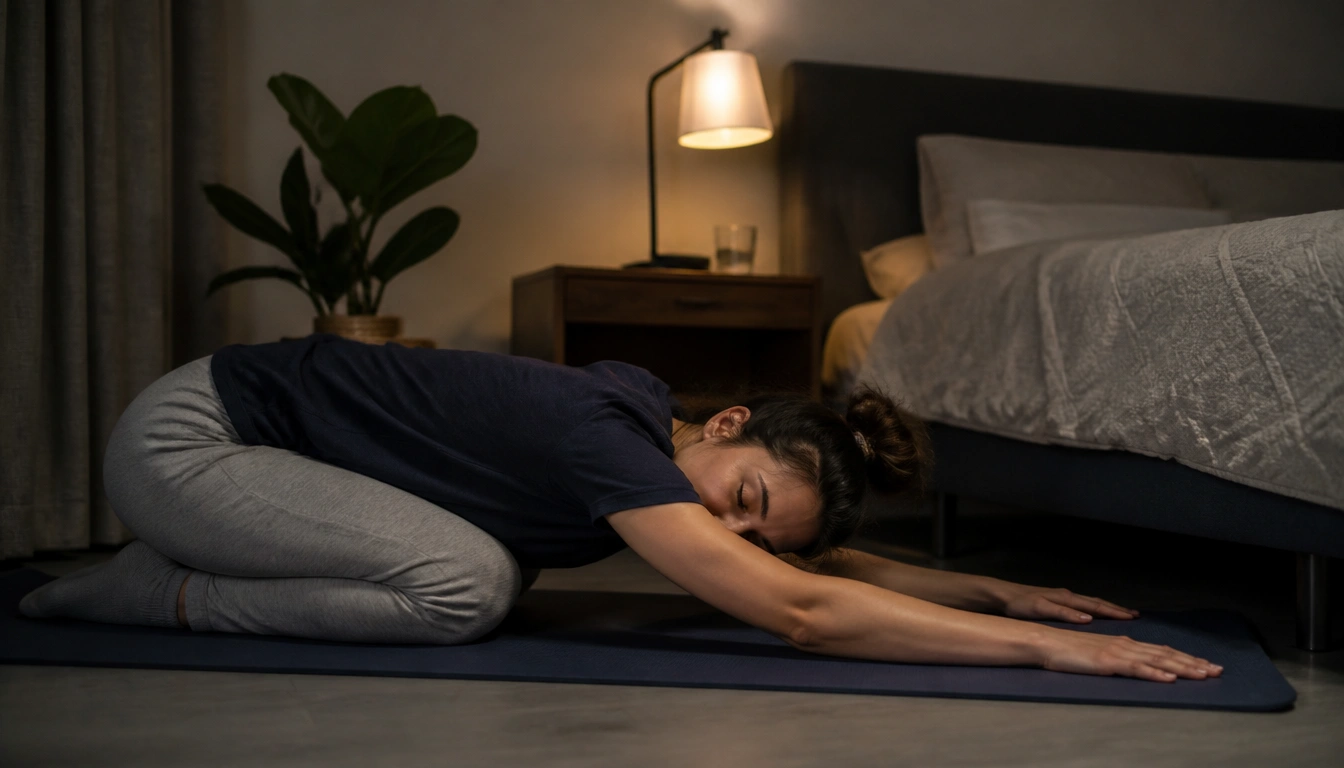
A good pre-bed stretch routine for shift workers is short, gentle, and floor-based: think 8 to 10 minutes of slow breathing, light mobility, and supported poses that ease the neck, shoulders, lower back, hips, and legs. The goal is not to become more flexible. It is to downshift your nervous system, reduce physical tension, and create a calm transition from work to sleep.
Key Takeaways
- Use stretching as a transition buffer after work, not as a workout. The aim is to help your body settle, not to push flexibility.
- Choose low-effort stretches that match where your shift stresses you most: neck, shoulders, lower back, hips, and legs.
- Keep the routine short, slow, and breath-led. If you start sweating, straining, or feeling more alert, it is probably too much.
- For night-shift workers, stretching works best when paired with light management on the commute home and other wind-down steps.
- Avoid heavy meals right before floor stretches; a light snack or short digestive buffer is often more comfortable.
- If pain is sharp, radiating, or persistent, or if sleep problems continue despite a routine, get evaluated rather than trying to stretch through it.
Why shift workers need a different wind-down
Shift workers often need a different pre-bed routine than day workers because the body is dealing with more than simple tiredness. After a night shift, rotating shift, or physically demanding evening, you may be sleepy and still be physiologically activated at the same time. Light exposure, work pace, safety demands, and irregular hours can keep the sympathetic nervous system switched on even when you are exhausted.
A relaxing pre-bed stretch for shift workers works best as a transition buffer. That means the routine is not about performance or gaining range of motion. It is a bridge between alert work mode and sleep mode. Gentle stretching can support parasympathetic activity, ease muscle guarding, and help your body feel safe enough to settle. The National Institutes of Health and the CDC both emphasize that shift work calls for tailored sleep hygiene, because standard bedtime habits do not always match circadian timing.
That physical settling matters because tension often builds in the same places during nonstandard hours: neck, shoulders, lower back, hips, and legs. Standing all night, sitting for long periods, driving, repetitive lifting, and monitoring work can all leave those areas braced and uncomfortable. If the body stays guarded, it is harder to drift into sleep or stay asleep.
For night-shift workers, stretching also fits into a bigger picture. Circadian cues still matter, especially light. A calm stretch routine may help, but it works better when the commute home, bedroom light, and timing of sleep are also handled with intention. Stretching cannot override bright morning light or a fully alert nervous system by itself.
How the routine should feel
The best routine is brief, easy, and almost boring. Aim for about 8 to 10 minutes. Use a mat, carpet, bed edge, or wall so the sequence stays low to the floor and low effort. Move slowly enough that your breathing stays smooth. If a stretch makes you hold your breath, grimace, or brace harder, it is too intense for bedtime.
Think of this as a breath-led cool-down. Inhale through the nose if possible, exhale longer than the inhale, and let each exhale feel like a cue to release effort. You do not need to chase a deep stretch. In fact, aggressive stretching can be counterproductive because strong strain can trigger an alerting response instead of relaxation.
A useful rule is to stay well below your max range. You should feel mild to moderate lengthening, not pain. If you are trying to “fix” tightness in one session, the routine is probably too forceful. Gentle repeated practice works better than one hard stretch session after a shift.
If you are extremely wired, start with the first minute or two of slow breathing before moving into the positions. That small pause can help the routine feel like a downshift rather than another task to complete.
A simple 8 to 10 minute sequence
Child’s pose variation. Start on hands and knees, widen the knees comfortably, and sit the hips back toward the heels. Walk the hands forward and rest the forehead on the floor, a pillow, or stacked hands. Breathe slowly for several breaths, letting the low back widen on the inhale and soften on the exhale. This is a useful first stop if your lower back feels compressed or your shoulders feel high and tense.
Knee-to-chest stretch. Lie on your back and draw both knees in loosely toward the chest. Keep the shoulders heavy and the jaw relaxed. If it feels good, gently rock side to side. This position can ease the lower back and give the hips a chance to soften after prolonged standing, driving, or lifting. You can then release one leg at a time if that feels more comfortable.
Supported supine twist. Stay on your back, extend the arms out like a T, and let both bent knees fall to one side. Keep the movement small and comfortable. Place a pillow under the knees if needed. This twist can help unwind the trunk and reduce the rotational tension that often builds from desk work, steering wheels, patient care, or repeated reaching. Hold each side for a few slow breaths, not a forced count.
Legs up the wall. Finish by moving close to a wall or the side of a bed and resting the legs upward with the back supported on the floor or mattress edge. Let the arms rest by your sides, palms up. This position is especially helpful after standing shifts or long periods on your feet because it reduces effort and can feel like a full-body exhale. Stay here for a minute or two while breathing slowly.
If you only have a few minutes, do the first and last positions. If your body likes more structure, repeat the sequence once rather than making each stretch deeper.
How to tailor the stretches to your job
Different shift jobs create different patterns of tension, so the same routine may need a small adjustment. If you stand most of the night, legs up the wall and knee-to-chest often feel best because they help with lower-body heaviness and low-back compression. If you sit, drive, or monitor screens for long stretches, the supine twist and child’s pose variation can help open the shoulders, chest, and mid-back.
For physically demanding shifts, keep the sequence more restorative and less ambitious. That means shorter holds, smaller ranges, and no “extra” stretching just because you feel stiff. Your muscles may be tired rather than short. Overdoing it can create more soreness, especially if you have been lifting, bending, or moving equipment for hours.
If your shift involves repetitive arm work or holding the head in one position, focus on the neck and shoulders without forcing the neck into large circles or strong pulls. Gentle positioning and stillness are usually better than dramatic movement when the goal is sleep readiness.
A simple adaptation rule is to stretch the body parts that were most locked in during the shift. Standing workers often need legs and lower back. Desk and driving workers often need thoracic spine, hips, and shoulders. Physical jobs often need a slower, more decompressive approach overall.
Modifications and safety
Comfort and safety matter more than completing every position. If your back is sensitive, keep the child’s pose small or skip it and start on your back instead. If a twist aggravates pain, keep the knees more centered or place a pillow between the knees and under them for support. If reaching the floor is difficult, use the bed, a bolster, or a folded blanket so the body can relax without strain.
Older adults and people with arthritis, spinal degeneration, or recent injury may need to limit deep hip flexion and spinal twisting. In those cases, smaller movements and more support are usually safer. The routine should feel stable, not wobbly. If getting down to the floor is difficult, a bedside version can still be useful: supported forward lean, gentle seated side bend, or legs propped on a chair.
Skip any movement that causes sharp pain, numbness, tingling, dizziness, or a feeling that the body is guarding harder rather than softening. Those signs are not normal stretching discomfort. They suggest that the movement may not be appropriate, or that there is an underlying musculoskeletal issue that needs assessment.
Also avoid breath-holding. If you notice yourself bracing through the stretch, shorten the range, use more support, or move on. Bedtime stretching should leave you calmer, not more determined.
How to fit it into a real post-shift evening
For many shift workers, the routine only works if it fits the actual end-of-shift sequence. A realistic order might be: finish work, dim your environment as much as possible, manage the commute home, shower if that helps you unwind, have a small snack if you are hungry, then stretch, then sleep.
That order matters because a heavy meal right before floor stretches can be uncomfortable. Bending, twisting, or lying flat on a very full stomach is not ideal, especially after a long shift. If you are hungry, a light snack may be easier than stretching on an empty, distracted stomach, but a short digestive buffer usually feels better than going straight from a large meal to the floor.
For night-shift workers, light management is especially important. The CDC and other public health guidance note that circadian cues influence sleep timing. Wearing dark glasses on the commute home, reducing bright light exposure, and keeping the bedroom dark can make the stretch routine more effective because the body is not getting mixed signals.
If noise is a problem in shared housing, make the routine quiet and repeatable. Use a mat, keep lights low, and let the sequence become a familiar cue that work is over. Predictability can be calming when your schedule is not.
Mistakes that make stretching less effective
The most common mistake is turning the routine into exercise. If you start chasing a deeper hamstring stretch, doing repeated reps, or holding positions until they feel intense, the nervous system may respond with alertness instead of sleepiness. The point is to settle, not to train.
Bouncing is another problem. Small ballistic movements can wake up the body and make muscles guard harder. So can aggressive neck pulls, strong twisting, or long holds that create pain. A pre-bed stretch should feel almost underwhelming compared with a fitness routine.
Timing mistakes matter too. Stretching immediately after a heavy meal can be uncomfortable, and doing a long, stimulating routine too late in the wind-down can make sleep feel farther away. If the routine keeps you mentally “on,” shorten it. A few slow breaths and two positions may work better than forcing a full sequence.
Finally, do not expect stretching to erase all fatigue. It is one tool in a broader wind-down. Hydration, light control, a cool sleeping space, and a consistent post-shift pattern all support sleep readiness alongside the stretches.
When stretching is not enough
If you regularly feel unable to sleep after shifts even when you are tired, the issue may be more than muscle tension. Persistent trouble falling asleep, staying asleep, or feeling excessively sleepy during off-hours can point to shift work disorder or another sleep problem. In that case, a sleep-focused evaluation is more useful than adding more stretches.
Also pay attention to pain patterns. Tightness that keeps returning in the same spot, sharp pain, radiating symptoms, weakness, or pain that lasts well beyond the shift can suggest a musculoskeletal problem. That deserves assessment from a clinician, physical therapist, or occupational health professional rather than being treated as routine post-work stiffness.
Stretching can help shift workers relax, but it has limits. If the routine is not improving sleep, or if your body is signaling something more serious, the next step is not a harder stretch. It is a proper evaluation and a better match between the problem and the treatment.
Frequently Asked Questions
How long should a pre-bed stretch routine be after a night shift?
Most shift workers do well with 8 to 10 minutes. That is usually long enough to slow the pace, ease common tension areas, and create a transition into sleep without becoming a workout. If you are short on time, even a few minutes of slow, supported stretching can still help.
Which stretches are safest for shift workers with tight lower backs or shoulders?
Gentle options such as child’s pose variation, knee-to-chest, supported supine twist, and legs up the wall are common choices because they are low effort and easy to modify. If a position increases pain, reduce the range, add support, or skip it. Safety matters more than doing every stretch.
Should I stretch before or after a shower when coming off a shift?
Either can work, but many people prefer to shower first if it helps them mentally separate work from sleep. A shower can also make it easier to relax into stretching. If you are very hungry or need a small snack, keep that in mind so you are not stretching on a very full stomach.
Can stretching help shift workers with sleep onset if they are too wired to rest?
Yes, gentle stretching can help, especially when the problem is a mix of physical tension and mental alertness. Slow movement, long exhalations, and a quiet environment can signal downshift. If you still feel wired after a routine, combine it with light reduction and a calmer pre-sleep environment.
What should I avoid doing during a pre-bed stretch routine so I do not wake myself up more?
Avoid bouncing, pushing into pain, turning the session into exercise, holding your breath, and using aggressive neck or back pulls. Also avoid a large meal right before lying on the floor. The routine should feel calming and easy, not intense or performance-driven.
The Bottom Line
A relaxing pre-bed stretch for shift workers works best when it is short, gentle, and tied to a real post-shift routine. Use it as a bridge out of work mode, not as a flexibility session. Focus on the areas that usually tighten during your shift, and keep the breathing slow.
For many people, the most useful pieces are a floor-based sequence, a little light control on the commute home, and enough time after food to avoid discomfort. If stretching starts to feel like exercise, it is probably too strong for bedtime.
If pain is sharp or persistent, or if sleep problems keep happening despite a wind-down routine, get a proper evaluation. Stretching can support recovery, but it should not replace care for a sleep disorder or an underlying musculoskeletal problem.
Medical disclaimer
Medical disclaimer: This content is for educational and informational purposes only and is not a substitute for professional medical advice, diagnosis, or treatment. Dietary needs and supplement suitability vary by individual.
