
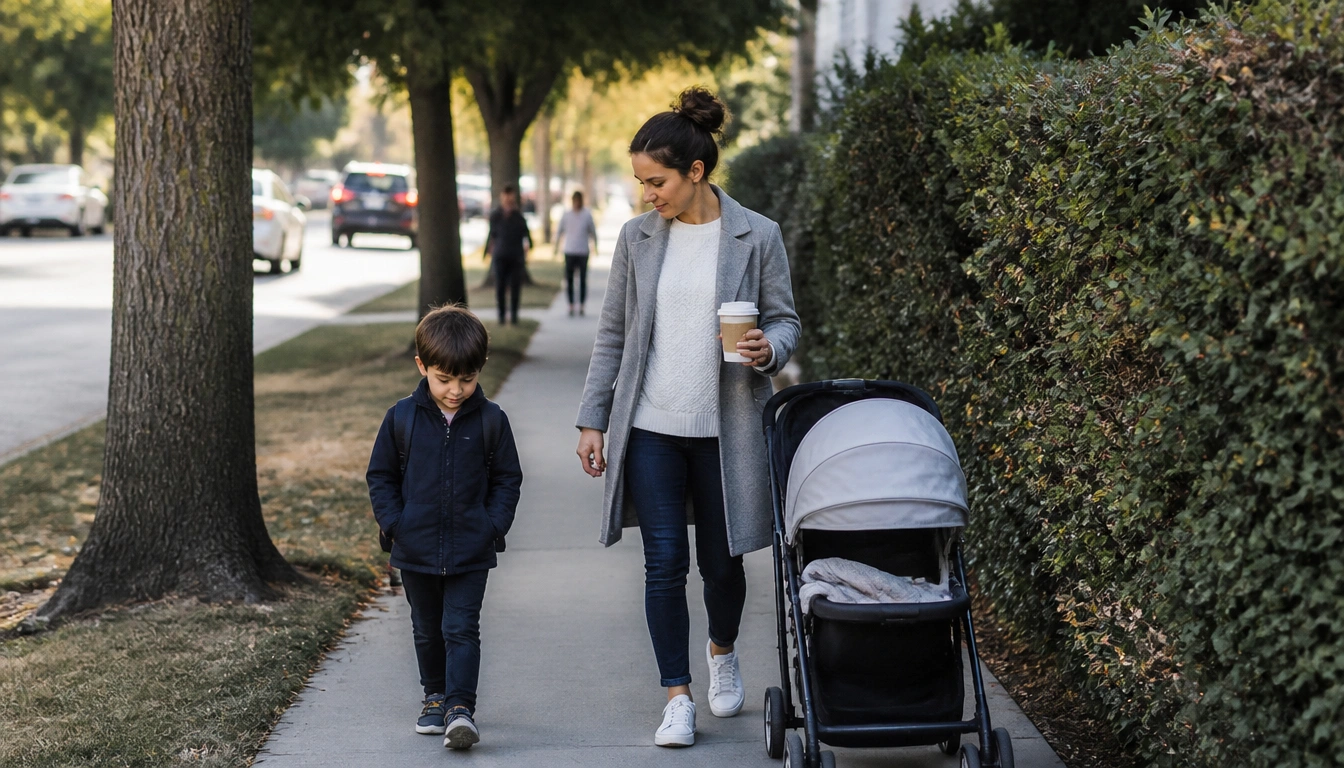
If you are too busy to sit and meditate, a mindfulness walk can be a realistic alternative. You use an ordinary walk—after school drop-off, around the block, through a parking lot, or while pushing a stroller—and bring gentle attention to your feet, breath, and surroundings for a few minutes. The goal is not perfect calm; it is a brief reset that helps interrupt stress and bring your attention back to the present.
Key Takeaways
- A mindfulness walk works best as habit stacking: attach it to something you already do, such as drop-off, errands, or walking kids to practice.
- You do not need a quiet park or a blank mind. Grocery aisles, sidewalks, and parking lots can all work.
- If internal focus feels uncomfortable, use external anchors such as footsteps, visual rhythm, or the feeling of the stroller moving.
- Wandering thoughts are expected. Noticing that your mind drifted is part of the practice, not a failure.
- Keep safety first: stay aware near traffic, strollers, curbs, uneven ground, and busy public spaces.
- Mindful walking can help with everyday stress, but persistent anxiety, depression, or burnout deserves professional support too.
Why a mindfulness walk can fit into a packed parenting day
A mindfulness walk for busy parents is useful because it does not ask you to create a new routine from scratch. It turns a routine you already have into a brief stress-reset. Walking itself is a familiar, low-barrier movement, and mindfulness adds a light layer of attention that can help interrupt the mental loop of planning, worrying, and reacting.
Research from organizations such as the National Institutes of Health and Harvard-affiliated programs suggests that mindfulness practices can support stress regulation, attention, and emotional steadiness. Walking also supports general physical health, which matters because stress tends to feel harder to manage when your body is already tense, restless, or depleted. The combination is practical: movement gives your attention something to land on, and present-moment awareness keeps the walk from becoming just more automatic motion.
The simplest version is enough. For about three minutes, walk at your normal pace and notice three things: the contact of your feet with the ground, the natural rhythm of your breath, and one or two details in the environment. If thoughts pull you away, gently return to the next step. The practice is not about emptying the mind. It is about noticing where attention goes and guiding it back without criticism.
What to notice during a mindfulness walk
A straightforward mindfulness walk usually works best when you have a small, repeatable sequence. You do not need to monitor every sensation. Pick a few anchors and keep them simple.
Start with your feet. Feel heel, midfoot, and toe as each step lands and rolls forward. You are not forcing a special walking style; you are just noticing the mechanics that are already there.
Then notice the breath. Let it stay natural. Some people find it helpful to sense the air entering and leaving without trying to deepen it. If attention to breathing feels distracting, skip it and return to the feet or the path ahead.
Notice the environment. Pick one or two neutral details: the color of a mailbox, the sound of wheels on pavement, the light on the sidewalk, or the shape of a tree. Optional labeling can help: “red car,” “cool air,” “voices,” “sunlight.” Keep labels plain and brief.
For busy parents, the best time to practice is often already built into the day: school drop-off, walking from the car to work, pushing a stroller, walking while kids ride scooters, pacing the sidelines at practice, or moving through errands. The walk does not need to happen in silence or in a beautiful location to count.
How to use it when the day is noisy, rushed, or emotionally full
Most parents will not be practicing in an ideal setting, and that is normal. A mindfulness walk can still work in a grocery store parking lot, on a crowded sidewalk, near a playground, or while your child is asking for the third time what is for dinner. The goal is not to escape the day. It is to create a small pocket of steadiness inside it.
When the environment is busy, reduce the amount of information you are trying to hold. One anchor is enough. You might choose footsteps only, or the rhythm of the stroller wheels, or the visual pattern of the curb and pavement. If your mind is overloaded, shorter is often better. A one-minute reset may be more realistic than a longer walk that leaves you frustrated.
If you are emotionally overloaded, do not use the walk as a test of whether you can “calm down.” Instead, let it be a place to observe your state without having to fix it immediately. You may notice impatience, jaw tension, rushing thoughts, or the urge to speed up. Those reactions are information, not failure. The practice is to keep walking and keep noticing.
Parents often benefit from habit stacking because it reduces decision fatigue. Linking the walk to a stable cue—school drop-off, the first trip from the car, the walk into the office, or a daily errand—makes it more likely to happen. That is especially useful on days when your energy is low and your schedule feels fragmented.
Common mistakes that make mindfulness walking feel harder than it is
One common mistake is trying to do the walk “correctly.” That turns a flexible stress tool into another performance task. If you spend the whole time judging your attention, the practice becomes heavier than it needs to be. A better goal is simply to notice, return, and continue.
Another mistake is expecting a blank mind. Mindfulness does not require perfect concentration. Thoughts will wander to work, childcare, groceries, school forms, and unfinished conversations. That is normal. The useful moment is not when your mind never wanders; it is when you realize it wandered and gently come back.
Some parents also treat the walk like a productivity assignment. They may try to squeeze in a podcast, answer texts, and do mindfulness at the same time. That usually reduces the calming effect. If you want the walk to function as a reset, keep the first few minutes free of extra input when possible.
Finally, avoid using self-criticism as motivation. A mindfulness walk is not a pass/fail behavior. Even a scattered walk can teach you something useful about your stress pattern. The point is not to have a perfect session; it is to create a repeatable pause in a busy day.
Safety, awareness, and when to pause
Mindful walking should not reduce your situational awareness. Stay alert near traffic, driveways, curbs, bikes, strollers, playground equipment, stairs, and uneven ground. If you are walking with children, the environment matters more than the meditation cue. You can keep one part of your attention on the present moment while still watching for safety.
It is usually wise to avoid overusing headphones or anything that blocks awareness in busy public spaces. If you need to cross streets, navigate a parking lot, or supervise a child, safety comes first. You can resume a more inward focus when the setting is calmer.
If you have a recent injury, dizziness, balance concerns, or another medical issue that makes walking uncomfortable or unsafe, check with a healthcare professional before turning walking into a regular practice. And if stress is no longer just a passing issue—if you are dealing with persistent anxiety, panic, low mood, hopelessness, sleep disruption, or burnout that interferes with daily functioning—mindfulness walking should be considered a support, not a substitute for care. A primary care clinician or licensed mental health professional can help you decide what kind of support fits best.
Adaptations for sensory sensitivity or discomfort with internal focus
Not everyone likes body scans or attention to the breath. Some people find internal focus unpleasant, especially if they are anxious, sensory-sensitive, or simply exhausted. That does not mean mindfulness walking is off-limits. It just means you may need a more external version of the practice.
If internal attention feels uncomfortable, use anchors outside the body. Notice the rhythm of your footsteps, the visual pattern of the sidewalk, the movement of trees or buildings passing by, or the change in light and shadow. You can also count steps quietly for a short stretch, then let the counting go.
For parents who are neurodivergent or easily overstimulated, reducing complexity is often helpful. Choose one sense instead of many. For example, you might attend only to visual rhythm or only to the contact of your shoes with the ground. If a crowded or loud setting feels too activating, practice in a simpler place first: a hallway, driveway, backyard, or a quiet stretch of sidewalk.
The practice can also be child-friendly. If your children are with you, you can invite them to notice one thing they see, hear, or feel under their feet. That is optional, not required. Your own task is simply to find a version that feels steady, manageable, and non-demanding.
A quick reset plan for one to five minutes
When time is extremely tight, the goal is not a full session. It is a usable reset. A one-minute mindfulness walk may be enough to interrupt a stress spiral and help you re-enter the next task with slightly more steadiness.
For one minute: walk to the next destination and notice only your feet. Feel the heel-to-toe pattern for a few steps, then return to your normal day.
For three minutes: combine feet, breath, and one environmental cue. This is a good fit for school drop-off, the walk from the car, or a short loop around the block.
For five minutes: keep the same anchors, but give yourself a little more time to notice what changes. You may start with tense shoulders or a racing mind and finish with slightly more room around those sensations.
If your mind keeps wandering, do not restart the session. Just come back to the next step. If you missed the whole point of the walk, that still counts as practice—because noticing that you drifted and returning is the skill being built. Over time, the repetition matters more than any single session.
That makes mindfulness walking especially useful for parents: it can live inside the day you already have. No special equipment, no perfect silence, and no need to wait for an open stretch of time.
Questions parents often ask about mindful walking
Short answers help remove the pressure to do this practice “right.” If you are deciding whether the approach fits your routine, these are the questions that usually matter most.
Frequently Asked Questions
How long does a mindfulness walk need to be to help?
There is no fixed minimum. Even one to three minutes can be useful if you actually bring attention to the walk. Many busy parents find a short, repeatable version easier to keep than a longer session they rarely have time for.
Can I do mindful walking while pushing a stroller or walking with kids?
Yes. You can use the stroller’s motion, your child’s pace, or the rhythm of your own steps as the anchor. The main adjustment is safety: keep enough attention on the path, traffic, curbs, and where the children are moving.
What should I focus on if my mind keeps wandering?
Focus on one simple anchor at a time: your feet, the breath, or a neutral sight or sound. When your mind wanders, notice that it wandered and return gently. That return is the practice, not a mistake.
Is mindful walking as effective as seated meditation for stress?
Research suggests that mindful walking can provide stress-relief benefits similar to seated mindfulness for some outcomes. The better choice is often the one you can actually do consistently. For restless or busy parents, movement may be easier to sustain.
Can I practice mindfulness walking in a noisy or crowded place?
Yes, as long as you keep safety in mind. You do not need silence or a perfect setting. A grocery aisle, sidewalk, parking lot, or sidelines can work if you lower the complexity and choose a simple anchor.
The Bottom Line
A mindfulness walk is one of the easiest ways for busy parents to practice mindfulness without carving out a separate meditation block. Attach it to a routine you already have, keep the practice short, and let the attention stay simple.
You do not need a blank mind, a quiet forest, or a perfect mood. Wandering thoughts, noise, and interruptions are part of normal life with kids. The practice still counts when you notice them and return to the next step.
Use safety, flexibility, and self-kindness as your guardrails. If everyday stress is becoming more persistent or severe, pair the walk with professional support rather than trying to manage everything on your own.
Medical disclaimer
Medical disclaimer: This content is for educational and informational purposes only and is not a substitute for professional medical advice, diagnosis, or treatment. Dietary needs and supplement suitability vary by individual.
Sources
- National Institutes of Health (NIH) — nih.gov. Accessed October 2026.
- Centers for Disease Control and Prevention (CDC) — cdc.gov. Accessed October 2026.
- National Institutes of Health (NIH) — nih.gov. Accessed October 2026.
- Academic / Medical Research Institution — apa.org. Accessed October 2026.
- Academic Research Institution — harvard.edu. Accessed October 2026.
