
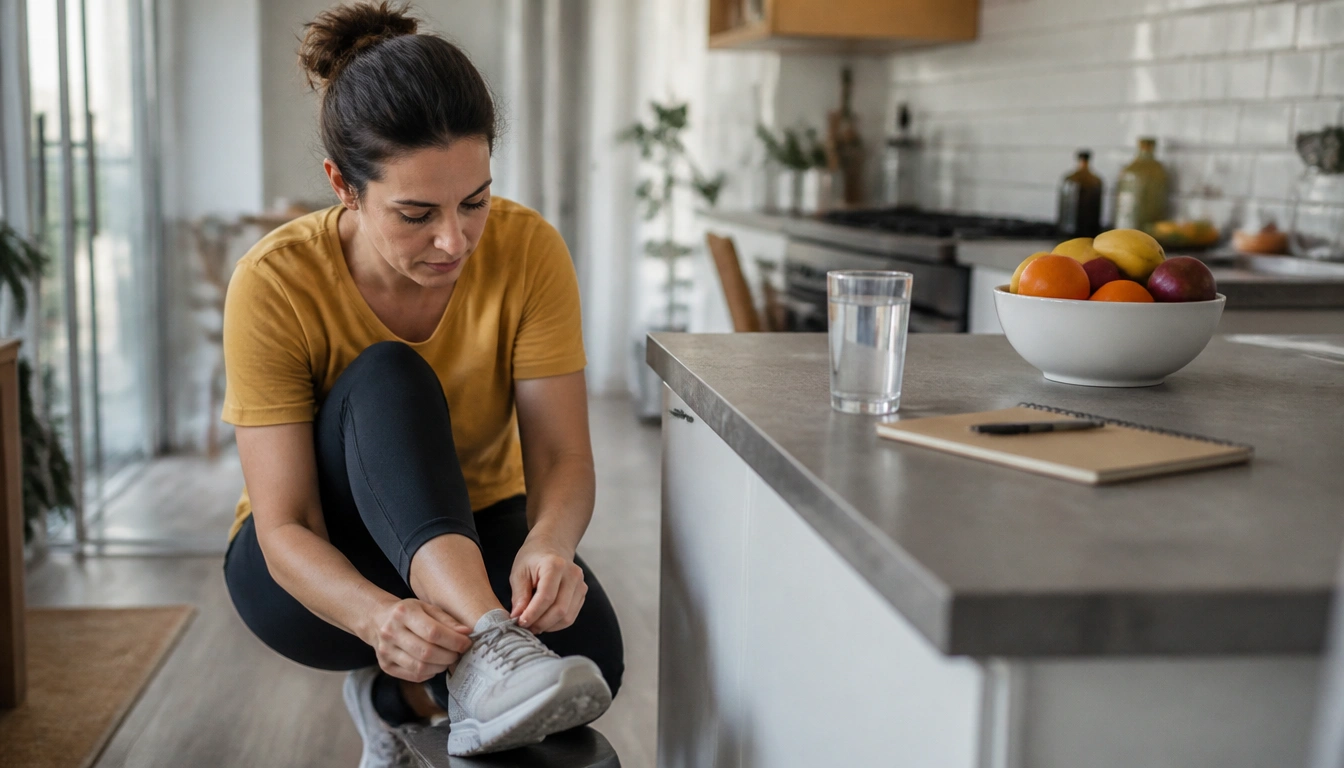
The smallest, most effective changes are the ones you can repeat on hard days. Start with one movement habit, one food habit, and one sleep habit that feel almost too easy to fail. Short walks, one-plate meal swaps, and a simple bedtime cue can restart momentum without requiring a total routine overhaul.
Key Takeaways
- Begin with a minimum viable restart: choose one movement action, one food upgrade, and one sleep cue you can do on your worst ordinary day.
- Small habits work because they reduce decision fatigue and become easier to automate when they are tied to existing cues.
- Short walks, brief mobility breaks, and snack-level movement still count toward weekly activity goals, according to the CDC and NHS.
- If you miss a day or week, restart at the next available opportunity instead of trying to “make up” for lost time.
- Movement, nutrition, and sleep affect each other; improving one area often makes the others easier to maintain.
Why restarting healthy habits feels hard after disruption
After illness, travel, caregiving strain, a busy season at work, or a run of poor sleep, healthy routines can stop feeling automatic. That is not a character flaw. It is a normal response to disrupted cues, lower energy, and more decisions than usual.
The best way back is not to rebuild your whole life at once. It is to choose a few actions that are simple enough to survive a stressful day. Public health guidance from the CDC and the NHS emphasizes that health gains come from steady movement, basic nutrition patterns, and enough sleep over time, not from perfect streaks. A restart works better when it respects your current capacity.
A useful starting point is the minimum viable restart: one movement habit, one food habit, and one sleep habit. For example, that might be a 10-minute walk after lunch, a plate that includes vegetables at dinner, and a phone-free wind-down before bed. The aim is not to do everything. The aim is to re-establish proof that you can show up again.
Micro-habits that create momentum
Small habits matter because they lower the mental cost of change. A low-friction action is easier to repeat, and repetition is what makes behavior feel more natural. Over time, those repeated actions become the default instead of a one-time effort.
This is also why tiny changes often unlock bigger ones. A short walk may not look impressive, but it can interrupt a sedentary stretch, improve alertness, and make the next choice easier. A glass of water or a more balanced snack can reduce the “I am running on empty” feeling that pushes people toward convenience foods later in the day.
Think in terms of the compound effect of micro-habits: if an action is simple enough to do with low energy, you are more likely to keep it going. That consistency matters more than intensity when you are rebuilding. Research institutions such as Stanford and public health agencies describe habit formation as a process of repeated cues and responses, not a test of willpower.
Good restart habits are usually small, specific, and visible. They do not need to be dramatic. They need to be clear enough that your brain does not have to negotiate every time.
How to use habit stacking to make a new routine feel automatic
Habit stacking means attaching a new action to something you already do. This reduces decision fatigue because the old cue does part of the work for you. Instead of asking, “When should I remember this?” you decide, “I will do this after that.”
Useful examples include a short walk after lunch, stretching after coffee, a glass of water when you start your workday, or a screen-free wind-down after brushing your teeth. The cue should be ordinary and reliable, not idealized. Existing routines are more dependable than motivation.
Keep the stacked habit small enough that you do not need a recovery day from it. If “after coffee” means two minutes of mobility, that can be enough. If “before bed” means dimming lights and putting your phone away, that is already a meaningful sleep support habit.
Once the cue feels stable, you can expand the habit gradually. But the first version should feel almost unreasonably doable. The point is to create an automatic loop, not a performance.
A realistic movement reset and a simple nutrition reset
For movement, start with what you can repeat, then build toward the public-health target of about 150 minutes of moderate activity a week or 75 minutes of vigorous activity, plus muscle-strengthening activity on at least two days. The CDC and NHS both emphasize that every bit counts, and short bouts can be broken up through the day. Three 10-minute walks can be a realistic bridge when a single long workout feels out of reach.
You do not need to begin with a formal exercise plan. Try one of these: a five-minute walk after meals, a brief mobility routine while the kettle boils, or a few stairs instead of waiting for a perfect workout window. If you are recovering from inactivity, building back slowly is often smarter than chasing the number right away.
For nutrition, one-plate changes are easier than diet overhauls. Fill part of a meal with vegetables, choose a whole grain when available, add a protein source that keeps you satisfied, or swap one ultra-processed default snack for fruit, yogurt, nuts, or a sandwich with more fiber. The NHS Eatwell Guide and CDC guidance both support patterns that center whole foods, fiber-rich choices, and less reliance on heavily processed items.
If budget matters, start with shelf-stable or frozen foods. Beans, oats, frozen vegetables, eggs, canned fish, lentils, and plain yogurt can support a healthier routine without raising the complexity of your shopping list. A better routine is the one you can actually feed and sustain.
Sleep and recovery basics that support the rest of your routine
Sleep is not separate from the rest of health. It affects appetite, energy, mood, focus, and your willingness to move. Most adults need seven or more hours of quality sleep, according to public health guidance. If sleep is shaky, everything else feels harder.
Start with one sleep cue, not a full bedtime makeover. A 30-minute digital sunset, dimmer lights, or a short reading ritual can help the body shift toward rest. If your schedule is irregular, protect a consistent wind-down sequence even when the bedtime itself changes.
Daytime habits also shape sleep. A short walk, morning light, less caffeine late in the day, and regular mealtimes can all support a steadier rhythm. This is where the brain-body loop matters: better sleep makes movement and food choices easier, and more movement during the day often improves sleep pressure at night.
If you are exhausted, keep the goal modest. A restorative routine does not have to be elaborate. It has to be repeatable.
How to recover after a missed day without spiraling
Missing a day or even a week does not mean the habit failed. Lapses are part of behavior change. The useful response is to restart at the next available opportunity instead of trying to preserve a perfect streak.
All-or-nothing thinking turns one missed walk or one poor meal into a reason to abandon the whole routine. A better reset is to ask, “What is the smallest useful action I can do today?” That might be five minutes of movement, one balanced meal, or going to bed ten minutes earlier than usual.
Relapse normalization matters because shame is expensive. It drains attention and makes the restart feel bigger than it is. If your old routine broke under stress, your new one should be designed for stress. That means smaller habits, fewer steps, and more forgiveness built in from the start.
If you need to restart often, do not treat that as failure. Treat it as data. Your habit may be too large, too vague, or tied to a cue that is not stable enough.
When to slow down, get medical clearance, or seek professional support
If you have a chronic condition such as cardiovascular disease, type 2 diabetes, severe joint pain, or another issue that could affect exercise tolerance, it is wise to check with a healthcare professional before making major changes to activity or diet. That is especially important after a long sedentary period or if you are recovering from illness or injury.
Stop exercise and seek immediate medical help if you get chest pain, unusual shortness of breath, sudden dizziness, or joint or muscle pain that is sharp or does not ease. Those symptoms need assessment, not routine advice.
Professional support also matters when mood, anxiety, substance use, or sleep problems are making daily life hard to manage. Healthy habits can support recovery, but they are not a substitute for medical or mental health care when a condition is present.
If you are unsure where to begin, it is reasonable to ask a clinician, physical therapist, dietitian, or mental health professional for a starting point that matches your capacity.
A 7-day starter plan for re-entering healthy habits
Day 1: Choose your three restart habits: one movement habit, one food habit, and one sleep habit. Keep each one small enough to finish on a tired day.
Day 2: Attach each habit to a cue. For example: after coffee, move for two minutes; after lunch, walk for five to ten minutes; before bed, dim lights and put the phone away.
Day 3: Do the movement habit twice if possible, but only if it feels easy. If not, do the original version and stop there.
Day 4: Make one meal more balanced by adding fiber-rich food, such as vegetables, beans, fruit, or whole grains.
Day 5: Protect your sleep cue again. Repeat the same wind-down order instead of inventing a new one.
Day 6: Add a second short walk or a brief mobility break if energy allows. If not, count the normal day as success.
Day 7: Review what was easiest to repeat. Keep that, reduce what felt forced, and plan next week around the habits that survived real life.
If you want a simple rule for the week, use this: repeat the smallest version first, then grow only after it feels stable.
Frequently Asked Questions
How do I restart healthy habits after a long break without burning out?
Start smaller than you think you need to. Pick one movement habit, one food habit, and one sleep habit you can do on a busy or tired day. The goal is consistency, not catching up immediately.
What small daily habits help most with movement, sleep, and nutrition?
A short walk after a meal, a fixed bedtime wind-down, and one more balanced meal or snack each day are strong starters. These habits are simple enough to repeat and often make other healthy choices easier.
How many minutes of exercise do I need if I’m starting from zero again?
You do not need to begin with a full workout routine. Even 5 to 10 minutes at a time can be useful when you are rebuilding. The CDC and NHS note that activity can be broken into short blocks as you work toward weekly targets.
What should I change first: food, movement, sleep, or hydration?
Choose the area that feels easiest to repeat right now. Many people do well starting with one movement cue, one food swap, and one sleep cue together, because they support each other and reduce the urge to overhaul everything.
How do I keep going after I miss a day or fall off track?
Treat the miss as normal and restart at the next available opportunity. Do not try to fix the week by doing too much at once. Return to the smallest version of the habit and rebuild from there.
The Bottom Line
The most effective restart is usually the least dramatic one. One small movement habit, one simple food change, and one sleep cue can rebuild momentum without overwhelming your schedule or your energy.
Short walks, one-plate meals, and a basic wind-down routine are not “too small” if they help you repeat them. That repetition is what turns a disrupted routine into a durable one. If you have medical conditions, sharp pain, or major fatigue, get individualized advice before pushing harder.
If you miss a day, the plan is not broken. Resume at the next available opportunity, keep the habit easy enough to survive real life, and let the routine grow only after the smallest version feels stable.
Medical disclaimer
Medical disclaimer: This content is for educational and informational purposes only and is not a substitute for professional medical advice, diagnosis, or treatment. Dietary needs and supplement suitability vary by individual.
Sources
- National Institutes of Health (NIH) — nih.gov. Accessed October 2026.
- Centers for Disease Control and Prevention (CDC) — cdc.gov. Accessed October 2026.
- National Health Service (NHS) — southwestyorkshire.nhs.uk. Accessed October 2026.
- Academic Research Institution — stanford.edu. Accessed October 2026.
