
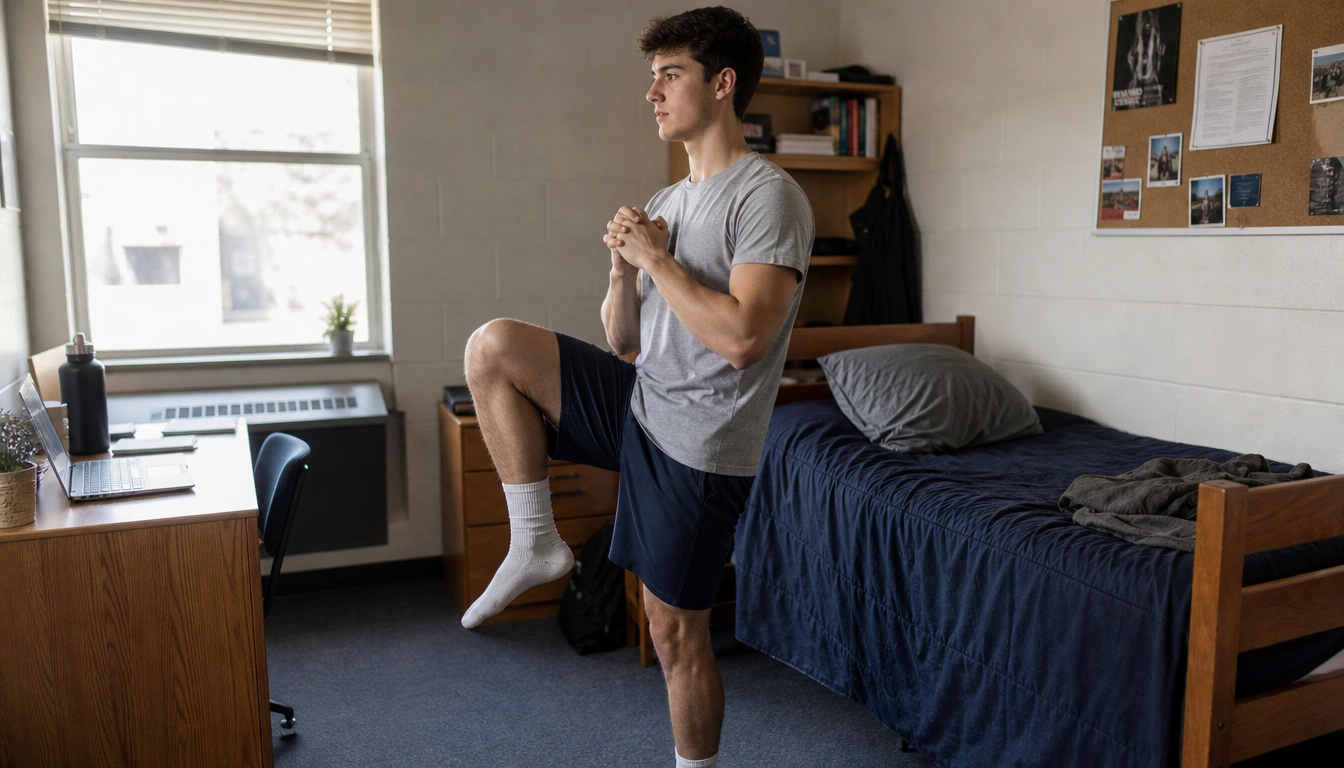
The best standing core routine for a college student is a short, no-equipment circuit that uses upright movements such as marching with a twist, cross-body reaches, standing woodchop-style rotations, side bends, and single-leg balance work. It fits small spaces, does not require floor time, and can be done in about 10 minutes. If you do it 2 to 3 times a week, it can support the muscle-strengthening part of a broader fitness routine.
Key Takeaways
- Standing core work is practical for dorms, libraries, and study breaks because it needs little space, no mat, and minimal setup.
- Upright core exercises train the abs, obliques, deep stabilizers, hips, and balance together, which better matches daily movement than crunches alone.
- Two to three short sessions per week can fit the American College of Sports Medicine’s muscle-strengthening guidance for healthy adults.
- Beginners can use a wall, shorten the range of motion, and slow the tempo; advanced students can add a backpack, water bottle, or textbook.
- Stop the routine if you get sharp pain, dizziness, or symptoms that feel unstable, and get checked if back or neck pain keeps returning.
Why standing core training fits college life
Standing core training works well for college students because it solves three common problems at once: time, space, and privacy. You can do it beside a dorm bed, next to a desk, or in an empty corner of a library study area without needing a mat or much room. That makes it easier to stay consistent than a floor routine that requires lying down, clearing space, and often changing clothes.
There is also a practical movement benefit. College life means a lot of sitting: lectures, reading, laptop work, commuting, and long study sessions. A standing core routine gives you a quick upright reset that asks your trunk, hips, and posture muscles to organize around gravity instead of around the floor. That is useful if you want something that feels more like real-life movement than a set of crunches.
According to the American College of Sports Medicine, healthy adults should include muscle-strengthening activity at least 2 days per week. A standing core routine can count toward that strength work, especially when it is done with control and enough effort to challenge your muscles. It is not a replacement for all exercise, but it is a realistic way to build consistency during a packed semester.
How standing core work challenges the core differently from floor exercises
Floor exercises can be helpful, but standing work asks the body to stabilize in a more functional position. Your core has to resist rotation, side-bending, and loss of balance while you remain upright. That means the exercise recruits more than the visible abdominal muscles. It also uses the deep stabilizers, the obliques, the lower back muscles, the glutes, and the hip muscles that help keep you steady during walking, carrying a backpack, or climbing stairs.
Standing movements also change how force moves through the body. Instead of curling the torso repeatedly, you are often bracing, reaching, rotating, or shifting weight while keeping the spine in a neutral position. For many students, that is more comfortable than repeated spinal flexion, especially if crunches or sit-ups aggravate the neck or low back.
That does not mean floor exercises are always bad. It means standing core work can be a smart option when space is tight, privacy is limited, or you want a form of training that carries over to daily movement. For students who spend a lot of time seated, the upright position can feel more useful and less awkward than getting on and off the floor between sets.
The 10-minute no-equipment standing core circuit
This circuit is designed for a small room and quiet movement. Do each exercise with control, then move to the next one. Complete 2 to 3 rounds, resting briefly between rounds if needed. The goal is not speed. The goal is steady tension, good posture, and clean form.
1. Standing march with a twist
March in place while lifting one knee and rotating your torso just enough to bring the opposite elbow toward it. Alternate sides in a smooth rhythm. This wakes up the abdominals and teaches your trunk to coordinate with your legs.
2. Cross-body reach or standing woodchop
Start with feet about shoulder-width apart and soft knees. Reach diagonally across your body, then return under control. You can make this more like a punch, a sweep, or a diagonal pull. Keep the movement smooth rather than forceful.
3. Single-leg balance reach
Stand on one leg, hinge slightly at the hips, and reach the free leg back as your torso tips forward a little. Return to standing. This is a core-and-balance drill, not a speed drill. Switch sides after the set.
4. Standing side crunch or oblique lean
Keep your chest facing forward and slide one hand down the side of your leg as the opposite side of your waist shortens. Return upright and repeat on the other side. The movement should be small and controlled, not a full sideways bend.
5. Standing anti-rotation hold
Clasp your hands in front of your chest and press them out a little while keeping your ribs and hips square. Hold steady against the urge to twist. This teaches the core to resist movement, which is a major part of real-world trunk strength.
If you want to keep the routine to about 10 minutes, aim for 20 to 30 seconds per exercise or a set number of controlled reps, then repeat the circuit until you finish 2 rounds. If you have more time, a third round can add work without needing a gym.
Exercise-by-exercise form cues and common mistakes
The best cue for every standing core exercise is simple: stay tall without locking your knees. Soft knees help you stay balanced, and a stacked posture helps the trunk do the work instead of the lower back.
For the standing march with a twist, keep the movement compact. A common mistake is swinging the torso hard just to touch the knee. That turns the drill into momentum instead of core control. Lift the knee with purpose, rotate only as far as you can without losing balance, and keep your shoulders relaxed.
For cross-body reaches or woodchop-style motions, avoid shrugging the shoulders or yanking through the arms. The torso should guide the movement. If you feel only the arms working, slow down and think about ribcage and pelvis moving together as one unit.
For the single-leg balance reach, do not force a deep hinge if your balance is shaky. A smaller lean is fine. The main goal is to keep the pelvis level and the standing foot grounded. If you wobble, use one fingertip on a wall or desk for support.
For the side crunch or oblique lean, avoid collapsing the chest or bending forward. The movement should stay in the side body. Keep the head aligned with the spine and stop before the motion becomes a sloppy side bend.
For the anti-rotation hold, the most common mistake is letting the ribs flare and the low back arch. Think about gently knitting the front of the ribs down while keeping the pelvis quiet. That helps the core do the stabilizing rather than the low back.
How to program the routine across a college week
A practical college schedule usually works better than an ambitious one. Two to three standing core sessions per week is enough for many students to build consistency and fit the muscle-strengthening side of a weekly fitness plan. You can place the routine on nonconsecutive days, such as Monday, Wednesday, and Friday, or use it as a short reset after a long study block.
If you also walk a lot on campus, play intramural sports, or lift weights elsewhere, this routine can complement those activities. If your week is mostly sedentary, it can still help as a regular movement break, but it should not be the only thing you do. Your body also benefits from aerobic activity, lower-body strength, and regular changes of position during the day.
Think in terms of repeatable habits. A 10-minute circuit done three times a week is easier to maintain than a longer workout that you keep postponing. If you miss a session, do not try to make up for it with a punishing workout. Just return to the plan at the next available time.
Beginner, intermediate, and harder variations
Beginners should make the routine easier before trying to make it harder. Use a wall, desk, or sturdy chair nearby for balance. Shorten the range of motion, slow down the tempo, and reduce the number of repetitions. This helps you build control without getting sloppy.
For an intermediate version, remove most balance support and hold each movement a little longer. You can also pause at the hardest point of the motion, such as the top of a knee lift or the end of a reach. That increases time under tension without needing extra equipment.
If you want a harder version, add light resistance with a backpack, textbook, or water bottle, but keep the load modest enough that your posture stays clean. You can also combine movements, such as marching with a twist followed by a controlled reach, to increase coordination demands. Another option is to slow the lowering phase so the muscles have to work longer.
The goal is progressive challenge, not maximal strain. If a harder version changes your form, it is too hard for that day. Use the version that lets you stay controlled from start to finish.
Safety checks: when to modify, stop, or get medical advice
Standing core work is often better tolerated than repeated spinal flexion, especially for students whose neck or low back complains during crunches or sit-ups. But even a standing routine should feel stable and controlled. If a movement increases pain rather than effort, modify it or skip it.
Stop the routine if you feel sharp pain, radiating pain, catching in the back, dizziness, faintness, or a sense that your balance suddenly is not reliable. Those are not signs to push through. They are signs to pause and assess what is happening.
Students with ongoing back pain, neck pain, hip pain, joint instability, vertigo, or a history of injury may need individualized advice before starting a new routine. A healthcare professional or physical therapist can help you adjust the exercise selection and range of motion to fit your body. If a movement feels fine one week and suddenly becomes painful the next, that also deserves attention rather than a push to continue.
Warm up briefly before the circuit if you have been sitting for a long time. A minute or two of easy marching, shoulder rolls, and gentle trunk rotation is usually enough to prepare your body for controlled standing work.
How to make the routine work in dorms, libraries, or between classes
In a dorm, the main challenge is usually space and noise. Keep the routine quiet by stepping lightly, avoiding jumping, and using smooth arm motions instead of sharp swings. If you have roommates, choose a time when you are less likely to be in the way, or use the routine as a quick reset when the room is empty.
In a library or study lounge, the best version is the one that looks almost invisible. You can do a shorter standing circuit between study blocks by focusing on small motions: marching in place, anti-rotation holds, controlled reaches, and brief balance work. If the space is crowded, even one or two exercises can still be useful as a movement break.
Between classes, the routine can become a “micro-workout.” You do not need the full circuit every time. Two rounds of one or two movements can wake up the trunk, break up sitting time, and get you moving again without needing to change locations or gear. Over a week, those small sessions add up.
If you want the routine to stick, attach it to an existing habit: after waking up, after your last class, or before you shower at night. The best standing core routine is the one you can actually repeat in a real college schedule.
Frequently Asked Questions
How often should a college student do standing core exercises?
Two to three times per week is a practical target for most healthy students. That fits well with general muscle-strengthening guidance and leaves recovery time between sessions. If you are also doing other strength training, standing core work can be one part of that larger plan.
Are standing core workouts effective compared with crunches or sit-ups?
They can be effective, especially for balance, trunk control, and resisting rotation while standing. Crunches and sit-ups emphasize spinal flexion more directly, while standing work trains the core in a more upright, functional way. Neither is automatically superior for every person.
What should I do if standing core exercises bother my back or neck?
First, shorten the range of motion and slow down. If the exercise still bothers your back or neck, stop that movement and try another one that keeps your spine more neutral. Sharp, shooting, or radiating pain should be evaluated by a healthcare professional.
Can beginners do standing core routines without equipment?
Yes. Beginners can start with simple bodyweight versions, use a wall or desk for balance, and keep the movements small and slow. You do not need weights to get value from the routine, especially if your goal is consistency and better control.
How can I make a standing core routine harder without going to the gym?
Use a backpack, textbook, or water bottle for light resistance, hold positions a little longer, slow the lowering phase, or combine two movements into one sequence. Keep the challenge controlled. If your posture breaks down, reduce the difficulty.
The Bottom Line
A standing core routine is a realistic choice for college students who need something quick, quiet, and space-saving. It can train the trunk, hips, and balance in a way that fits dorms, libraries, and busy campus days.
Use the circuit as a repeatable habit rather than a one-off workout. Two to three sessions per week is a practical way to build core strength while staying aligned with broader muscle-strengthening guidance.
If standing work causes sharp pain, dizziness, or repeated neck or back symptoms, stop and get individualized advice. The routine should feel challenging, but it should also feel controlled and stable.
Medical disclaimer
Medical disclaimer: This content is for educational and informational purposes only and is not a substitute for professional medical advice, diagnosis, or treatment. Dietary needs and supplement suitability vary by individual.
Sources
- American College of Sports Medicine (ACSM) — acsm.org. Accessed October 2026.
- health.clevelandclinic.org — clevelandclinic.org. Accessed October 2026.
- acefitness.org — acefitness.org. Accessed October 2026.
