
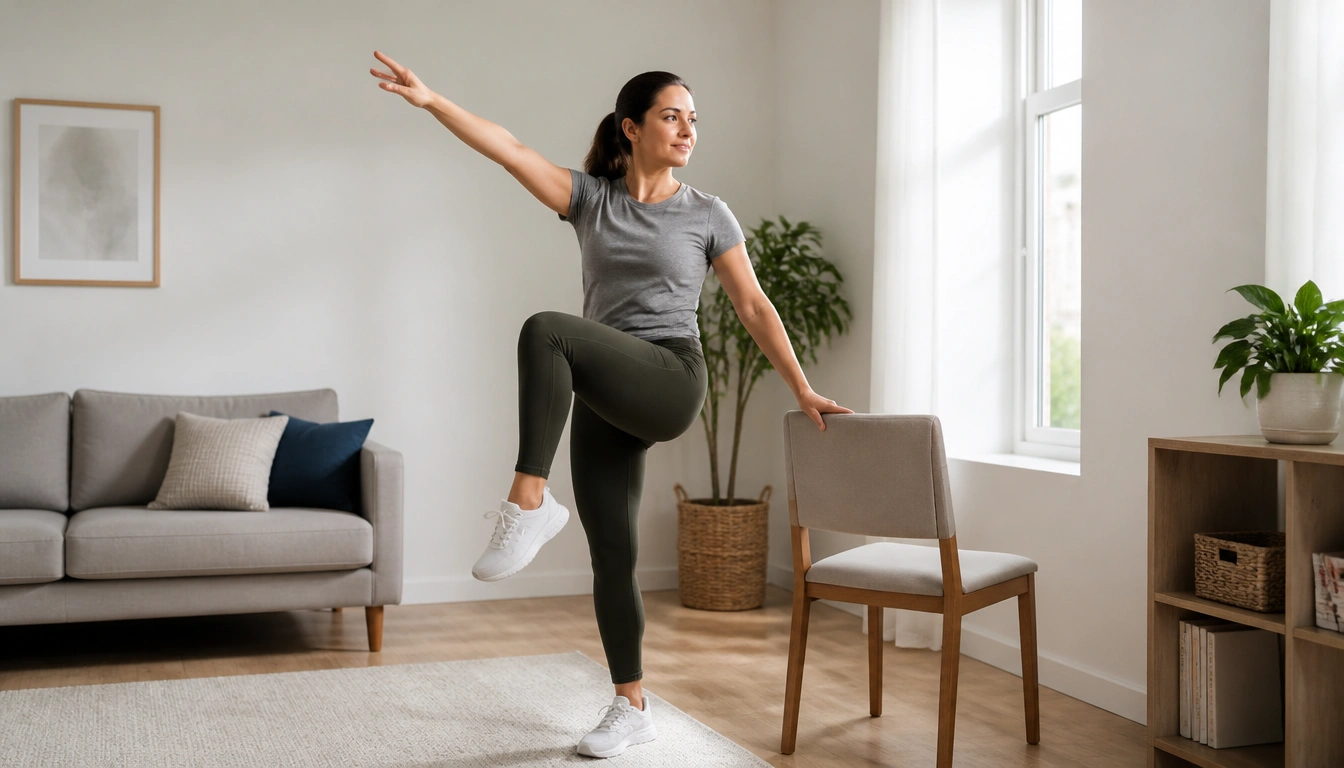
A standing core routine can absolutely work at home if it focuses on controlled upright movement, balance, and trunk stability rather than fast twisting or bending. The safest approach is usually a short circuit of standing marches, diagonal reaches, and single-leg stabilizer drills done slowly, with light support from a wall or chair if needed. For most adults, fitting it into a broader strength plan at least 2 days per week is a solid starting point.
Key Takeaways
- Standing core work trains your trunk in the upright position you actually use for walking, reaching, carrying, and turning at home.
- Good standing core moves challenge anti-rotation, side-bending control, and balance in ways floor crunches often do not.
- Beginners and older adults can keep one hand near a wall or sturdy chair and still get a meaningful workout.
- Use slow reps or timed intervals instead of momentum so the core muscles do the stabilizing work.
- Stop a move if it causes sharp pain, radiating symptoms, dizziness, or unsafe balance loss.
- Pregnancy can make upright work appealing, but balance changes mean support is especially important.
Why standing core training makes sense for home workouts
A standing core routine at home is useful because it trains the trunk where it actually has to function: upright, on your feet, and reacting to gravity. That matters for daily tasks like stepping over obstacles, reaching into a cabinet, carrying groceries, or turning while walking. Instead of lying on a mat and focusing on repeated spinal flexion, you are asking the core to stabilize the spine while the arms and legs move.
That upright demand is one reason standing work can feel more natural for many people. It also tends to be friendlier for people who dislike floor exercises or who notice neck tension during crunches. According to the American Council on Exercise and clinical guidance from organizations such as the Cleveland Clinic, standing core exercises can be a practical way to train trunk control without relying on a floor setup. The goal is not to eliminate all other core training, but to add a pattern that better matches everyday movement.
Standing core work also fits a functional movement pattern: the trunk resists motion while the body shifts weight. That is a real-life skill, not just a gym skill. If the routine is done well, you are training the abdominal wall, obliques, spinal muscles, hips, and balance system together rather than isolating one muscle group in one position.
How to build a simple standing core circuit at home
A good beginner circuit can be built from three moves: a standing march with an optional cross-body twist, a diagonal reach or woodchopper pattern, and a single-leg balance reach or hinge-based stabilizer drill. These cover forward control, rotational control, and the ability to stabilize on one leg. That mix gives the core a more complete job than endless repetitions of one movement.
Standing march with optional cross-body twist: Stand tall with feet hip-width apart. Lightly brace your midsection, then slowly lift one knee and lower it under control before switching sides. If you want more trunk involvement, allow the opposite elbow and knee to move toward each other without forcing the twist. Keep the movement smooth and avoid leaning back or hiking the shoulders.
Standing woodchopper or diagonal reach: Start with your hands together near one shoulder or above one side of your head. Sweep the arms diagonally across your body toward the opposite hip while the torso rotates with control. Keep your feet planted or allow a small pivot, depending on comfort and balance. This pattern asks the obliques to manage rotation instead of letting momentum do the work.
Exercise 3: single-leg balance reach or hinge-based stabilizer drill
The third move can be a single-leg balance reach or a small hinge-based drill. Shift weight onto one leg, soften the knee, and hinge slightly at the hips while the other leg reaches back. The spine stays long and neutral. Another option is to stand on one leg and reach the free foot lightly forward, sideways, and back in small controlled taps. Both versions challenge the trunk to resist wobbling while the hips and foot muscles help with stability.
If balance is shaky, keep the reach smaller and use fingertips on a wall or chair. The purpose is not to test how far you can move. The purpose is to keep the trunk steady while the body changes shape and direction. That is what makes the exercise useful for home life and safer for people who do not want to go to the floor.
You can cycle through the three moves in order, then repeat the circuit once or twice. If you only have five minutes, one round done carefully is enough to practice the pattern and build consistency. If you have more time, add another round before increasing speed or complexity.
How to choose reps, sets, and tempo without relying on momentum
For a standing core routine, controlled work matters more than high rep counts. The core should be stabilizing you, not just moving your limbs. That is why slow tempo and clear posture are better than rushing through a big number of repetitions. The ACSM recommends muscle-strengthening activity for major muscle groups at least 2 days per week, and a standing core circuit can fit into that broader weekly pattern.
For practical home programming, you can use repetitions or time. A simple option is 8 to 12 controlled reps per side for each move. Another option is 20 to 40 seconds of steady work per exercise, followed by a short rest. Use a pace that lets you keep your ribs stacked over your pelvis and your breathing controlled. If you start swinging your arms, arching your lower back, or shifting weight wildly, the set is too fast.
Think of each repetition as a stability drill. Pause briefly at the top of a knee lift or at the end of a diagonal reach. That small pause forces the trunk muscles to do their job. If you want to progress later, lengthen the control phase before you add speed, range, or load.
How to modify the routine for beginners, older adults, or people who need support
Support is not a failure; it is a smart way to preserve the training goal. Beginners, older adults, and anyone with lower confidence in balance can stand beside a wall or sturdy chair and keep one or two fingertips available. That light contact can reduce the fear of tipping without turning the exercise into a completely different movement.
Make the lifts smaller and the stance wider if needed. A shorter knee raise, a smaller diagonal reach, or a gentler hinge still trains the trunk if the movement stays controlled. If standing on one leg feels too unstable, keep the toes of the free foot on the floor as a kickstand. That still asks the core to resist sway while you build confidence.
For people with low-back or neck sensitivity, the main goal is a neutral, tall posture. Avoid crunching the neck forward or over-arching the lower back. A slower tempo and a smaller range of motion often make the routine more comfortable while still being effective.
When standing core training may be preferable to floor-based core exercises
Standing core training may be a better fit when floor work causes neck strain, hip flexor dominance, or discomfort lying flat. It can also be useful when the goal is to connect core work with standing balance, gait, and reach patterns. Because the body stays upright, the trunk has to manage gravity and coordinate with the legs in a way that resembles everyday movement.
That said, standing core work is not automatically “better” for everyone. Floor exercises can still have a place in a well-rounded program. The advantage here is specificity: if you want trunk control for standing tasks, a standing core routine is highly relevant. If you want a lower-friction way to exercise at home without getting on the floor, it may also improve consistency.
People with chronic back issues often tolerate upright stabilization better than repeated spinal flexion, but individual response matters. If a standing pattern increases discomfort instead of improving control, change the range, add support, or choose a different exercise. Exercise should feel challenging in the muscles, not threatening in the joints or spine.
Safety checks: space setup, balance risks, and signs to stop
Clear a small open area before you start. Remove loose rugs, clutter, and anything you could catch a foot on. Keep a chair, wall, or countertop nearby if your balance is not fully reliable. Good setup matters because standing core drills remove the wide base of support you get from lying on the floor.
Pay attention to symptoms. Stop immediately if you feel sharp pain, a shooting or radiating sensation, dizziness, or a sudden loss of balance. Those are not cues to push through. They are cues to modify the movement or seek medical guidance. If an exercise feels unstable because of medical balance issues, recent injury, severe neuropathy, vestibular problems, or a recent surgery, get individualized advice before progressing.
For pregnancy, upright core exercises can be appealing because they avoid prolonged supine work, but balance changes may be more noticeable as the center of gravity shifts. Use support more readily, reduce twisting force, and keep the routine gentle and controlled. If any movement feels unsafe, choose a supported version or pause the session.
How to fit a 5-minute standing core routine into a daily habit
The easiest routine is the one you actually repeat. Attach the standing core circuit to something you already do, such as waiting for coffee to brew, preheating the oven, or finishing a work-from-home break. A five-minute block is enough to practice the pattern without needing a mat, a private room, or a full workout setup.
A simple weekly structure is to do the circuit on strength days or as a short add-on before a walk or other home workout. If you are already doing full-body resistance work at least 2 days per week, the standing core routine can be part of those sessions. If you are starting from zero, even a few consistent sessions each week can help you learn the movements and build a habit.
To progress without equipment, use one change at a time. Slow the tempo further, increase the pause at the end of each rep, narrow the stance slightly, or reduce your support from a full hand to fingertips. You can also add a second round or extend each timed interval by a few seconds. The goal is not to chase fatigue. The goal is to make the trunk work a little more while keeping form steady and safe.
Frequently Asked Questions
What exercises belong in a beginner standing core routine at home?
A beginner routine usually includes a standing march with a gentle cross-body reach, a diagonal woodchopper-style sweep, and a single-leg balance or hinge drill. Those three movements cover forward control, rotation, and balance without requiring floor work or equipment.
How many days per week should I do a standing core workout?
For most adults, a practical target is to fit standing core work into a broader strength routine at least 2 days per week, consistent with major public health exercise guidance. Shorter practice sessions can be added more often if they stay controlled and do not cause irritation.
Is standing core training better than crunches or sit-ups for back or neck comfort?
It can be more comfortable for many people because it avoids repeated neck flexion and floor-based spinal curling. Standing work is not universally better, but it often feels friendlier for people who dislike crunches or notice low-back or neck strain on the mat.
How can I modify standing core exercises if I have poor balance or need a chair or wall for support?
Stand near a wall or sturdy chair and use light fingertip support. Shorten the range of motion, keep the feet wider apart, and use slower movements. You can also keep the free foot lightly touching the floor instead of fully lifting it.
Can pregnant people safely do standing core exercises at home?
Often yes, if the routine is gentle, well-supported, and approved by the person’s clinician when needed. Upright exercise can avoid prolonged lying on the back, but balance may change during pregnancy, so support and conservative range of motion are important.
The Bottom Line
A standing core routine can be a practical at-home option if you want to train your trunk without floor exercises. The most useful moves are the ones that teach upright stability, controlled rotation, and balance, not fast crunching or swinging.
Start with a small circuit, move slowly, and use a wall or chair whenever balance feels uncertain. If a move causes sharp pain, radiating symptoms, or dizziness, stop and get medical advice. Over time, the best progression is better control, not just more effort.
Medical disclaimer
Medical disclaimer: This content is for educational and informational purposes only and is not a substitute for professional medical advice, diagnosis, or treatment. Dietary needs and supplement suitability vary by individual.
Sources
- American College of Sports Medicine (ACSM) — acsm.org. Accessed October 2026.
- health.clevelandclinic.org — clevelandclinic.org. Accessed October 2026.
- acefitness.org — acefitness.org. Accessed October 2026.
