
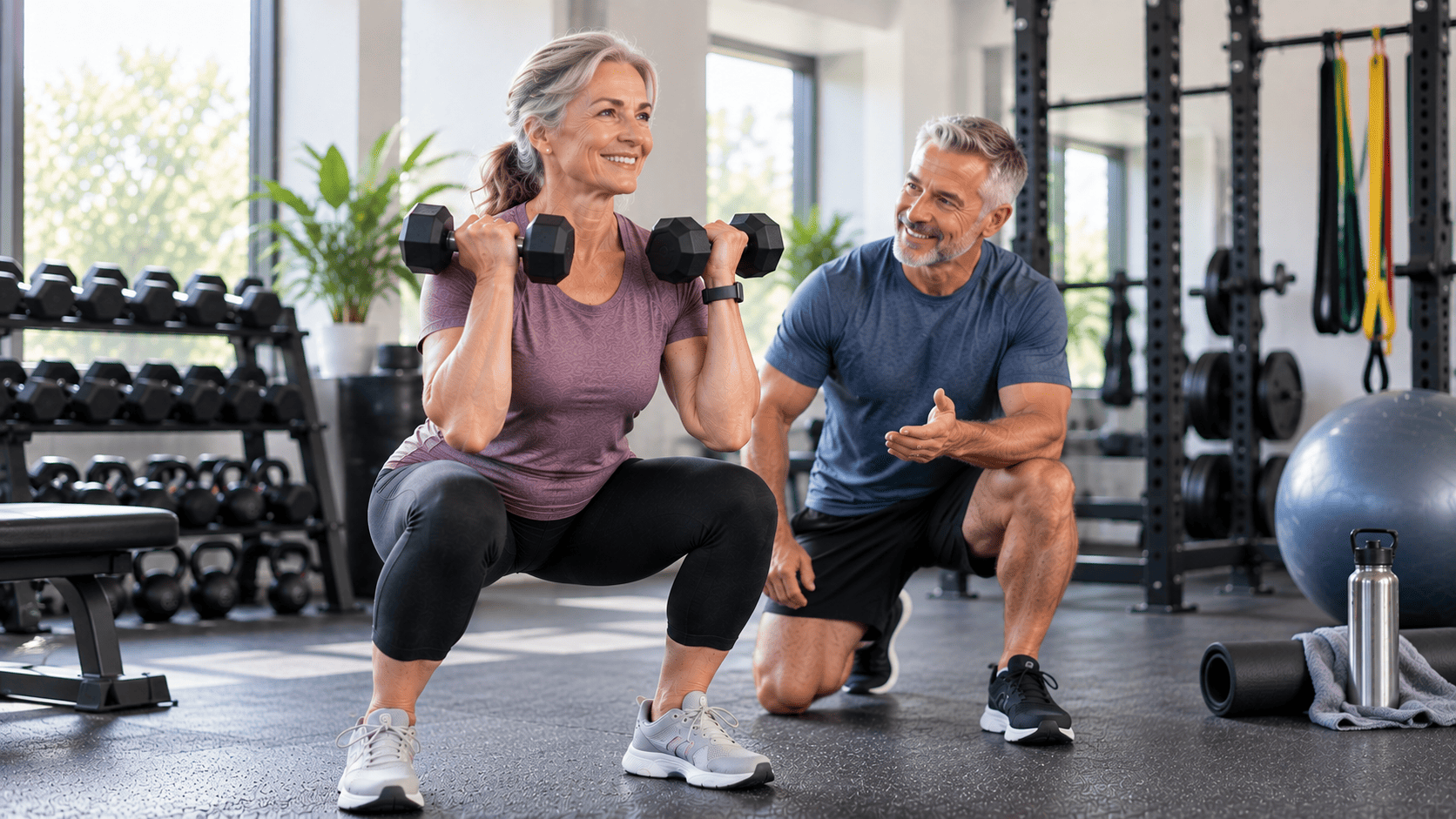
Beginner strength training after 50 can be simple, gradual, and effective. A routine that works the major muscle groups at least twice per week can help improve strength, maintain muscle, and support everyday function. You can begin with body-weight exercises, resistance bands, machines, or free weights. Focus first on controlled technique and consistency, then gradually increase resistance, repetitions, sets, or exercise difficulty as your ability improves.
Key Takeaways
- Adults should include muscle-strengthening activity on at least two days each week.
- Beginners do not need heavy weights or complicated workouts to start building strength.
- A small group of exercises can train the legs, hips, back, abdomen, chest, shoulders, and arms.
- Increase training difficulty gradually rather than trying to make every workout harder.
- Strength training works best alongside aerobic activity, adequate recovery, good nutrition, and balance work as you move into older adulthood.
Why Start Strength Training After 50?
Strength influences much more than what you can lift in a gym. It affects your ability to carry groceries, climb stairs, get out of a chair, lift household objects, garden, travel, and participate in hobbies.
The National Institute on Aging notes that muscle mass, strength, and physical performance tend to decline with age. Maintaining an active lifestyle that includes resistance training can slow age-related losses, and many older adults can increase their strength through exercise.
Turning 50 does not mean you need an extreme or highly specialized workout. It does make maintaining muscle and physical capacity increasingly useful for the decades ahead.
Start from your current ability: A beginner who is active but new to lifting may need a different program from someone returning after many years without structured exercise. Age alone does not determine the right starting resistance.
What Counts as Strength Training?
Strength training, resistance training, and muscle-strengthening exercise all involve making muscles work against resistance. The resistance can come from several sources.
- Dumbbells and other free weights.
- Weight-training machines.
- Resistance bands.
- Body-weight exercises such as sit-to-stands, squats, or modified push-ups.
- Other activities that substantially challenge the muscles.
CDC recommends working all the major muscle groups: the legs, hips, back, abdomen, chest, shoulders, and arms.
How Often Should Beginners Over 50 Strength Train?
Current U.S. physical-activity guidance recommends at least two days per week of muscle-strengthening activity for adults. For a beginner, two full-body workouts on nonconsecutive days can be a practical starting schedule.
For example, you might train on Monday and Thursday or Tuesday and Friday. This approach gives you repeated practice while allowing recovery time between sessions that challenge the same major muscle groups.
You may eventually train more often, but beginners do not need a five- or six-day lifting schedule to make meaningful progress.
A simple goal: Build a two-day routine you can perform consistently before adding more training days or complicated workout splits.
A Simple Beginner Full-Body Framework
A beginner workout does not need dozens of exercises. A few movement patterns can collectively challenge the major muscle groups while giving you enough repetition to learn good technique.
| Movement | Beginner-friendly examples | Main areas trained |
|---|---|---|
| Squat or sit-to-stand | Chair sit-to-stand, supported squat | Legs and hips |
| Hip-dominant movement | Supported hip hinge or coached deadlift variation | Hips, legs, and back |
| Push | Wall push-up, incline push-up, machine chest press | Chest, shoulders, and arms |
| Pull | Resistance-band row, cable row, machine row | Back and arms |
| Trunk or carry | Appropriate core exercise or loaded carry | Trunk, grip, and stability |
These are examples rather than mandatory exercises. Machines may feel more stable for some beginners, while bands or dumbbells may be more convenient at home. Choose movements that fit your mobility, comfort, equipment, and experience.
How Many Sets and Repetitions?
CDC describes 8 to 12 repetitions as a practical range for a muscle-strengthening set. It notes that at least one set can provide benefit and that two or three sets may provide additional benefit.
The National Institute on Aging provides similar guidance for older adults and recommends beginners first becoming comfortable with movements before adding substantial resistance.
These numbers are useful starting guidelines rather than a rule that every exercise must be performed in exactly the same way. Different exercises and individual circumstances may call for different approaches.
Begin conservatively: A smaller amount of well-controlled training gives you room to practice movements and assess how your body responds before increasing volume.
How Heavy Should a Beginner Lift?
There is no universal dumbbell weight for beginners over 50. Your appropriate starting resistance depends on your current strength, the exercise, mobility, previous activity, technique, and health.
Choose resistance that allows you to complete the movement through a comfortable range with control. As you become familiar with the exercise, the resistance should provide a meaningful challenge without forcing you to use excessive momentum or lose technique.
You do not need to test your maximum strength or take every set to complete muscular failure when you are learning.
How to Progress Gradually
Muscles adapt when they are repeatedly challenged. The National Institute on Aging notes that gradually increasing resistance, repetitions, sets, or training frequency can result in stronger muscles.
- Add a small amount of resistance when the current weight becomes manageable.
- Perform additional repetitions with the same resistance.
- Add another set when additional training volume is appropriate.
- Use a slightly more challenging exercise variation.
- Improve control and comfortable range of motion before increasing weight.
Progress does not need to happen every workout: Maintaining the same weight while your technique, control, and confidence improve can still be productive.
Recovery Matters After 50
Resistance training provides a stimulus for adaptation, while recovery gives your body time to respond. Training the same muscle group hard every day is generally unnecessary for a beginner.
NIA advises avoiding work for the same muscle group on consecutive days when performing muscle-strengthening exercise. Recovery needs still vary with workout difficulty, sleep, nutrition, health conditions, stress, and other physical activity.
Temporary muscle soreness may occur after unfamiliar training. Extreme soreness is not required for improvement. Persistent or worsening joint pain, significant swelling, numbness, or loss of function deserves more attention than ordinary muscle fatigue.
Do Beginners Over 50 Need Cardio Too?
Strength training is one part of a well-rounded activity plan. CDC recommends that adults accumulate at least 150 minutes of moderate-intensity aerobic activity per week, or 75 minutes of vigorous activity, or an equivalent combination, in addition to muscle-strengthening activity on at least two days.
Brisk walking, cycling, swimming, and other aerobic activities can complement strength training. The activity can be spread across the week and broken into smaller periods.
Balance Training Becomes More Important With Age
CDC specifically recommends balance-improving activities for adults age 65 and older in addition to aerobic and muscle-strengthening exercise. You do not need to wait until age 65 to develop better balance and stability.
Some resistance exercises performed while standing can challenge stability, while specific balance exercises can be added separately. If you have significant balance problems or a history of falls, use appropriate support and consider individualized guidance.
Common Beginner Mistakes After 50
Doing Too Much Too Soon
Trying to make up for years without strength training in the first few weeks can create unnecessary fatigue. Start with a manageable amount of exercise and give yourself room to progress.
Using Weight as the Only Measure of Progress
Lifting more weight can show progress, but so can improved technique, additional controlled repetitions, better balance, a larger comfortable range of motion, and easier performance of everyday tasks.
Changing Exercises Constantly
Repeating several basic movements gives beginners time to develop skill and makes progress easier to evaluate. Variety can be useful, but it does not need to replace every exercise every week.
Treating Soreness as the Goal
A productive workout does not need to leave you extremely sore. Consistency, controlled technique, gradual progression, and improving physical function are more useful measures.
When to Get Professional Guidance
Many adults can begin appropriately scaled physical activity, but medical conditions, injuries, or mobility limitations can change which exercises and intensities are suitable.
Individual guidance may be especially useful if:
- You have significant heart, lung, neurological, joint, or metabolic disease.
- You have osteoporosis or a history of fragility fractures.
- You are returning to activity after surgery or a major injury.
- You have substantial balance or mobility limitations.
- Exercise repeatedly causes significant or worsening pain.
A healthcare professional can help clarify medical restrictions. A qualified exercise professional or physical therapist may also help with technique, exercise modifications, and an appropriate progression plan.
Frequently Asked Questions
Related reading
The Bottom Line
Strength training for beginners over 50 does not require an advanced program. Start with a manageable group of exercises that collectively work the major muscle groups, use controlled technique, and aim for muscle-strengthening activity on at least two days each week.
Increase the challenge gradually as your strength and confidence improve. Combine resistance exercise with aerobic activity, adequate recovery, and an appropriate nutrition pattern. As you approach older adulthood, balance training also becomes an increasingly useful part of a well-rounded routine.
Medical disclaimer
Medical disclaimer: This content is for educational and informational purposes only and is not a substitute for professional medical advice, diagnosis, or treatment. Dietary needs and supplement suitability vary by individual.
Sources
- Centers for Disease Control and Prevention, Adult Activity: An Overview, December 20, 2023.
- Centers for Disease Control and Prevention, What You Can Do to Meet Physical Activity Recommendations, December 4, 2025.
- Centers for Disease Control and Prevention, What Counts as Physical Activity for Adults, December 6, 2023.
- Centers for Disease Control and Prevention, Older Adult Activity: An Overview, December 4, 2025.
- National Institute on Aging, How Can Strength Training Build Healthier Bodies as We Age?, June 30, 2022.
- National Institute on Aging, Three Types of Exercise Can Improve Your Health and Physical Ability, accessed September 2026.
