
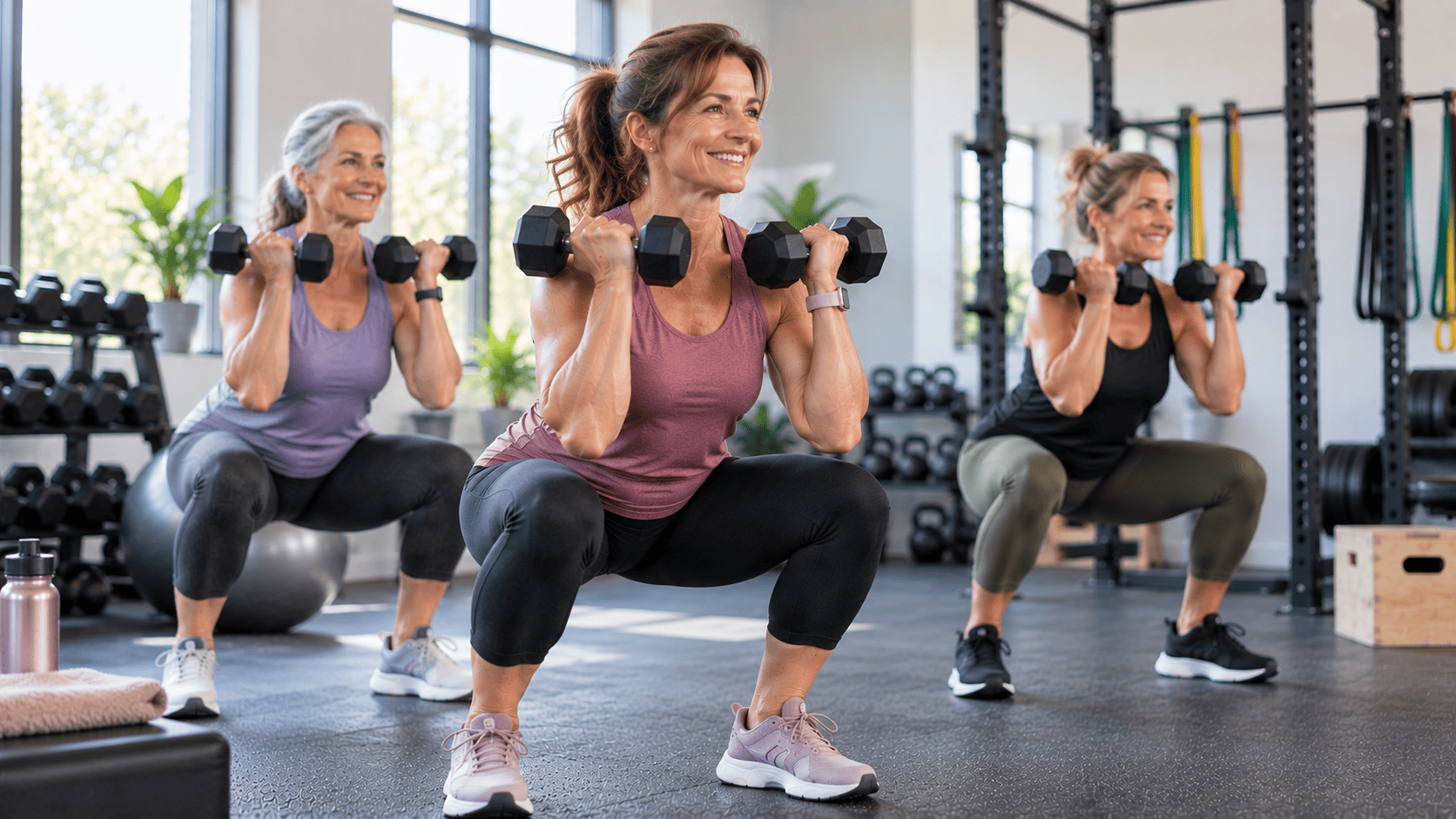
Strength training for women over 40 can help build or maintain muscular strength, support everyday function, and contribute to an active lifestyle through midlife and beyond. Women do not need a special “light-weight” program simply because they are over 40. A practical routine trains the major muscle groups, uses resistance appropriate to current ability, and gradually becomes more challenging as strength and technique improve.
Key Takeaways
- U.S. guidelines recommend muscle-strengthening activity on at least two days each week.
- Recent research indicates women can improve muscular strength with resistance training before and after menopause.
- Dumbbells, machines, resistance bands, and body-weight exercises can all be useful.
- Progress gradually instead of trying to lift the heaviest possible weight from the beginning.
- Exercise needs may change with health, injuries, osteoporosis, menopausal symptoms, and training experience, so individualization matters.
Why Strength Training for Women Over 40 Matters
Strength affects far more than performance in the gym. It helps with carrying groceries, climbing stairs, moving furniture, lifting luggage, getting up from the floor, gardening, and participating in sports or recreational activities.
Resistance training becomes especially relevant through midlife because maintaining muscle and physical capacity can support healthy aging. A 2026 systematic review and meta-analysis involving women across adulthood found meaningful improvements in muscular strength in both premenopausal and postmenopausal women who performed resistance training.
Importantly, the review did not support the idea that women need completely different resistance-training principles solely because of age or menopausal status. Individual fitness, health, experience, goals, and recovery remain important when designing a program.
You are not limited to tiny weights: Women can use progressively challenging resistance just as other adults can. The appropriate load is the one that challenges your muscles while allowing controlled technique and fitting your current health and experience.
What Counts as Strength Training?
Strength training, resistance training, and muscle-strengthening exercise describe activities in which muscles work against resistance. A gym membership is optional.
- Dumbbells, barbells, kettlebells, and other free weights.
- Weight-training machines.
- Resistance bands or tubes.
- Body-weight movements such as squats and modified push-ups.
- Other activities that sufficiently challenge major muscle groups.
CDC recommends working the legs, hips, back, abdomen, chest, shoulders, and arms across your weekly muscle-strengthening activities.
Does Perimenopause Change Strength Training?
Many women enter perimenopause during midlife, but the timing and symptoms vary substantially. Sleep disruption, hot flashes, changes in menstrual patterns, stress, and other symptoms can affect how someone feels from one training session to another.
That does not mean resistance training needs to stop. Instead, training can be adjusted according to energy, recovery, symptoms, and overall health. On a difficult week, reducing training volume or using more manageable resistance can be more practical than abandoning the routine completely.
The U.S. Office on Women’s Health encourages physical activity around and after menopause, including muscle-strengthening exercise on two days each week.
Menopause is not a training diagnosis: Two women of the same age may have very different symptoms, strength levels, health histories, and recovery needs. Adjust the program to the person rather than using one universal “menopause workout.”
Strength Training and Muscle After 40
One common concern is that building strength becomes impossible in midlife. The evidence does not support that assumption. The 2026 meta-analysis of 126 studies and more than 4,000 women found that resistance training improved muscular strength in both premenopausal and postmenopausal groups.
The same analysis also reported favorable changes in measures of functional mass across the included women. Results still vary from person to person, and not everyone will experience the same change in muscle size or body composition.
What About Bone Health?
Bone health becomes increasingly important through and after menopause because lower estrogen levels are associated with greater osteoporosis risk. The Office on Women’s Health specifically identifies osteoporosis as an important health consideration after menopause.
Research on resistance training and bone mineral density is promising but more complex than claims such as “lifting weights prevents osteoporosis.” A 2025 systematic review of randomized trials reported improvements in bone mineral density at several skeletal sites in postmenopausal women, although results varied considerably among studies.
Resistance training can therefore be one component of a bone-supportive lifestyle, but it does not replace osteoporosis screening, nutrition, medication when indicated, or individualized medical care.
If you have osteoporosis or a previous fragility fracture: Avoid assuming that every popular lifting exercise is appropriate. Exercise selection, loading, spinal movement, and progression may need to be individualized with professional guidance.
How Often Should Women Over 40 Strength Train?
CDC recommends muscle-strengthening activity on two or more days each week. That recommendation applies to adult women as part of the broader physical-activity guidelines.
For a beginner, two full-body sessions on nonconsecutive days can provide a simple starting structure. Someone with more experience may use three or more training days, depending on how exercises are divided and how well the program fits recovery and lifestyle.
A higher training frequency is not automatically superior. A program you can perform consistently is more useful than an ambitious schedule that repeatedly leaves you exhausted or gets abandoned.
A Simple Full-Body Strength Framework
You do not need a separate exercise for every individual muscle. A handful of movement patterns can efficiently train the major areas of the body.
| Movement | Examples | Primary areas |
|---|---|---|
| Squat pattern | Chair sit-to-stand, squat, goblet squat | Legs and hips |
| Hip-dominant movement | Hip hinge or appropriately coached deadlift variation | Hips, legs, and back |
| Push | Incline push-up, machine press, dumbbell press | Chest, shoulders, and arms |
| Pull | Band row, cable row, machine row | Back and arms |
| Trunk or carry | Appropriate trunk exercise or loaded carry | Trunk, grip, and stability |
These are examples, not mandatory movements. Joint comfort, injury history, mobility, equipment, pregnancy or postpartum considerations, pelvic-floor symptoms, and personal preferences may influence exercise selection.
How Many Sets and Repetitions?
CDC describes 8 to 12 repetitions as one practical example for muscle-strengthening activity. One set can provide benefit, while additional sets may provide more benefit.
That does not mean every woman needs to use exactly the same repetition range. Many resistance-training approaches can improve strength when the muscles receive sufficient challenge and the program progresses appropriately.
For beginners: Start with a manageable amount of training. Learning the movement and understanding how your body responds is more important than immediately maximizing the number of exercises or sets.
How Heavy Should Women Over 40 Lift?
There is no correct dumbbell weight based on sex or age alone. Your starting resistance depends on the movement, current strength, experience, joint comfort, and health.
When learning an exercise, use enough resistance to practice it with control. Over time, the movement should become challenging enough to make the working muscles exert substantial effort without requiring uncontrolled momentum or painful movement.
You also do not need to test your one-repetition maximum or take every set to complete muscular failure to participate in effective strength training.
How to Progress
A strength program needs some form of progression if you want adaptation to continue. Progress does not have to mean adding weight every session.
- Add a small amount of resistance.
- Perform more controlled repetitions with the same resistance.
- Add a set when additional training volume is appropriate.
- Use a more challenging exercise variation.
- Improve technique, control, or comfortable range of motion.
Increase the challenge when the current workload is consistently manageable rather than forcing progress according to an arbitrary calendar.
Recovery, Sleep, and Midlife Training
Training provides a stimulus, but adaptation also depends on recovery. Sleep disruption, work stress, caregiving demands, changes in menstrual symptoms, and other aspects of midlife can influence how recovered you feel.
Recovery needs are individual. Instead of assuming that everyone over 40 needs unusually long rest periods, pay attention to performance, persistent fatigue, joint discomfort, sleep, and how well you recover between sessions.
Temporary muscle soreness can occur after unfamiliar training, but severe soreness is not required for progress.
Protein and Nutrition for Active Women
Strength training is one part of maintaining muscle. Overall nutrition also needs to provide enough energy and essential nutrients to support health, training, and recovery.
Protein-containing foods provide amino acids used to maintain and build body proteins. Food options include fish, poultry, eggs, dairy foods, soy foods, beans, lentils, nuts, and seeds.
Protein powders may be convenient but are not automatically required. Individual protein needs vary with body size, overall diet, training, health, and other factors. People with medical conditions affecting protein intake should follow individualized guidance.
Should You Combine Strength Training With Cardio?
Yes. Muscle-strengthening exercise and aerobic activity serve complementary roles. CDC recommends at least 150 minutes of moderate-intensity aerobic activity per week, 75 minutes of vigorous activity, or an equivalent combination, in addition to muscle-strengthening activity on at least two days.
Brisk walking, cycling, swimming, running, and other aerobic activities can fit around strength workouts according to your schedule and preferences. You do not need to choose between cardiovascular fitness and muscular strength.
Common Strength-Training Mistakes Women Make After 40
Assuming You Must Only Lift Light Weights
Resistance should match your ability, but there is no rule that women over 40 must avoid challenging loads. Appropriate progression is more useful than imposing an unnecessarily low ceiling on training.
Doing Too Much Too Soon
If you are starting after years without structured strength training, begin below your maximum capacity. Trying to compensate for lost time in the first few workouts can create unnecessary fatigue and soreness.
Training Only for Calorie Burn
A strength workout does not need to feel like nonstop cardio to be worthwhile. Muscular challenge, technique, progression, and recovery are central parts of resistance training.
Using Soreness as a Measure of Success
Soreness may happen when training is unfamiliar, but it is not a reliable score for workout effectiveness. Increasing strength, improving technique, and remaining consistent are more useful indicators.
Changing the Program Constantly
Repeating several core movements long enough to improve them makes strength progress easier to measure. Variety is fine, but completely changing the workout every session can make progression harder to track.
When to Get Professional Guidance
Many women can participate in appropriately scaled resistance exercise, but health conditions and symptoms can affect exercise selection and progression.
Individual guidance may be useful if:
- You have osteoporosis or a previous fragility fracture.
- You have significant heart, lung, neurological, joint, or metabolic disease.
- You are recovering from surgery or a substantial injury.
- You have persistent pelvic-floor symptoms or significant balance limitations.
- Exercise repeatedly causes significant or worsening pain.
A healthcare professional can help clarify medical restrictions. A physical therapist or appropriately qualified exercise professional may help with technique, modifications, and a suitable progression plan.
Frequently Asked Questions
Related reading
The Bottom Line
Strength training for women over 40 can support muscular strength, physical function, and an active lifestyle through midlife and beyond. Women can benefit before and after menopause, and they do not need an entirely different set of training principles simply because they have reached their 40s.
Start with manageable resistance, train the major muscle groups consistently, and increase the challenge gradually. Combine resistance training with aerobic activity, adequate recovery, and a nutritious dietary pattern, while adjusting the program when health conditions, osteoporosis, injuries, or significant symptoms require a more individualized approach.
Medical disclaimer
Medical disclaimer: This content is for educational and informational purposes only and is not a substitute for professional medical advice, diagnosis, or treatment. Dietary needs and supplement suitability vary by individual.
Sources
- Centers for Disease Control and Prevention, Adult Activity: An Overview, accessed September 2026.
- Centers for Disease Control and Prevention, Adding Physical Activity as an Adult, December 4, 2025.
- Office on Women’s Health, U.S. Department of Health and Human Services, Menopause and Your Health, accessed September 2026.
- Isenmann E, Geisler S, Havers T, et al. It’s never too late: The impact of resistance training on strength and body composition in females across the lifespan — a systematic review and meta-analysis. Journal of Science and Medicine in Sport. 2026;29(10):1174-1185.
- González-Gálvez N, Moreno-Torres JM, Vaquero-Cristóbal R. Resistance training effects on healthy postmenopausal women: a systematic review with meta-analysis. Climacteric. 2024;27(3):296-304.
- Zhao F, Su W, Sun Y, et al. Optimal resistance training parameters for improving bone mineral density in postmenopausal women: a systematic review and meta-analysis. Journal of Orthopaedic Surgery and Research. 2025;20(1):523.
